Best Medical Assistant Resume Examples for 2026
A medical assistant resume for 2026 has to hit vitals, EHR charting, and certifications fast. See examples plus the keywords that clear ATS.



A well-crafted medical assistant resume is essential for standing out in this fast-growing field. With job opportunities projected to increase by 15% from 2022 to 2032, competition is rising, making it crucial for medical assistant job seekers to showcase both clinical and administrative expertise.
To secure a job, your resume must highlight key skills like patient communication, medical coding, diagnostic testing, and EHR proficiency. However, many medical assistant resumes never reach hiring managers due to Applicant Tracking Systems (ATS), which scans applications based on keywords. Hence, without optimization, your resume could be overlooked.
Whether you’re an experienced medical assistant or entering the field, this blog will guide you in crafting a standout resume for 2025—ensuring it meets industry standards, passes ATS scans, and effectively showcases your qualifications to land interviews and advance your career.
Medical assistant resume example
Are you ready to land your next medical assistant position but unsure how to make your resume stand out? A strong resume is your ticket to more interviews, and we’ve got the perfect example to help you craft yours. Check out our sample resume now!
Medical assistants play a key role in healthcare, handling both patient care and administrative tasks. Employers want candidates who are skilled in medical procedures, patient communication, and EHR management. They’re also looking for efficiency, organization, and the ability to multitask in fast-paced environments. If you can show these qualities on your resume, you’ll have a much better chance of landing the job.
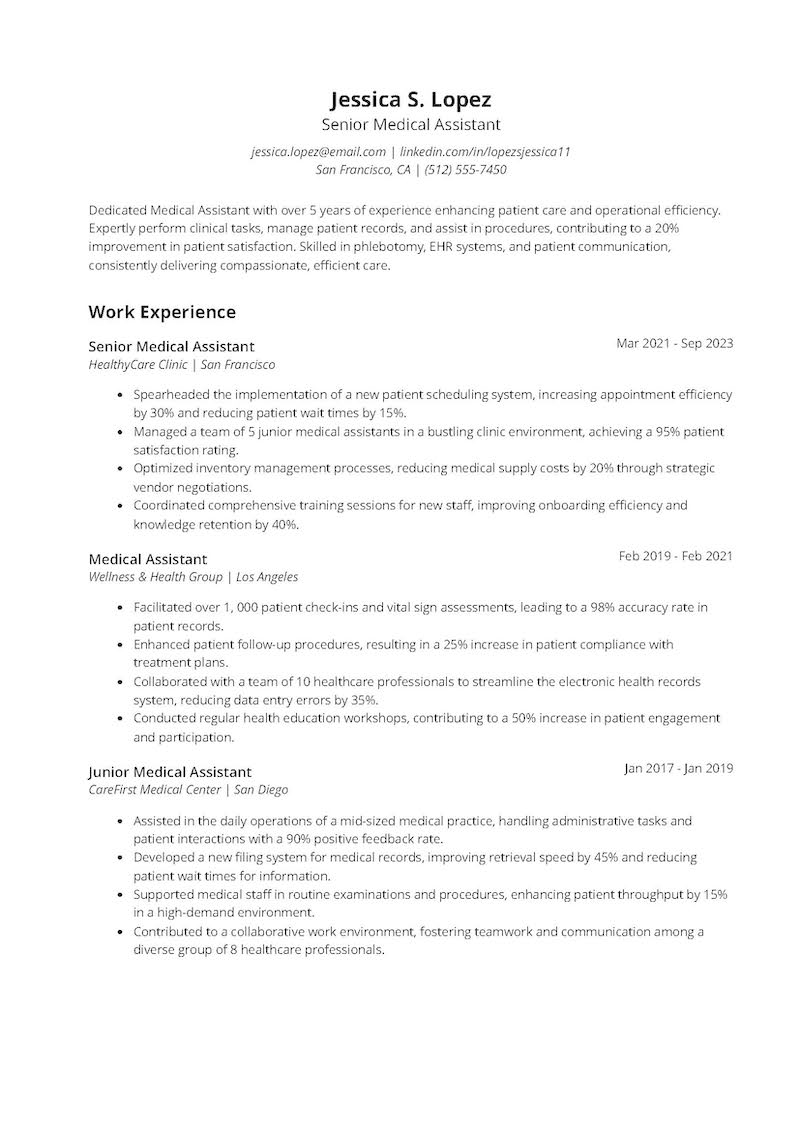
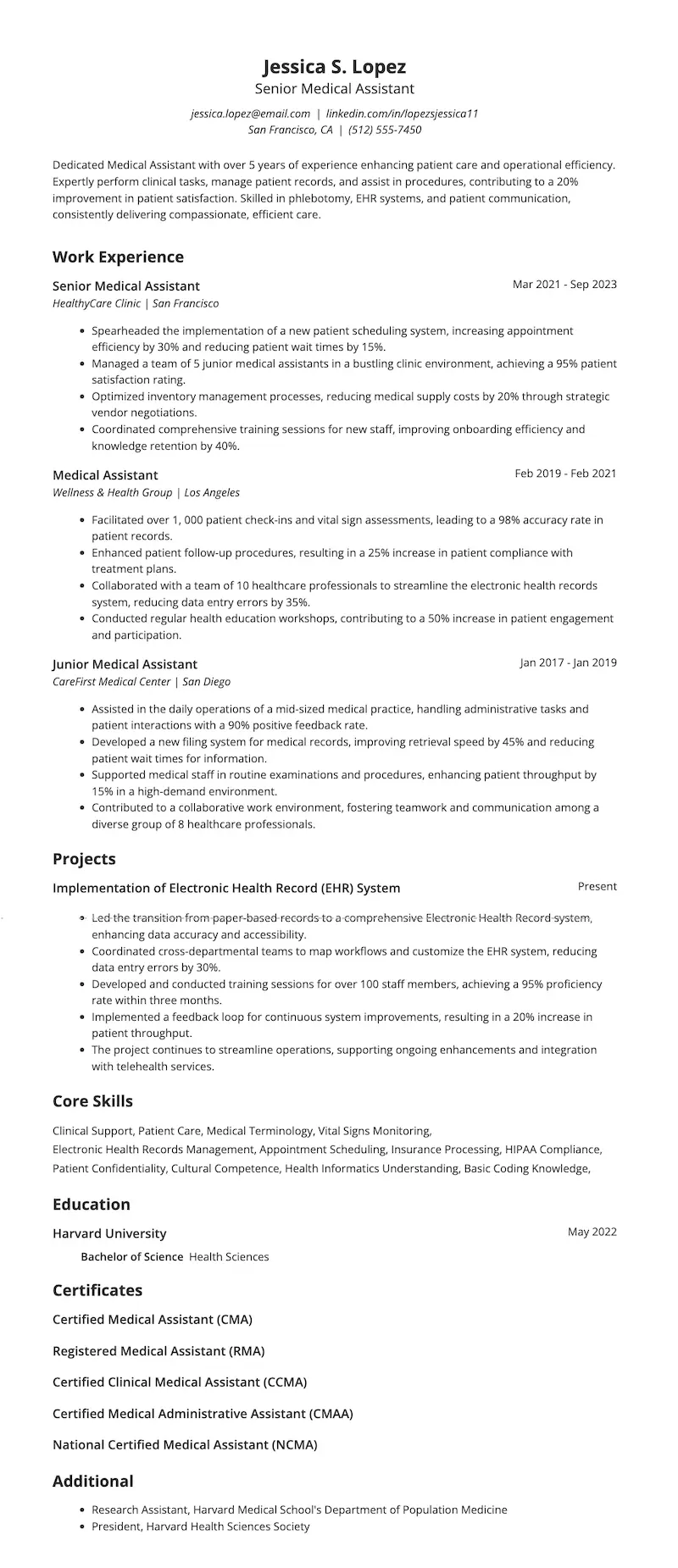
This medical assistant resume template effectively integrates clinical expertise, administrative efficiency, and leadership experience. Quantifiable achievements, such as increasing appointment efficiency by 30%, highlight the candidate’s operational impact. The EHR system implementation project showcases technical skills and training capabilities, while certifications reinforce credibility in the medical field.
A well-structured layout, clear core skills, and a track record of improving patient satisfaction and workflow efficiency make this resume highly compelling to prospective employers seeking a versatile medical assistant.
Medical administrative assistant resume example
If you are looking for a medical administrative assistant resume, you’re in the right place. Here’s a great example of how to showcase your skills, experience, and accomplishments effectively.

Medical administrative assistants handle scheduling, patient records, billing, and office coordination. Employers want candidates who are detail-oriented, organized, and tech-savvy, with strong communication skills. Your resume should highlight efficiency, problem-solving, and experience with EHR systems. If you can clearly demonstrate these strengths, you’ll have a much better chance of securing the job you want.
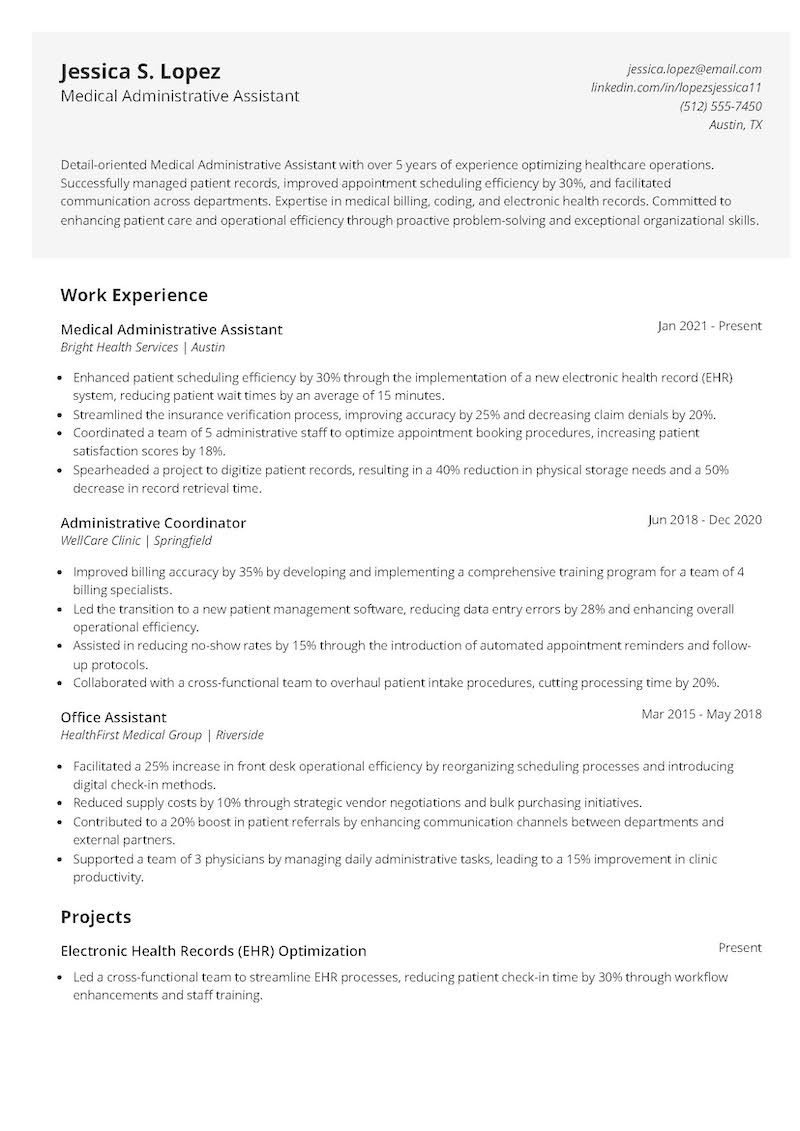
Key achievements, such as improving appointment scheduling efficiency by 30% and reducing data entry errors by 28%, demonstrate the candidate’s results-driven approach. The resume highlights leadership in optimizing EHR systems, streamlining insurance verification, and enhancing billing accuracy.
This medical administrative assistant resume stands out with a strong focus on healthcare operations, patient scheduling, and electronic records management. Furthermore, a well-structured work history with quantifiable improvements in patient satisfaction, operational efficiency, and administrative workflows makes this resume a compelling choice for employers.
Entry-level medical assistant resume example
Are you starting your career as a medical assistant and wondering how to make your resume stand out? How do you showcase your skills and limited experience in a way that grabs an employer’s attention? Look no further—this entry-level medical assistant resume example is designed to help you present your qualifications effectively.
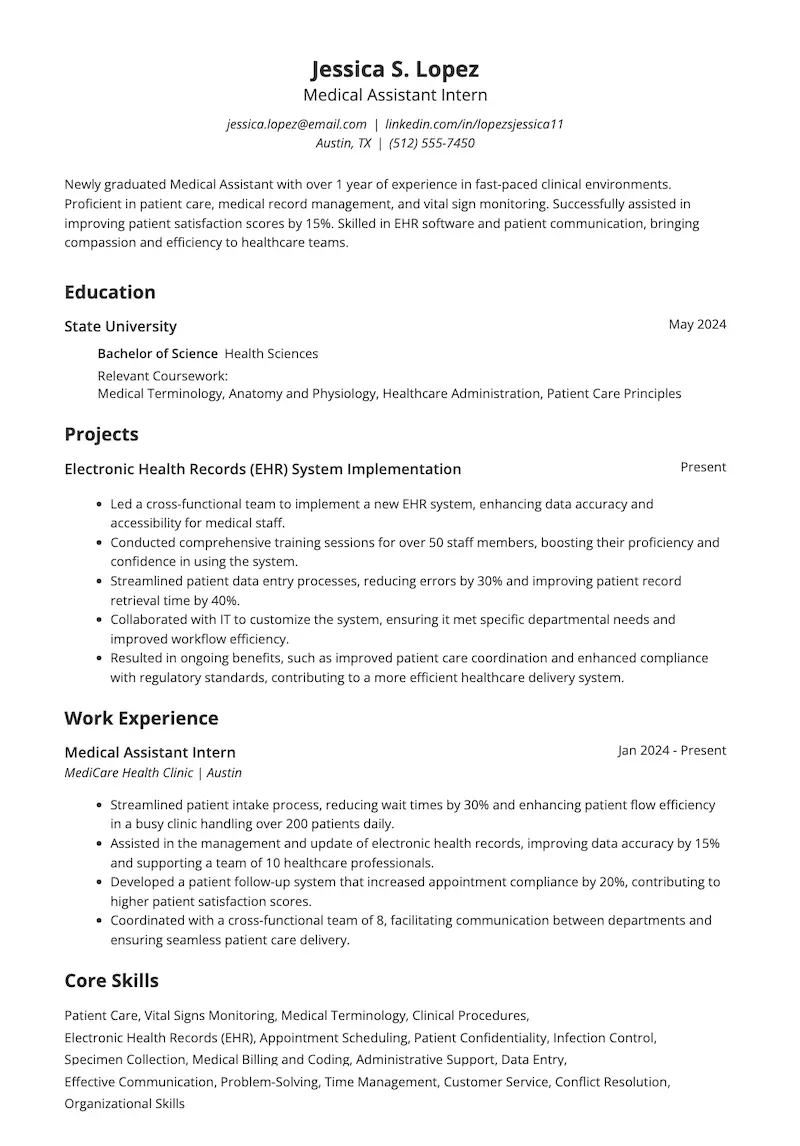
A strong medical assistant resume should highlight your clinical and administrative skills, education, and any hands-on experience, even from internships or training programs. If you’re pursuing an entry-level role, focus on demonstrating your ability to learn quickly, communicate effectively, and contribute to a smooth-running healthcare environment.
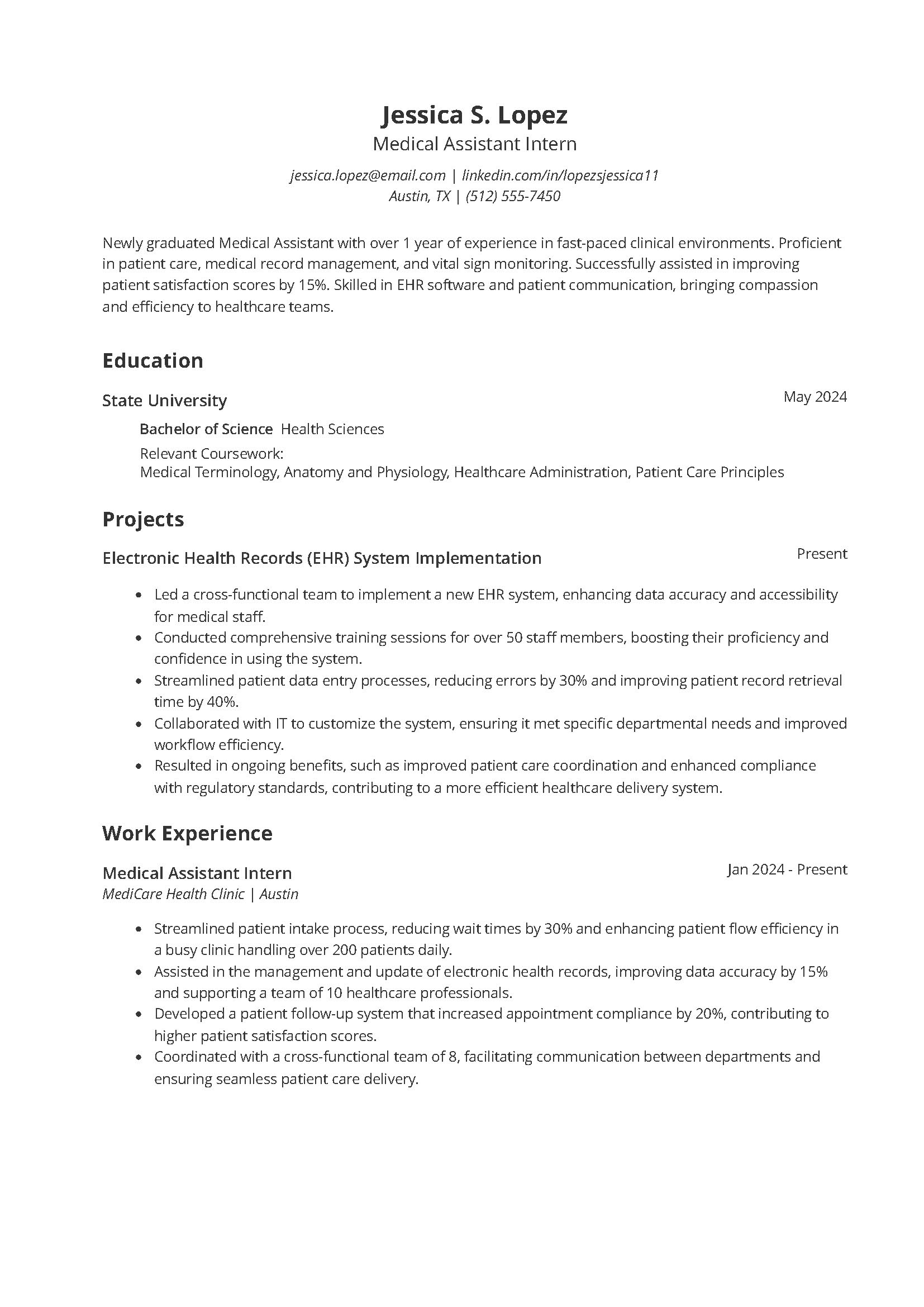
A strong foundation in patient care, clinical procedures, and administrative support sets this entry-level medical assistant resume template apart from the competition. It highlights proficiency in patient care, EHR management, and clinical procedures while emphasizing key accomplishments, such as improving patient satisfaction and streamlining workflows. The inclusion of a well-structured core skills section ensures that essential qualifications are easily identifiable.
Additionally, internship experience demonstrates hands-on involvement in patient intake, record management, and interdepartmental coordination, making this resume a well-rounded representation of a capable and adaptable medical assistant ready to contribute effectively.
How to write a medical assistant resume that will get you an interview
These days, simply having the right skills and experience isn’t enough—you need a resume that can pass Applicant Tracking Systems (ATS). Most healthcare employers use ATS software to scan resumes before they ever reach a hiring manager.
Understanding how ATS works is crucial for job seekers, as it helps them craft an ATS-friendly resume and increases their chances of passing the scan. These act as search engines for recruiters.
Here’s how it works:
- Employers input job details like title, required skills, and qualifications into the ATS.
- The ATS scans and stores applications in a database, analyzing resumes for relevant keywords.
- Recruiters search the database using keywords to find the most qualified candidates.
Without proper optimization, even highly qualified candidates can be overlooked.
One of the best ways to ensure your resume is ATS-friendly is by using Jobscan, a powerful tool designed to create resumes for ATS compatibility. With its proprietary AI, Jobscan ensures your resume is well-structured, optimized with the right keywords, and aligns with what recruiters seek.
LeverageJobscan’s ATS resume maker to create a medical assistant resume that stands out, boosting your chances of securing interviews and advancing your career.

1. Key elements of a medical assistant resume
A well-structured medical assistant resume should include the following key sections to highlight your skills, experience, and qualifications effectively:
- Contact information: Include your full name, phone number, email address, and location (city, state). If applicable, add a LinkedIn profile or a professional portfolio link.
- Professional summary: A 2-3 sentence summary highlighting your experience, key skills, and career achievements. Tailor it to the specific job by incorporating relevant keywords.
- Skills section: List hard and soft skills relevant to the role.
- Work experience: Detail your job history in reverse chronological order. Each entry should include job title, employer/ company name and location, employment dates, key responsibilities and accomplishments. Use bullet points and action verbs to list key responsibilities.
- Education section: List your degree or diploma, the institution name, and the year of completion. If you’re a recent graduate, include relevant coursework.
- Certifications & licenses: Highlight important certifications and licenses, such as Certified Medical Assistant (CMA), Registered Medical Assistant (RMA), and Basic Life Support (BLS) Certification.
- Additional sections (optional): This section can include volunteer experience (if relevant to healthcare), languages (bilingual skills can be an advantage), and professional memberships (such as the American Association of Medical Assistants, AMT, or similar organizations).
2. Write a strong professional summary
Your professional summary should be concise, engaging, and tailored to the job description. This 2-3 sentence section should highlight your experience, key skills, and career achievements, making a strong case for why you’re the ideal candidate.
Good examples of a resume summary
- “Certified Medical Assistant with 5+ years of experience in clinical and administrative roles. Skilled in patient care, EHR management, and medical coding. Proven ability to improve office efficiency and enhance patient satisfaction in fast-paced healthcare settings.”
- “Results-driven medical assistant with 10+ years of experience in clinical and administrative roles. Expertise in patient communication, lab procedures, and insurance processing. Implemented a new scheduling system, reducing patient wait times by 30%.”
Bad examples of a resume summary
- “I have worked in different healthcare settings, handling various duties such as front desk management, patient interaction, billing, and clinical procedures. I enjoy working with people and hope to find a medical assistant role where I can learn and grow.”
- “I am a hardworking medical assistant who loves helping people. I have some experience with patients, medical supplies, and office tasks.”
Crafting a compelling summary can be challenging, but Jobscan’s resume summary generator makes it easy. This feature analyzes job descriptions and creates a personalized, ATS-friendly summary that highlights your strongest qualifications.
3. Demonstrate key medical assistant skills
Highlighting the right skills—especially those that match the job description. This helps your resume pass Applicant Tracking Systems (ATS) and stand out to hiring managers.
Hard skills
These are the technical skills and industry-specific knowledge required for the role:
- Electronic Health Records (EHR) Management
- Medical Billing & Coding (CPT (Certified Phlebotomy Technician), ICD-10)
- Taking & Recording Vital Signs
- Administering Injections & Medications
- Phlebotomy & Lab Procedures
- Patient Scheduling & Insurance Verification
Soft skills
- Strong Patient Communication & Clinical Skills
- Attention to Detail & Organizational Skills
- Multitasking in Fast-Paced Environments
- Team Collaboration & Adaptability
- Problem-Solving Under Pressure
- Professionalism & Confidentiality
Integrating these skills into your bullet points can help you show off your accomplishments and highlight your proficiencies. But there’s a right and wrong way to highlight your medical assistant skills in your bullet points.
4. Craft impactful resume bullet points for medical assistants
Good examples of resume bullet points
- “Administered injections and performed phlebotomy procedures for an average of 30+ patients per day, ensuring accuracy and patient comfort.”
- “Managed accurate patient records using Epic EHR, reducing documentation errors by 15%.”
- “Processed insurance claims with 95% accuracy, minimizing billing issues.”
Bad examples of resume bullet points
- “Took blood and helped doctors.”
- “Used a computer for medical records.”
- “Answered phones and talked to patients.”
Struggling to create powerful resume bullet points? Jobscan’s resume bullet point generator helps you craft ATS-optimized, results-driven statements based on your experience. Try it today!
5. Highlight your achievements as a medical assistant
Employers value results-driven professionals who can make a tangible impact in healthcare settings. Instead of just listing job duties, highlight achievements that demonstrate your skills, efficiency, and contributions. Use numbers, percentages, and specific outcomes to show your value.
Here are a few examples of how you can highlight your achievements:
- “Reduced patient wait times by 25% by streamlining the appointment scheduling process.”
- “Managed an average of 50+ patient records daily with 99% accuracy using Epic EHR.”
- “Implemented a new inventory management system, reducing supply shortages by 30%.”
- “Trained and onboarded 5 new medical assistants, improving team efficiency and patient care.”
- “Recognized for providing exceptional patient care, increasing positive feedback scores by 15%.”
6. Tailor your medical assistant resume to the job description
A generic resume may not highlight the exact skills and qualifications the employer is looking for, reducing your chances of getting an interview.
Here’s how you can tailor your resume to the job description:
- Analyze the job description to identify required skills and qualifications.
- Use job-specific keywords to optimize your resume for ATS.
- Highlight relevant experience that matches the listed responsibilities.
- Customize your professional summary to reflect the employer’s needs.
- Showcase key skills such as EHR proficiency, patient care, and medical coding.
- Emphasize achievements with measurable results (e.g., reduced patient wait times by 20%).
- Include relevant certifications like CMA (Certified Medical Assistant) or RMA (Registered Medical Assistant).
- Align your work experience bullet points with the job’s duties and expectations.
- Keep it concise and well-structured to maintain clarity and readability.
7. Include relevant education & certifications
Your education and certifications validate your qualifications as a medical assistant and help your resume stand out. Many employers require specific certifications to ensure candidates meet industry standards and are prepared for clinical and administrative responsibilities.
Here’s how to do it effectively:
- List your degree (e.g., Associate’s Degree in Medical Assisting, [School Name], [Year]).
- Include relevant coursework if you’re a recent graduate (e.g., anatomy, medical coding, clinical procedures).
- Mention your certifications (e.g., Certified Medical Assistant (CMA), Registered Medical Assistant (RMA), Basic Life Support (BLS)).
- Add issuing organizations and expiration dates for certifications if applicable.
- Prioritize healthcare-related certifications that strengthen your qualifications.
Top medical assistant certifications
Here are some medical assistant certifications that can enhance your resume:
- Certified Medical Assistant (CMA)
- Registered Medical Assistant (RMA)
- Certified Clinical Medical Assistant (CCMA)
- National Certified Medical Assistant (NCMA)
- Basic Life Support (BLS) Certification
Medical assistant resume tips
Follow these tips to ensure your medical assistant resume is ATS-friendly, well-structured, and impactful.
- Use an ATS-friendly format.
- Use clear section headings (e.g., “Work Experience,” “Certifications”).
- Avoid images, charts, and excessive formatting, as ATS may not read them properly.
- Incorporate job-specific keywords.
- Write strong, action-oriented bullet points.
- Start each bullet with an action verb.
- Stick to a one-page resume (unless you have extensive experience).
- Focus on recent and relevant experience—omit unrelated jobs.
- Ensure grammar, punctuation, and formatting are correct.
Include a cover letter with your medical assistant resume
Many applicants overlook the power of a well-crafted medical assistant cover letter, but it can make a significant difference in setting you apart from other candidates. It allows you to explain why you’re the perfect fit for the role and how your expertise aligns with the employer’s needs. A strong cover letter also provides an opportunity to showcase your communication skills, elaborate on key achievements, and demonstrate your enthusiasm for the position.
Here’s what you can add in your cover letter:
- Personalized greeting (address the hiring manager if possible).
- Strong opening paragraph (mention your interest in the role and key qualifications).
- Highlight relevant skills (patient care, EHR proficiency, medical coding, administrative tasks).
- Showcase key achievements (e.g., improved clinic efficiency, enhanced patient experience).
- Align your experience with the job description to demonstrate your fit.
- Express enthusiasm for the role and how you can contribute to the team.
- Professional closing statement (thank the employer and request an interview).
Jobscan’s cover letter generator simplifies the process of crafting a customized, ATS-friendly cover letter that aligns with the job description and highlights your most relevant strengths. By ensuring your cover letter contains the right keywords and structure, Jobscan helps you maximize your chances of making a strong first impression.
Land more interviews with a resume that works for you
Crafting a standout medical assistant resume in 2025 is all about strategically showcasing your qualifications, optimizing for ATS, and proving your value to potential employers. With the right approach, you can create a resume that not only gets noticed but also lands you interviews.
Now that you know what it takes, why not see these strategies in action? Check out our sample medical assistant resumes to get inspiration or leverage Jobscan to structure your application like a pro. Don’t let a mediocre resume hold you back—take the next step toward your dream job today!

Medical assistant common interview questions
“I’ve always been passionate about helping others, and working as a medical assistant allows me to provide direct patient care while also supporting healthcare teams. I enjoy the mix of clinical and administrative duties, and I find it fulfilling to assist patients and ensure a smooth workflow in a medical setting.”
“I remain calm, listen to their concerns, and show empathy. If a patient is upset, I acknowledge their feelings and try to address the issue professionally. If needed, I involve a nurse or physician to ensure the patient receives the best care while maintaining a respectful environment.”
“I have experience using Epic and Cerner EHR systems for updating patient records, scheduling appointments, and managing billing. I’m comfortable navigating EHR software and ensuring accurate data entry while maintaining patient confidentiality.”
“I follow standard procedures, double-check my readings, and ensure the medical equipment is properly calibrated. I also confirm any unusual readings with a second measurement to guarantee accuracy before documenting the data.”
“I strictly follow HIPAA regulations and guidelines by keeping patient information confidential. I ensure that patient records are securely stored, only share information with authorized personnel, and never discuss patient details in public areas.”
Medical assistant resume frequently asked questions
Key skills include clinical abilities (vital signs, phlebotomy, EKG), administrative expertise (EHR management, medical billing, scheduling), and soft skills (patient communication, multitasking, teamwork). Tailor your skills to match the job description for ATS optimization.
List your degree or diploma, the school name, and graduation year under the “Education” section. If you have relevant coursework or hands-on training, briefly mention it. Certifications like CMA, RMA, or CCMA should be listed in a separate “Certifications” section.
Focus on transferable skills from past jobs (customer service, administrative tasks, teamwork), highlight internships or clinical training, and emphasize education and certifications. Use a functional or combination resume format to showcase skills over work history.