Best Scrum Master Resume Examples for 2026
Scrum Master resume examples for 2026 that land agile roles. See samples highlighting sprint facilitation, coaching, and the certifications ATS looks for.




A Scrum Master plays a crucial role in ensuring Agile teams function smoothly, delivering high-quality products efficiently. If you’re aiming for this role, your resume needs to showcase your expertise in Agile methodologies, leadership, and problem-solving. This blog offers expertly designed resume examples and valuable insights to help you write a compelling application that stands out.
The demand for Scrum Masters is on the rise, with Agile adoption growing across industries. Employers seek candidates who can facilitate collaboration, remove roadblocks, and drive continuous improvement. A well-structured resume is your key to proving your impact and securing interviews in this competitive field.
Ready to write a resume that grabs attention? Keep reading for practical examples, proven tips, and the secrets to making your application shine!
Scrum master resume example
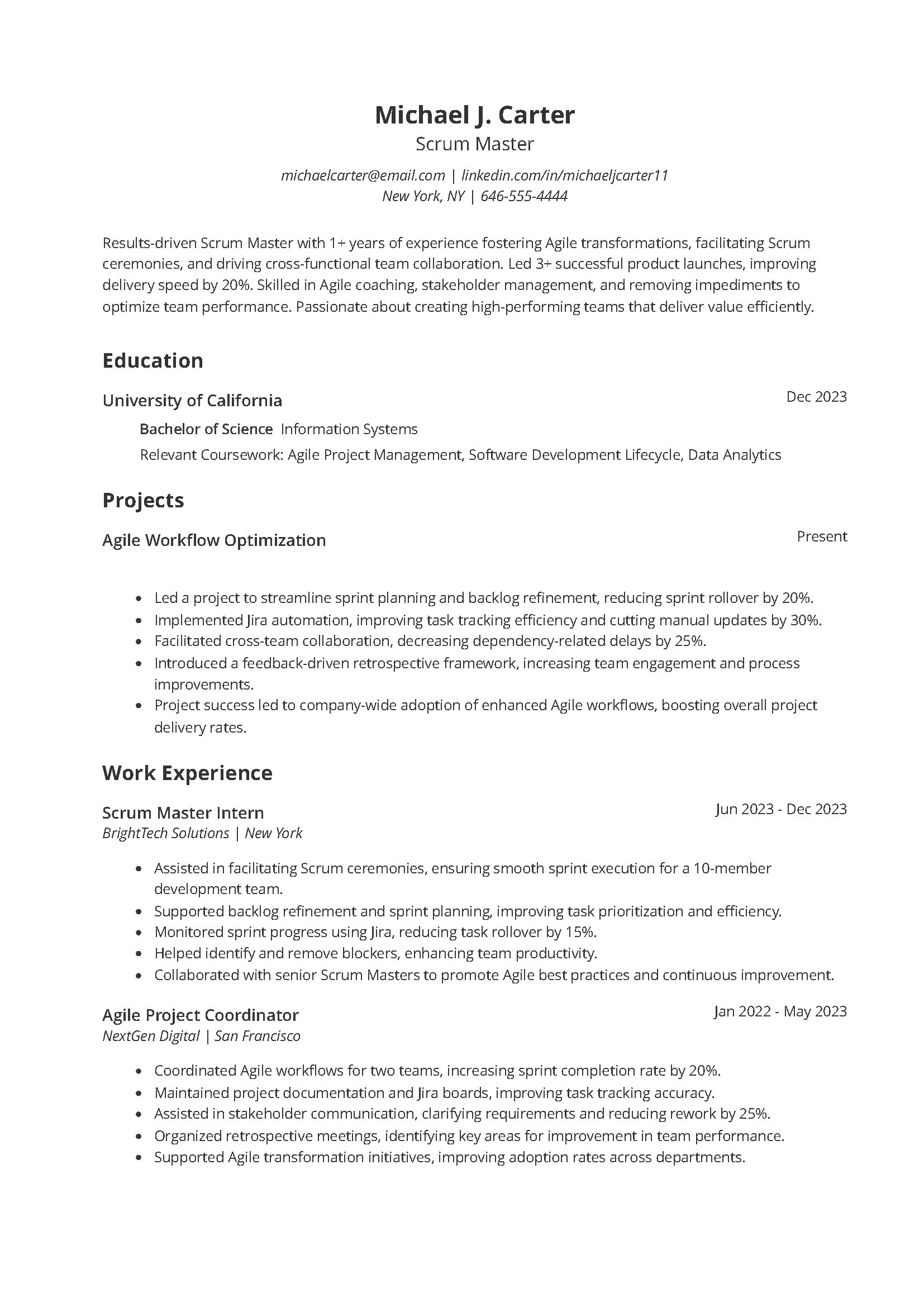
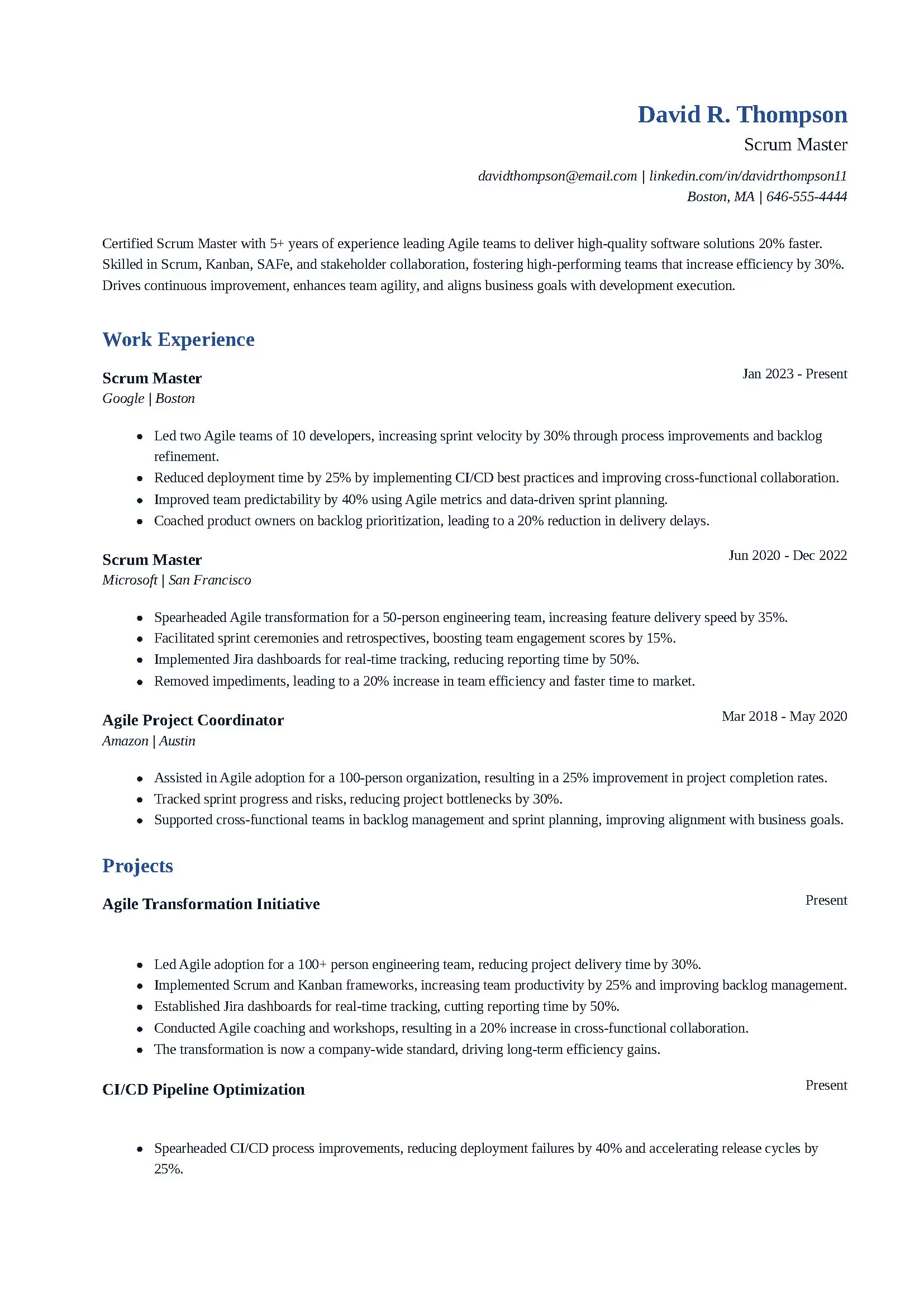
Looking to land a scrum master role but not sure how to showcase your skills and experience? Wondering how to highlight your Agile expertise in a way that grabs recruiters’ attention? This Scrum Master resume example is designed to help you stand out by emphasizing key achievements, Agile methodologies, and leadership impact.

A Scrum Master needs to do more than just run daily stand-ups. Companies expect candidates who can drive Agile adoption, remove roadblocks, and boost team efficiency. Your resume should clearly show how you’ve improved processes, enhanced collaboration, and delivered measurable results—just like the example above.
This resume is packed with measurable achievements and clear, action-driven language. Employers love seeing numbers that show real impact—like boosting efficiency by 30% or cutting deployment time by 25%. Plus, it’s well-structured with strong, relevant skills upfront, making it easy to scan. The mix of Agile expertise, leadership, and process improvements makes it a perfect fit for companies seeking a results-oriented Scrum Master.
Entry-level scrum master resume example
Trying to break into the Scrum Master role but not sure how to showcase your skills? Wondering how to make your resume stand out with little experience? This entry-level Scrum Master resume highlights the right mix of Agile knowledge, teamwork, and problem-solving to help you get noticed.
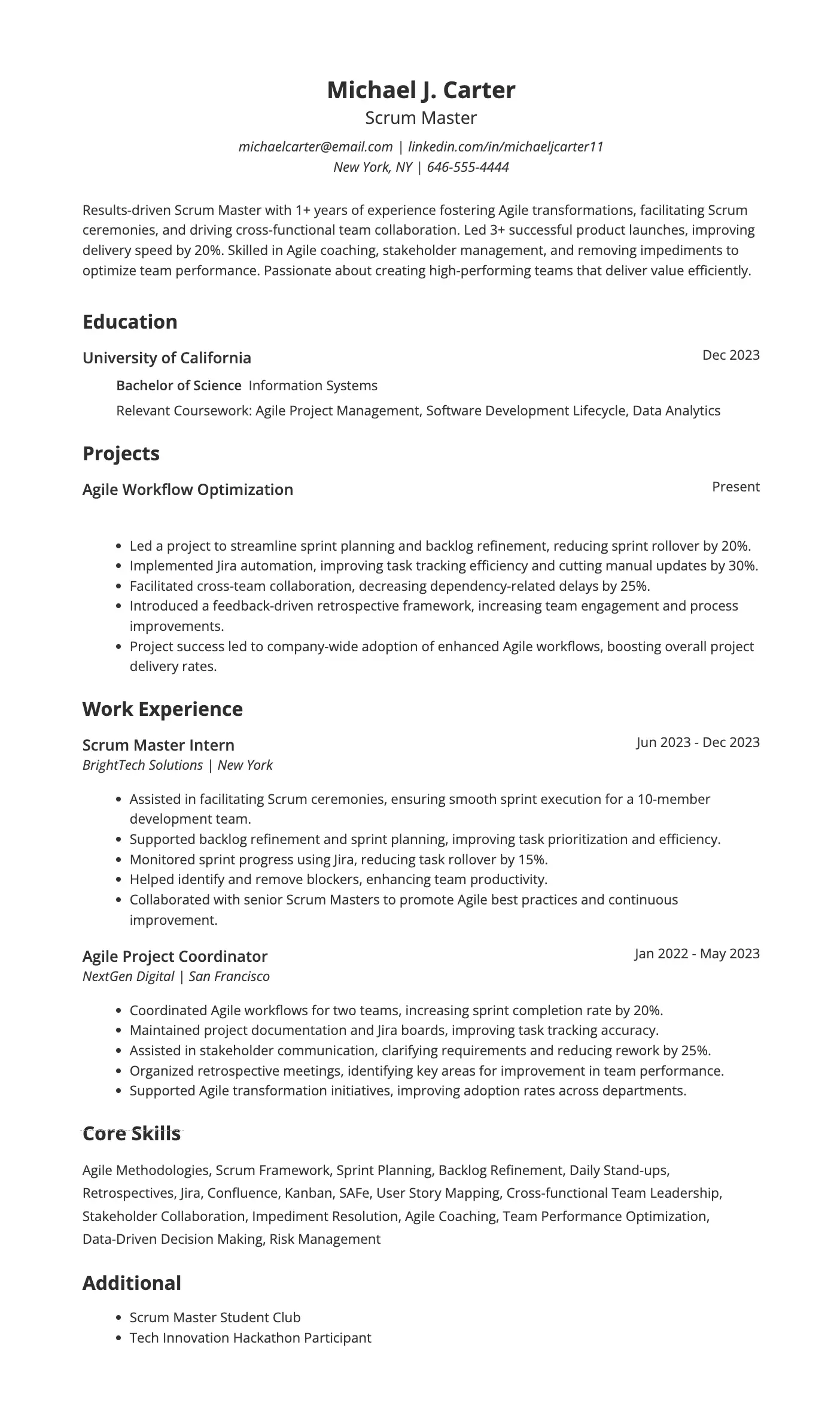
Scrum Masters are expected to facilitate Agile processes, remove roadblocks, and keep teams focused. Employers want candidates who understand Scrum principles, collaboration, and continuous improvement. A strong resume should show your ability to drive results, even with limited experience. This example does just that.
By focusing on relevant experiences like Agile coordination and Scrum facilitation, the resume shows hands-on experience with Jira, backlog management, and team collaboration—key for an entry-level Scrum Master. Employers value its structured format and clear impact statements, making it easy to see the candidate’s potential to lead Agile teams effectively.
Junior scrum master resume example
Struggling to create a resume that highlights your Agile experience and leadership skills? Wondering how to stand out as a Junior Scrum Master? Check out this resume example—it’s designed to showcase skills, measurable achievements, and the qualities hiring managers look for.

A Junior Scrum Master needs to be an effective facilitator, problem-solver, and Agile advocate. Employers expect candidates to support teams, remove roadblocks, and improve processes. Strong communication, leadership, and adaptability are key. If you’re aiming for this role, make sure your resume highlights your ability to drive Agile success and deliver value.
By focusing on relevant skills and tools, this resume highlights expertise in industry-standard software like Jira and Confluence and shows familiarity with essential tools for a Scrum Master role. Additionally, the emphasis on key Agile practices like sprint planning, backlog refinement, and retrospectives demonstrates a solid understanding of the Scrum framework.
This approach appeals to employers by showcasing readiness to contribute and a strong foundation despite limited experience, which is crucial for a junior Scrum Master role.
Senior scrum master resume example
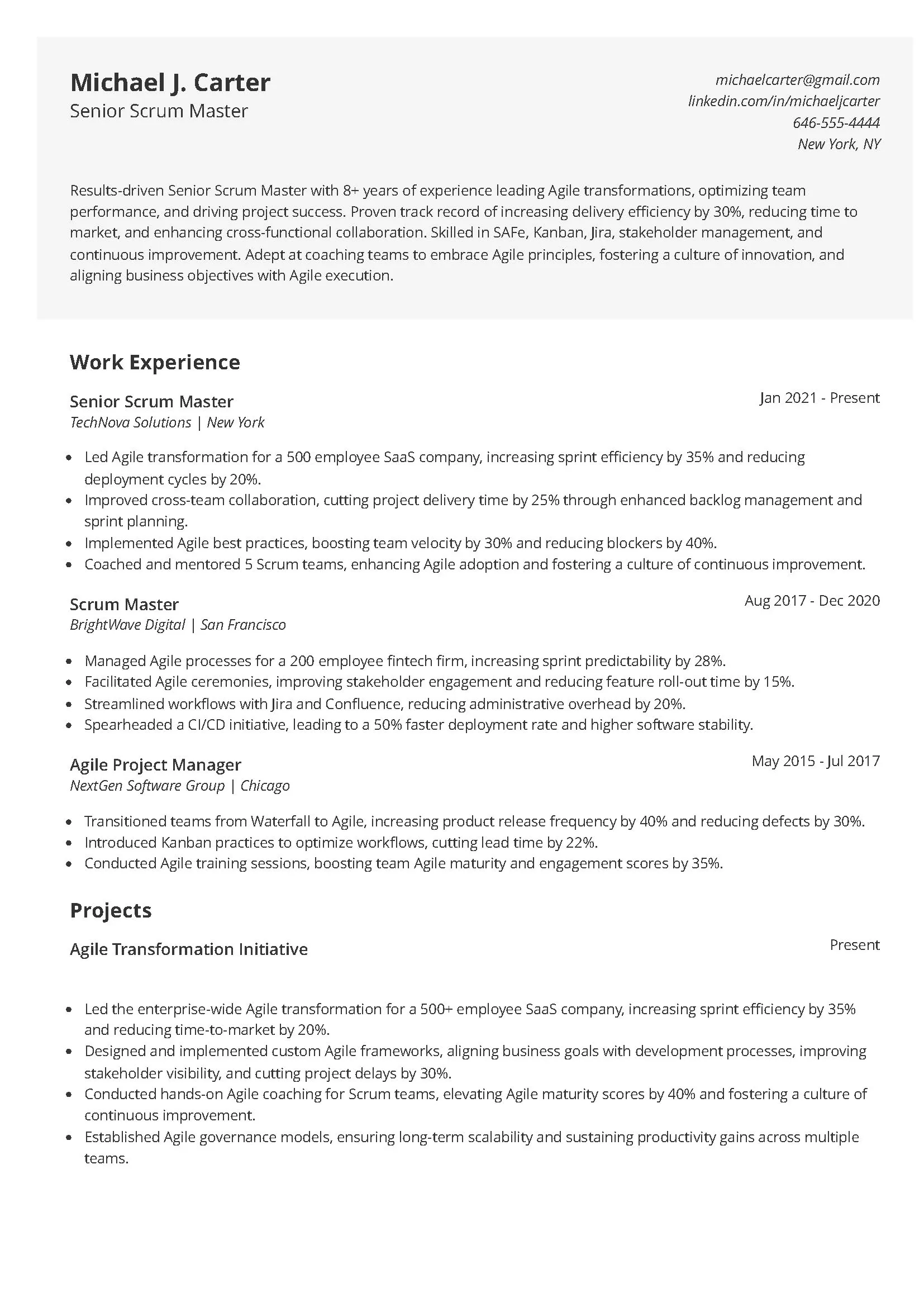
Looking to land a senior scrum master role but not sure how to showcase your experience? Struggling to highlight your impact in Agile environments? Check out this resume example—it’s structured to grab attention, packed with measurable achievements, and tailored for Agile leadership roles.

A senior scrum master isn’t just about running stand-ups—it’s about driving Agile success. Employers want candidates who boost efficiency, improve collaboration, and lead teams through Agile transformations. Your resume should show clear results—how you increased velocity, reduced blockers, and optimized workflows.
The use of strong action verbs like “led,” “coached,” “spearheaded,” and “optimized” gives the resume a sense of ownership and initiative, making the candidate’s contributions clear and impactful. The Projects section is a standout, showcasing expertise by detailing specific initiatives like Agile transformations and CI/CD pipeline optimization.
This not only highlights technical skills but also demonstrates the ability to drive meaningful change within organizations, which appeals to employers looking for proven expertise in the field.
How to write a scrum master resume that will get you an interview
A well-written scrum master resume highlights your ability to lead Agile teams, remove roadblocks, and drive successful project deliveries. Hiring managers look for candidates with strong leadership, facilitation, and problem-solving skills. To stand out, your resume should be clear, concise, and tailored to the job description.
Most companies use Applicant Tracking Systems (ATS) to streamline the hiring process. ATS functions as a search engine for resumes—hiring managers input specific keywords to find the best candidates. If your resume doesn’t contain the right terms, it might never make it to a human recruiter.
For a Scrum Master role, recruiters may search for keywords like “Agile methodologies,” “Scrum ceremonies,” “Sprint planning,” and “team facilitation.” If your resume includes these key terms, it has a better chance of being seen. Without them, it could get overlooked in the system.
How ATS works:
- Job posting setup – Employers enter job details, including the title, required skills, and qualifications, into the ATS.
- Resume scanning – The ATS scans submitted resumes, extracting and storing relevant information.
- Searchable database – Hiring managers search the database using specific keywords or review ranked results.
Without proper optimization, your resume might not appear in recruiter searches. That’s why formatting it for ATS success is essential.
Need help creating an ATS-friendly scrum master resume? Jobscan’s free resume builder helps you write a well-structured resume optimized with the right keywords, ensuring your skills and experience stand out—giving you a better chance at landing interviews.

1. Key elements of a scrum master resume
Your resume should include the following sections:
- Contact details: Include your full name, phone number, email address, LinkedIn profile, and optionally, your city and state.
- Professional summary: A brief overview of your experience, skills, and achievements.
- Skills: Highlight Agile methodologies, Scrum frameworks, and relevant tools like Jira or Trello.
- Work experience: Showcase your professional experience managing Agile teams and delivering projects successfully.
- Certifications: Mention certifications like Certified Scrum Master (CSM) or Professional Scrum Master (PSM).
- Education: List your degree(s) and any relevant coursework.
2. Write a strong professional summary
Your professional summary is the first thing recruiters see, so it should grab attention quickly. Keep it concise—around 3–4 sentences—focusing on your expertise, achievements, and what you bring to the table.
Let’s look at some examples of both good and bad professional summaries below.
Good examples of a resume summary
- “Experienced Scrum Master with 5+ years leading Agile teams to deliver high-impact projects. Adept at facilitating Scrum ceremonies, removing impediments, and driving continuous improvement. Proven track record of enhancing team collaboration and increasing delivery efficiency. Certified Scrum Master (CSM) with a passion for Agile transformation.”
- “Results-driven Scrum Master with a background in software development and Agile coaching. Skilled in scaling Agile frameworks, optimizing workflows, and mentoring cross-functional teams. Strong ability to foster a culture of transparency and continuous improvement. Holds a Professional Scrum Master (PSM) certification.”
Bad examples of a resume summary
- “Hardworking and dedicated professional with experience in project management. Seeking a challenging role in a dynamic company.”
- “Scrum Master with knowledge of Agile and experience in managing teams. Looking for an opportunity to apply my skills.”
Having trouble writing a compelling resume summary? Jobscan’s professional summary generator can simplify the process by creating a strong, achievement-focused summary tailored to your experience. Just enter your details, and let Jobscan generate a polished summary that captures recruiters’ attention.
3. Demonstrate key scrum master skills
A strong Scrum Master resume should highlight both hard and soft skills that showcase your ability to lead Agile teams, facilitate collaboration, and drive project success.
Hard skills
These are the technical and process-related skills that demonstrate your expertise in Agile methodologies:
- Agile Frameworks (Scrum, Kanban, SAFe)
- Sprint Planning
- Backlog Management
- Facilitating Scrum Ceremonies
- Jira
- Trello
- Azure DevOps
- Agile Coaching
- Team Mentoring
- Risk Management
- Impediment Resolution
- Continuous Improvement Strategies
Soft skills
Scrum Masters also need strong interpersonal and leadership skills to foster a productive team environment:
- Effective Communication
- Conflict Resolution
- Team Facilitation
- Strategic Planning
- Team Leadership
- Time Management
- Change Management
- Stakeholder Management
- Problem-Solving
- Adaptability
To create a strong scrum master resume, it’s important to highlight both your technical expertise and leadership skills in your bullet points. Rather than simply listing responsibilities, focus on demonstrating your impact, team facilitation, and measurable improvements in Agile processes. Here are some good and bad examples of resume bullet points.
4. Write impactful resume bullet points for scrum master
Resume bullet points are the core of your experience section. They should clearly communicate your skills, the impact you’ve made, and the value you bring to a team. Instead of listing tasks, focus on what you accomplished using specific tools, action verbs, and measurable results. Here’s what that looks like:
Good examples of resume bullet points
- “Led daily stand-ups, sprint planning, and retrospectives, improving team collaboration and reducing sprint overruns by 20%.”
- “Implemented Agile best practices, increasing team velocity by 30% within six months.”
- “Facilitated cross-functional team coordination, ensuring on-time delivery of product releases in a fast-paced environment.”
- “Trained and mentored junior Scrum Masters, fostering an Agile mindset across the organization.”
- “Resolved team impediments proactively, reducing project roadblocks and improving sprint efficiency.”
Bad examples of resume bullet points
- “Managed scrum meetings and helped the team.”
- “Worked with the team to complete projects on time.”
- “Used Jira for tracking tasks.”
- “Helped with agile development and processes in the company.”
Use Jobscan’s resume bullet point generator to write impactful, results-oriented bullet points for your resume. Simply upload your resume and the job description to your Jobscan dashboard, and the tool will provide customized phrase suggestions that emphasize your skills and accomplishments.
5. Highlight your achievements as a scrum master
Recruiters look for measurable impact when reviewing resumes. Instead of just listing responsibilities, focus on your achievements—how you improved processes, enhanced team performance, or contributed to successful project deliveries.
Here are some examples of how to highlight your achievements effectively:
- “Increased sprint velocity by 35% within six months by introducing Agile best practices and streamlining backlog refinement sessions.”
- “Reduced sprint overruns by 20% through improved sprint planning and proactive risk management.”
- “Led a team of 10+ developers, fostering a high-performing Agile culture that improved project delivery timelines.”
- “Implemented Jira dashboards to improve transparency, leading to a 50% reduction in missed deadlines.”
- “Coached cross-functional teams on Agile methodologies, resulting in a 25% improvement in stakeholder collaboration.”
6. Tailor your resume to the job description
Customizing your resume for each job application increases your chances of getting noticed by recruiters. Instead of using a generic resume, align your skills and experience with the specific requirements of the job posting.
Here’s how to tailor your resume effectively:
- Analyze the job posting: Identify key skills, responsibilities, and keywords used in the job description.
- Use keywords from the job description: Identify key skills, tools, and methodologies mentioned in the posting and incorporate them naturally into your resume.
- Match your experience with job requirements: Highlight past roles (including company name) and achievements that align closely with the employer’s needs.
- Customize your professional summary: Emphasize the most relevant skills and accomplishments based on the job description.
- Prioritize relevant skills: If the job emphasizes SAFe or Kanban, ensure those are prominently featured if you have experience with them.
- Showcase industry-specific experience: If the role is in fintech, healthcare, or e-commerce, highlight any relevant years of experience in those industries.
- Optimize for ATS: Avoid excessive formatting, images, or unusual fonts to ensure your resume is ATS-friendly.
Also Read: The Top 5 ATS Resume Keywords of 2025
7. Include relevant education and certifications
Having the right education and certifications strengthens your credibility as a scrum master. While a degree in business, IT, or a related field is beneficial, certifications demonstrate your expertise in Agile methodologies and Scrum frameworks.
Here’s how to do it effectively:
- Include your degree, major, and institution in a concise format (e.g., Bachelor of Science in Computer Science, XYZ University).
- If you’re a recent graduate, add your graduation year and relevant coursework or honors related to Scrum, Agile, or project management.
- For experienced professionals, keep it brief and focus on higher education degrees, especially those related to Agile methodologies or Scrum.
- If switching careers, mention coursework, certifications, or degrees that relate to Scrum or project management.
- List relevant certifications that enhance your Scrum Master skills (e.g., Certified ScrumMaster (CSM), Professional Scrum Master (PSM)).
- If you specialize as an Agile project manager, include certifications like PMI-ACP (Agile Certified Practitioner).
- For professionals with extensive experience, focus on industry-recognized certifications, like CSM or PSM, rather than listing all past training programs.
Top scrum master certifications
Earning a certification can set you apart from other candidates and show employers that you have a solid understanding of Agile practices. Here are some of the most recognized Scrum Master certifications:
- Certified Scrum Master (CSM)
- Professional Scrum Master (PSM)
- SAFe Scrum Master (SSM)
- Advanced Certified Scrum Master (A-CSM)
- Certified SAFe Advanced Scrum Master (SASM)
- ICP-ACC (ICAgile Certified Agile Coach)
Scrum master resume tips
A well-written scrum master resume should effectively highlight your Agile expertise, leadership skills, and measurable achievements. Here are some key tips to make your resume stand out:
- Use a strong professional summary – Start with a compelling summary that highlights your experience, key Scrum skills, and certifications. Tailor it to the job description to align with what recruiters are looking for.
- Use strong action verbs – Start bullet points with impactful action verbs like “facilitated,” “coached,” “implemented,” “optimized,” or “streamlined” to make your achievements more compelling and dynamic.
- Emphasize Agile and Scrum expertise – Showcase your knowledge of Agile methodologies, Scrum frameworks, and tools like Jira, Trello, or Confluence. Include relevant certifications such as CSM, PSM, or SAFe.
- Highlight leadership and facilitation skills – Demonstrate how you’ve successfully coached teams, removed roadblocks, and facilitated Agile ceremonies like daily stand-ups, sprint planning, and retrospectives.
- Showcase measurable achievements – Use metrics to highlight your impact, such as improving sprint velocity, reducing blockers, or increasing team efficiency.
- Tailor your resume to each job – Use keywords from the job description and emphasize the most relevant experience and skills for the role.
- Keep it concise and well-structured – Use clear headings, bullet points, and a professional format to ensure easy readability.
Also Read: How to Organize Your Resume Sections to Stand Out?
Include a cover letter with your scrum master resume
A strong cover letter enhances your resume by providing context for your experience and highlighting why you’re a great fit for the role. Instead of repeating your resume, use it to showcase your most relevant skills and achievements in a compelling way.
What to include in your cover letter:
- Start with a strong opening – Grab attention by addressing the hiring manager (if possible) and mentioning the specific role you’re applying for.
- Highlight your agile experience – Emphasize your background in Agile environments, leadership in facilitating Scrum teams, and any key successes.
- Showcase measurable achievements – Provide specific examples of how you improved team performance, increased efficiency, or contributed to successful project delivery.
- Address career transitions – If moving into a scrum master position, explain how your past experience aligns with Agile principles and team facilitation.
- End with confidence – Express enthusiasm for the role and include a clear call to action, such as requesting an interview or further discussion.
Need help creating a professional cover letter? Jobscan’s Cover Letter Generator can help you create a job-winning cover letter in minutes! Try it now!
Stand out with a winning scrum master resume
Writing a strong scrum master resume is a great way to showcase your Agile expertise and leadership skills. A well-structured resume not only improves your chances of landing interviews but also supports your professional development by highlighting key achievements and industry-relevant certifications. By following the best resume writing practices, tailoring your application to the job description, and incorporating measurable impact, you can stand out in this competitive field.
Enhance your job search with Jobscan’s ATS resume builder tool. This powerful resource helps you write ATS-friendly resumes by suggesting job-specific keywords and optimized formatting, ensuring your resume catches the attention of both hiring managers and applicant tracking systems. With Jobscan, resume writing becomes more efficient, giving you a great way to streamline your application process. Start building your winning resume today!

Scrum master common interview questions
Resistance to Agile often stems from a lack of understanding or past experiences. I first try to identify the root cause by having one-on-one conversations and actively listening to their concerns. Then, I provide education on Agile benefits and show how these practices improve efficiency and collaboration. If needed, I involve stakeholders or showcase real data to demonstrate success. Encouraging small wins and gradual adoption often helps skeptical team members embrace Agile.
Continuous improvement is driven through regular retrospectives, where the team reflects on what went well and what could be improved. I create a safe space for honest discussions and encourage actionable takeaways. Additionally, I track progress on improvements, ensure accountability, and introduce best practices like experimenting with process changes or refining backlog prioritization. By fostering a culture of learning and adaptation, teams become more efficient over time.
While Agile allows for flexibility, frequent mid-sprint changes can disrupt workflow. I first assess the urgency and impact of the change. If it’s critical, I collaborate with the Product Owner to adjust priorities while minimizing disruption. If it can wait, I guide stakeholders on Agile principles, emphasizing backlog refinement and sprint planning to incorporate changes efficiently in future sprints. Effective communication helps balance stakeholder needs with team productivity.
Conflicts are natural in any team, and as a Scrum Master, my role is to facilitate resolution constructively. I encourage open communication and active listening, ensuring that all perspectives are heard. If necessary, I mediate discussions to find common ground and align on a solution. By fostering a culture of respect, collaboration, and psychological safety, I help the team navigate challenges while staying focused on shared business objectives.
Scrum master resume frequently asked questions
Your resume should showcase a mix of hard and soft skills in the skills section. Key technical skills include Agile methodologies such as Scrum methodologies, Kanban, and SAFe, sprint planning, backlog management, Jira or Trello proficiency, Agile coaching, and risk management. Soft skills like servant leadership, team facilitation, conflict resolution, stakeholder management, and adaptability are equally important. Prioritizing skills that match the job description increases your chances of getting noticed.
List your highest degree first, including the institution name and graduation year. If your degree is relevant, such as in Computer Science, Business, or Project Management, highlight coursework related to Agile or leadership. For those with Scrum or Agile-related training, certifications should be listed in a separate section to showcase expertise.
If you’re transitioning into a scrum master role, highlight transferable skills, Agile exposure, and leadership experience. Mention contributions to Scrum practices, project management, and teamwork facilitation. Earning a CSM or PSM certification and showcasing Agile-related personal or volunteer projects can strengthen your resume. A well-structured resume focusing on Agile knowledge, leadership, and problem-solving can help you secure your first role.