




-
The Industry Standard: Over 98% of Fortune 500 companies use an ATS to manage the massive volume of digital applications, converting unstructured resumes into searchable databases.
-
Search, Don’t Reject: Contrary to popular belief, an ATS rarely “rejects” a candidate automatically. Instead, it acts as a search engine for recruiters to filter and rank applicants based on specific keywords and “knockout” requirements.
-
Under the Hood: Systems use Natural Language Processing (NLP) to parse your resume and an inverted index (like a book’s index) to instantly pull candidates who match specific skills or Boolean searches.
-
Human-Driven Logic: While the software automates the sorting, humans set the criteria. Recruiters define the necessary skills, experience, and “scorecards” that determine which candidates move forward.
-
ATS vs. CRM: An ATS manages active applicants who have already applied, while a CRM (Candidate Relationship Management) is used to engage passive talent who haven’t submitted an application yet.
As the volume of digital job applications continues to scale, enterprise HR teams rely on complex software to manage the pipeline. So, what is an applicant tracking system (ATS)?
It is the core recruiting architecture used by over 98% of Fortune 500 companies to parse, search, and rank candidate data.
To understand the modern hiring ecosystem, we need to look under the hood at how these platforms operate, their market share, and how they differ from traditional candidate relationship management (CRM) tools.

What is an ATS? The core architecture of an ATS
Online job boards like Indeed have made it easy for job seekers to submit applications. Just click submit, submit, submit.
The result is that employers are now flooded with resumes for every open position.
To manage this resume overload, employers have turned to applicant tracking systems (ATS).
At its core, an ATS is a specialized subset of Customer Relationship Management (CRM) software tailored for the recruitment lifecycle. Its architecture is designed to handle high volumes of unstructured data (resumes) and convert them into a structured, searchable database.
An ATS is software that helps companies streamline their recruitment process by:
-
- Collecting resumes submitted online.
-
- Ranking candidates based on relevant keywords and qualifications (not all ATS do this).
-
- Filtering resumes that don’t match the “knockout” job requirements the recruiter set.
-
- Tracking each candidate’s progress through the hiring process.
By automating these steps, an ATS helps employers save time and money while ensuring that qualified candidates don’t slip through the cracks.
But for job seekers, what really matters are these three basic steps:
STEP 1: Recruiters enter into the ATS details about the job opening—job title, required skills, and experience. In other words, the job description.
STEP 2: The ATS scans incoming resumes and stores the resumes in a searchable database.
STEP 3: Recruiters can search the database for strong candidates.
Here’s a deeper encyclopedic guide about the inner workings of most ATS software.
Parsing, searching, and ranking mechanisms
Step 1: The parsing mechanism
Parsing is the process of deconstructing a resume. Modern parsers don’t just “read” text; they use Natural Language Processing (NLP) to understand context.
- Extraction: The system uses Optical Character Recognition (OCR) for text layer extraction for PDFs.
- Tokenization & NER: The parser uses Named Entity Recognition (NER) to identify “entities.” For example, it identifies “Google” as an Organization and “2018-2022” as a Date Range.
Once the resume’s text is assigned to database fields, isolated data is pushed to the recruiter dashboard as a structured, searchable candidate.
Step 2: The searching mechanism (indexing)
An ATS doesn’t search through the original files every time a recruiter types a query; that would be too slow. Instead, it searches an inverted index. But what is an inverted index?
- The Inverted Index: Similar to how a book index works, the system creates a map of every word and which candidate profile it belongs to.
If a recruiter searches for “Python,” the system doesn’t scan 10,000 resumes. It goes to the “Python” entry in the index and instantly pulls the IDs of the 400 candidates attached to it.
Recruiters and hiring managers also rely on Boolean logic for searches. How does Boolean logic work?
- Boolean Logic: The user interface allows for AND, OR, and NOT (e.g., “Java AND (Spring OR Hibernate) NOT Junior”).
This helps narrow search results down to more granular details and pulls up candidates who are a more highly specific fit.
Step 3: The recruiter’s “sort and rank” control
Contrary to enduring myths, ATS software doesn’t actually rank candidates or decide who is “better”. But it provides the recruiter with a set of dials and knobs to filter the database. If a recruiter wants to set binary rules, the ATS will enforce them.
These are called Knockout Questions.
“Do you have a valid CPA license?”
If you answer “No,” the recruiter has likely set a rule that automatically moves you to the “Not Hired” folder as part of an automated workflow.
- The Human Factor: A person chose to make that a requirement; the ATS just executes the command.
In high-end systems, the “score” often refers to Scorecards filled out by human interviewers.
- The Aggregate Score: The ATS can then average these human inputs to give the candidate an overall rating in the pipeline.
- Interview Kits: The architecture provides a digital form for every person on the hiring team.
- Standardized Ratings: After an interview, the human interviewer gives a score (e.g., 1–5 or “Strong Yes” to “Strong No”) on specific competencies like “Technical Proficiency” or “Culture Fit.”
Overview summary of responsibilities
| Action | Who does it? | Why? |
|---|---|---|
| Parsing | The System | To make the document searchable. |
| Defining Criteria | The Recruiter | To tell the system what to look for. |
| Filtering/Sorting | The System | To save the human time by organizing the data. |
| Reviewing & Rating | The Recruiter | To apply judgment, context, and nuance. |
| Final Decision | The Hiring Manager | Because software can’t predict “team fit.” |
ATS market share in 2026: Who is powering Fortune 500 hiring?
Applicant tracking systems (ATS) are now commonplace in hiring, especially for large companies.
Jobscan research reveals that 98.4% of Fortune 500 companies use an ATS. That’s 492 out of 500 companies.
The remaining 8 companies didn’t have a detectable ATS, which might mean they use a proprietary system built in-house.

ATS aren’t just for Fortune 500 companies and large corporations. They’re used by a wide range of organizations, including:
- Staffing agencies: To quickly match candidates to jobs across different industries.
- Government organizations: For handling the complex hiring processes in the public sector.
- Mid-sized companies: To stay organized and keep up with growing applicant numbers.
- Small businesses: Particularly those growing fast or hiring for competitive roles.
- Nonprofits: To manage both paid staff and volunteer applications.
In short, any organization that deals with a large number of applicants or that needs to streamline its hiring process can benefit from using an ATS.
Which ATS are most popular?
Using Jobscan data, we analyzed job descriptions from over 12,820 companies where an ATS was detected to see which systems are most popular. Here’s what we found:
- 19.3% of analyzed companies use Greenhouse.
- 16.6% of analyzed companies use Lever.
- 15.9% of analyzed companies use Workday.
- 15.3% of analyzed companies use iCIMS.

How to do an ATS check on your resume
For most job seekers, figuring out which ATS the job is attached to is a mystery.
That’s where an online tool like Jobscan’s resume scanner can help. The ATS Tip feature will detect which ATS your target role is using and provide specific advice.
Here’s how it works:
Step 1: Upload your resume into the scanner.
Step 2: Paste the job description into the scanner.
Step 3: Click the “scan” button.
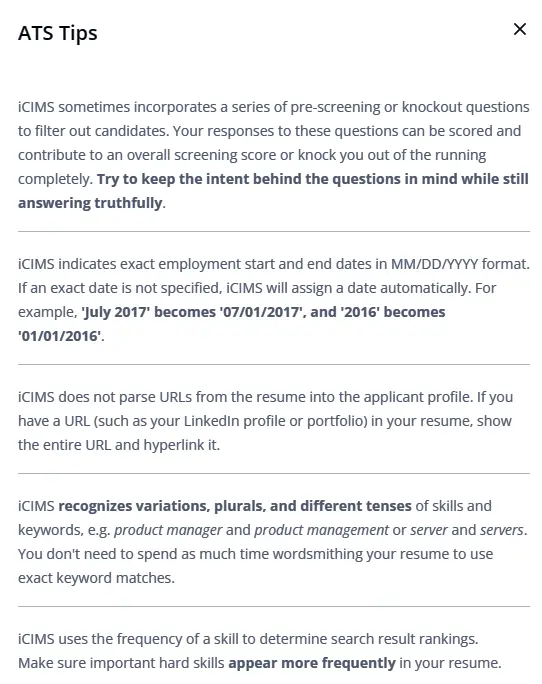
You’ll then receive a match report highlighting the checks on over 30 parameters. If you input the link to the job description, you’ll receive an ATS Tip like the one below.
This ATS Tip is for iCIMS and provides detailed and tailored recommendations based on this particular ATS functionality.
Try a resume scan for free below.
Now that you understand what an applicant tracking system is, it’s time to write an ATS resume that accommodates the software.
Why is an ATS important for recruiters?
Many job seekers think an ATS is just there to block them from reaching a real person. But that’s not the case.
Applicant tracking systems do much more behind the scenes to help companies manage the entire hiring process. Here’s what else they handle:
-
Schedule interviews: Automatically sends reminders and syncs with calendars to keep things on track.
-
Communicate with candidates: Uses built-in email templates and automated messages to keep applicants in the loop.
-
Team collaboration: Lets hiring teams share notes and feedback in real time, so everyone’s on the same page.
-
Track hiring data: Provides insights into time-to-hire, source of applicants, and more to improve recruiting strategies.
-
Tool integration: Connects with CRM systems, email platforms, and onboarding software for a smoother workflow.
-
Candidate tracking: Keeps tabs on every applicant throughout the process so no one slips through the cracks.
By managing all of these tasks, an ATS helps hiring teams stay organized, communicate more efficiently, and make smarter hiring decisions.
What’s the difference between an ATS and a CRM?
There are two main types of recruiting software:
- Applicant Tracking Systems (ATS)
- Candidate Relationship Management (CRM) Systems
Here’s a quick breakdown of each.
Applicant tracking systems (ATS)
The ATS manages candidates during the hiring process. But it only tracks people who’ve already applied for a job at the company.
With the flood of resumes coming in—especially since it’s so easy to apply online—ATS help companies quickly find the right applicants.
Candidate relationship management (CRM) systems
CRMs build relationships with potential candidates who haven’t applied yet. These candidates are sometimes referred to as passive candidates or talent.
CRMs include tools like email campaigns, scheduling, and messaging features that help companies stay connected with potential candidates and keep them engaged until they’re ready to apply.
The key difference? ATS focus on applicants, while CRMs focus on potential candidates who might not even know they want to work for a company yet.
Many companies use both ATS and CRM to cover all their recruiting bases—from finding top talent to hiring the perfect fit.
What is the future of applicant tracking systems?
Artificial intelligence (AI) is already reshaping recruitment, and ATS is evolving with it.
Today’s AI-powered applicant tracking systems don’t just screen resumes. They can identify top candidates, handle parts of the interview process, and even help conduct background checks.
AI technology will help hiring teams create more targeted job descriptions, making it easier to tailor your resume.
With more AI tools, the goal is to personalize candidates’ experiences without adding time to the recruitment process.
And for job seekers, the shift in ATS architecture means the “rules of the game” have moved away from tricking a robot and toward proving value to a human-led, AI-enhanced system.
-
Mobile-friendly tools: Both job seekers and recruiters want the freedom to search, apply, and manage applications right from their phones or tablets.
-
Better experiences for job seekers: Expect more intuitive platforms, self-scheduling interview tools, and built-in chatbots to answer questions and keep candidates updated.
-
Social media integration: ATS systems will likely connect more deeply with platforms like LinkedIn to help recruiters find and vet candidates faster.
-
Reducing bias in hiring: Future ATS tools may anonymize resumes by removing names, photos, and other identifying information. This will allow hiring teams to focus purely on skills and qualifications.
Ultimately, AI will help streamline hiring and create a more personalized experience on both sides of the process.
FAQs
ATS stands for Applicant Tracking System. It’s computer software that companies use to manage resumes and screen candidates during the hiring process.
Employers use ATS to manage the hiring process more efficiently. They search resumes for specific keywords and job titles that match the job description. This helps HR departments quickly filter through large volumes of resumes and focus on the most qualified candidates. ATS can also schedule interviews and handle email communications.
Over 98% of Fortune 500 companies use ATS. But it’s not just large corporations—staffing agencies, government organizations, mid-sized companies, small businesses, and nonprofits also rely on ATS to handle the high volume of applications and streamline recruitment.
All ATS recognize Word documents. Most of them can also read PDF files.
The best way to see if your resume is ATS-friendly is to use a resume scanner like Jobscan’s.
Yes, small companies do use applicant tracking systems for resume screening, especially those experiencing growth or handling competitive job roles. Studies show that around 35% of small businesses now use ATS and that number is rapidly growing.
Some of the best ATS providers include Lever, Greenhouse, Taleo, and iCIMS.