



Mentorship programs in higher education can be pivotal in helping students navigate the transition from college to a fulfilling professional life.
As career paths evolve and job roles shift rapidly, mentorship is one of the most effective ways for students to gain a foothold in the job market. A mentor’s insight can offer both a realistic view of the professional world and the encouragement students need to stay motivated, complete their degrees, and launch their careers with confidence.
Despite their potential, mentorship opportunities are often underused. A survey by Inside Higher Ed and College Pulse found that mentorship is one of the least-accessed services offered by college career centers. There are many reasons for that (we’ll get into them later). But that can be changed!
These programs have the power to extend the reach of career services by providing meaningful, one-on-one connections for students. Plus, with companies increasingly using ATS, graduates with networking connections are more likely to be interviewed and hired, thereby improving post-graduate employment statistics.
Mentorship programs for students also offer broader institutional benefits. They engage alumni and faculty in the rewarding work of student support, enhance employment outcomes for graduates, and strengthen a school’s reputation. Beyond career advice, these relationships foster social connections that can bolster student well-being, reinvigorate academic engagement, and encourage mentors to become more involved in the campus community.
Understanding Mentorship Programs for Students
The personal relationships that mentors and mentees develop can significantly impact students’ success and, ultimately, career outcomes for graduates. While guidance from advisors or career center staff provides assistance with job searching skills, resume preparation, and career exploration, mentors share their personal experiences in education and the workforce as they build relationships with mentees.
The supportive nature of mentorship programs for students offers a more individualized interaction that is about more than just skills—it includes networking and role modeling that can have a lasting impact on a student’s life trajectory.
What Is a Mentorship Program for Students?
Mentors can be peer students further along in their studies, faculty members, alumni, or professionals in the student’s field of study. Colleges can establish formal mentorship programs that match students with different types of mentors at various stages of their college journey, from helping first-year students navigate college life to smoothing the transition from college to a professional career.
Informal mentorships sometimes develop naturally when college students “click” with a professor or more advanced student, or through an internship or work experience where a student comes into contact with a professional in their field.
Mentorship programs for students may include various formal activities, but often one-on-one meetings are at the heart of building these relationships. Again, including networking and apprenticeship opportunities are crucial – and are best implemented as their own activities within the program.
Approaches To Mentorship
Over time, mentorship has become a catch-all term for many different approaches to mentorship.
“What people really want in a ‘mentorship program’ is really three different needs: networking, apprenticeship, and mentorship itself,” explains Kierra Trotter, Director of Alumni Career and Education at the Alumni Association of the University of Michigan, “Networking means access – access to make quick connections, advice, visibility, and opportunity. Apprenticeship means learning by doing – building trust, getting real experience, and receiving long-term advocacy. And Mentorship on its own is about relationship-based support over time. But the term mentorship has become a catch-all term for all three needs, despite what students and alumni really want, which is networking and apprenticeship.”
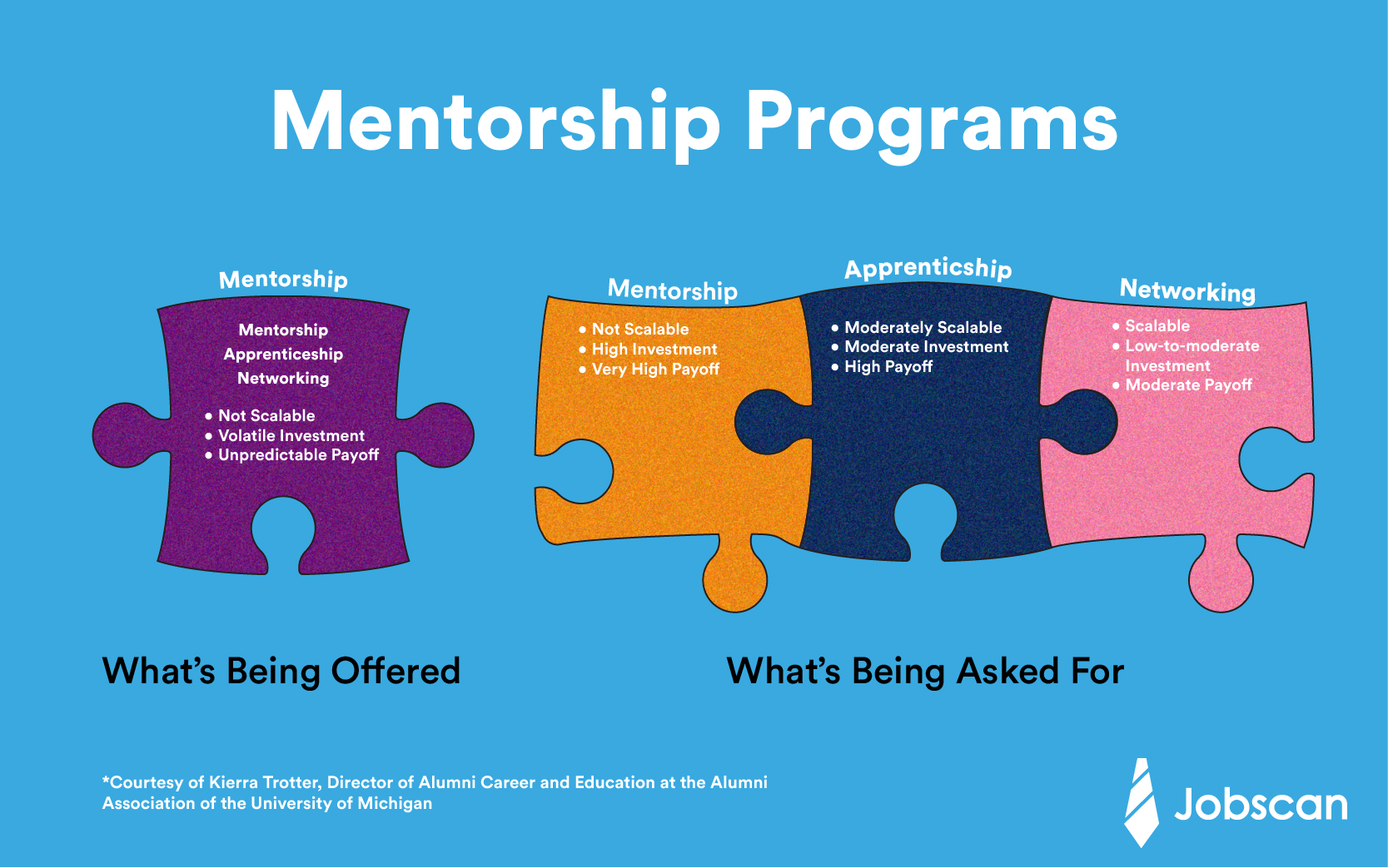
It is important to consider what your mentorship program approach will be. If you attempt to blend all three approaches, you run the risk of a program that is difficult to implement, measure, and yields unpredictable (often disappointing) outcomes.
Types of Mentorship Programs in Higher Education
Career centers can incorporate various types of mentorship within their offerings to meet students’ needs at every stage of their college careers. Here are the most common types of mentorship programs in higher education:
• Peer mentors: Peer mentors are typically other students who are selected based on completion of a specified number of credits and maintaining a minimum GPA.
• Faculty mentors: Instructors provide academic and career path guidance to students planning to pursue a career related to the faculty members’ specialty.
• Alumni or professional mentors: Alumni and business professionals can engage and give back by mentoring students toward their career goals.
• Group mentoring: One mentor works with two or more mentees during regular group meetings. An older student could lead a small group of incoming students, a professional could work with a few students heading into a particular industry, or a faculty mentor could give regular academic guidance to pupils in a major.
Targeted Student Mentorship Programs for Retention
Choosing the pool of people to draw from as mentors can be fruitful, but it is also beneficial to consider a program from the perspective of the students you wish to serve.
• First-year student programs: The transition to the academic and social demands of college can be a challenge for many entering students, so providing direction and individual attention can measurably boost retention at this critical time.
• International student programs: Students often need support when integrating into a US institution, so setting up an international student mentorship program can help foreign-born students feel welcome and stay enrolled at your school.
• First-generation student programs: The promise of a college education is more difficult for those without a role model within their family, and the extra encouragement from a mentor has been shown to have a positive impact on persistence and graduation rates.
• Military or veteran student programs: The transition from the military to a college environment can be confusing. Matching students with other veteran students for peer mentoring can provide the academic, social, and career support needed to navigate the process successfully.
• Industry-specific programs: Some professional associations offer mentorship programs for students aimed at rising talent in fields as diverse as interior design, pharmaceutical science, engineering, security, and speech-language pathology. Schools seeking to smooth the transition to jobs for a popular or growing department can also arrange career-specific mentoring to boost student success and institutional reputation.
What Are the Benefits of Student Mentorship Programs?
It’s hard for career center staff to dedicate the time to understand each student’s needs and offer personalized advice. One way to achieve that goal is using tools to make transactional tasks more efficient, like resume optimization tools. Then mentorship programs become impact multipliers. By adding mentorship programs for students, you expand the number of ears and experienced minds willing to help them take the next steps.
Institutionally, mentorship programs can provide:
• Improved student retention and degree completion: Inspiration for a career path motivates undergraduates to study harder and recognize the value of earning a degree.
• Increased graduate employment metrics: With guidance, mentored graduates are more likely to secure jobs in their field of study, which improves graduate employment and salary statistics for schools.
• Campus environment and reputation boosts: Adding a mentoring program positively impacts the campus community and enhances your institution’s reputation for student support and career success.
• Expanded impact for the career center: Mentors add their expertise to your assets and help you reach and involve more undergrads in career readiness activities.
• Community and alumni engagement: Bringing professionals and alumni in to volunteer improves relationships and solidifies support for your university, which administrators appreciate.
Beyond the advantages for students and college career center staff, mentors benefit from a sense of purpose, networking opportunities, and report higher levels of career satisfaction. The mentoring process is a win-win-win, with positive impacts and personal development for everyone involved.
Designing Mentorship Programs for University Students
A good design is based on your approach and the types of program you want to run. Properly structuring, implementing, and monitoring your mentoring program can help you avoid some of the pitfalls that could occur without forethought and attention. Even without extra staff, starting mentorship programs for students is achievable with careful planning.
Step 1: Define Your Objectives
Assess the stages at which your student body will most benefit from mentoring, determine goals and metrics to measure the program’s success, and explore available resources to achieve the objectives. Get buy-in and feedback from administrators and faculty to help define and then support the program.
Again, it’s crucial that you consider the three approaches that make up a strong mentorships program: mentorship itself, networking, and apprenticeship.
For each, you have to consider the desired payoff you want to achieve before you can project the payoff from the entire program. This is because the design of the program and the level of investment that must be put in differ based on which of those three approaches you take.
As Mrs. Trotter adds, “Each approach has a different design, investment level, and payoff. (Not considering that) can result in a misalignment between, 1) what’s being asked for; 2) what’s being offered; 3) what’s possible at scale. If a mentorship program is not aligned on what’s being asked for vs. what’s being offered, you risk building the wrong thing at scale.”
Career services need to be clear and focused on what the desired payoff of their mentorship program is or they may invest too many resources for too little payoff. Low engagement is then certain to follow.
Step 2: Develop and Plan
Determine the program format (group, peer, faculty, or alumni) and the approaches (mentorship, networking, and apprenticeship) to then outline the responsibilities of both mentors and mentees. Develop the activities and structures within the program and set up participant support channels and monitoring protocols.
Step 3: Recruit and Train
Identify the students and particular mentor groups to target and the outreach channels to use to attract a solid base of mentors. Establish clear criteria for program acceptance and outline expectations for participants. Clearly state the benefits of the program and the structure for prospective mentors and mentees. Hold training events to introduce the program and orient all program participants to best practices.
Step 4: Pair Mentors with Students
As you match participating students with mentors, consider the mentors with interests, academic experience, and career goals that will best serve each student. Be flexible in finding solutions and try to match all willing participants with suitable partners.
Step 5: Start the Program and Support Participants
Launch your program and offer guidance to both mentor and mentees throughout the process. Provide clear channels for participants to ask questions and bring issues to your attention for resolution.
Step 6: Continuously Monitor and Assess the Program
Keep track of meetings and activities occurring within the program, both formal and informal. Have participants log their activities and track progress to identify areas where intervention could solve problems to make the process more beneficial. At the end, collect feedback from all participants and track their academic progress and career outcomes. Develop reporting on the program to identify areas for improvement in future iterations and to secure continued support from administration.
Challenges in College Mentoring Programs
Creating mentorship programs for university students is challenging—people vary, expectations can clash, and communication skills are not always as polished as would be ideal. Plus, administering yet another program within the career center can seem like a burden for staff already overwhelmed with their responsibilities. Here are some common obstacles when creating a mentoring program:
Attracting and Engaging Participants
Effectively promoting the program may require some trial and error, but reaching students through mentoring programs can introduce them to the other career services you offer. Finding the right mentors can take creativity and may involve partnerships with community businesses and organizations or with the alumni engagement team.
Finding Staff Time to Manage the Program
Career centers offer a range of services, including resume and LinkedIn profile creation. If some of those tasks can be supported by technology, staff can allocate the time to create a mentorship program that offers a high-impact service and expands the number of students served.
Participant Time Constraints
Students and professionals are often busy, making it seem daunting to add mentoring to their already packed schedules. Spell out realistic time requirements for participants, and lean into the fun and social aspects of the meetings to entice participants to commit to the program.
Mismatched Pairings
Gathering enough information during the matching process to find good mentor-mentee pairs requires time, but it pays off.
Training Participants
Educating both mentors and mentees on the program’s structure and best practices requires effort, but the soft skills involved ultimately help the program succeed and prepare students for professional relationships.
Unclear Objectives or Program Design
Without clear goals and guidelines, mentor meetings may not be productive or lead to a strong mentoring relationship. Structuring the program with clear meeting times, instructions, activities, and expectations can help participants stay on track.
Assessing and Tracking Program Success
Monitoring the program helps keep participants on track, and measuring outcomes proves the value, but it’s challenging for staff to incorporate program management with their other responsibilities. Yet, supporting the program by evaluating and refining it will help meet program goals and provide metrics that boost institutional success and student enrollment, which is a win for both the center and the college.
Why Universities Need Mentorship Programs
Impact matters, so finding the time and attention to add mentoring to the career center programs can make the work you do more productive.
But don’t do it for the sake of it – while university mentoring is one of the most effective ways to help incoming students adjust and find a sense of belonging, it has to be done correctly or you risk inconsistent impact.
If you do want to start or take your program to the next level, consider your approach and give each the proper design and investment they require.
A well-run mentorship program expands the number of people who can help guide students, improve ROI with statistics like higher retention and graduation rates, and impress the administration by raising the college’s reputation as a supportive institution that produces highly employable graduates.