




- A resume profile is a short, 3-to-5 line introduction placed at the top of your resume that highlights your job title, experience level, and top strengths.
- Profiles and summaries often overlap, but a profile is shorter and more condensed, while a summary reads more like a confident, achievement-driven paragraph.
- A strong profile follows four parts: title and scope, one proof point, your signature skill, and target alignment.
- Below you’ll find 10 resume profile examples organized by situation, from recent graduates to senior managers.
- Keep your profile to three to five lines and skip first-person pronouns like “I” or “my.”
- Place your profile directly below your contact information, in a standard text block your ATS can actually read.
- Pick one: a profile or a summary, not both.
You’re filling out a resume template and it says “Profile” at the top, right where you expected “Summary” or “Objective.” Now what goes there?
A resume profile is a short introduction, usually three to five lines, placed at the top of your resume below your contact information. It highlights your job title, experience level, signature strengths, and alignment with the role you’re targeting.
This guide covers the difference between a profile and a summary, when each one earns its spot, and 10 examples organized by situation so you can see what a strong one actually looks like.
What is a resume profile?
A resume profile functions as a snapshot rather than a story. Where a full narrative section walks through your career arc, a profile condenses everything a hiring manager needs into three to five lines they can read in under 10 seconds.
A strong profile typically includes four elements: your target job title (or current title, if it matches), your experience level, two or three signature strengths or areas of expertise, and a signal that you’re aligned with the specific role. Some profiles also work in one quantified result, though that detail shows up more often in summary-style writing.
Because it’s short, a profile works well as a header treatment: sometimes a title line followed by a few keyword-style phrases, sometimes a tight paragraph. Either way, the goal is orientation, not persuasion. For a fuller picture of what belongs near the top of your resume, see our guide to what to include on a resume.
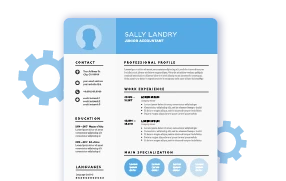
Resume profile vs. resume summary (vs. objective)
Templates use “Profile,” “Summary,” and “Objective” almost interchangeably, and sometimes they really are the same section wearing a different label. But when the distinction matters, here’s how the three break down.

Verdict: If you have solid experience and a metric-worthy accomplishment to lead with, lean toward summary-style writing. See our resume summary examples for the full formula.
If you’re newer to the workforce, or your template simply labels the section “Profile,” the shorter, more condensed format described in this guide does the job.
The two aren’t in competition, and templates fudge the terminology more than recruiters do. What matters is that the section isn’t empty.
How to write a resume profile
A resume profile follows a simple four-part formula:
- Title and scope. Lead with your job title (or target title, if you’re changing paths) and your years or scope of experience. For example, “Marketing Coordinator with 4 years of experience in B2B campaigns.”
- Proof point. One concrete result or credential, kept brief. This isn’t a full achievement paragraph, just enough to establish credibility fast.
- Signature skill. The one or two skills that show up most often in the job descriptions you’re targeting.
- Target alignment. A closing phrase that ties your background to what the employer is looking for.
Writing in first person (“I” or “my”), leaning on vague adjectives without evidence (“hardworking,” “team player”), letting the profile creep past five lines, and copying an example’s exact wording instead of adapting it to your own background.
10 resume profile examples by situation
Each example below follows the four-part formula and stays within the three-to-five-line range. Swap in your own title, numbers, and skills rather than reusing the wording directly.
1. Experienced professional
“Operations Coordinator with 6 years of experience in logistics and vendor management. Cut fulfillment errors by 18% through a process redesign. Strong in inventory systems, cross-team coordination, and vendor negotiation.”
Why it works: It leads with title and tenure, backs that up with one metric, and closes with the three skills most likely to appear in a posting for this role.
2. Career changer
“Aspiring Project Coordinator bringing 7 years of experience managing multi-stakeholder projects in an education setting. Directed a district-wide curriculum rollout across 12 schools. Skilled in scheduling, stakeholder communication, and process documentation.”
Why it works: “Aspiring” signals the transition honestly, while the metric and skill list reframe teaching experience in project-management language.
3. Recent graduate
“Marketing graduate with hands-on experience from two internships in content and social strategy. Grew an internship client’s Instagram engagement by 22% over one semester. Strong in copywriting, scheduling tools, and analytics basics.”
Why it works: It substitutes internship results for full-time tenure and still leads with a measurable outcome.
4. No experience
“Recent business administration graduate seeking an entry-level role in customer operations. Led a 5-person student project that came in under budget and ahead of deadline. Comfortable with spreadsheets, scheduling, and client communication.”
Why it works: With no work history to draw on, coursework and group projects fill the proof-point slot and still tie to a measurable result.
5. Management and leadership
“Senior Operations Manager with 9 years leading teams of up to 25 across two distribution centres. Reduced overtime costs by 14% by restructuring shift scheduling. Strengths in team leadership, budget oversight, and process improvement.”
Why it works: Scope, team size, and number of sites, does double duty as both experience level and proof of leadership capacity.
6. Technical and IT roles
“DevOps Engineer with 5 years of experience automating CI/CD pipelines for cloud-based applications. Reduced deployment time by 35% through a pipeline redesign. Proficient in AWS, Terraform, and Kubernetes.”
Why it works: It leads with the exact tools recruiters and ATS filters search for, alongside a metric that proves the tools were put to use.
7. Part-time or returning to work
“Administrative Professional returning to the workforce after a career break, with 8 years of prior experience in office management and scheduling. Managed vendor contracts for a 40-person office. Skilled in calendar management, Microsoft Office, and client-facing communication.”
Why it works: It names the gap without over-explaining it, then immediately re-establishes credibility with tenure and a concrete responsibility.
8. Customer service
“Customer Service Representative with 4 years of experience in high-volume call centre environments. Maintained a 96% customer satisfaction rating while handling 60-plus calls daily. Strong in conflict resolution, CRM software, and de-escalation.”
Why it works: Volume and satisfaction rate together show both workload capacity and quality, a combination customer service hiring managers look for.
9. Sales and retail
“Sales Associate with 3 years of experience in retail electronics. Consistently exceeded quarterly targets by 15%, including a top-performer ranking in Q3. Skilled in product knowledge, upselling, and POS systems.”
Why it works: Sales roles reward numbers first, and this profile front-loads two of them without wasting a line on soft-skill filler.
10. Healthcare and allied professions
“Certified Medical Assistant with 5 years of experience in outpatient clinics. Reduced average patient check-in time by 20% through workflow adjustments. Skilled in EHR systems, patient intake, and HIPAA compliance.”
Why it works: Certification, workflow metric, and compliance keyword together hit what both recruiters and ATS filters scan for in clinical support roles.

Where the profile goes (and formatting)
Place your profile directly below your contact information and above your work history, so it’s the first content block a recruiter or ATS parser reaches. Keep it to three to five lines. Skip text boxes, columns, and graphics, since many applicant tracking systems can’t parse content trapped inside them.
Stick to a standard text block in your resume’s default font. If you’re not sure your formatting will survive a scan, see our ATS-friendly format guide before you submit.
FAQs
Often, yes. Both sit at the top of the resume and introduce your qualifications. The main difference is length and tone: a profile is shorter and more condensed, while a summary reads more like a confident, achievement-driven paragraph. If your template only offers one section, either format works.
Three to five lines, or two to four short sentences. Long enough to establish your title, experience, and top strengths, short enough that it doesn’t compete with your work history for attention.
No. You should pick one. Including both is redundant and uses up space near the top of your resume that’s better spent on your work history.
The bottom line on profile for resume
Whichever label your template uses, the content underneath it matters more than the heading. Jobscan’s resume summary generator drafts a tailored version from your resume and the job you’re targeting, whether the section above it says “Profile,” “Summary,” or nothing at all.
Want to check how the rest of your resume holds up? Run a free scan first.