




LinkedIn is where recruiters look first: in Employ’s 2024 Recruiter Nation Report, 71% named it the top social channel they use for hiring. Adding your resume gives them one more way to evaluate you, and LinkedIn gives you three places to put it.
There are three ways, and they are not interchangeable:
- Featured section. Puts your resume on your profile, where anyone viewing you can download it.
- Easy Apply. Attaches it to one application, visible only to that employer.
- Resumes and job application data. Saves resumes in your settings to reuse later.
Use the Featured section to be found. Use Easy Apply for one specific job. Either way, tailor the resume to the job description and check it against the ATS first with Jobscan’s resume scanner.
How to upload your resume to LinkedIn: 3 methods
Where each method puts your resume, and who sees it:
| Method | Where your resume lives | Who can see it |
|---|---|---|
| Featured section | On your public profile | Anyone who views your profile, including recruiters searching LinkedIn |
| Easy Apply | Attached to one application | Only the employer you applied to |
| Resumes and job application data | Saved in your account settings | Nobody until you attach it to an application |
Most job seekers want the Featured section, because it is the only method that works when you are not applying to anything.
Save time with an optimized LinkedIn profile using Jobscan’s LinkedIn optimization tool today!
Add your resume to LinkedIn during Easy Apply
If you find a job opportunity with the option for Easy Apply, you can upload your resume when prompted.
To add your resume to LinkedIn during Easy Apply:
Step 1. Search LinkedIn for job opportunities that interest you
Narrow your search with the filters below the search box: job type, salary range, and experience level, among others.

Switch on the “Easy Apply” filter to show only postings that use the feature.

Learn More: Different Ways to Job Search on LinkedIn
Step 2. Click on the job title to open the information panel for the position
The full job post opens on the right side of the screen, with the scope of the role, requirements, location, and other details.

Step 3. Click on “Easy Apply” and fill out the required information fields
LinkedIn asks for your name, email address, phone number, and home address. Complete every required field.

Step 4. Under “Resume,” click the button to upload your resume as a .doc, .docx, or PDF file that’s 2MB or less in size

Step 5. Complete all required fields and submit your application when finished
After the upload there are a few more questions. Check that everything is correct and hit “Submit.”
LinkedIn will send you application updates when the job poster downloads your resume.

Upload your resume to your LinkedIn account
You can save a resume to your LinkedIn account through your settings. Use this method if you apply often and do not want to re-upload the same file every time. To get there from your LinkedIn feed:
Step 1. Go to the navigation bar and click “Me”

Step 2. In the dropdown menu, select “Settings & Privacy”
Open “Settings & Privacy” to adjust your profile visibility, messaging settings, and select your preferences.

Step 3. Under “Data Privacy” on the left-hand sidebar, scroll down to “Resumes and application data”
This is the same area where you set your job seeking preferences, including whether your profile is shared with recruiters and whether your job alerts are visible.

Step 4. Click “Upload Resume” under the “Manage Your Resumes” header

You can save more than one resume here, which makes it easier to keep a tailored version for each type of role. You can also replace or delete a saved resume from the same screen, so check what is stored there before your next application.
Read more: 28 LinkedIn Profile Tips to Supercharge Your Job Opportunities
Attach your resume to your LinkedIn profile (Featured Media section)
Uploading your resume to your profile as “Media” is another option to keep your resume on your profile. This option is also great for uploading a portfolio or project decks alongside your resume.
Step 1. Click “Add Profile Section” from your profile page that sits below your LinkedIn profile picture and LinkedIn headline
“Add Profile Section” is the hub that controls what appears on your profile: education, courses, skills, and the other details recruiters look for. If you already have a Featured section, skip this and use the plus sign inside that section instead.

Learn More: How to Write a LinkedIn Headline (with Examples)
Step 2. In the pop-up, click “Add Featured”
Your “Featured” options include writing posts, adding articles, and sharing links to help frame your profile as an industry expert.

Step 3. Click the plus (+) sign in the upper right-hand corner and choose “Add Media”
Media covers photos, videos, presentations, and documents that prove your experience. It is underrated: it attracts recruiters and separates you from everyone else in your field.

Step 4. Your finder window will open so you can select your resume file to attach to your LinkedIn profile

Recruiters, hiring teams, and other users will be able to see and download your attached resume file. For more ways to use this space, see our guide to the LinkedIn Featured section.

Keep Reading: How to Download Your LinkedIn Resume
Should you add your resume to LinkedIn?
There are some distinct benefits and drawbacks to adding your resume to LinkedIn:
- You gain more exposure and hiring managers can find your resume without applying to a specific job, increasing your chances of inbound job leads.
- Adding a resume can signal that you’re open to new job opportunities.
- LinkedIn can use your resume to give you more targeted job opening recommendations.
- It encourages you to use Easy Apply with your saved resume, so you miss out on the boost that comes from tailoring your resume to the job description.
- You have to upload updated resume files to keep your resume fresh and relevant to the opportunities you’re open to.
The second problem is the one worth solving. If you are reusing a saved resume, run it against the job description first so you know it matches before you send it.
What are the differences between a resume and a LinkedIn profile?
It’s important to remember that your resume and LinkedIn have different purposes.

LinkedIn is more dynamic, a place for storytelling, personalization, endorsements, recommendations, and engaging multimedia. Clair shares that “unlike a resume, which you update periodically, your LinkedIn profile should be continuously updated with new experiences, accomplishments, and skills. This keeps your profile current and shows that you are actively engaged in your professional development.”
Adding your resume to your LinkedIn should enhance your profile, not be an exact copy.

Attach your resume to LinkedIn with the understanding that the two formats aren’t interchangeable. Qourzal suggests you “use your resume to share your brand with one employer with the goal of an interview, and use LinkedIn to communicate your brand far and wide with the goal of a solid professional reputation.” And if your LinkedIn profile is already strong, Jobscan’s LinkedIn resume builder can turn it into a polished resume.
Learn More: How to Write a LinkedIn Summary (with Examples)
LinkedIn resume best practices
When uploading your resume on LinkedIn, it’s still critical to format your resume for the applicant tracking system (ATS). The ATS stores and parses your resume for specific keywords from the job description. Optimizing your resume with the correct format and keywords can help you land the interview.
- Keep your resume concise and direct.
- Use the chronological resume format.
- Highlight relevant skills and experiences.
- Show off measurable results with numbers and metrics.
- Optimize with relevant keywords for your desired role and industry.
- Avoid buzzwords and fluff.
- Leave out headers, footers, tables, graphics, and images.
- Delete irrelevant experience that doesn’t support your desired career trajectory.
Use Jobscan’s ATS-friendly resume templates for a polished document.
Keep Reading: Everything You Need to Know About LinkedIn Certifications
How to optimize your LinkedIn profile
Intentionally and strategically building every section of your LinkedIn profile takes a lot of effort and time, but the ROI is worth it.
Save time with our LinkedIn optimization tool: it shows you what to change in your profile so recruiters find you for interviews.
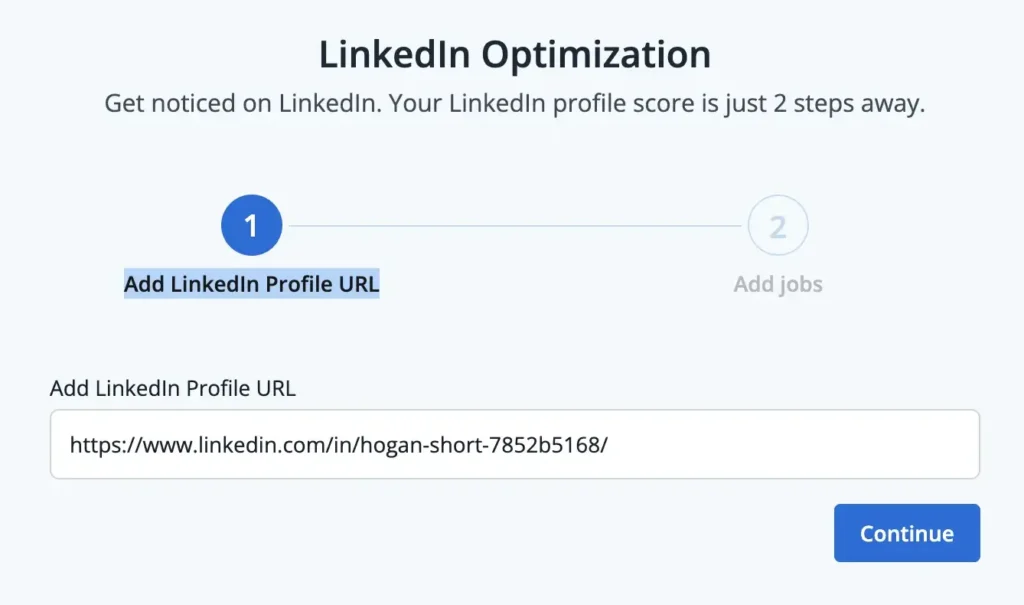
You’ll start with step one: “Add LinkedIn Profile URL.” Just paste your LinkedIn profile URL, add at least three job descriptions, and click “Scan,” shown below.
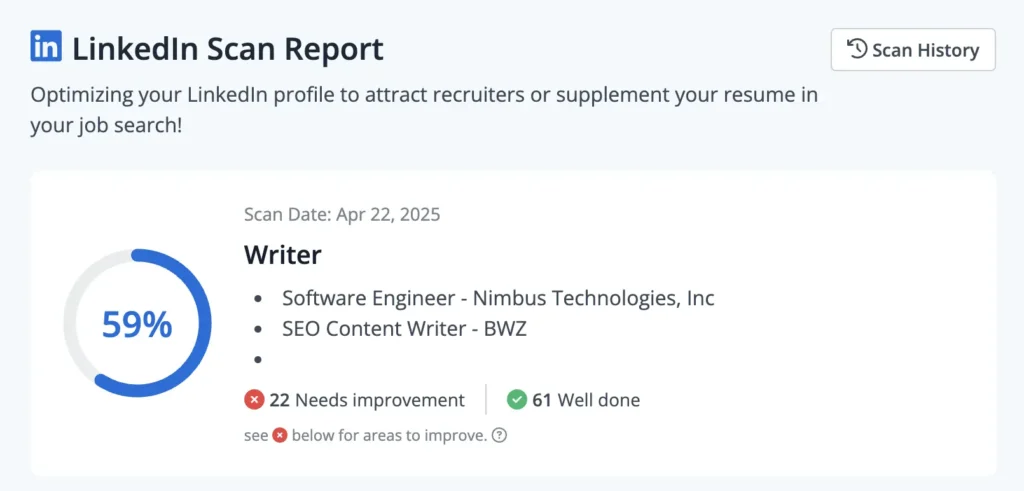
You’ll receive a score that shows how well your profile matches what recruiters are looking for. You’ll immediately see what is optimized, and which areas need improvement.
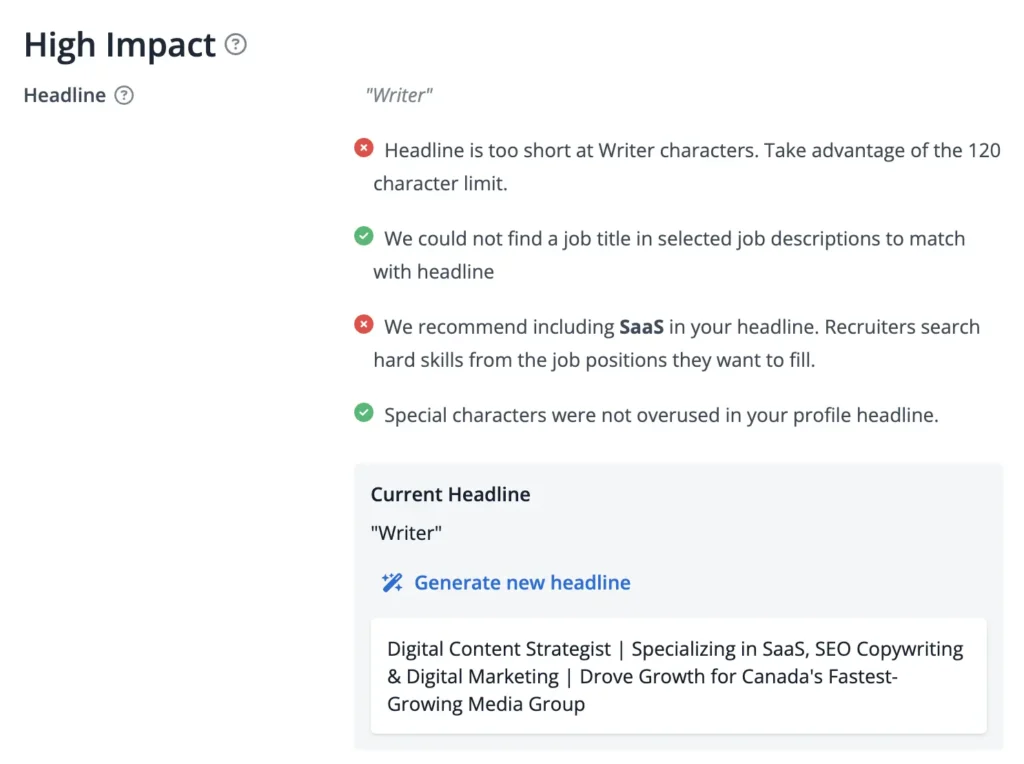
Our AI tools can then help you brainstorm new LinkedIn headlines and LinkedIn summaries. Click the blue button (shown below) for an AI suggested headline to boost your score, or generate an entirely new summary.
The tool also shows you keywords you’re missing, red flags in your work experience section, basic information suggestions, and more. When you’re finished, scan again and see how your score improved. An optimized LinkedIn profile keeps your presence current and brings recruiter interest to your inbox.
Can you post your resume on LinkedIn without your employer knowing?
Worried your boss might see your job search? LinkedIn offers settings to help you keep things discreet. While not 100% foolproof, these steps significantly reduce the chances of alerting your employer.
- Go to Settings & Privacy > Visibility.
- Turn off “Share profile updates with your network.”
- Under Profile viewing options, choose “Private mode” to browse anonymously.
- In Connections, limit who can see your connections.
- Block or remove specific individuals, if needed.
- Avoid uploading your resume publicly, and use private application uploads instead.
Key takeaways
Three methods, three different jobs:
- Want recruiters to find your resume? Add it to your Featured section.
- Applying to one specific role? Upload it during Easy Apply.
- Applying often? Save versions under Resumes and job application data.
Keep the file under 2MB in .doc, .docx, or PDF format, and tailor it to the job description before you upload it.
FAQs
You can add your resume to LinkedIn in a few ways:
• Featured Section: You can upload your resume directly to your LinkedIn profile by using the “Featured” section. Click on your profile, scroll down to the “Featured” section, and click the “+” icon to add your resume. This makes it visible to anyone viewing your profile.
• Job Applications: When applying for jobs through LinkedIn, you can upload your resume during the application process. This resume will be attached to your application but not visible on your public profile.
• Profile Summary: Some users choose to include a link to their resume in their profile summary. This can be done by adding a link to a cloud storage service like Google Drive or Dropbox.
In most cases, yes. A resume in your Featured section gives recruiters something concrete to evaluate before they contact you, and it works even when you are not actively applying. Just remember that a posted resume cannot be tailored to every role, so treat it as an introduction rather than the version you send with applications.
It depends on how you added it. A resume in your Featured section appears on your public profile, where anyone viewing you can download it. One uploaded during Easy Apply goes only to that employer. One saved under “Resumes and job application data” stays private until you attach it to an application.
If you’re having trouble uploading your resume on LinkedIn, it might be due to the following reasons:
• File Size or Format: LinkedIn only accepts certain file types (PDF, DOC, DOCX) and caps uploads at 2MB. Make sure your resume meets these requirements.
• Technical Glitch: Sometimes, temporary issues with LinkedIn’s platform can prevent file uploads. Try clearing your browser cache or using a different browser.
• Profile Section: If you’re trying to upload your resume directly to a section of your profile that doesn’t support file uploads, such as the “About” section, it won’t work. Use the “Featured” section instead.
To attach your resume to a LinkedIn message:
• Messaging Interface: Open the LinkedIn messaging interface with the person you want to send your resume to.
• Attach File: Click on the paperclip icon in the message box, select your resume file (PDF, .doc, or .docx format), and click “Send.”
Recruiters can only see your resume on LinkedIn if you’ve uploaded it to the “Featured” section of your profile. If you have applied for a job through LinkedIn and uploaded your resume as part of the application process, only the recruiters for that specific job will see your resume. Additionally, your LinkedIn profile itself acts as a resume, providing recruiters with your professional information.
It’s generally recommended to upload your resume as a PDF. PDFs preserve the formatting and are more universally accessible. Word documents (.doc or .docx) can sometimes have formatting issues when opened on different devices or software versions, and they may not look the same as intended.