




Instead of spending your time building a resume or filling out a job application with students, why not empower them with the confidence to network and apply to jobs on their own with a guided job application course?
A job application course won’t replace that crucial 1-to-1 student support, it simply systematizes the most basic and repeatable elements and frees your time up for advanced coaching. And students need it.
DOWNLOAD OUR JOB APPLICATION MASTERCLASS COURSE TO USE AT YOUR INSTITUTION ⬅️
In one of the toughest job markets in 15 years, serving all students can feel like an uphill climb.
The average higher education career center has just seven full-time counselors tasked with helping a graduating class – often in the thousands – enter the workforce at one time. This high ratio (averaging 2,263 students to each counselor and we’ve heard some as high as 3,000:1 on prospect calls) and seasonal swings means that career centers simply can’t serve all students in a meaningful, personal way.
During a typical traditional career counseling session, you spend 30 to 60 minutes walking students through the basics, like how to create a resume and how to apply to a job.
That leaves little time for what students need the most, like industry-specific advice, mock interviews, and recommendations for specific employers or alumni to connect with.
By creating a job application course, you shift many of the transactional tasks that lead you to do repetitive work from the one-to-one approach to the one-to-many approach.
The Ideal: College Career Counseling at Scale
If you could outsource just one of the functions you do repeatedly in a week, like job application practice for students, and instead focus on more high-value activities in counseling sessions, you could ease your workload while improving job-seeker outcomes.
To teach the basics at scale, create a structured job application course and coaching program for a one-to-many approach.
Why You Should Create a Job Application Course
A course focused on the essentials of job applications gives learners a consistent, repeatable process to follow, freeing up your team for deeper guidance and mentorship. Here’s why you should consider it.
1. It’s flexible and accessible
Research shows that scheduling conflicts are one barrier to students seeking career services. An asynchronous program increases access and gives them the flexibility to work around classes, shifts, and caregiving. This can help reach the approximately one-third of students who never set foot in their career services office.
2. It’s time efficient
By creating a repeatable program, you can significantly reduce the time you spend answering common questions and demonstrating how to apply for a job over high-value coaching time.
3. It’s scalable and repeatable
Creating a course takes time upfront, but once it’s developed, it’s infinitely scalable. If you spend 50 hours developing a course that takes students five hours to complete, 10,000 students can complete that course and gain job application practice— a feat that would have taken you 50,000 hours in 1:1 sessions.
First Things First: How To Get Students to Join Your Job Application Course
It’s difficult to get students to do, well, most things.
It’s important to remember, this isn’t a fault of students – it’s a difference in understanding their priorities.
Students are not walking around campus thinking only about the things a career center has to offer or what they can learn there.
They’re thinking about more complicated, nuanced things.
Whether they chose the right major.
Whether AI has taken the job they thought was waiting for them after school.
Is it possible to get an internship in this field?
The girl who sits behind them in their first period course.
The trick to getting them interested in anything you have to say is connecting them with the thing they want.
“Your major has some really exciting career paths – and you don’t have to work for that big company everyone in your family has heard of. There are some exciting companies that are looking for skills you have – we can really put those skills on the forefront, but we have to know how to do that and that’s where this Job Application Course comes in.”
If you can connect your course – or any programs you offer – to their inner desires, you’ll have firmly slide your foot in the door.
What to Include in a Job Application Course
A job application course should strike the right balance of career exploration, coaching, and practice. Here’s a sample of what a successful course might include.
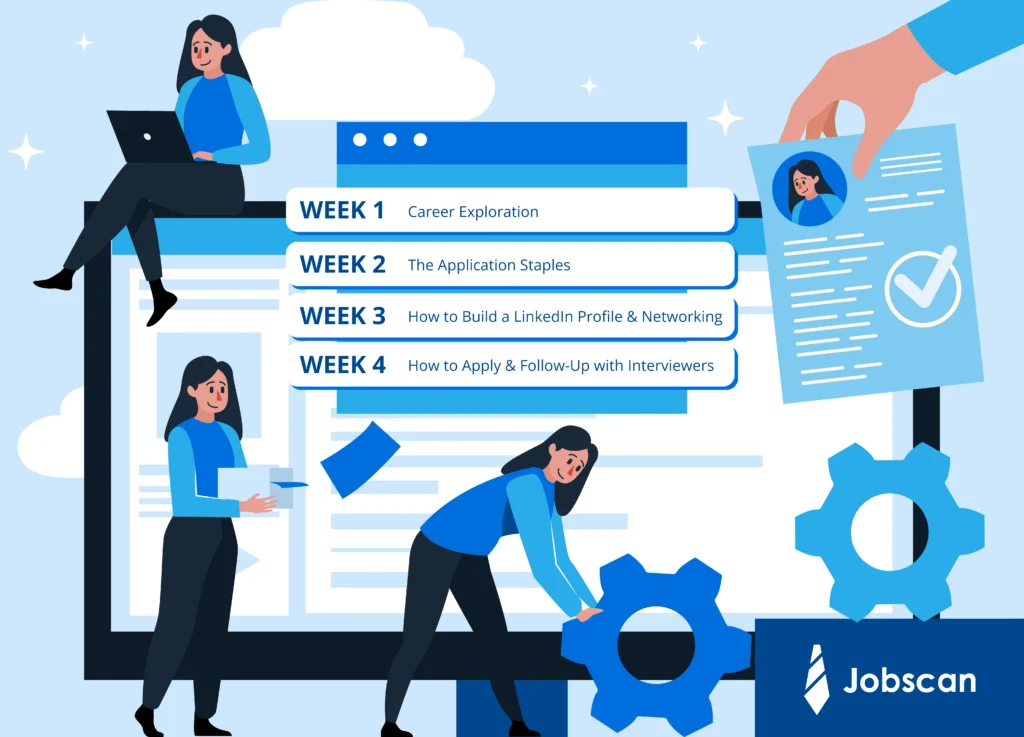
Week 1: Career Exploration
While some college students have known what they wanted to do since high school, others are still in the exploration phase. Offer assessments, interest inventories, and labor market data to guide job-seekers toward careers that align with their values, skills, and goals.
Sample activities:
- Personality and strengths assessments
- Industry research exercises
- Goal-setting worksheets
- Finding target companies through a Google search or other resource
Week 2: The Application Staples
Students often struggle with writing resumes and cover letters that stand out. Teach them how to translate academic experiences into professional language, highlight transferable skills, and tailor documents to specific job postings.
Resumes
Many students struggle with finding the best resume format and determining which skills and experience to include, versus which to leave out. There’s also the matter of ATS: Over 98% of Fortune 500 companies, plus most recruiters, use applicant tracking systems (ATS) to screen candidates. It’s crucial to provide an ATS optimization tool that so students can see their resume the way an ATS sees it and make appropriate adjustments.
This is also the ideal place to provide them with the tools to get them started.
The real benefit of going through these staples in a course format? The one-to-many approach allows you to get multiplem students through a repetetive task
Cover Letters
Many students are already using AI to write cover letters, but they may not be doing it thoughtfully or correctly. Walk learners through how to write a fantastic cover letter from scratch, provide examples, then how to use AI tools like Jobscan to efficiently customize letters for each job.
Key topics to include:
- Resume structure and ATS optimization
- Writing targeted cover letters that speak to the job requirements
- Best practices for writing a resume and cover letter with AI
- Sample resumes and cover letters
Week 3: How to Build a LinkedIn Profile & Networking
LinkedIn is more than just a digital resume— it’s a networking tool that connects students to recruiters, alumni, and hiring managers during their job search. Guide learners through creating a complete, keyword-rich LinkedIn profile that reflects their personal brand.
Key topics to include:
- Crafting a compelling LinkedIn headline and summary
- Showcasing projects and coursework
- Sending an introductory note when adding contacts
- Requesting recommendations and endorsements
- Using a LinkedIn optimization tool
- Tactics, tips and tricks
- Encourage students to learn from an expert like Jeremy Schifeling of The Job Insiders (author of Linked: Conquer LinkedIn. Get Your Dream Job. Own Your Future.Week 4: Interview Prep and Practice)
Interviewing is a skill, and practice makes perfect. 1:1 interview practice sessions are highly valuable, but also highly time-intensive. A course can integrate mock interviews, role-play scenarios, and feedback loops so students feel confident walking into any interview.
Sample activities:
- Answering behavioral and situational interview questions
- Using the STAR method (Situation, Task, Action, Result)
- Sample job applications and listings
Week 4: How to Apply & Follow-Up with Interviewers
The final week should focus on the actual application process. Walk students through online systems, common pitfalls, and best practices for staying organized and proactive.
Key topics to include:
- How to fill out a job application for students (both by hand and digitally)
- Tracking applications and deadlines
- Sending follow-up messages after submitting an application
Bonus Week: Interview Prep
Hopefully, your student is getting callbacks and booking interviews by this point. THe next step is getting ready for the interview.
Having a full week dedicated to interview practice would give students the confidence and competence to deliver when the lights are on. Using AI-powered solutions can give students the most tailored interview based on the contents of their uploaded resumes and the job description they are looking for – asking probing questions like an employer would.
Tools like Jobscan’s new Interview Practice feature give you the ability to make interview practice part of a teaching course.
Lesson Structure and Teaching Methods
Gen Z prefers short, visual content over long lectures or articles. To engage learners, keep your lessons short and visual and vary your teaching formats throughout the course. Limit each content section to five to ten minutes of content, tracking student progress as they complete them. Consider these teaching methods and lesson structures for the best success.
Video Modules and Walkthroughs
Walkthroughs and videos are the most powerful teaching assets you can give students in a course. If there’s something you feel like you need to walk students through for them to “get”, try recording it in a video instead.

Dispel the myth that you need a professional studio to film video content. Instead, use Loom or a similar tool to record yourself walking through a process with a screenshare. You can also record quick presentations on key topics, like how to pick the best resume keywords. Use good lighting and an external microphone to boost the video quality, but again, authenticity wins over polish.
Hands-On Activities
The best way that students can learn how to fill out a job application is by doing it themselves. Provide a way for participants to build resumes, write cover letters, and create LinkedIn profiles during the course. Give unlimited job application practice based on real-world applications.
Weekly Challenges
Gamification is a great way to engage learners and encourage them to complete the course. Assign tasks like reaching out to three connections on LinkedIn or applying to one job.
Knowledge Checks and Feedback
Besides challenges, you can integrate quizzes or other knowledge checks between modules to make sure students are tracking with the content in HVAC. Another way to blend your course with counselor expertise is to have them submit recordings or resumes for feedback, either from AI, your career counselors, or both.
What Technology is Best for Practice Job Applications?
Career centers need a simple tool stack to build a job application course, including an LMS, video recordings, and a job application practice and resume scanner platform like Jobscan. A job application practice tool should be easy to use, with AI-powered feedback and analytics for career service professionals.
Learning Management System (LMS)
An LMS is a platform students can access to access the course material and track progress and completion. Your institution likely already licenses an LMS like Canvas, Moodle, or Blackboard for academics. It’s smart to stick with a tool students already know.
Video Recording and Hosting
If you plan to create videos, think about which tool you want to record them (Zoom, Google Meet, Loom, etc.) and whether your LMS will host them or if you will need a third-party tool.
Job Application Practice for Students
Offer a way for students to practice applying to jobs to give them hands-on learning and help them feel ready to hit the job market.
Look for a tool that simulates the process of applying to a real job by uploading resumes, answering interviewer questions, and tailoring materials. By doing this, students gain hands-on practice navigating application portals and optimizing responses for ATS.
Optimization Tool for Resumes, Cover Letters, and LinkedIn Profiles
In addition to job application practice, students need real-time feedback to get their profiles and assets up to par. Provide a tool where students can plug and play with their real application materials (Jobscan or similar) and receive the instant feedback they need to improve them.
How to Scale Your Coaching Program With Job Application Courses
Don’t be intimidated when creating your first job application course. You can get started by outlining your lessons and leveraging a few simple tools to build it. Be conversational and authentic, just as you would in a 1:1 coaching session.
A job application course doesn’t replace 1:1 student support, it simply systematizes the most basic and repeatable elements and frees your time up for advanced coaching.
Instead of spending your time building a resume or filling out a job application with students, you can empower them with the confidence to network and apply to jobs on their own.