Best Program Coordinator Resume Examples for 2026
Build a Program Coordinator resume for 2026 with real examples, the coordination and budgeting skills employers scan for, and ATS-ready formatting.



Program coordinators keep the moving parts of a program aligned: schedules, budgets, stakeholders, reporting, and the day-to-day logistics that decide whether a program actually delivers. It is a role built on organization and follow-through, and your resume needs to prove both at a glance.
Hiring managers want evidence that you can run multiple workstreams at once without dropping a thread. They look for measurable outcomes (events delivered, budgets managed, timelines hit) and the tools you used to get there. Before a person ever reads it, an applicant tracking system scans your resume for role-specific terms like program coordination, stakeholder communication, budget tracking, and project management software, so those keywords need to appear in plain, accurate language.
The examples below show how to do both. Match your experience to the level and title you are targeting, lead with results over duties, and you will have a resume that clears the filters and earns the interview.
Ready to build yours? Try our ATS-friendly resume builder or scan your draft against the job description.
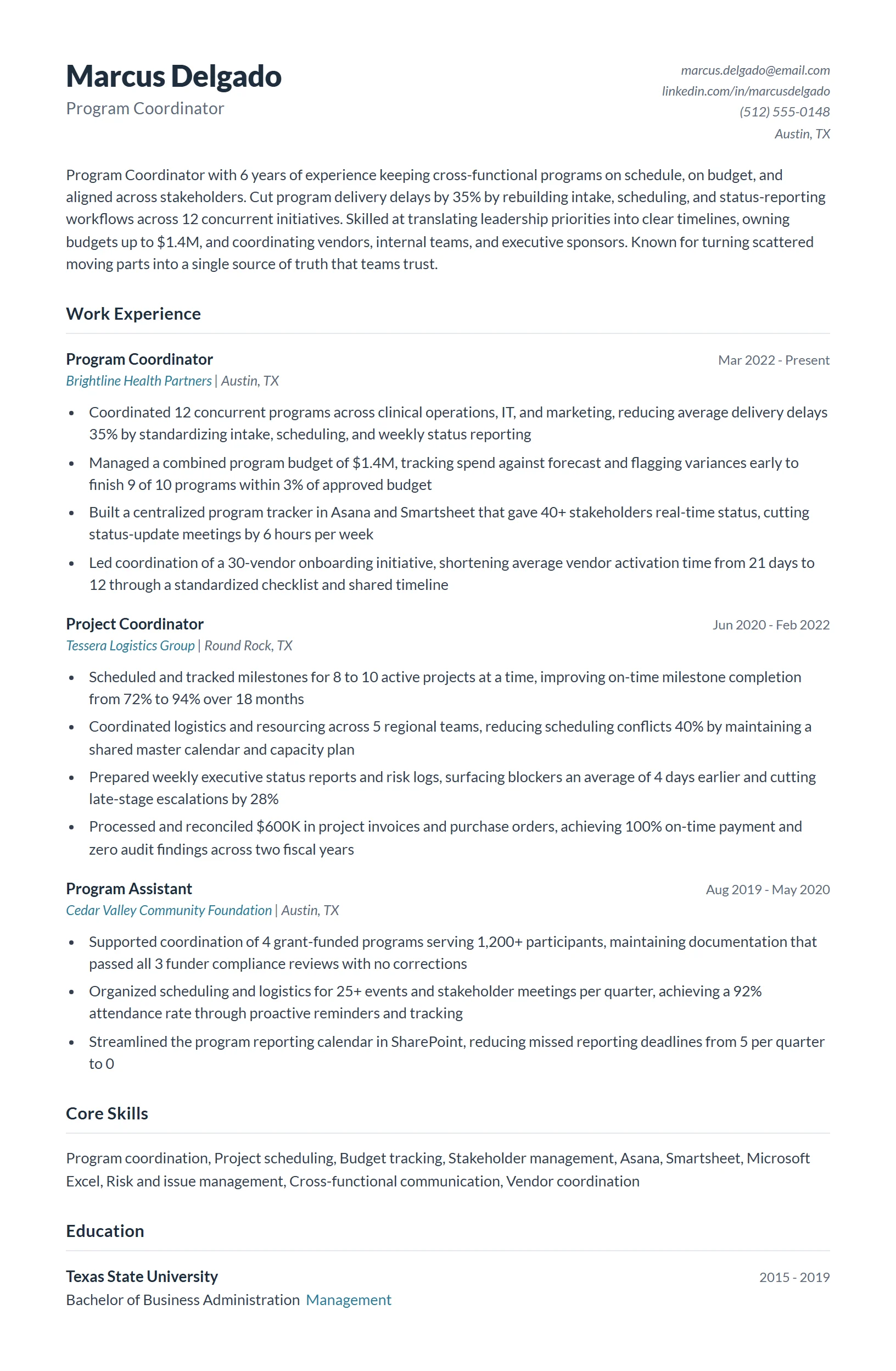
Program Coordinator resume example
A mid-level resume that frames you as the person who keeps a program running end to end, from planning through reporting.
It leads with quantified outcomes (programs coordinated, budgets managed, stakeholders aligned) instead of a list of tasks, which is what separates a coordinator who executes from one who just assists. The skills section pairs hard tools like project management software and budget tracking with the communication and organization terms ATS scanners expect, so it reads well to both the software and the hiring manager.
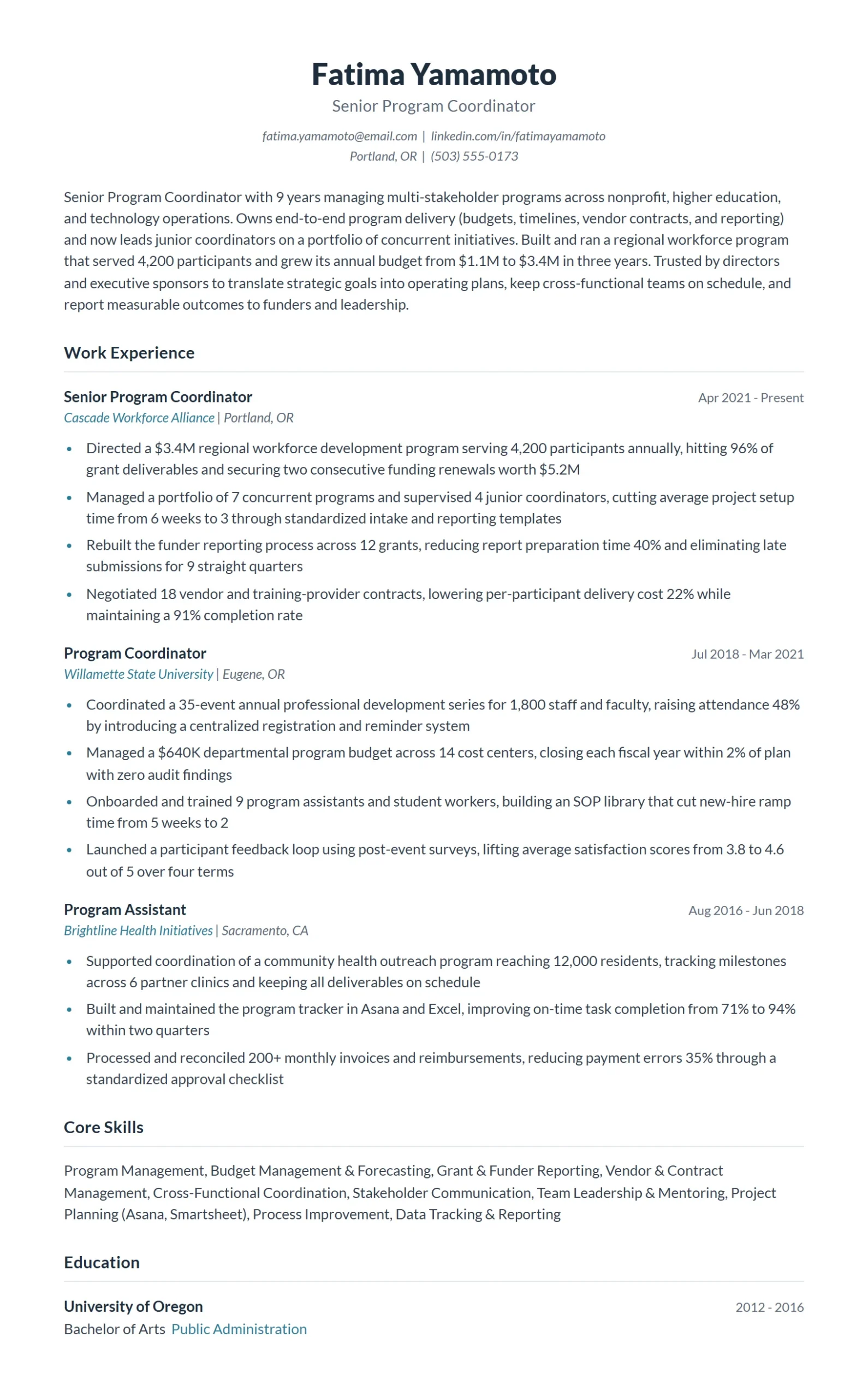
Senior Program Coordinator resume example
A resume for coordinators ready to show ownership of larger programs, bigger budgets, and the people who support them.
It shifts the emphasis from executing tasks to driving results across multiple programs, with metrics on scale (budget size, number of programs, team members supported) that justify the senior title. Process improvements and mentoring of junior staff signal the leadership growth employers look for at this level, without overstating into a manager role.
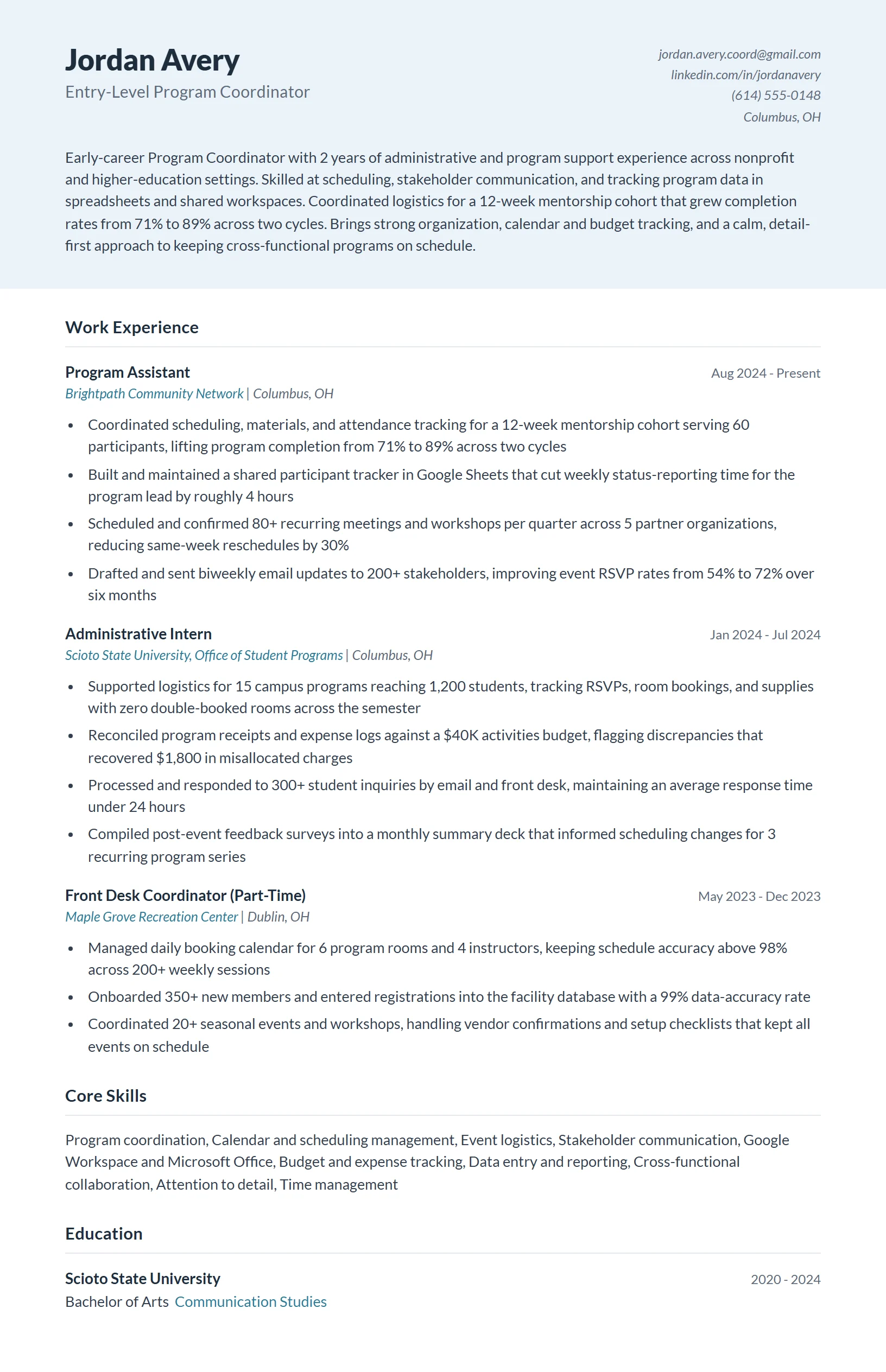
Entry-Level Program Coordinator resume example
A resume for candidates moving into program coordination from internships, administrative work, or adjacent support roles.
It leans on transferable skills (scheduling, event support, document management, stakeholder communication) and concrete coursework, internships, or volunteer work to offset a short job history. A focused summary states the target role clearly and front-loads the keywords a recruiter scans for, so a thinner resume still clears the ATS and reads as ready to step up.
Program Manager resume example
A resume for the step-up role, built around owning program strategy and outcomes rather than coordinating logistics.

It centers on accountability for results, budget authority, and cross-functional leadership, with metrics that prove business impact rather than task completion. Framing past coordination work as program ownership, and naming methodologies like Agile or stakeholder management, positions a coordinator credibly for the next level up.
Program Assistant resume example
A support-focused resume for the on-ramp role that keeps a program’s logistics, scheduling, and documentation in order.

It highlights reliability and detail: calendar and meeting coordination, record keeping, data entry, and clear communication, backed by small but concrete wins. Because it is an entry point to coordinator work, it deliberately mirrors program-coordination keywords so the resume reads as a natural next step rather than a lateral move.
Project Coordinator resume example
A resume for the close sibling role, scoped to defined projects with set deliverables and deadlines rather than ongoing programs.
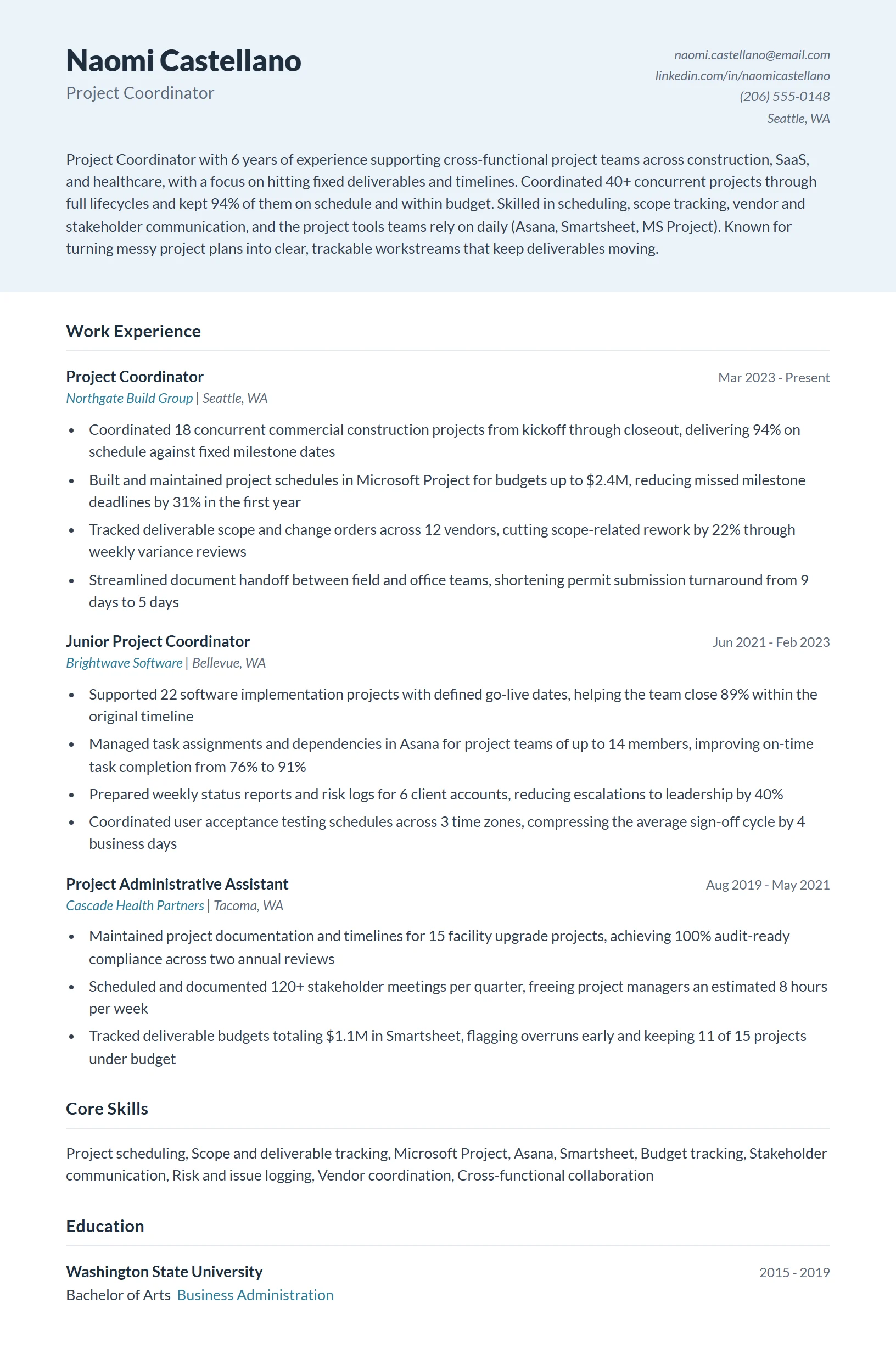
It frames experience around project lifecycle work (timelines, task tracking, status reporting, and tools like Asana or Microsoft Project) to match how project roles are evaluated. Spelling out the project-versus-program distinction in the summary, and matching keywords to the job description, helps the resume land for the specific title without looking generic.
How to write a Program Coordinator resume that gets interviews
A Program Coordinator keeps the moving parts of a program on track: schedules, budgets, vendors, reporting, and the people who need answers. Hiring managers scan your resume for proof you can run logistics without dropping a ball, juggle competing priorities, and communicate across teams that do not report to you. Most employers also run your resume through an Applicant Tracking System (ATS) first, so the wording has to match the job description before a human reads a word. The tips below show you how to do both: clear the ATS scan and convince the coordinator-turned-hiring-manager reading next.
- Lead with the scale and scope you coordinate: “Program Coordinator” means very different jobs at a 5-person nonprofit and a 500-person hospital system. Show your scope in numbers up top: how many programs, events, or cohorts you run, the budget you track, the headcount you coordinate, and the stakeholders you report to. A line like “Coordinated 3 concurrent grant-funded programs serving 1,200 participants on a combined $480K budget” tells a hiring manager in one sentence whether you can handle their workload.
- Quantify the logistics, not just the activities: Anyone can write “scheduled meetings and managed calendars.” Show the result: “Coordinated 40+ events per year with a 98% on-time vendor delivery rate,” “reduced scheduling conflicts 60% by building a shared program calendar,” or “processed 200+ reimbursements per quarter with zero budget overruns.” Coordination is judged on accuracy, timeliness, and things not falling through the cracks, so attach a number to those outcomes wherever you can.
- Name your tools and systems explicitly: ATS scans for specific software. List what you actually use: project tools (Asana, Monday.com, Trello, Smartsheet), CRMs or databases (Salesforce, Airtable), scheduling and comms (Outlook, Google Workspace, Slack, Zoom), and any budget or grant systems (QuickBooks, SAP, Excel pivot tables). If the posting names a specific platform you know, use that exact term. Coordinators live in these tools all day, and recruiters expect to see them.
- Show you manage people and vendors without authority: Coordinators get things done through people who do not report to them: program managers, vendors, volunteers, faculty, clinicians, executives. Use bullets that name the relationship and the result: “Served as primary liaison between 6 community partners and the program director, keeping all quarterly deliverables on schedule.” This signals you can chase down updates, resolve conflicts, and keep stakeholders aligned, which is the real job.
- Highlight reporting, compliance, and documentation: A huge part of coordination is tracking progress and proving it happened. Call out the reports you produce, the data you maintain, and any compliance or grant requirements you meet: “Prepared monthly progress reports for a $2M federal grant, maintaining 100% reporting compliance across 3 audit cycles.” In nonprofit, healthcare, education, and government programs especially, clean documentation and on-time reporting are what separate a strong coordinator from a busy one.
- Tailor to the program type and keep the format ATS-clean: A nonprofit grant program, a corporate training program, and a clinical research program reward different keywords. Mirror the posting: swap in “grant administration,” “event logistics,” “curriculum coordination,” or “IRB compliance” to match the role. Then keep the layout parseable: standard section headings, one clean column, no text boxes or tables that scramble the ATS. Run it through Jobscan to check your match rate against the job description before you apply.

Program Coordinator resume summary examples
Your summary is the first thing a recruiter reads. Lead with your specialty, years of experience, and a quantified win.
Good program Coordinator resume summary examples
- Detail-driven Program Coordinator with 5+ years supporting grant-funded and corporate programs. Coordinated 3 concurrent programs serving 1,200+ participants on a combined $480K budget with zero overruns. Skilled in Asana, Salesforce, and stakeholder reporting, with a track record of keeping cross-functional deliverables on schedule across teams of 15+.
- Organized Program Coordinator specializing in event logistics and partner management for nonprofit programs. Ran 40+ events per year at a 98% on-time delivery rate and cut scheduling conflicts 60% by building a centralized program calendar. Trusted liaison between community partners, vendors, and executive leadership.
- Program Coordinator with a background in healthcare and clinical research operations. Maintained 100% reporting compliance across a $2M federally funded program through 3 audit cycles, and onboarded 80+ participants per quarter while keeping data clean in Airtable and Salesforce.
What to avoid
- Hardworking Program Coordinator seeking a role where I can use my organizational skills and grow with a great team. (It is about what the candidate wants, not what they deliver. There is no scope, no budget, no tools, and no proof of impact. A hiring manager learns nothing they can act on.)
- Detail-oriented multitasker who is passionate about helping programs run smoothly and is a great communicator. (Pure adjectives with no evidence. “Detail-oriented” and “great communicator” are claims anyone can make. It names no programs coordinated, no systems used, and no measurable result, so the ATS and the recruiter both skip past it.)
Program Coordinator resume skills
Mirror the exact tools and program terms in your target job description, then see the Program Coordinator skills page for the full list and how to weave them into your bullets.
Hard skills for a program Coordinator resume
- Program coordination and scheduling
- Budget tracking and reimbursement processing
- Event and logistics management
- Project management tools (Asana, Monday.com, Smartsheet, Trello)
- CRM and database management (Salesforce, Airtable)
- Progress and grant reporting
- Calendar and meeting coordination (Outlook, Google Workspace)
- Vendor and contract coordination
Soft skills for a program Coordinator resume
- Cross-functional communication
- Stakeholder and partner management
- Prioritization under competing deadlines
- Attention to detail
- Problem-solving
Program Coordinator resume work experience bullet point examples
Lead each bullet with a strong verb and a measurable result.
Good bullet point examples
- Coordinated 3 concurrent grant-funded programs serving 1,200+ participants on a combined $480K budget, delivering all milestones on schedule with zero budget overruns.
- Managed logistics for 40+ events per year, including venues, vendors, and materials, achieving a 98% on-time delivery rate and a 4.7/5 average participant satisfaction score.
- Built a centralized program calendar and tracking workflow in Asana, cutting scheduling conflicts 60% and reducing weekly status meetings from 5 hours to 2.
- Prepared monthly progress reports for a $2M federal grant, maintaining 100% reporting compliance across 3 audit cycles and flagging risks before they affected deliverables.
Bad bullet point examples
- Responsible for scheduling meetings, taking notes, and helping with various program tasks as needed. (Vague and duty-based with no outcome. “Various tasks as needed” signals filler work, and there is no scale, no tool, and no result a hiring manager can measure.)
- Helped coordinate events and worked with different teams to make sure things ran smoothly. (No numbers and no specifics. How many events? Which teams? What does “smoothly” mean? Without scope or a measurable result, it reads as a job description, not an achievement.)
- Handled emails, filing, and data entry for the program office. (Reads as clerical, not coordination. It lists low-level tasks with no scale or impact, and misses the chance to show budget tracking, stakeholder management, or reporting that defines the role.)
Program Coordinator resume tips
A targeted resume can move you from the ATS pile to the interview shortlist faster than you think.
- Mirror Job Description Keywords: Copy the exact phrasing the posting uses for tools and tasks (for example, ‘grant reporting’ not ‘funding documentation’ and ‘Smartsheet’ not ‘spreadsheet software’) so your resume clears ATS keyword filters before a human ever reads it.
- Quantify Coordination Impact: Use the metrics that matter for this role: number of concurrent projects managed, budget amounts tracked, event headcounts, vendor contracts overseen, or reporting deadlines met at a specific percentage rate, because these numbers signal scale and reliability to hiring managers.
- List Tools Explicitly: Name every relevant platform you have used, including Asana, Monday.com, Smartsheet, Trello, Salesforce, Airtable, and Google Workspace, in a dedicated skills section so ATS systems can match them directly to job requirements without inferring.
- Highlight Cross-Team Scope: Program coordinators manage people who do not report to them, so note the number of departments, external partners, or stakeholders you supported in each role to show you can drive alignment without formal authority.
- Tailor for Sector Fit: Nonprofits scan for grant reporting and funder compliance while corporations look for budget reconciliation and vendor contracts, so swap in the language that matches the employer’s sector on every application rather than using one generic version.
- Keep It to One Page: Unless you have more than ten years of coordinator experience, a single page with tight bullet points signals the same prioritization skill hiring managers expect you to apply on the job, and it prevents ATS parsers from misreading a sprawling second page.
Pair your program Coordinator resume with a cover letter
A strong resume goes further with a tailored cover letter. Browse our program coordinator cover letter examples to round out your application.
Program Coordinator resume frequently asked questions
Lead with the operational and people skills that run programs day to day: project coordination, scheduling and calendar management, budget tracking, stakeholder communication, and event or meeting logistics. Pair those with the tools you actually use, such as Asana, Monday.com, Microsoft Office, Google Workspace, Salesforce, or a CRM. Mirror the exact skill terms from the job description so your resume matches what the ATS and hiring manager are scanning for.
Quantify the scale and outcomes of the programs you supported, not just the tasks you did. Use numbers like the size of events coordinated, the number of stakeholders or participants managed, the budget you tracked, or the time and cost you saved through better processes. For example, ‘Coordinated logistics for 12 quarterly events serving 500+ attendees while keeping each under a $20K budget’ shows results a bullet like ‘responsible for events’ never will.
Use a reverse-chronological format, which lists your most recent role first and is the format recruiters and ATS expect. Keep it to one page if you have under 10 years of experience, and use clear section headings like Summary, Experience, Skills, and Education. Save the file as a .docx or PDF only if the application allows it, since some older ATS read .docx more reliably.
Match the keywords in the job posting, especially the job title, required tools, and recurring skill phrases, and use them naturally in your experience and skills sections. Stick to a simple single-column layout with standard headings, and avoid tables, text boxes, headers, footers, and graphics that ATS often cannot read. Run your resume through Jobscan to compare it against the job description and see your match rate before you apply.
Choose verbs that signal ownership and organization, like coordinated, scheduled, facilitated, implemented, streamlined, managed, monitored, and liaised. Start every bullet with one of these instead of weaker phrases like ‘helped with’ or ‘responsible for.’ Vary your verbs across bullets so your resume reads as active and specific rather than repetitive.
Highlight transferable experience from internships, volunteer roles, student organizations, or adjacent jobs where you organized events, managed schedules, or coordinated people. Use a strong summary that frames you as an organized, detail-oriented coordinator, and lean on a skills section that lists the relevant tools and competencies the job asks for. Then quantify whatever you can, such as the size of a team you supported or an event you helped run, to prove capability even without the exact title.