Best Construction Project Manager Resume Examples for 2026
Construction project manager resume examples for 2026, all experience levels. Quantify budgets, schedules, and safety with keywords that clear ATS filters.



The role of a construction project manager is crucial in overseeing and ensuring the successful completion of construction projects. This blog will provide professionally tailored resume examples and tips that will help you stand out to employers in this competitive field.
Employers are looking for candidates who can demonstrate strong leadership, cost management, and scheduling expertise.A well-structured resume is essential in securing a job in this high-demand industry.
Ready to take the next step in your construction project management career? Keep reading to discover actionable insights and resume examples that will help you land your dream job!
Construction project manager resume example
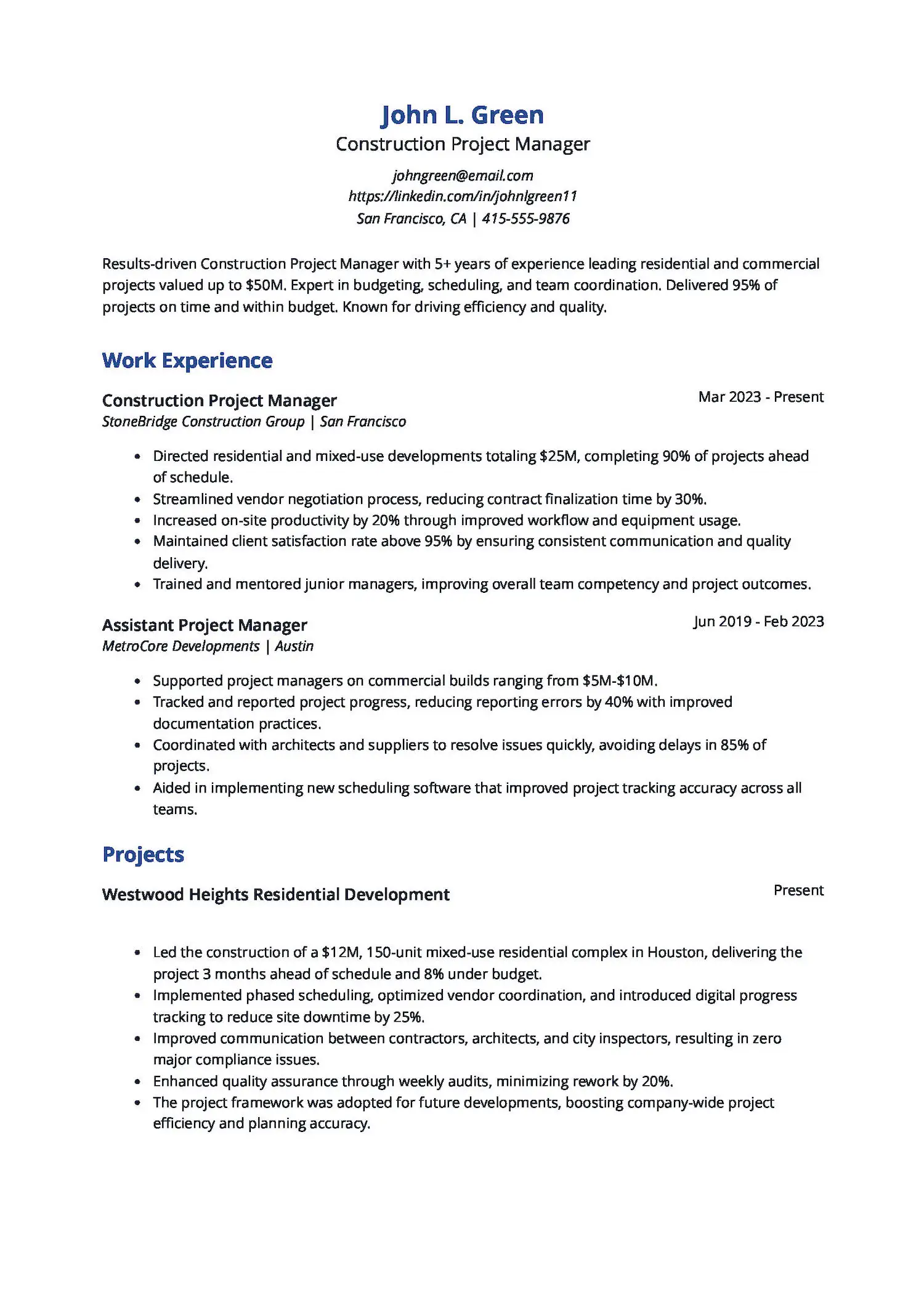
Are you looking for a construction project manager role where you can showcase your leadership and drive results? Wondering how to present your experience in a way that grabs an employer’s attention? This resume example for a construction project manager highlights how strong action verbs and measurable outcomes make a real impact. It demonstrates how to communicate your achievements effectively, leaving employers with a clear picture of your value.

A construction project manager role requires strong leadership, problem-solving skills, and the ability to manage complex projects. Employers look for candidates who can deliver projects on time, within budget, and with exceptional quality. They expect candidates to be proactive, efficient, and results-driven, with a proven track record of improving processes and leading teams to success. This resume captures those qualities perfectly.
This resume template stands out with its clear focus on results. The work experience section uses strong action verbs like”directed” and “streamlined,” showing proactive leadership. Metrics such as “reduced contract finalization time by 30%” and “increased on-site productivity by 20%” highlight the candidate’s direct impact. These details provide a clear picture of how the candidate delivers measurable improvements, making the resume compelling to employers.
Entry-level construction project manager resume example
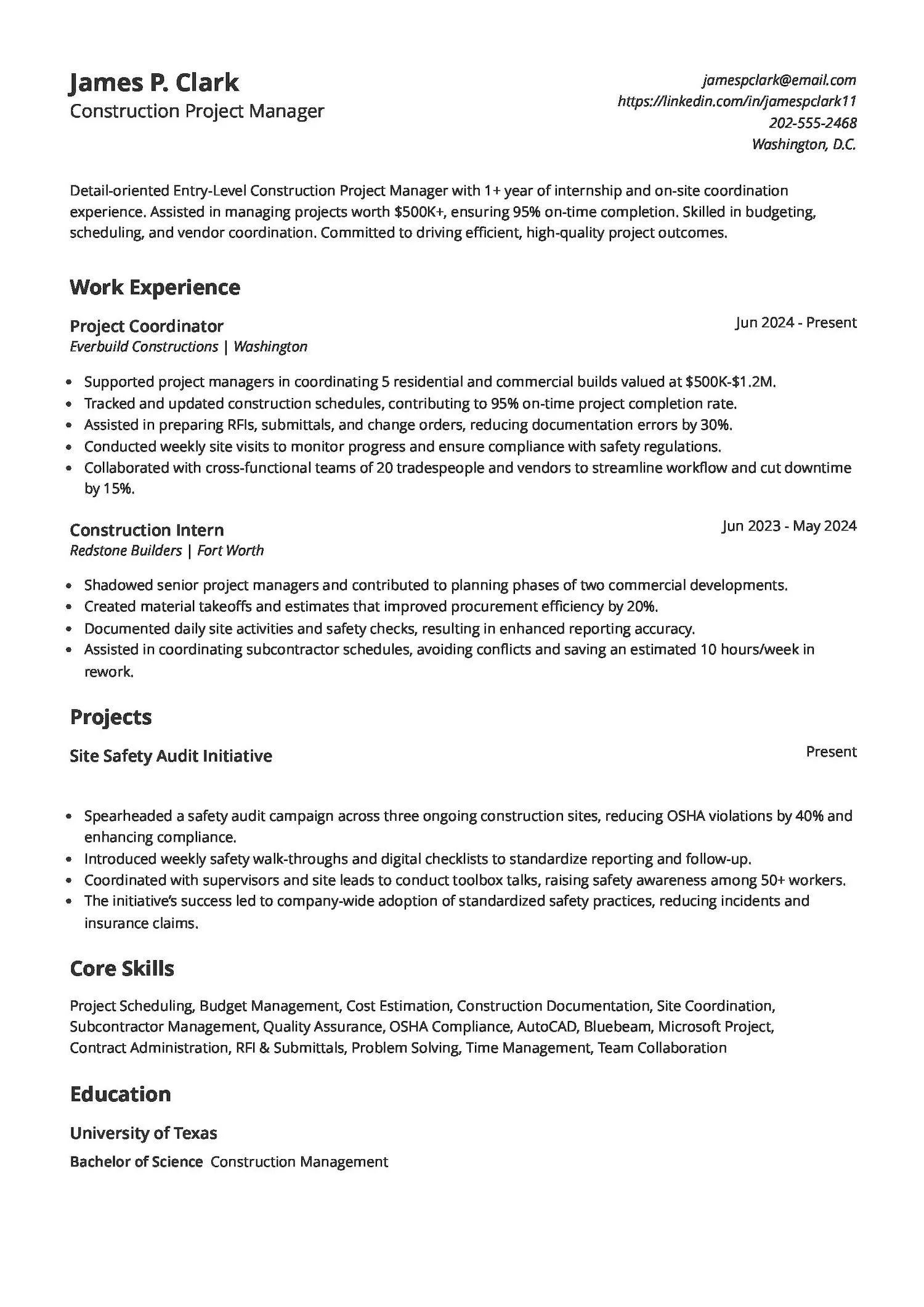
Looking for a job in construction project management but unsure where to start? Wondering how to highlight your internship experience or entry-level skills to land that first full-time position? This resume example is a great starting point. It shows how to showcase your strengths, including project scheduling, budgeting, and site coordination, in a clear and professional way.
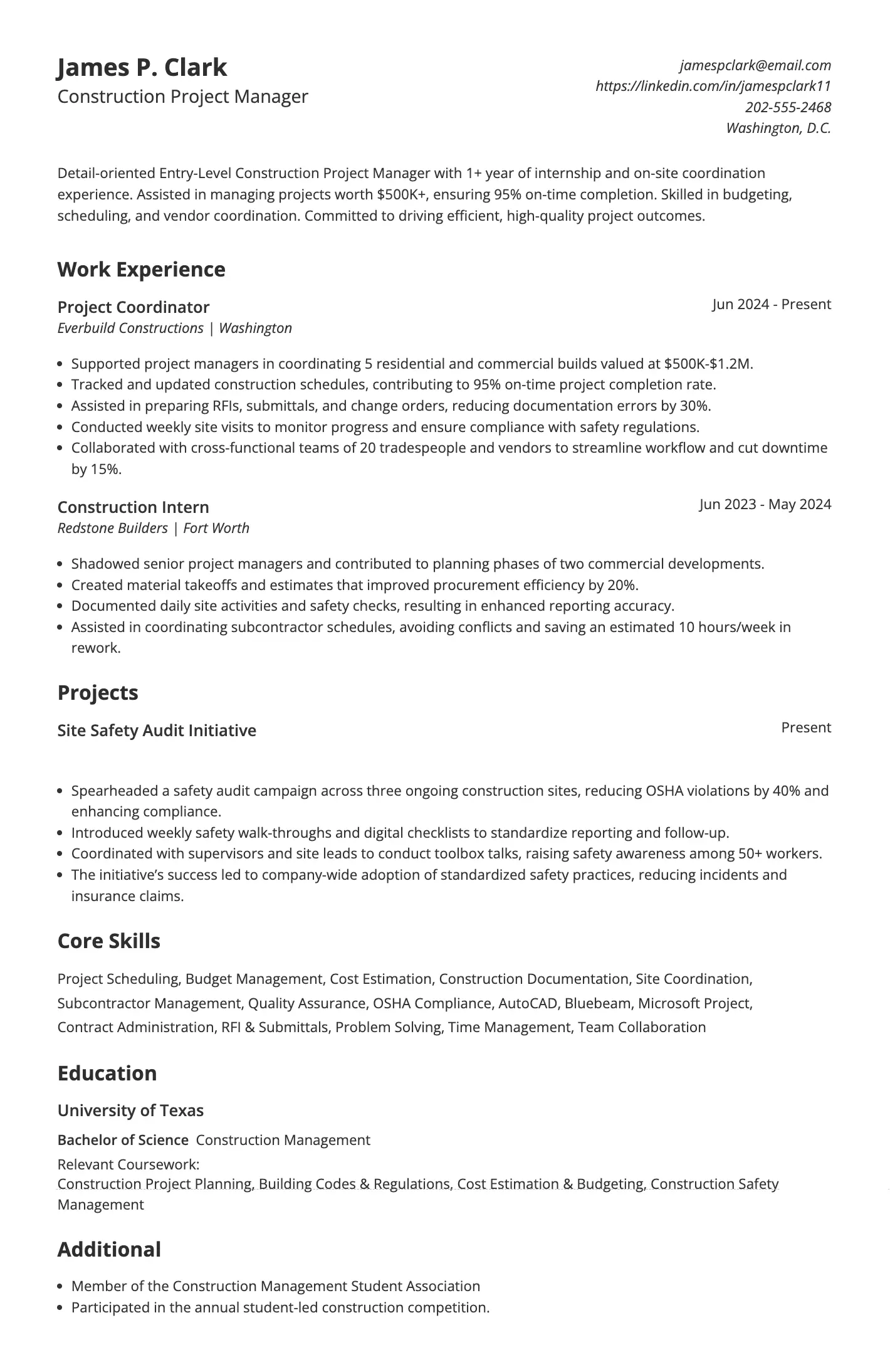
The role of an entry-level construction project manager typically requires excellent organizational skills, attention to detail, and the ability to manage multiple tasks. Employers expect candidates to have solid experience, even if it’s through internships, with strong knowledge of managing timelines, budgets, and safety compliance. This resume illustrates those skills, making it a valuable tool for anyone looking to break into the industry.
This resume is strong for an entry-level construction project manager role. The professional summary quickly highlights relevant skills, such as project coordination and on-site experience. The internship experience is valuable, showing hands-on learning in project management, safety, and budgeting. Employers will appreciate the precise structure, with measurable achievements like the 95% on-time completion rate and process improvements. Overall, it presents a well-rounded candidate ready to contribute and grow in the field.
Junior construction project manager resume example
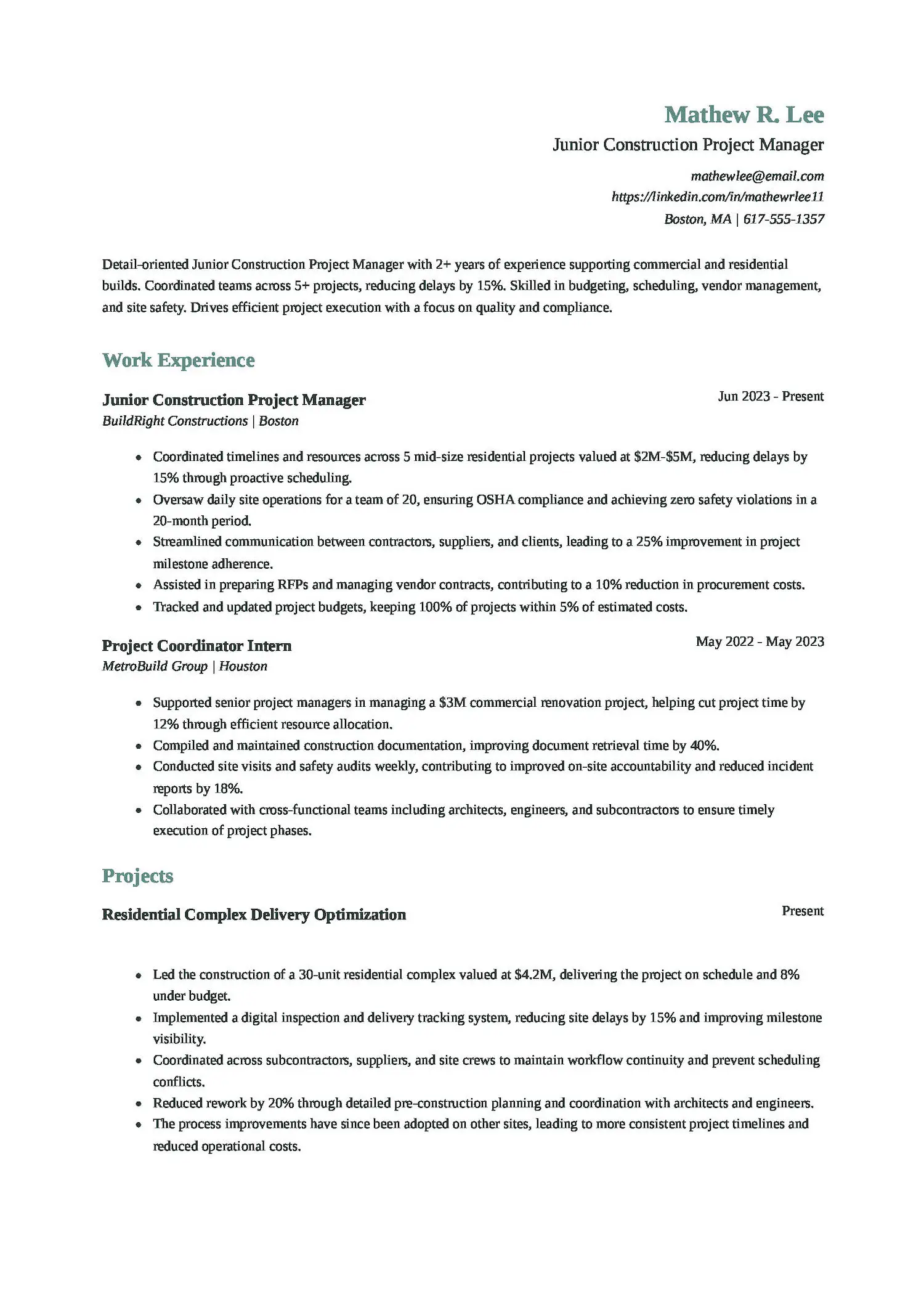
Want to break into construction project management but unsure how to showcase your skills and experience? Does your limited experience hold you back? This resume example can help. It offers a clear, professional format that highlights relevant skills and accomplishments in a way that’s easy to follow.
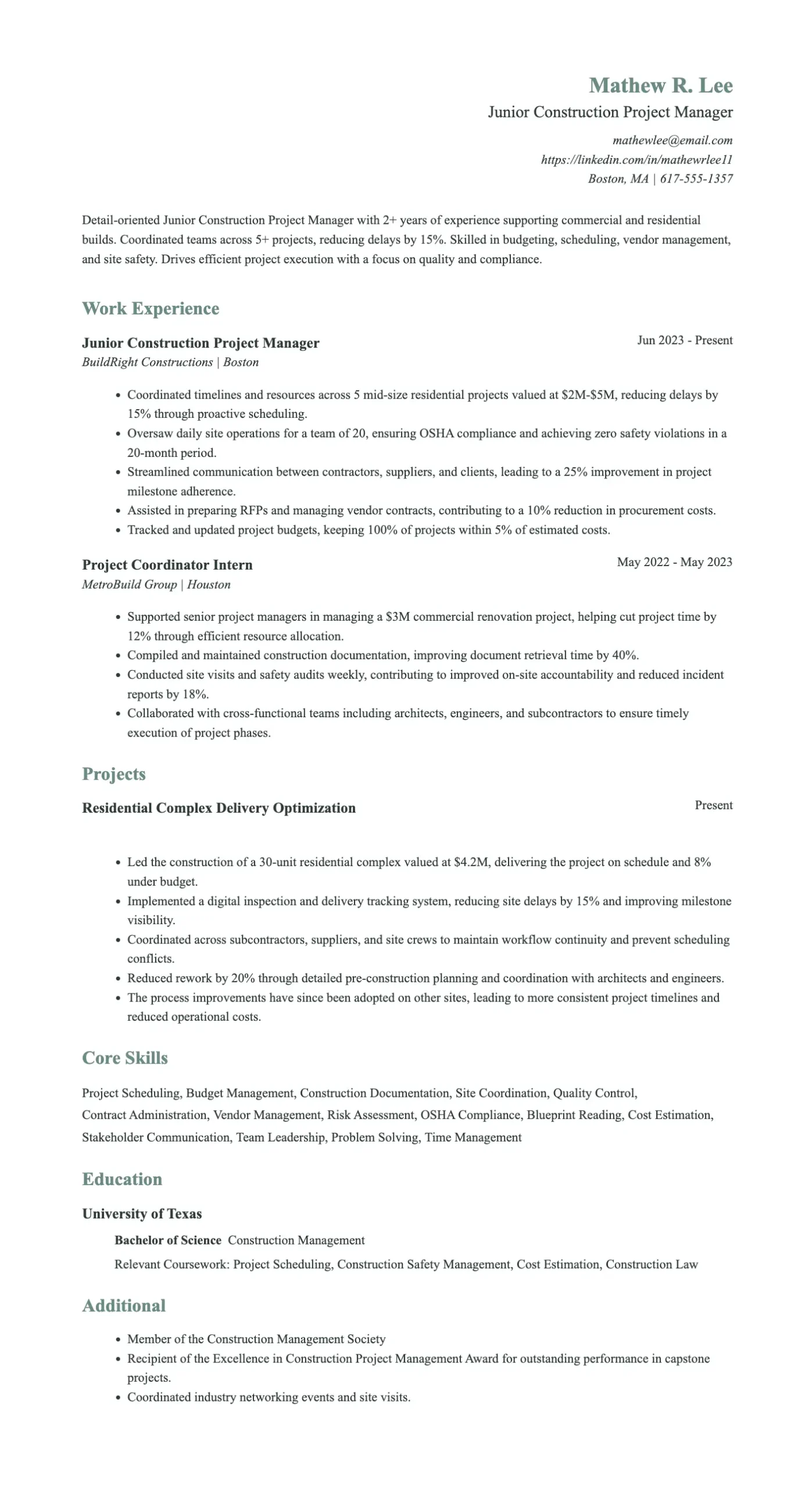
A junior construction project manager role requires attention to detail, solid communication, and the ability to handle multiple tasks in a fast-paced environment. Employers expect candidates to coordinate timelines, manage resources, and ensure projects stay within budget.
By highlighting core skills such as project scheduling, budget management, and vendor coordination, this resume directly aligns with the responsibilities of a junior construction project manager. Despite limited experience, the education section adds credibility, especially with relevant coursework and honors. The resume’s focus on measurable achievements, like reducing delays by 15% and staying under budget, speaks to employers looking for efficiency and results, making it an appealing choice for hiring managers.
Senior construction project manager resume example
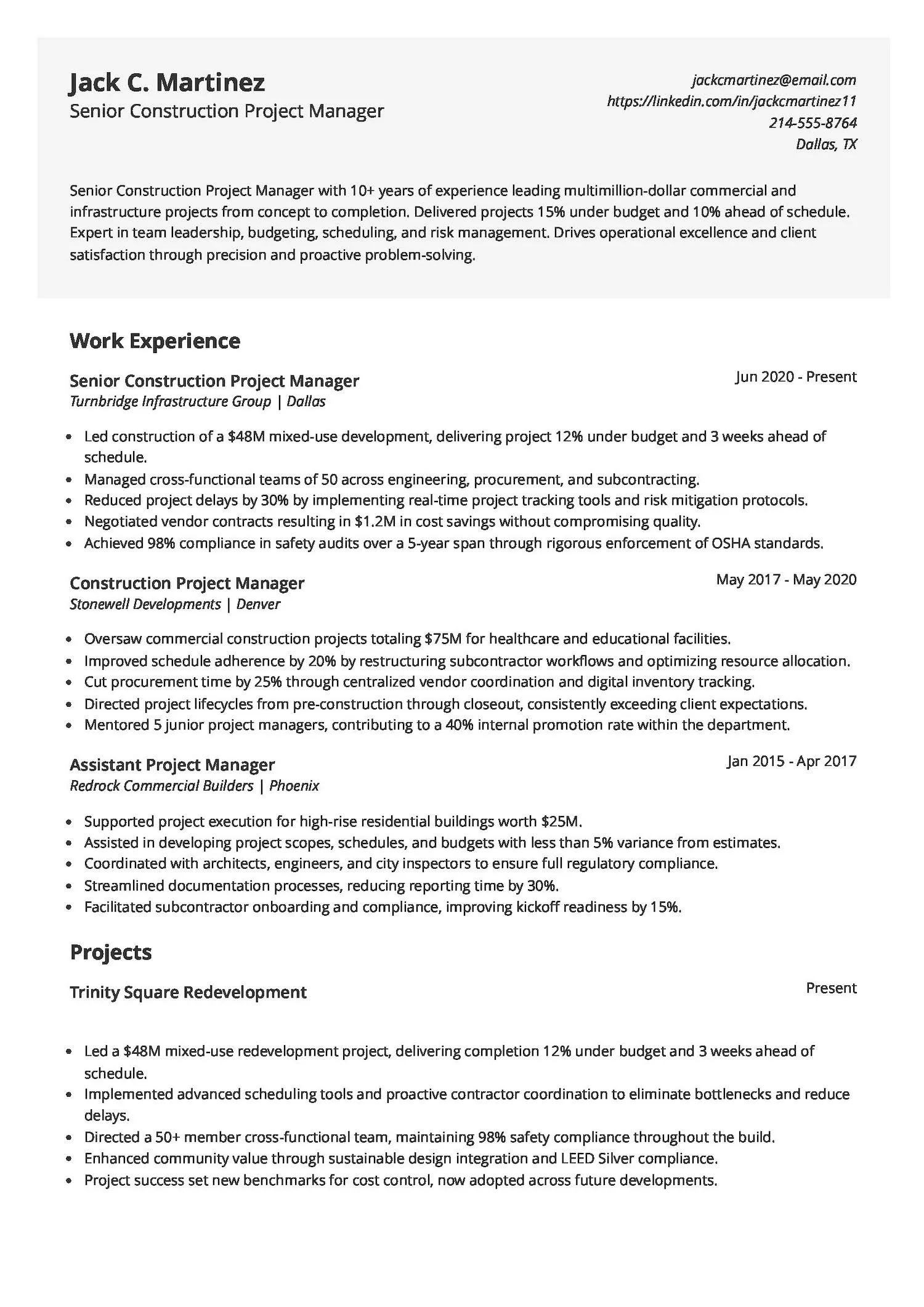
Are you a senior construction project manager looking to take your career to the next level? This resume example showcases the perfect blend of leadership, project management skills, and cost-saving strategies. It’s designed to highlight the value you bring to any construction team.
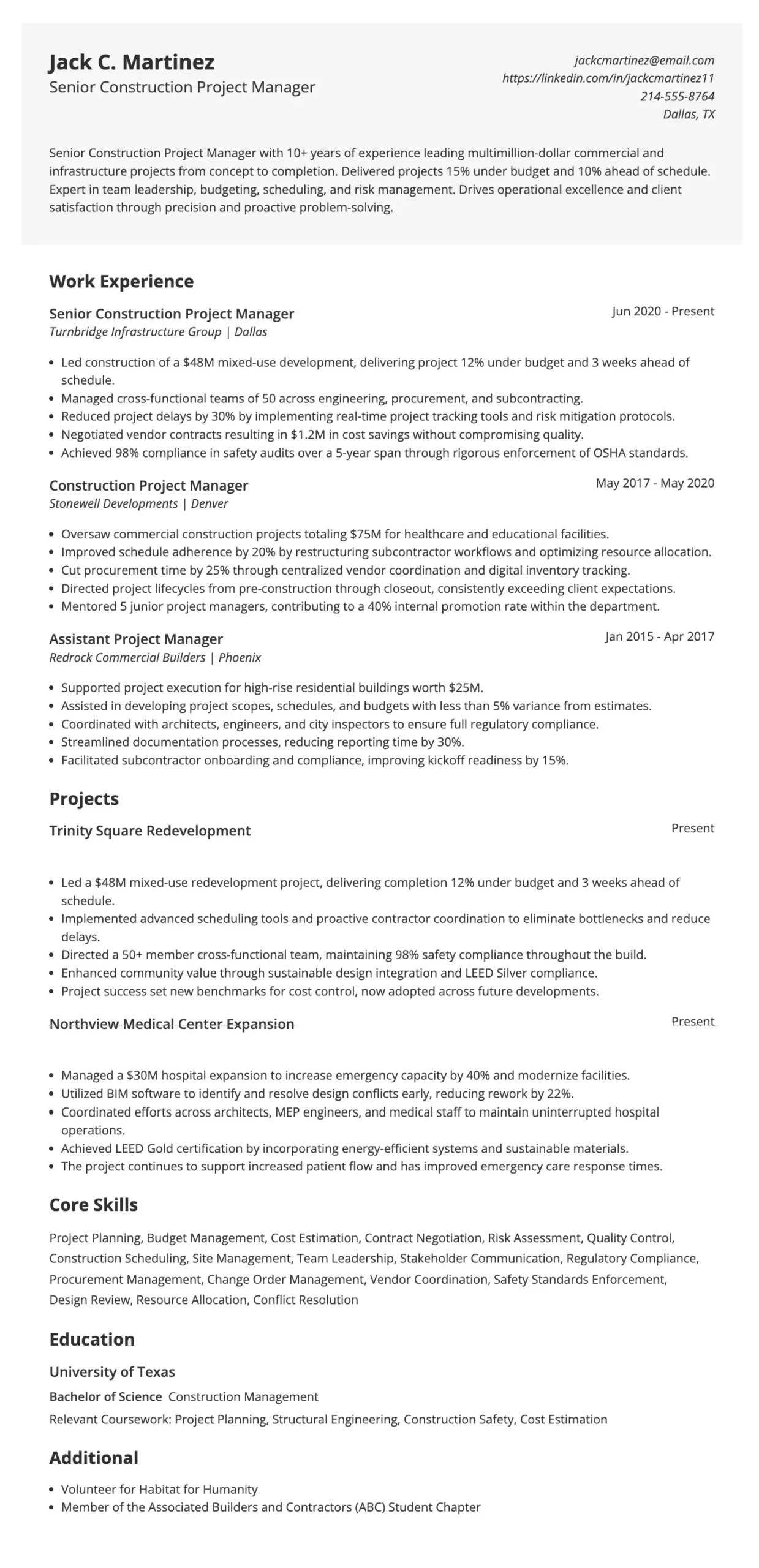
The role of a senior construction project manager requires strong leadership, budgeting expertise, and the ability to manage large, complex projects. Employers expect candidates to have a proven track record of meeting deadlines, reducing costs, and ensuring safety standards. You should be someone who can lead teams, negotiate with vendors, and manage all aspects of construction projects efficiently.
This senior project manager resume is effective for a senior role because it emphasizes relevant experience, especially with a dedicated Projects section. By showcasing high-impact projects like Trinity Square Redevelopment and Northview Medical Center Expansion, it highlights the ability to manage large, complex projects and deliver impressive results. The resume’s clean layout and ATS-friendly format make it easy to navigate, ensuring it stands out to both hiring managers and automated systems. Employers appreciate how it clearly presents leadership, expertise, and measurable success.
Also Read: 10 Best Resume Skills to Put on a Resume
How to write a construction project manager resume that will get you an interview
Breaking into the construction industry or landing your next big project management role takes more than just experience—you need a resume that reflects your leadership, planning, and technical know-how.
Most construction firms, engineering consultancies, and general contractors now use Applicant Tracking Systems (ATS)to simplify the hiring process. Think of ATS as a search engine—if your resume doesn’t include the right keywords, it may never make it to the top of the stack.
For a construction project manager position, hiring teams often search for keywords like “site supervision,” “budget management,” “scheduling,” “project lifecycle,” and “compliance with safety regulations.” Including these terms—where relevant—can significantly improve your chances of being seen.
How ATS works:
- Job posting setup – Employers create listings with specific job titles, skills, and qualifications.
- Resume scanning – The ATS scans each resume, pulling out keywords, experience, and relevant data.
- Searchable database – Recruiters search or filter candidates based on the keywords they’re looking for.
Even if you’re highly qualified, your resume could get passed over if it isn’t optimized for ATS. Using industry-relevant terms and a clean, organized layout makes your resume more searchable—and more likely to land you an interview.
Need help getting started? Jobscan’s free ATS resume builder can help you write a well-structured, keyword-optimized resume that highlights your expertise in project management, construction software, and leadership.

Key elements of a nurse practitioner resume
To make a strong impression, your resume should include the following sections:
- Contact information: Include your full name, phone number, professional email address, city and state, and optionally your LinkedIn profile or professional portfolio link.
- Professional summary: A brief, impactful overview of your experience and what you bring to the role.
- Licensure and certifications: Clearly list your RN and NP licenses, board certifications, DEA registration, and any state-specific credentials.
- Clinical experience: Highlight your relevant roles with details on responsibilities, types of patients served, and settings (hospitals, clinics, etc.) in the work experience section. It serves as a proven track record of your clinical expertise.
- Education: List your nursing degrees in reverse chronological order, including the name of the institution and graduation year.
- Skills: Showcase your core competencies, including clinical skills, technical tools like EMRs, and soft skills like communication and empathy.
- Projects: Mention any quality improvement initiatives, research participation, community health efforts, or clinical projects that reflect leadership or innovation.
- Professional affiliations: Memberships in organizations like the American Association of Nurse Practitioners (AANP) or the American Nurses Association (ANA) can boost your credibility.
Write a strong professional summary
The professional summary is the first thing that hiring managers see and serves as your introduction. In 2–4 sentences, it should communicate your specialty, experience level, and what sets you apart. This is your chance to capture attention quickly, so make it count by tailoring it to the job and emphasizing your strengths.
Below are some examples of both good and bad professional summaries.
Good examples of a resume summary
- “Seasoned Construction Project Manager with over 10 years of experience overseeing commercial and residential projects valued at up to $50M. Proven ability to lead cross-functional teams, control costs, and deliver projects on time and within scope.”
- “Results-driven construction leader with a civil engineering background and 8+ years of experience managing multi-site builds. Skilled in scheduling, safety compliance, and stakeholder coordination, with a consistent record of increasing site efficiency.”
Bad examples of a resume summary
- “Construction manager with some experience. Good with people and can handle projects. Looking for new opportunities.”
- “Looking for a position in construction where I can use my abilities. I have done a few projects and am ready for the next challenge.”
Struggling to write a compelling resume summary? We’ve got you covered. Jobscan’s summary generator makes it easy to create a strong, results-focused summary tailored to your construction project management experience.Just enter your details, and the tool will generate a polished, professional summary that highlights your leadership, project delivery, and technical skills—helping you stand out to recruiters right away.
Demonstrate key construction project manager skills
To make your resume stand out, you need to showcase both your technical expertise and leadership abilities. Hiring managers look for a balance of hard and soft skills (interpersonal skills) that prove you can handle complex projects, lead teams, and communicate effectively.
Hard skills for a construction project manager
- Budget Management
- Cost Estimation
- Scheduling
- Blueprint Reading
- Code Compliance
- Quality Control
- Contract Negotiation
- Procore
- AutoCAD
- Site Supervision
- Risk Management
- MS Project
- Bluebeam
Soft skills for a construction project manager
- Team Leadership
- Communication
- Problem Solving
- Time Management
- Conflict Resolution
- Attention to Detail
- Adaptability
- Client Relations
- Delegation
- Strategic Planning
- Critical Thinking
Effectively weaving these skills into your resume bullet points helps you highlight your accomplishments and show the impact you’ve made on past projects. But listing duties alone won’t cut it—how you present your construction management skills can make a big difference. Let’s look at examples of strong and weak ways to showcase your skills in resume bullet points.
Write impactful resume bullet points for construction project manager
Resume bullet points are the core of your experience section. They should clearly communicate your skills, the impact you’ve made, and the value you bring to a team. Instead of listing tasks, focus on what you accomplished using specific tools, action verbs, and measurable results. Here’s what that looks like:
Good examples of resume bullet points
- “Led a $25M commercial office project from planning to completion, delivering on schedule and 6% under budget.”
- “Supervised on-site operations for a 10-story residential build, ensuring full compliance with OSHA and local building codes.”
- “Implemented a new project tracking system using Procore, reducing reporting errors by 30%.”
- “Coordinated with architects, subcontractors, and city officials to resolve permitting issues and keep project timelines on track.”
Bad examples of resume bullet points
- “Worked on a building site and helped with different tasks.”
- “Managed a team and reduced project cost and tried to stay on schedule.”
- “Used software to track progress.”
- “Did safety stuff and talked to clients.”
Use Jobscan’s resume bullet points generator to create strong, results-driven bullet points tailored to your construction project management experience. Just upload your resume and the job description to your Jobscan dashboard, and the tool will suggest customized phrases that highlight your skills, project achievements, and leadership impact—making your resume stand out to recruiters.
Highlight your achievements as a construction project manager
Hiring managers want to see the real impact you’ve made—not just a list of tasks. Focus on accomplishments that show how you added value to past projects, led teams successfully, saved costs, or improved processes. Use metrics wherever possible to make your contributions clear and measurable.
Here are a few examples:
- “Delivered a $30M commercial retail project two weeks ahead of schedule and 5% under project budget by streamlining subcontractor scheduling and material procurement.”
- “Reduced construction delays by 40% through the implementation of a proactive risk management system and real-time progress tracking with Procore.”
- “Managed a team of 25+ contractors on a high-rise residential development, maintaining a zero-incident safety record for over a year.”
- “Negotiated vendor contracts that cut equipment rental costs by 15%, saving $250K across multiple infrastructure projects.”
Tailor your resume to the job description
Submitting the same resume for every job might seem like a time-saver, but it could be costing you interviews. A tailored resume increases your chances of passing the ATS and catching a hiring manager’s attention—especially in a competitive field like construction project management.
Here’s how to tailor your resume to the job description:
- Analyze the job description: Look for key responsibilities, required certifications, and preferred tools or project types (e.g., LEED, Procore, commercial builds).
- Use the right keywords strategically: Naturally incorporate relevant terms such as “cost control,” “project scheduling,” or “site supervision” into your professional summary, skills, and experience sections.
- Highlight matching experience: Focus on achievements and duties that align with the role—such as leading large teams, managing multimillion-dollar budgets, or ensuring safety compliance.
- Customize your professional summary: Briefly showcase how your background fits the specific project type or management style the company is seeking.
- Adjust bullet points: Emphasize results and metrics that reflect the employer’s priorities—for example, reducing delays, cutting costs, or improving safety records.
- ATS optimization: Stick to clean formatting, standard fonts, and avoid using images or graphics so that your resume is easily scanned by ATS software.
Also Read: The Top 5 ATS Resume Keywords of 2025
Include relevant education and certifications
Your education and certifications show potential employers that you have the foundational knowledge and professional training required for managing construction projects effectively.
Here’s how to present them strategically:
- List your degree, major, and institution clearly (e.g., Bachelor of Science in Construction Management, XYZ University).
- If you’re a recent graduate, include your graduation year and relevant coursework like project scheduling, building codes, or construction safety.
- Experienced professionals should keep this section brief, focusing on degrees and certifications most relevant to senior project management roles.
- If you’re transitioning from another field, highlight coursework or training that aligns with construction management, such as project planning or contract administration.
- Include key industry certifications that show your qualifications and commitment to the profession (e.g., Project Management Professional (PMP), OSHA 30-Hour Certification, LEED AP).
- If you specialize in certain types of projects, such as green building or commercial construction, include certifications that reflect that expertise.
- For senior-level professionals, emphasize widely recognized credentials rather than listing every training session or workshop you’ve completed.
Top construction project manager certifications
- PMP (Project Management Professional)
- OSHA 30-Hour Construction Certification
- LEED Accredited Professional (LEED AP)
- CCM (Certified Construction Manager)
- AIC Certified Professional Constructor (CPC)
Construction project manager resume tips
A polished, well-structured resume helps you stand out in a competitive industry. Beyond listing your skills and professional experience, it should reflect your leadership, problem-solving ability, and success in managing complex projects. Here are some tips to help your construction project manager resume make an impact:
- Keep it concise: Aim for a one-page resume if you have under 10 years of experience. Two pages are acceptable for seasoned professionals managing large-scale projects.
- Quantify your achievements: Use numbers to show the scope of your work—budget sizes, project timelines, team sizes, or cost savings.
- Focus on outcomes: Emphasize results rather than just listing duties. Hiring managers want to see what you accomplished, not just what you wre assigned.
- Use strong action verbs: Start bullet points with impactful verbs like “led,” “delivered,” “negotiated,” “executed,” or “streamlined” to convey ownership and initiative.
- Use clear formatting: Stick to clean, professional fonts and organized sections so your resume is easy to scan, especially with ATS software.
- Tailor for each job: Align your skills and experience with what’s listed in the job description. Use keywords naturally to improve your chances with applicant tracking systems.
- Prioritize certifications and tools: Highlight industry-recognized credentials and software knowledge like PMP, OSHA 30, Procore, MS Project, or AutoCAD.
- Keep language active: Avoid passive phrasing—make every bullet point reflect action and impact.
- Update regularly: Review your resume frequently to ensure your most recent projects, certifications, and tools are accurately reflected.
Also Read: How to Organize Your Resume Sections to Stand Out?
Include a cover letter with your construction project manager resume
A well-written cover letter can set you apart from other candidates by highlighting your leadership experience, ability to manage complex builds, and enthusiasm for the role. While your resume lists your skills and achievements, a cover letter allows you to personalize your application and explain why you’re the right fit for the project and the team.
What to include in your construction project manager cover letter:
- A strong opening: Mention the specific position you’re applying for and express enthusiasm for the company or project.
- Relevant experience: Highlight key construction management skills and achievements that align with the job description.
- Project leadership focus: Emphasize your ability to lead teams, stay on schedule, and deliver projects within budget.
- A compelling closing: End with a confident statement about your qualifications and a request for an interview.
Use Jobscan’s cover letter generator to create a customized, ATS-friendly cover letter that pairs seamlessly with your resume and grabs the hiring manager’s attention.
Write a standout construction project manager resume with Jobscan
A well-structured construction project manager resume can significantly improve your chances of landing your ideal role. By emphasizing your key skills, tailoring your resume to the job description, and showcasing your project management achievements, you can stand out in a competitive field. Don’t forget to pair your resume with a well-written cover letter to leave a strong first impression.
Need help creating a polished, professional resume? Try Jobscan’s ATS resume maker to generate a customized, ATS-friendly resume in minutes. Enter your details and let the tool format your resume to industry standards, helping you get noticed by hiring managers faster.

Construction project manager common interview questions
Answer:
“I start by identifying the root cause of the delay and immediately assessing how it impacts the overall timeline and budget. Then, I meet with the team to realign resources, adjust the schedule, and communicate any changes to stakeholders. For example, when material shipments were delayed on a commercial build, I resequenced work phases to keep progress going and avoided a full stop on-site.”
Answer:
“In every project, as a team leader, I monitored the budget closely from pre-construction to closeout. I use cost-tracking tools and hold regular budget reviews to ensure spending stays on track. On a $12M office complex project, I identified scope gaps early and negotiated vendor contracts that helped save over $300K, bringing the project in under budget.”
Answer:
“I prioritize safety by conducting regular site audits, ensuring all crew members have up-to-date training, and holding daily toolbox talks. I also enforce compliance with OSHA standards and document all inspections. On my last project, we maintained a zero-incident safety record over 18 months.”
Answer:
“On a mixed-use development project, two subcontractors had a dispute over scheduling and site access. I brought both parties together to clarify the scope, adjusted the work sequence, and updated the schedule to ensure fairness and avoid delays. Open communication and documenting agreements helped restore trust and keep the project moving forward.”
Construction project manager resume frequently asked questions
Focus on skills that demonstrate your ability to lead projects from start to finish. These include project planning, budgeting, scheduling, site supervision, risk management, contract negotiation, and familiarity with construction software like Procore or MS Project. Soft skills like communication skills, leadership, and problem-solving are equally essential and should also be included.
List your master’s or bachelor’s degree, major, and the name of your institution. For example, I have a Bachelor of Science in Construction Management from XYZ University. If you’re a recent graduate, you can include your graduation year and relevant coursework. Experienced professionals can keep it brief and focus on degrees and certifications that support their qualifications for the role.
If you’re new to the role, focus on transferable skills from previous positions—such as leadership, time management, budgeting, or team coordination. Include any internships, assistant roles, or coursework related to construction. Highlight relevant certifications like OSHA 30 or PMP-in-progress, and use a strong summary to position yourself as motivated and capable of stepping into a project management role.
Pair your resume with a cover letter
A strong job application includes both. Browse our Construction cover letter examples to write a cover letter that complements your resume.