Best Technical Product Manager Resume Examples for 2026
Technical product manager resume examples for 2026 that show how to pair product judgment with engineering depth and clear the ATS.



A technical product manager sits between product strategy and engineering execution. You own the roadmap, but you also speak the language of APIs, architecture, and data, so your resume has to prove both the business outcomes you drove and the technical fluency that let you drive them.
Hiring managers scan a TPM resume for two things at once: shipped products with measurable impact (adoption, revenue, latency, retention) and the technical scope you operated in (the systems, platforms, and engineering teams you partnered with). The ATS scans for the same signal in keyword form, matching terms like roadmap, API, SQL, Agile, and cross-functional against the job description before a human ever reads your file.
The examples below show how to do both. Use them to frame your experience around outcomes, surface the technical keywords recruiters search for, and build a resume that reads as credible to engineers and compelling to executives.
Ready to build yours? Try our ATS-friendly resume builder or scan your draft against the job description.
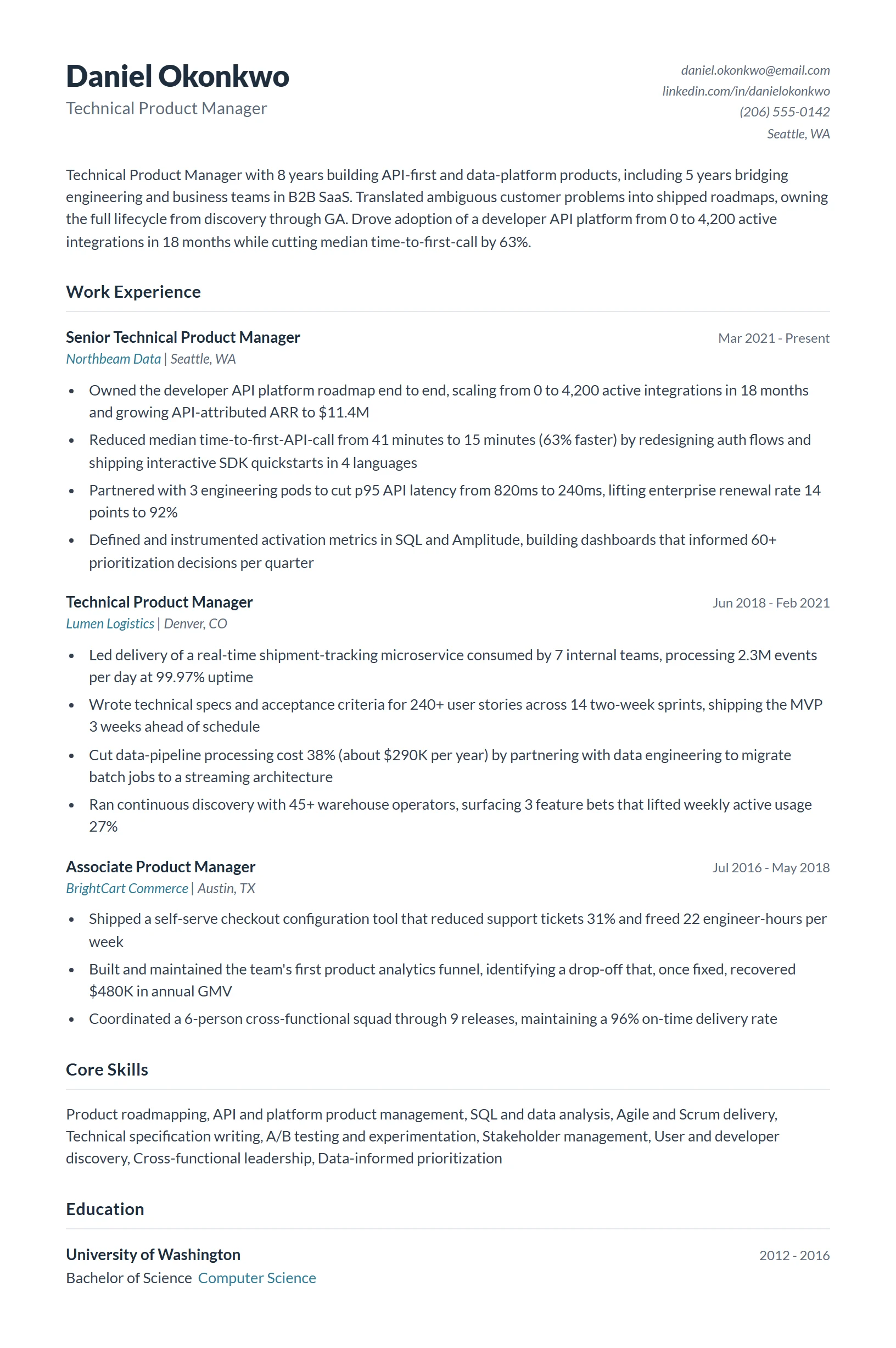
Technical Product Manager resume example
A core TPM resume built around shipped products and the engineering work behind them. It balances roadmap ownership with hands-on technical fluency.
This resume works because every bullet ties a product decision to a measurable result, then names the technical context (APIs, data pipelines, platform work) that made it possible. It front-loads keywords like roadmap, cross-functional, and API so the ATS matches it, while the outcomes prove to a hiring manager that you can ship, not just spec.
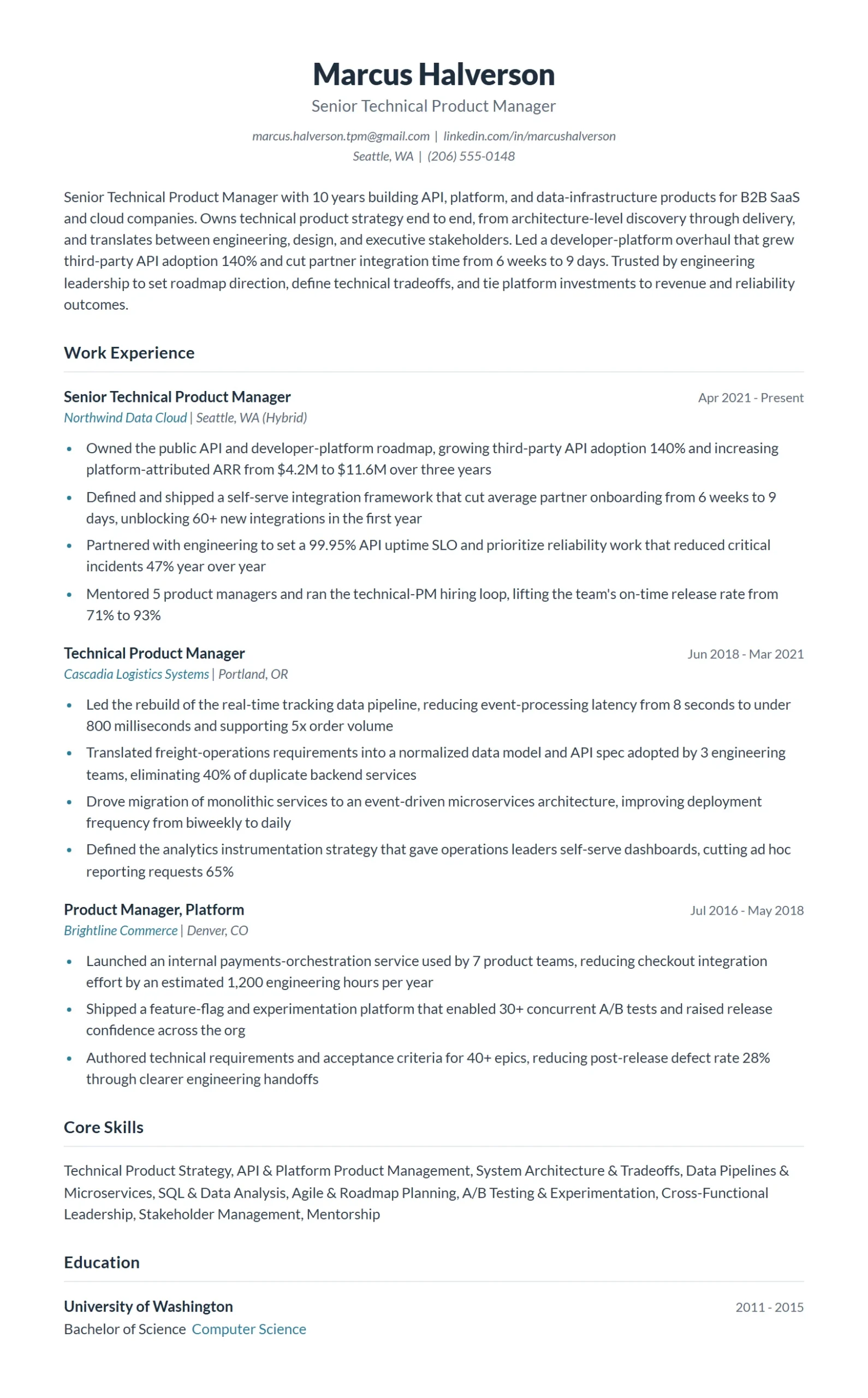
Senior Technical Product Manager resume example
For TPMs stepping into senior scope, this example leads with strategy, ownership of a product area, and the technical decisions that shaped it.
At the senior level, recruiters look for breadth of influence, not task lists. This resume highlights multi-team roadmaps, architecture trade-offs you weighed in on, and revenue or platform outcomes you owned end to end. Leading with scope and impact signals readiness for the title and keeps the ATS fed with senior keywords like platform strategy and stakeholder alignment.
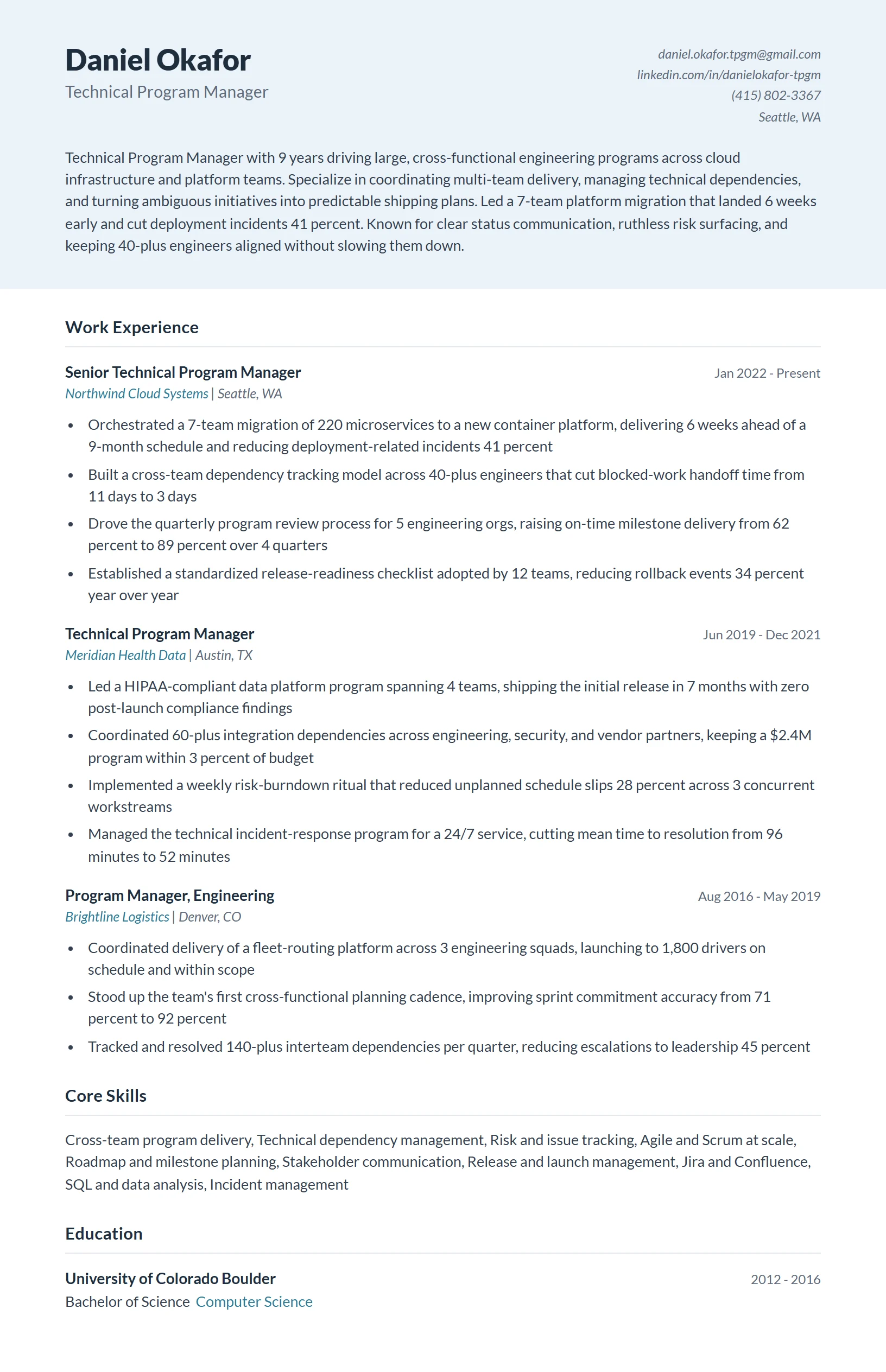
Technical Program Manager resume example
A TPgM resume centered on delivery: coordinating engineering programs, managing dependencies, and shipping complex initiatives across teams.
This example works because it foregrounds the program manager’s real value: driving cross-team execution and removing blockers at scale. It quantifies programs delivered, teams coordinated, and timelines hit, then surfaces keywords like dependencies, risk management, and Agile that distinguish a TPgM from a product-owning TPM in the ATS.
Technical Project Manager resume example
A delivery-focused resume for technical project managers who own scope, schedule, and budget on engineering-heavy projects.

Hiring managers want proof you delivered on time and on budget, so this resume quantifies project size, budget managed, and on-time delivery rate. It pairs PM methodology keywords (Agile, Scrum, stakeholder management) with the technical domain you worked in, which separates a technical PM from a generalist and helps the ATS rank you for the right role.
Technical Product Owner resume example
An Agile-centric resume for product owners who manage the backlog and translate technical requirements into a clear delivery path.

This resume works because it speaks the Scrum team’s language: backlog prioritization, user stories, sprint outcomes, and acceptance criteria. It quantifies velocity and feature impact while loading in keywords like backlog, sprint, and stakeholder so the ATS recognizes a true product owner rather than a generic coordinator.
How to write a Technical Product Manager resume that gets interviews
A Technical Product Manager resume has to prove two things at once: that you can set product direction and that you can go deep with engineering on architecture, APIs, and trade-offs. Hiring managers and ATS filters both scan for shipped products tied to business outcomes, not a list of responsibilities. Lead every bullet with the result, show the technical decisions you owned, and quantify the impact. These tips show you how to do exactly that for a TPM role.
- Quantify product outcomes, not activity: Recruiters skim for impact, so anchor each bullet in a number: adoption, revenue, latency, retention, cost, or time saved. Write “Launched a real-time pricing API used by 40+ internal teams, cutting quote generation from 8 seconds to under 1” instead of “Responsible for pricing API.” If you cannot share exact figures, use defensible estimates or relative percentages.
- Show technical depth without becoming an engineer’s resume: A TPM is judged on technical judgment, not on writing the code. Name the systems you worked across (REST and GraphQL APIs, event-driven architecture, data pipelines, microservices, SDKs) and the decisions you drove (build vs. buy, API versioning, latency budgets, technical debt trade-offs). Keep the focus on the product and business call you made, with the technology as context.
- Mirror the keywords in the job description for ATS: Jobscan data consistently shows TPM postings repeat a recognizable set of terms: roadmap, API, SDL, agile, Scrum, technical specifications, A/B testing, SQL, stakeholder management, and the relevant platform (cloud, mobile, data, or developer tools). Pull the exact phrasing from the posting into your summary, skills, and bullets so you clear the keyword match and rank for the recruiter.
- Lead with the full product lifecycle you owned: Strong TPM resumes show ownership end to end: discovery and customer research, writing PRDs and technical specs, prioritizing the roadmap, running sprints with engineering, and measuring post-launch results. Use bullets that span that arc so a hiring manager can see you drove a product from problem to shipped, measured outcome, not just managed a backlog.
- Prove cross-functional leadership with engineering: TPMs win by aligning engineering, design, data, and go-to-market without formal authority. Call out how many engineers or teams you coordinated, the cadence you ran (sprint planning, technical reviews, launch readiness), and how you resolved conflicting priorities. “Aligned 3 engineering pods and 2 partner teams on a shared API roadmap” reads stronger than “strong communicator.”
- Use a tight, scannable format and a clear skills section: Keep it to one page for under 10 years of experience, two pages beyond that. Put a dedicated technical skills section near the top so an ATS and a recruiter both see your stack in five seconds. Use a clean reverse-chronological layout, standard section headings (Summary, Experience, Skills, Education), and consistent date formatting so parsing stays clean.

Technical Product Manager resume summary examples
Your summary is the first thing a recruiter reads. Lead with your specialty, years of experience, and a quantified win.
Good technical Product Manager resume summary examples
- Technical Product Manager with 7 years shipping developer-facing and data products for B2B SaaS. Owns the full lifecycle from PRD and technical spec through launch and post-release measurement, partnering daily with engineering on API design, scalability, and latency trade-offs. Launched a public REST API now driving 28% of platform revenue and led a migration to event-driven architecture that cut sync errors 64%. Trusted by engineering and executive stakeholders to translate ambiguous problems into prioritized, measurable roadmaps.
- Results-driven Technical Product Manager with 5 years building cloud and platform products. Combines a computer science background with product strategy to own roadmap, technical requirements, and cross-team delivery. Shipped a self-serve onboarding flow that lifted activation 41% and reduced support tickets 33%, and ran the A/B testing program behind a 19% conversion gain. Comfortable in SQL, API documentation, and sprint planning across 3 engineering teams.
- Senior Technical Product Manager with 10 years leading data and infrastructure products at scale. Sets technical product vision, defines API and SDK strategy, and aligns engineering, data science, and go-to-market on a single roadmap. Drove a platform re-architecture that reduced cloud spend $1.2M annually and improved P95 latency 47%, and grew a developer API program to 12,000 active integrations. Mentors PMs and partners with VP-level stakeholders on multi-quarter strategy.
What to avoid
- Hardworking and detail-oriented product manager looking for a challenging Technical Product Manager role where I can use my skills to help a great company grow and succeed. (Objective-style, all about what the candidate wants, and contains zero technical signal, no products shipped, and no metrics. An ATS finds no role-specific keywords and a recruiter learns nothing about the candidate’s actual capability.)
- Technical Product Manager responsible for managing the product roadmap, working with engineers, and overseeing development of new features across multiple teams. (Lists responsibilities instead of results. “Responsible for” and “overseeing” describe a job title, not impact. No numbers, no technical specifics (which systems, what scale), and nothing that differentiates this candidate from every other applicant.)
Technical Product Manager resume skills
Keep your resume skills section tight and tailored to the posting; see our dedicated Technical Product Manager skills guide for the full breakdown and how to phrase each one.
Hard skills for a technical Product Manager resume
- Product roadmapping and prioritization
- Technical requirements and PRD authoring
- API and SDK product strategy
- Agile, Scrum, and sprint planning
- SQL and data analysis
- A/B testing and experimentation
- System architecture and technical trade-offs
- Cloud platforms (AWS, GCP, or Azure)
- Analytics tools (Amplitude, Mixpanel, GA4)
- Product analytics and KPI definition
Soft skills for a technical Product Manager resume
- Cross-functional leadership
- Stakeholder management
- Engineering collaboration
- Clear technical communication
- Data-informed decision making
Technical Product Manager resume work experience bullet point examples
Lead each bullet with a strong verb and a measurable result.
Good bullet point examples
- Launched a public REST API and developer SDK that grew to 6,500 active integrations in 12 months, contributing 24% of net-new platform revenue
- Led the migration from a monolith to event-driven microservices across 4 engineering teams, cutting P95 latency from 900ms to 310ms and reducing production incidents 52%
- Defined the technical requirements and roadmap for a real-time data pipeline processing 2B events per day, shipping it one sprint ahead of schedule with zero rollback
- Ran a 9-experiment A/B testing program on the onboarding flow, lifting trial-to-paid conversion 19% and adding an estimated $740K in annual recurring revenue
Bad bullet point examples
- Worked closely with engineering teams to build new product features and improve the platform. (Vague and unquantified. “Worked closely” and “new product features” could describe any role at any company. No scale, no technical detail, and no measurable outcome for an ATS or recruiter to latch onto.)
- Responsible for the product roadmap and gathering requirements from stakeholders. (States a duty, not an achievement. Starts with “Responsible for,” carries no metric, and gives no evidence the roadmap or requirements led to anything shipped or improved.)
- Used agile and Scrum methodologies to manage sprints and deliver products on time. (Keyword-stuffed but hollow. It names methodologies without showing what was delivered, at what scale, or what business result followed. Process alone is not an accomplishment on a TPM resume.)
Technical Product Manager resume tips
A strong Technical Product Manager resume positions you as the rare candidate who can own a roadmap and debate system architecture in the same meeting.
- Mirror Job Description Keywords: Copy exact phrases from each posting, such as ‘API strategy,’ ‘sprint planning,’ or ‘cloud infrastructure (AWS),’ into your skills section and bullets so ATS parsers score you as a match before a human reads a word.
- Quantify Product Impact: Anchor every shipped feature to a business metric that TPM hiring managers care about: latency reduction (ms), API adoption rates, revenue influenced ($), developer onboarding time cut (%), or engineering cycle time saved (sprints).
- Name the Stack You Owned: List specific platforms and tools you used to make decisions, such as AWS Lambda, BigQuery, or Stripe APIs, because recruiters and ATS systems filter for named technologies, not vague references to ‘cloud platforms.’
- Highlight PRD Authorship: Call out that you authored or co-authored PRDs and technical requirements documents by name, since this single artifact proves you can bridge product vision and engineering execution in a way that separates TPMs from general PMs.
- Add Relevant Certifications: Include certifications that signal both sides of the role, such as AWS Cloud Practitioner or Professional Scrum Product Owner (PSPO), placing them in a dedicated section so ATS systems index them as standalone keywords.
- Keep It Two Pages Maximum: TPM resumes need space for technical context, but cap at two pages and cut any bullet older than ten years that does not show a direct technical decision, because a bloated resume signals poor prioritization to the exact audience that prizes it.
Pair your technical Product Manager resume with a cover letter
A strong resume goes further with a tailored cover letter. Browse our cover letter examples to round out your application.
Technical Product Manager resume frequently asked questions
A Technical Product Manager resume leans harder into engineering fluency: it shows you can speak the language of developers, weigh in on architecture trade-offs, and own technical requirements, not just market-facing features. Keep the core PM signals (roadmap ownership, prioritization, cross-functional leadership) but add concrete technical depth like APIs, data pipelines, system design, or platform work. The bullet points should prove you bridge business goals and engineering reality, which is exactly what hiring managers screen for in a TPM.
List the skills that match the job description and that you can actually defend in an interview. Common ones include SQL, REST and GraphQL APIs, system design, cloud platforms (AWS, GCP, Azure), CI/CD, Agile and Scrum, and analytics tools like Amplitude, Mixpanel, or Looker. Pair the technical stack with product skills such as roadmapping, A/B testing, and requirements gathering so the resume reads as a product leader who is technical, not an engineer who happens to write PRDs. Run the posting through an ATS checker to confirm you are matching the exact terms the employer used.
Mirror the keywords from the specific job description, including hard skills (Agile, SQL, API, roadmap) and the exact job title when it fits your experience. Use a clean, single-column layout with standard section headings like Experience, Skills, and Education, and avoid tables, text boxes, columns, and graphics that scanners misread. Save as a .docx or text-based PDF unless the posting says otherwise. Jobscan compares your resume against the job description and shows your match rate plus the keywords you are missing.
Tie each accomplishment to a metric the business cares about: revenue, adoption, retention, latency, cost, or velocity. Strong examples include “Launched a self-serve API that grew developer signups 45% in two quarters” or “Cut checkout latency 30% by prioritizing a backend redesign with engineering.” Lead with the outcome, then name the action and the technical lever you pulled. Vague phrases like “managed the product lifecycle” carry far less weight than a number a recruiter can picture.
No, but you do need enough technical depth to earn engineers’ trust and make informed trade-off decisions. Many successful TPMs come from engineering, QA, data, solutions engineering, or technical support rather than years of full-time coding. On your resume, surface the technical exposure you do have (writing queries, reading code, owning API or platform features, working in the SDLC) and show how it shaped product decisions. The bar is credibility with the engineering team, not a computer science degree.
Beyond “Technical Product Manager,” target adjacent titles such as Product Manager, Platform Product Manager, API Product Manager, and Product Owner, since roles overlap and recruiters search across them. Weave in the high-value keywords employers list: Agile, Scrum, roadmap, stakeholder management, SQL, APIs, system design, and the specific platforms or domains you know. Tailor these to each posting rather than using one generic resume. Checking your resume against the job description before you apply is the fastest way to find the exact terms you are missing.