Best Technical Writer Resume Examples & Tips for 2025
Need help writing your technical writer resume? Dive into technical writer resume examples, proven tips, and key skills to create a resume that gets you hired in 2025!



The role of a Technical Writer is more critical than ever in 2025, as companies look for clear, concise, and accurate documentation to support their products and services. This blog is here to provide expert-written resume examples and tips to help you stand out in this competitive field and land your next technical writing role.
Employers are seeking candidates with a blend of strong writing skills, technical knowledge, and an eye for detail. A polished resume is your first step to impressing hiring managers and securing that coveted job.
Ready to take your technical writing career to the next level? Keep reading as we dive into actionable resume tips and real-world examples that will help you write a resume that catches the eye of hiring managers. Let’s get started!
Entry-level technical writer resume example
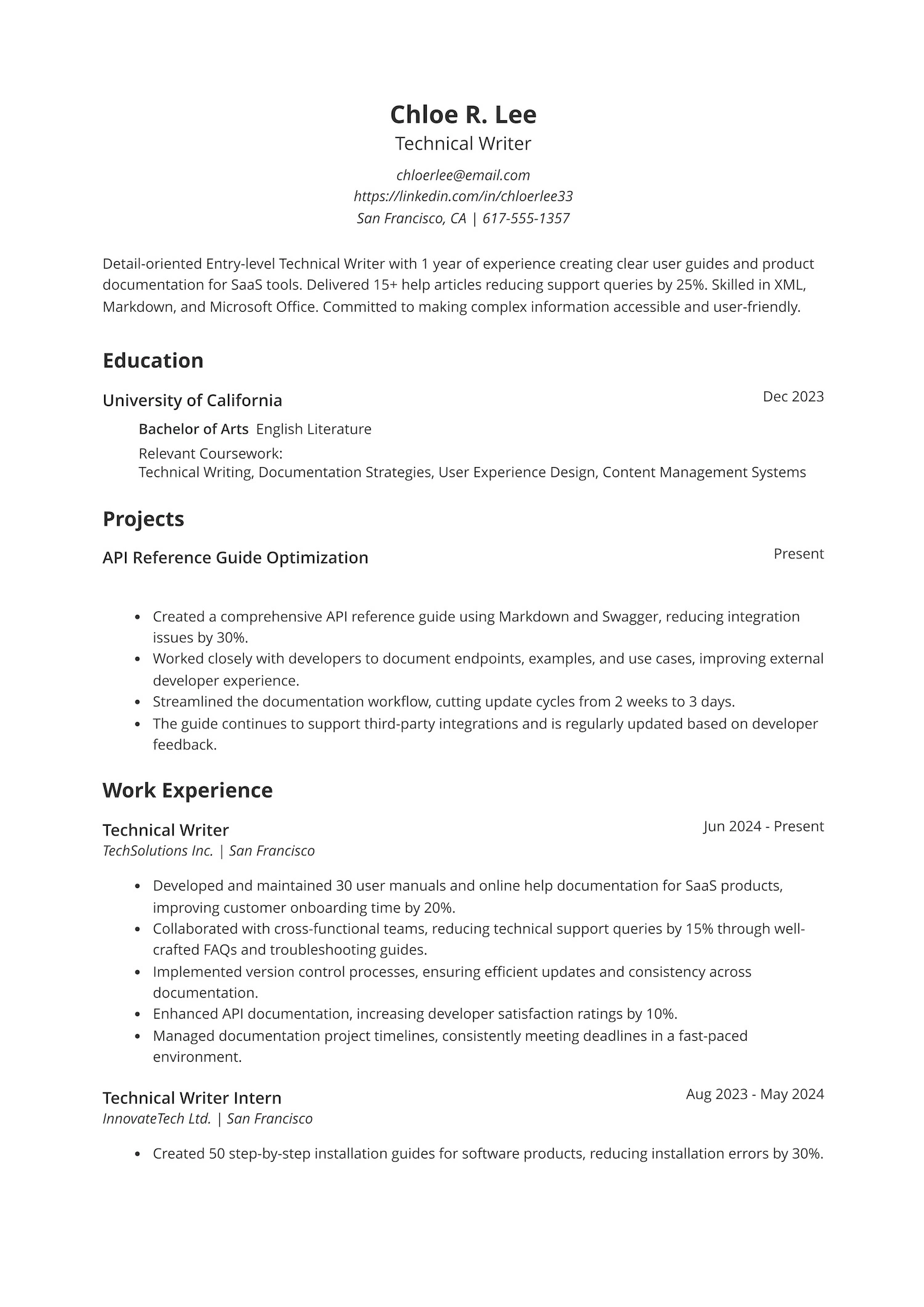
Are you eager to start your career as a Technical Writer? Looking for a role where you can use your skills in content development, documentation, and collaboration to make a real impact? This resume highlights key strengths like creating clear user guides, reducing support queries, and improving onboarding processes—exactly what employers are seeking in entry-level candidates.

In a Technical Writer role, you’ll be expected to create clear, concise documentation that simplifies complex concepts for users. Candidates should be proficient in tools like Markdown and XML, with a strong focus on attention to detail and meeting deadlines. Employers look for someone who can work cross-functionally, manage documentation projects, and improve user experience with well-written content.
This resume template stands out for an entry-level role with a strong professional summary that clearly highlights key skills like technical content development, user documentation, and collaboration. The internship experience adds real value, showing hands-on involvement in creating guides and improving user comprehension. The inclusion of measurable achievements, like reducing installation errors and support queries, appeals to employers by demonstrating impact. This resume effectively communicates a candidate’s potential to contribute from day one.
Junior technical writer resume example
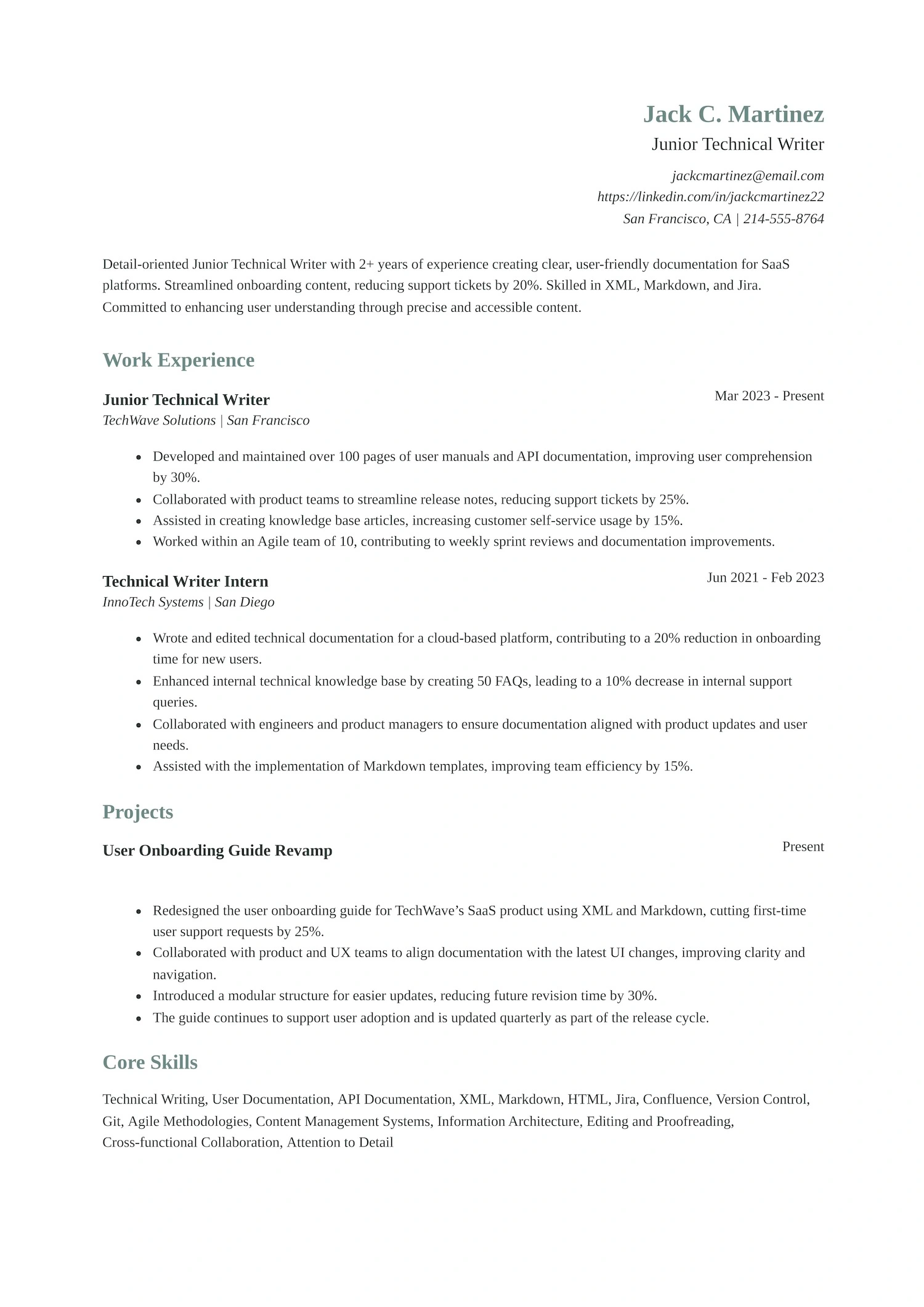
Are you looking to take your technical writing skills to the next level? Want to create clear, user-friendly documentation that helps users understand complex software? This Junior Technical Writer resume example highlights the experience and skills you need to succeed, from improving user comprehension to collaborating with teams. If you’re ready to make an impact, this resume can inspire your next career step.

As a Junior Technical Writer, you’ll be responsible for writing user manuals, API documentation, and knowledge base articles for software products. You’ll collaborate with product and engineering teams to ensure your content is up-to-date and aligned with the latest product features. Attention to detail, strong
This resume works because it highlights key skills like technical writing, user documentation, and tools such as XML, Markdown, and Jira, which are crucial for the role. The core skills section is well-rounded, showcasing both technical expertise and soft skills like attention to detail and cross-functional collaboration.
Despite limited professional experience, the relevant education in English Literature adds credibility, showing a strong foundation in writing and communication that appeals to employers looking for potential and capability.
Experienced technical writer resume example
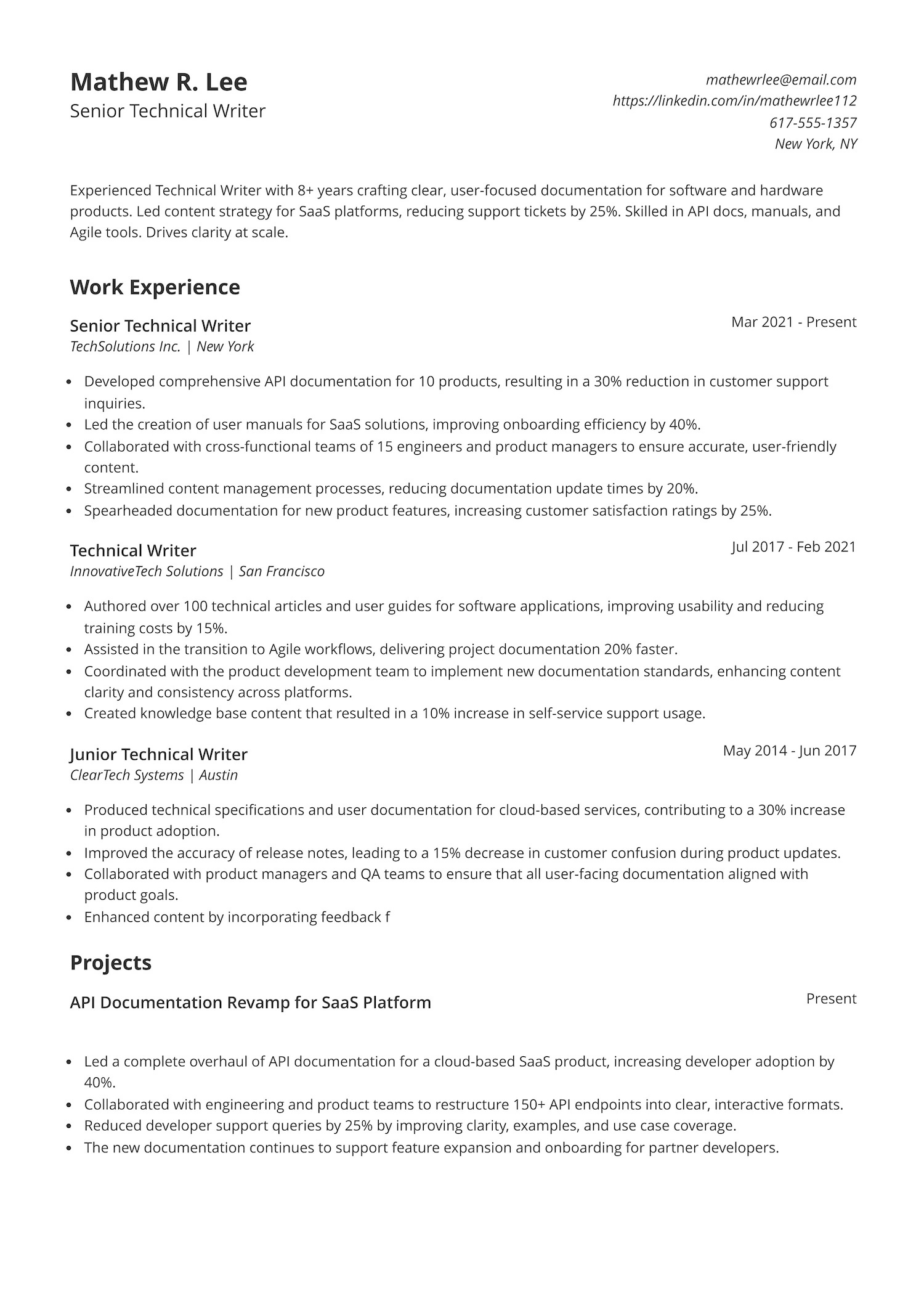
Looking to advance your career as a technical writer by creating clear documentation that reduces support inquiries and improves onboarding? This resume highlights a professional skilled in API documentation, SaaS content, and process optimization.

The technical writer role requires strong writing, attention to detail, and the ability to collaborate with teams to produce accurate, user-friendly content. Experience with API documentation, Agile workflows, and content management systems is essential for success in this position.
This resume stands out for senior roles by including a dedicated projects section, highlighting key accomplishments like “API Documentation Revamp for SaaS Platform” and “Company-Wide Documentation Portal.” These projects demonstrate leadership and expertise in handling complex tasks and driving process improvements.
The clean layout and ATS-friendly format make it easy for prospective employers to quickly assess key skills and achievements, ensuring it appeals to hiring managers looking for a highly organized and experienced professional.
Also Read: 10 Best Resume Skills to Put on a Resume
How to write a technical writer resume that will get you an interview
Writing a resume that effectively showcases your skills as a technical writer is crucial to landing your next interview. Your resume should highlight not only your technical knowledge but also your ability to communicate complex information clearly and concisely.
Many companies, especially in tech, use Applicant Tracking Systems (ATS) to simplify the hiring process. ATS functions like a search engine—if your resume doesn’t include the right keywords and proper formatting, it may not reach a hiring manager.
For technical writing roles, recruiters often search for terms like “technical documentation,” “user manuals,” “content management systems,” or “API documentation.” Including these keywords increases your chances of being found in the ATS.
Here’s how ATS works:
- Job posting setup: Employers outline required tools, writing experience, and relevant skills in the job listing.
- Resume scanning: The ATS scans resumes for matching terms and organizes key details.
- Searchable database: Hiring teams organize candidates based on the presence of those relevant keywords.
Want your resume to stand out to recruiters? Use Jobscan’s Free Resume Builder to create a clean, ATS-optimized resume tailored for technical writing—for free!

Key elements of a technical writer resume
A technical writer resume should feature the following key elements:
- Contact information: Include your name, phone number, email address, and LinkedIn profile.
- Professional summary: A brief statement highlighting your experience and skills.
- Skills section: A list of relevant technical and soft skills such as software knowledge (e.g., MadCap Flare, Adobe FrameMaker), writing proficiency, and project management.
- Experience section: Include your relevant job experience with bullet points that highlight achievements and key responsibilities in your work experience section.
- Projects: Include notable projects you’ve worked on, showcasing your ability to handle various technical documentation tasks.
- Education: Include your degree, certifications, and any relevant courses or training.
- Portfolio: If applicable, provide links to writing samples or a portfolio showcasing your work.
Write a strong professional summary
The professional summary is one of the most important parts of your technical writer resume. It provides a snapshot of your experience and skills, and it should immediately grab the hiring manager’s attention. Tailor it to the specific role you’re applying for, and focus on your strengths in writing, technical knowledge, and problem-solving abilities.
Let’s look at a few examples of both good and bad professional summaries.
Good examples of a resume summary
- “Detail-oriented technical writer with 5+ years of experience in creating clear and user-friendly documentation for software products. Skilled in using MadCap Flare, Adobe FrameMaker, and Microsoft Word to deliver concise content. Adept at collaborating with engineers and developers to understand complex technical concepts and translate them into easily understandable materials.”
- “Results-driven senior technical writer with expertise in writing technical manuals, user guides, and system documentation. Experienced in working with cross-functional teams to develop content that meets both technical and business requirements. Proficient in content management systems and documentation standards.”
Bad examples of a resume summary
- “Looking for a job as a junior writer. I am good at writing and have some experience with software.”
- “Technical writer with a lot of experience and skills. I’m looking for a challenging role where I can apply my skills to a good company.”
Skip the stress of writing your professional summary with Jobscan’s Summary Generator. Just input your background details, and the tool will generate a polished, ATS-friendly summary tailored to your technical writing experience, using the right keywords to grab the attention of hiring managers.
Demonstrate key technical writer skills
To stand out as a technical writer, it’s essential to showcase both your hard and soft skills in your resume. A strong combination of these essential skills will demonstrate your ability to produce high-quality, user-friendly documentation while also being adaptable to different work environments and communication styles.
Hard skills for a technical writer
- MadCap Flare
- Adobe FrameMaker
- Microsoft Word
- Content Management Systems
- HTML
- CSS
- JavaScript
- API Documentation
- Visio
- Lucidchart
Soft skills for a technical writer
- Communication
- Attention to Detail
- Collaboration
- Time Management
- Critical Thinking
Incorporating your skills into resume bullet points shows hiring managers how you apply those abilities in real-world situations. The way you present your skills can make all the difference. Let’s look at examples that demonstrate how to effectively highlight your skills in your resume bullet points.
Write impactful resume bullet points for a technical writer
Resume bullet points are the core of your experience section. They should clearly communicate your skills, the impact you’ve made, and the value you bring to a team. Instead of listing tasks, focus on what you accomplished using specific tools, action verbs, and measurable results. Here’s what that looks like:
Good examples of resume bullet points
- “Created comprehensive user manuals, troubleshooting guides, and release notes for software applications, reducing customer support requests by 20%.”
- “Collaborated with engineering team members to develop API documentation, ensuring accuracy and ease of use for third-party developers.”
- “Developed and maintained online help systems, incorporating feedback from users to improve documentation clarity and usefulness.”
- “Produced high-quality documentation for a cloud-based software platform, meeting all project deadlines and client specifications.”
Bad examples of resume bullet points
- “Wrote documentation for software.”
- “Worked on projects with developers to create guides and technical articles.”
- “Created user manuals for products.”
- “Responsible for editing content and improving documentation.”
Make your technical writer resume more impactful with Jobscan’s Bullet Point Generator. By uploading your resume along with the job description, you’ll get tailored phrase suggestions that highlight your writing skills, tools expertise, and accomplishments in a clear, results-driven way. It’s an easy way to ensure your bullet points align with what hiring managers are looking for.
Highlight your achievements as a technical writer
Hiring managers want to see more than just your responsibilities—they want to understand the impact of your work. Instead of listing tasks, focus on measurable achievements that show how you added value to past projects or employers. Use action verbs, quantify results where possible, and highlight how your documentation made a difference.
Here are strong examples of how to present achievements on a technical writer resume:
- “Reduced customer support tickets by 25% by developing a searchable online help center for a SaaS platform.”
- “Improved onboarding efficiency by creating comprehensive training manuals, cutting new employee ramp-up time by 30%.”
- “Developed user guides for a complex cloud software suite, which improved user satisfaction scores by 15% over six months.”
- “Streamlined documentation workflows using automation tools, decreasing publishing time from two weeks to three days.”
Tailor your resume to the job description
One of the most effective ways to make your resume stand out is to tailor it to the specific job you’re applying for. Many companies use Applicant Tracking Systems (ATS) to store resumes, and tailoring your resume ensures that you’re using the right keywords to be searchable in the database. But beyond that, customizing your resume helps you highlight the skills, experiences, and achievements that are most relevant to the position.
Here’s how to tailor your resume to the job description:
- Analyze the job description: Focus on keywords like documentation tools, platforms, and writing standards mentioned in the job posting. Include these keywords in your resume.
- Match your experience to the job requirements: Highlight relevant roles or projects that align with the employer’s preferred tools and documentation types.
- Showcase relevant achievements: Emphasize accomplishments that align with the job’s responsibilities, like reducing support tickets or improving user understanding.
- Customize your professional summary: Tailor your summary to reflect the job’s key requirements and explain how your skills and background make you a strong match.
- Use the right keywords: Include specific terms such as “API Documentation,” “Agile Environment,” or “Content Management Systems” to help your resume reach hiring teams.
- Highlight matching experience: Focus on roles where you used the same tools, collaborated in similar workflows, or created the same type of content listed in the job ad.
- Adjust bullet points: Modify your work experience bullet points to reflect the specific duties in the job description, emphasizing achievements and tasks that match.
Include relevant education and certifications
Including your education and certifications on your resume is essential for establishing credibility, especially for technical writing roles. It shows that you have a strong foundation in writing, communication, or relevant technical subjects—and that you’re committed to ongoing professional development.
Here’s how to list your education and certifications effectively:
- Use a clean, concise format for your degree and major, such as “Bachelor of Arts in English, XYZ University” or “Bachelor of Science in Technical Communication, ABC College.”
- Mention relevant coursework like Technical Writing, Information Design, or Software Documentation to show alignment with the role if you’re a recent graduate.
- Focus on your highest degree and any specialized education that supports your technical writing expertise if you’re an experienced professional.
- Emphasize certifications or coursework in writing, UX, software tools, or technology platforms you’ll be using on the job if you’re transitioning into technical writing.
- Highlight certifications like Certified Professional Technical Communicator (CPTC), UX Writing by UX Content Collective, or software-specific courses in tools like MadCap Flare or Adobe FrameMaker.
- Focus on certifications that are well-regarded in the tech writing or documentation field over short-term or niche training programs.
- For entry-level candidates, your education may carry more weight. For experienced technical writers, certifications can reflect advanced skills and specialized knowledge.
Top certifications for technical writers
Here are some certifications that can strengthen your resume:
- Certified Professional Technical Communicator (CPTC)
- UX Writing Certification – UX Content Collective
- Technical Writing Certificate – Society for Technical Communication (STC)
- MadCap Flare Certification
- Google Technical Writing Course
- Adobe FrameMaker Certification
Technical writer resume tips
Creating an effective technical writer resume requires a blend of showcasing your writing skills, technical knowledge, and the ability to explain complex information clearly. To ensure your resume stands out to hiring managers and ATS, here are some valuable tips:
- Focus on clarity and readability: Just as you would for technical documents, make sure your resume is easy to read. Use clean, simple formatting, and break content into clear sections with headings that stand out.
- Highlight relevant experience: Showcase your experience in creating user manuals, online help guides, technical documentation, or any writing that demonstrates your ability to explain complex subjects to non-experts.
- Use action verbs and quantify achievements: Use action verbs to describe your accomplishments, such as “improved,” “developed,” “streamlined,” or “collaborated.” Quantify your achievements where possible (e.g., “Reduced support tickets by 20% by creating a comprehensive FAQ guide”).
- Include technical tools and software: List the documentation tools, content management systems (CMS), or programming languages you’re proficient in, such as MadCap Flare, Adobe FrameMaker, HTML, or CSS. These are essential for technical writing roles.
- Tailor your resume for each job: Customize your resume based on the job description, emphasizing the skills and experience that match the specific role.
- Keep your resume concise: Ideally, your resume should be one to two pages, depending on your experience. Focus on the most impactful and relevant experiences, especially those that directly relate to the technical writing field.
- Showcase a portfolio of work (if applicable): If you have a portfolio of documentation, user guides, or other writing samples, include a link to it on your resume. This provides concrete evidence of your skills and experience.
- Highlight soft skills: Don’t forget to showcase your communication, collaboration, and attention to detail—skills that are essential for a technical writer to succeed in cross-functional teams.
Also Read: How to Organize Your Resume Sections to Stand Out?
Include a cover letter with your technical writer resume
A tailored cover letter can give your technical writer application a competitive edge by offering a personal introduction to your skills, experience, and passion for the role. While your resume lists your qualifications, the cover letter provides an opportunity to explain why you’re an ideal fit for the position and how you can contribute to the company’s success.
What to include in your cover letter:
- Introduction: Start with a clear statement about the role you’re applying for and what attracted you to it. Mention any connections to the company or specific aspects of the role that piqued your interest.
- Your qualifications: Highlight your relevant experience in technical writing, such as creating user manuals, API documentation, or software guides. Include key technical skills, like proficiency with tools such as MadCap Flare, Adobe FrameMaker, or content management systems.
- Key achievements: Showcase specific accomplishments, like improving documentation clarity, reducing customer support queries, or enhancing user experience through well-written documentation.
- Alignment with the company’s needs: Demonstrate your understanding of the company’s mission, products, or technical environment, and explain how your background aligns with their goals or technical requirements.
- Closing statement: Conclude with a confident summary of your interest in the role and express enthusiasm about the opportunity to discuss how you can contribute to the company’s success.
Using tools like Jobscan’s Cover Letter Generator can help you write an ATS-friendly, compelling cover letter that highlights your technical writing strengths and complements your resume. Make a strong impression and show hiring managers why you’re the right fit for the job.
Create a standout technical writer resume with Jobscan
A clear, well-structured resume is key to landing a great technical writing role. By highlighting your writing skills, attention to detail, and experience creating user-focused documentation, you can position yourself as a strong candidate in any tech-driven team. Tailoring your resume to the job description and pairing it with a compelling cover letter can help you stand out from the competition.
Need help building a professional resume? Jobscan’s free Resume Builder makes it simple to create a customized, ATS-friendly technical writer resume. Just enter your information, and the tool will format your resume to match industry standards, helping you get noticed faster.