Electrical Engineer Resume Examples & Tips for 2025
Looking to upgrade your electrical engineer resume for 2025? Check out our examples and tips to write a standout resume that grabs the attention of employers.




In the competitive field of electrical engineering, writing a standout resume is essential for job seekers looking to land their next electrical engineer position. With the ever-evolving nature of the industry, which spans everything from power systems to renewable energy, a well-written electrical engineering resume is key to standing out.
Whether you’re an experienced electrical engineer with years of experience or an entry-level candidate looking to break into the industry, your resume needs to showcase your skills, technical expertise, and relevant projects effectively.
This blog will walk you through examples and best practices for creating a tailored resume that aligns with industry standards, appeals to potential employers, and emphasizes your key skills. By the end, you’ll have a clear understanding of how to use action verbs and strategic formatting to ensure your resume stands out in a competitive job market. Let’s get started!
Electrical engineer resume example
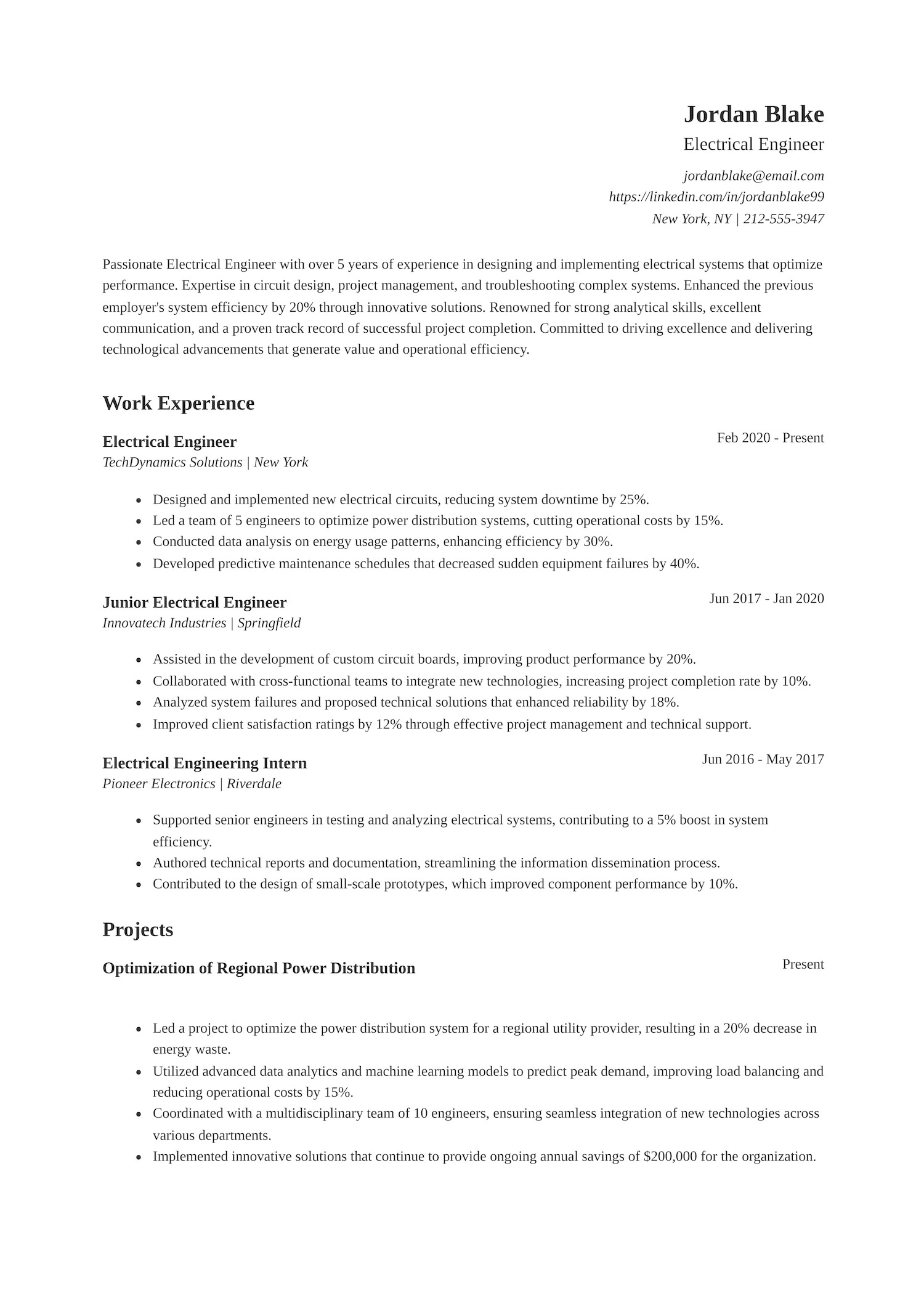
Struggling to build a strong electrical engineer resume that gets noticed? You’re not alone—many professionals find it tough to highlight the right mix of technical skills and project achievements. That’s why we’ve put together the resume example below. Take inspiration from it to build your own.

For this role, employers want someone who’s hands-on with circuit design, power systems, and data analysis. Your resume should highlight real results, like improved system efficiency or cost savings. Hiring managers also look for strong communication skills and a team-focused mindset, since collaboration is key in most engineering projects. Keep it focused, measurable, and relevant.
This resume template effectively combines technical expertise and measurable results. It showcases achievements like a 30% efficiency boost and $200,000 in annual savings through smart engineering solutions.
The clear structure highlights strong project leadership, analytical thinking, and advanced skills in circuit design, data analysis, and cross-functional collaboration—key traits that make this candidate a strong fit for impactful electrical engineering roles.
Entry-level electrical engineer resume example
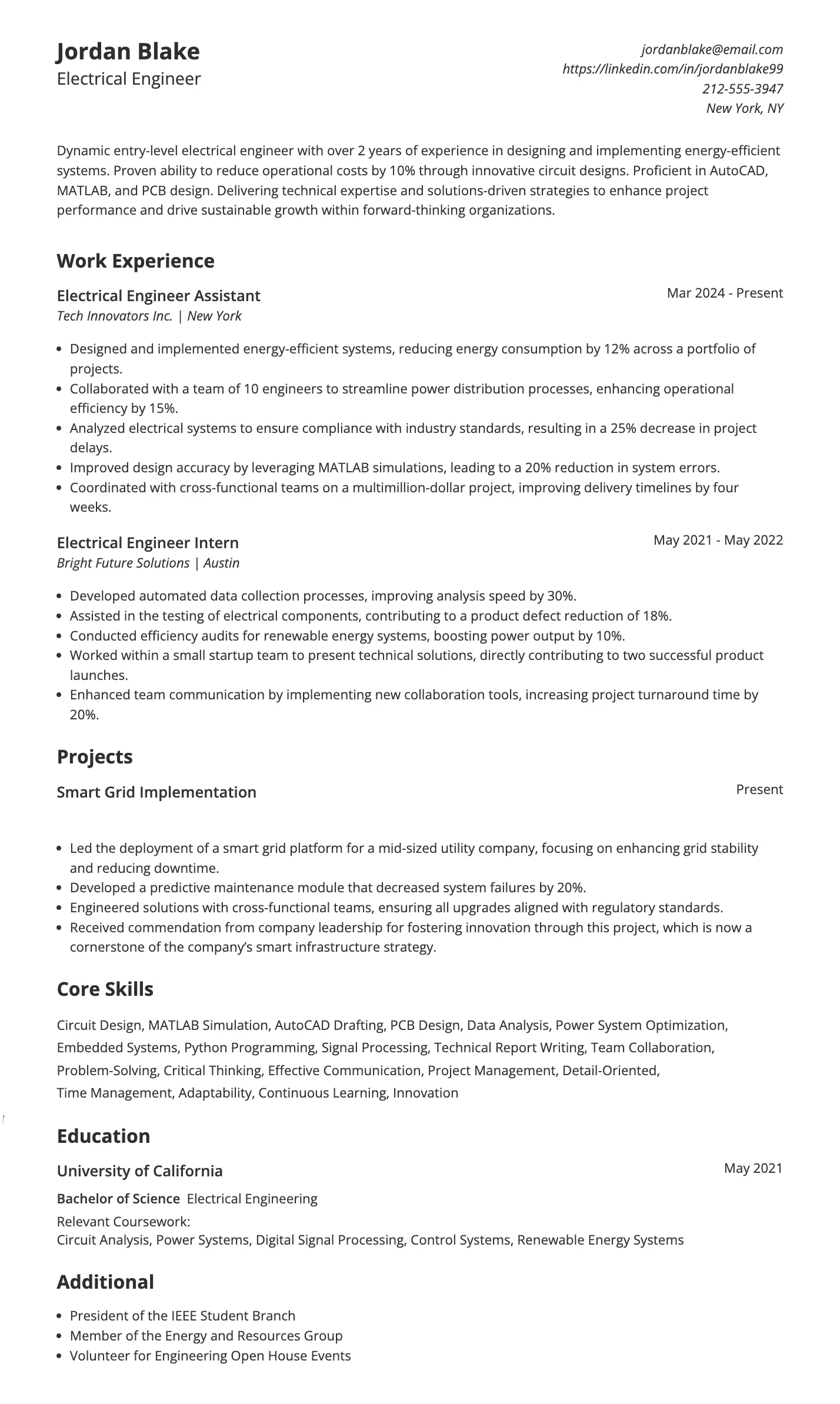
Looking to power up your job search with a resume that truly shines? Check out the example resume below for inspiration and see how it effectively highlights key qualifications and achievements.
An entry-level electrical engineer role typically calls for a solid understanding of circuit design, power systems, and problem-solving. Your resume must clearly demonstrate these abilities, along with any relevant software proficiencies and project experience. Hiring managers expect candidates who are detail-oriented, can collaborate effectively, and are eager to contribute to innovative projects.
This resume effectively showcases early-career impact by highlighting measurable achievements like a 12% energy reduction and 20% error decrease through technical solutions. The work experience demonstrates both technical depth and teamwork across complex projects, while the skills section covers a wide range of in-demand tools like AutoCAD, MATLAB, and PCB design.
Strong extracurriculars, including leadership as IEEE Student Branch President, reinforce initiative and industry involvement, positioning the candidate as a well-rounded, capable, and driven entry-level electrical engineer.
Junior electrical engineer resume example
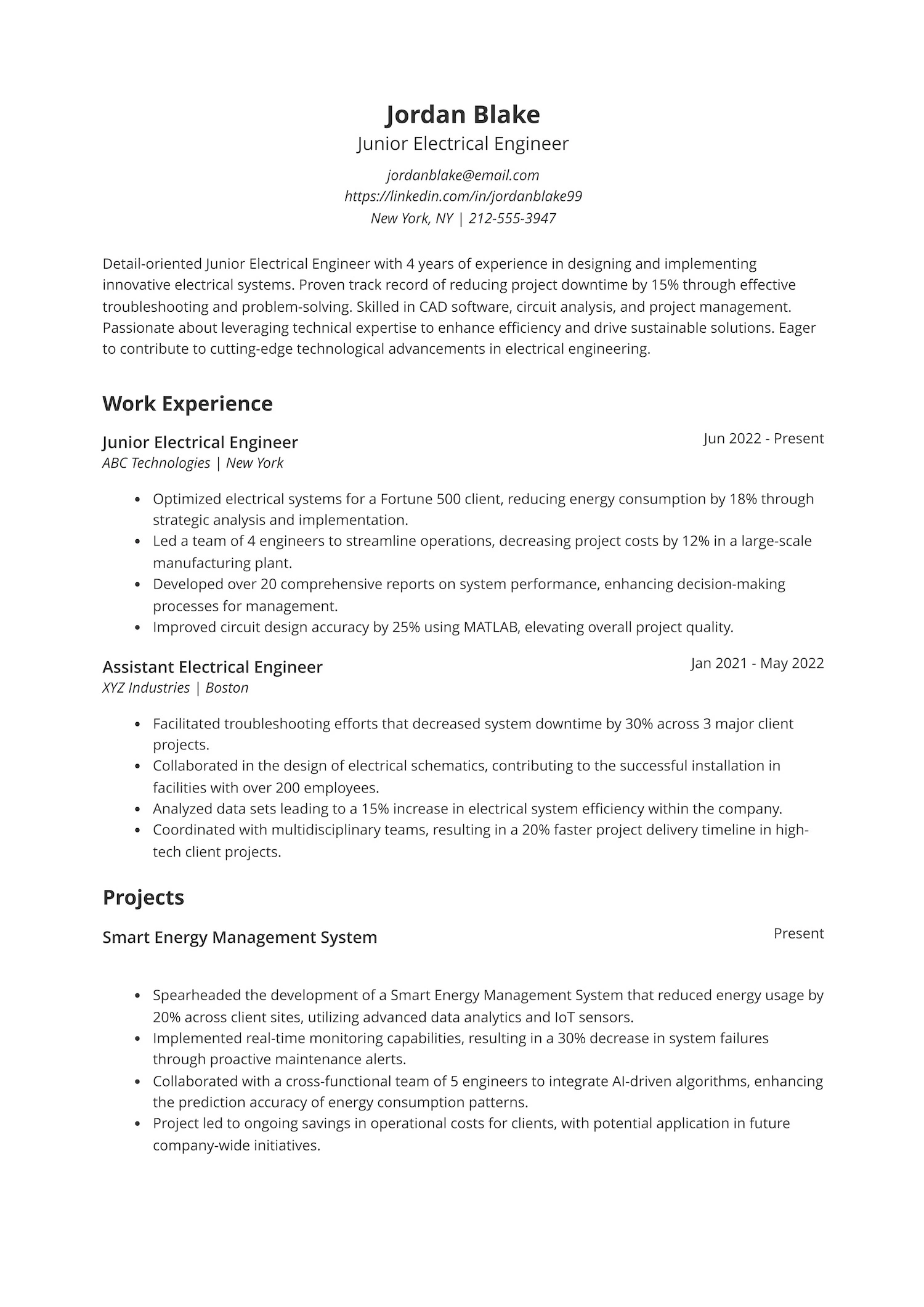
Starting your career as a junior electrical engineer, and not sure how to showcase your impact? This resume is a great example of how to highlight real results, technical expertise, and teamwork, even with just a few years of experience. Take a look and borrow ideas to help structure your own resume in a way that grabs attention.

As a junior electrical engineer candidate, you must be able to solve problems, optimize systems, and communicate well with teams. Your resume should clearly show hands-on experience, technical know-how, and measurable contributions to past projects.
With a clear professional summary that highlights four years of hands-on experience and measurable achievements, this resume sets the tone for a strong candidate. The projects section stands out by showcasing real-world impact, like reducing system failures by 30% and energy usage by 20%, through advanced technologies like AI and IoT.
Combined with strong academic credentials and collaborative work on high-level initiatives, this resume reflects both technical depth and a results-driven mindset, making the candidate a great fit for junior engineering roles.
Senior electrical engineer resume example
Looking to apply for a senior electrical engineering role but not sure how to make your experience stand out? Check out this resume and learn how to show leadership, innovation, and results—all in one place. Take a few ideas from it or use it as a base to build your own.

If you’re aiming for a senior role, your resume should highlight team leadership, project outcomes, and deep technical knowledge. Employers want candidates who can manage complex systems, lead projects efficiently, and deliver measurable value.
This resume presents a seasoned professional with a solid track record of driving energy efficiency and optimizing electrical systems across various industries. The candidate’s leadership in high-impact projects, such as the renewable energy integration initiative, showcases a results-oriented approach and technical expertise.
With certifications like Certified Electrical Engineer (CEE) and Certified Energy Manager (CEM), the resume highlights the candidate’s commitment to professional development and adherence to industry standards. These credentials, combined with the demonstrated success in reducing operational costs and enhancing system performance, make the candidate an ideal fit for senior electrical engineering roles.
How to write an electrical engineer resume that will get you an interview
To increase your chances of landing an interview for an electrical engineer job, it’s crucial to create a resume that not only showcases your technical skills and experience but is also optimized for Applicant Tracking Systems (ATS). Most companies today use ATS software to manage the large volume of resumes they receive.
Think of the ATS as a search engine for resumes. Hiring managers might enter terms like “electrical engineering,” “PLC programming,” or “project management” to find qualified candidates. If your resume doesn’t include those keywords, it likely won’t make it past the system, even if you have the right skills and experience.
Understanding how ATS works can help you write a resume that gets noticed. Here’s a breakdown of how ATS functions:
- Job posting setup: Recruiters input specific job titles, required skills, relevant experience, and qualifications into the ATS when creating a job listing.
- Resume scanning: Once resumes are submitted, the ATS scans them and extracts important information such as work history, education, and key skills.
- Searchable database: All resumes are stored in a searchable format. Hiring managers use keywords—often technical skills, job titles, or certifications—to search for the best candidates.
Want to make sure your resume is ATS-friendly? Jobscan’s Free Resume Builder is a powerful tool designed to help job seekers like you beat the system. Irrespective of the position you’re applying for, this tool ensures your resume is optimized for both ATS and hiring managers, giving you a competitive edge in today’s job market.

Key elements of an electrical engineer resume
An effective electrical engineer resume must present your technical expertise, problem-solving abilities, and hands-on experience in a clear and organized format. Including the right sections ensures your resume meets industry standards and is ATS-friendly while showcasing your value to potential employers. Here are the key elements every electrical engineer’s resume should include:
- Contact information: Include your full name, phone number, professional email address, LinkedIn profile, and optionally, a portfolio or personal website showcasing relevant projects.
- Professional summary: A brief paragraph highlighting your years of experience, specific technical skills, and the type of electrical engineering positions you’re targeting. Tailor this section to each job to make a strong first impression.
- Core skills: A bulleted list of key skills such as electrical design, circuit boards, PLC programming, power distribution, and design software. This section helps your resume remain searchable in the ATS and shows hiring managers your technical proficiency.
- Work experience: List your previous roles in reverse chronological order. Focus on relevant experience and use action verbs to describe contributions to engineering projects.
- Projects: Highlight specific technical projects you’ve completed, especially those involving electrical systems, renewable energy solutions, or team-based engineering work. Include metrics or outcomes if available.
- Education: Detail your academic background, such as a Bachelor of Science in Electrical Engineering or a related field. Include the institution’s name, graduation year, and any honors received.
- Certifications: List certifications like Professional Engineer (PE), Certified Electrical Engineer, or specialized training in electrical design or control systems.
- Honors and awards: Mention scholarships, academic honors, or recognition received for engineering excellence or innovative project contributions. This section can help you stand out, especially if you’re applying for competitive roles.
Write a strong professional summary
A strong professional summary is a concise overview that highlights your most relevant skills, experience, and accomplishments. For electrical engineers, it should reflect your technical expertise, key achievements, and the type of roles you’re targeting—all within 2–3 sentences. This section is often the first thing a hiring manager sees, so making it compelling is essential.
Good examples of a resume summary
- “Experienced electrical engineer with 7+ years of hands-on experience in circuit design, power distribution systems, and renewable energy solutions. Proven track record of leading cross-functional teams and delivering cost-effective, energy-efficient electrical systems.”
- “Detail-oriented electrical design engineer skilled in PLC programming, control systems, and technical support. Adept at managing large-scale electrical projects from concept to completion, consistently meeting project deadlines and budget goals.”
Bad examples of a resume summary
- “I am an electrical engineer looking for a new job where I can use my skills and grow in my career.”
- “Worked with electricity and systems. I know how to use tools and can do engineering work.”
To write a professional summary that instantly grabs attention and includes the right keywords for your target job, try Jobscan’s Summary Generator. It helps you create tailored summaries based on your skills, job goals, and industry standards, so you can make a strong first impression every time.
Demonstrate key electrical engineer skills
Your electrical engineer resume should showcase a balanced mix of hard and soft skills. These skills highlight both your technical proficiency and your ability to work effectively on complex projects, often as part of a team of engineers or in collaboration with other departments. Here are some essential skills to include:
Hard skills for electrical engineer
- Circuit Design and Analysis
- Power Distribution Systems
- Electrical Schematics Interpretation
- PLC Programming
- Control Systems Engineering
- Design Software (e.g., AutoCAD, MATLAB, ETAP)
- Technical Documentation
- Renewable Energy Systems
- Electrical Safety Standards (e.g., NEC, IEEE)
- Troubleshooting and Diagnostics
Soft skills for electrical engineer
- Problem-Solving
- Project Management
- Communication Skills
- Attention to Detail
- Collaboration and Teamwork
- Time Management
- Critical Thinking
- Adaptability
- Leadership Skills
- Decision-Making
Including a strong mix of these skills in your bullet points allows you to effectively showcase your expertise and achievements. Here are some good and bad examples to inspire you to write compelling bullet points that make your resume stand out.
Write impactful resume bullet points for a electrical engineer
Resume bullet points are the core of your experience section. They should clearly communicate your skills, the impact you’ve made, and the value you bring to a team. Instead of listing tasks, focus on what you accomplished using specific tools, action verbs, and measurable results. Here’s what that looks like:
Good examples of resume bullet points
- “Designed and implemented a power distribution system that reduced energy costs by 15% across a manufacturing facility.”
- “Led a team of engineers to complete an electrical system upgrade project two weeks ahead of schedule and under budget.”
- “Created detailed electrical schematics using AutoCAD for large-scale industrial automation projects.”
Bad examples of resume bullet points
- “Worked on some electrical stuff for the company.”
- “Helped with wiring and fixing things.”
- “Responsible for electrical things at my job.”
Want help writing powerful, ATS-optimized bullet points tailored to your electrical engineer resume? Jobscan’s Bullet Point Generator is a smart tool that helps you create clear, results-driven bullet points based on your experience and target job. Try it today!
Highlight your achievements as an electrical engineer
Your achievements show hiring managers the real-world impact of your skills and experience. Rather than just listing responsibilities, focus on accomplishments that demonstrate your value, especially those tied to measurable outcomes, innovation, or leadership.
Here are some strong examples to inspire you:
- “Improved system efficiency by redesigning electrical circuits, resulting in a 20% reduction in energy consumption.”
- “Led the installation of a new PLC-based control system that increased production line speed by 30%.”
- “Managed a $500K electrical design project, delivering it on time and 10% under budget.”
- “Developed a renewable energy solution that reduced the facility’s reliance on the grid by 40%.”
- “Created detailed electrical schematics and documentation for a new power distribution network across five locations.”
- “Reduced downtime by 25% through proactive maintenance scheduling and real-time troubleshooting strategies.”
Tailor your resume to the job description
A generic resume might get lost in the shuffle, but a targeted one shows hiring managers (and ATS software) that you’re a strong match for the role.
Here’s how you can tailor your resume to the job description:
- Analyze the job posting: Carefully read the job ad and highlight key qualifications, technical skills, and responsibilities mentioned.
- Use the same keywords: Mirror the exact phrases and keywords from the job description throughout your resume, especially in your skills section, professional summary, and work experience.
- Match job titles when appropriate: If your past role is similar but had a different title, consider aligning it with the job you’re applying for (without misrepresenting). For example, “Electrical Design Engineer (Role aligned with Electrical Project Engineer responsibilities).”
- Tailor your professional summary: Customize your summary to reflect the job’s top priorities. For instance, if the role emphasizes renewable energy projects, highlight your experience in that area.
- Adjust your skills section: Include specific technical skills or tools mentioned in the description, such as AutoCAD, ETAP, or circuit design, to improve your ATS match rate.
Include relevant education & certifications
Your education and certifications show hiring managers that you meet the technical and academic requirements for an electrical engineering position. Including this information the right way helps establish credibility and ensures your resume aligns with industry standards.
Here’s how to include relevant education and certifications in your resume:
- List your highest level of education first: Include your degree, the institution name, location, and graduation year. Mention honors or relevant coursework if it adds value.
- Include certifications in a separate section: Label it clearly as Certifications or Licenses & Certifications, and list the name of the certification, the issuing organization, and the year you earned it.
- Only list relevant certifications: Focus on certifications that relate to electrical engineering roles.
Top electrical engineer certifications
- Professional Engineer (PE) License
- Certified Electrical Engineer (CEE)
- Certified Energy Manager (CEM)
- OSHA Safety Certification
- AutoCAD Certification
- SolidWorks Certification
- PLC Programming Certification
- Project Management Professional (PMP)
Electrical engineer resume tips
To ensure your resume catches the attention of hiring managers and ATS software, here are some essential tips:
- Keep your resume layout clean and easy to read. Use a professional font (like Arial or Times New Roman) and consistent formatting for headings, bullet points, and sections.
- Avoid clutter; focus on key information like your skills, experience, and qualifications.
- Start each bullet point with a strong action verb like “Designed,” “Managed,” “Led,” or “Implemented.” This makes your responsibilities sound more dynamic and demonstrates leadership qualities.
- Remove outdated or irrelevant roles and limit personal information, like hobbies, unless they are directly relevant to the role.
- Double-check your resume for spelling, grammar, and formatting mistakes. A polished resume reflects professionalism and attention to detail—key qualities for an electrical engineer.
Include a cover letter with your electrical engineer resume
A well-written cover letter is an essential companion to your electrical engineer resume. It provides you with an opportunity to highlight your most relevant skills and experiences, showcase your enthusiasm for the position, and demonstrate why you’re the perfect fit for the role.
Here’s what to include in your electrical engineer cover letter:
- Address the letter to the hiring manager by name if possible. If the name isn’t available, “Dear Hiring Manager” is an acceptable alternative.
- Show that you’ve researched the company and explain why you want to work there. Mention any projects or values of the company that resonate with your professional goals and values.
- Close your letter by expressing your interest in discussing the position further in an interview. Provide your availability and thank the hiring manager for considering your application.
- Use a professional sign-off such as “Sincerely” or “Best regards,” followed by your name.
Writing a tailored, compelling cover letter can be time-consuming and tricky, but Jobscan’s Cover Letter Generator takes the guesswork out of it. The tool helps you create an ATS-optimized cover letter that includes the right keywords, highlights your relevant experience. Start creating your personalized cover letter today with this tool, and improve your chances of landing that dream electrical engineer job!
Final words
You’ve now got the blueprint for building a resume that’s not just good, but electrifying! From writing a compelling summary to showcasing your mastery of both hard and soft skills, you’re armed with the knowledge to make your application shine. But don’t stop there! The job market is dynamic, and your resume needs to be a living document, constantly evolving to stay ahead of the curve.
Take advantage of Jobscan’s powerful features that are designed to help you write ATS-friendly resumes tailored to your target jobs, boosting your chances of landing that dream role.
Ready to transform your resume from a simple document into a powerful career catalyst? Head over to Jobscan today and take the first step toward your next electrical engineer opportunity!

Electrical engineering common interview questions
Answer:
“I have extensive experience designing and analyzing electrical circuits for various applications, including industrial automation and power systems. For instance, I worked on a project where I designed a circuit for a renewable energy system that optimized power flow efficiency. I use design software like AutoCAD and MATLAB to create accurate schematics and perform simulations before implementing the design. My process includes testing for potential failures and refining designs based on performance results.”
Answer:
“Safety is a top priority in every project I work on. I ensure that all electrical designs adhere to the National Electrical Code (NEC) and relevant safety standards. I conduct thorough risk assessments during the design phase and include protective components like circuit breakers and fuses. Additionally, I always make sure that the design accounts for potential environmental hazards and human interaction with electrical systems, ensuring that they are safe to use and operate.”
Tell us about a challenging electrical engineering problem you’ve solved.
Answer:
“One challenging project I worked on involved troubleshooting a malfunctioning power distribution system. After analyzing the electrical schematics and running diagnostics, I found that a combination of faulty components and poor wiring led to frequent system failures. I identified the root cause, replaced the damaged components, and rewired the system. As a result, the system’s reliability improved by 30%, and the number of unplanned outages decreased significantly.”
Answer:
“I use project management tools like Microsoft Project or Trello to keep track of deadlines, milestones, and dependencies. I break down larger tasks into smaller, more manageable parts, prioritize them based on urgency and impact, and allocate resources accordingly. Communication is key, so I ensure that I stay in regular contact with team members to track progress and resolve any issues quickly.”
Answer:
“I have hands-on experience with PLC programming for industrial automation projects. I’ve worked with Siemens and Allen-Bradley PLC systems, developing code to control machinery and processes. For example, I wrote a PLC program to control a production line, including sensor integration and real-time monitoring. I also regularly test and debug PLC programs to ensure they operate efficiently and reliably under all conditions.”
Answer:
“I stay current by attending industry conferences and workshops, where I can learn about the latest technologies and trends. I also subscribe to industry journals like IEEE Spectrum and participate in online forums and professional groups. I make it a point to continually upgrade my skills, whether through certifications or self-learning platforms, to keep up with innovations in renewable energy, control systems, and power management.”
Electrical engineering resume frequently asked questions
Key skills to highlight include circuit design, PLC programming, power distribution, control systems, AutoCAD proficiency, project management, problem-solving abilities, technical troubleshooting, and knowledge of industry standards like NEC or IEEE.
List your highest degree first, including the degree name (e.g., Bachelor of Science in Electrical Engineering), university, graduation year, and any honors or relevant coursework. Mention certifications or specialized training that relate to the job.
Focus on your educational achievements, internships, personal projects, and any relevant coursework. Highlight transferable skills like problem-solving, technical proficiency, and familiarity with industry tools (e.g., MATLAB, AutoCAD), even if gained in academic settings.