Mechanical Engineer Resume Examples & Tips for 2025
Want to write a powerful resume? Check out our mechanical engineer resume examples for 2025 designed to help you showcase your strengths and land interviews.

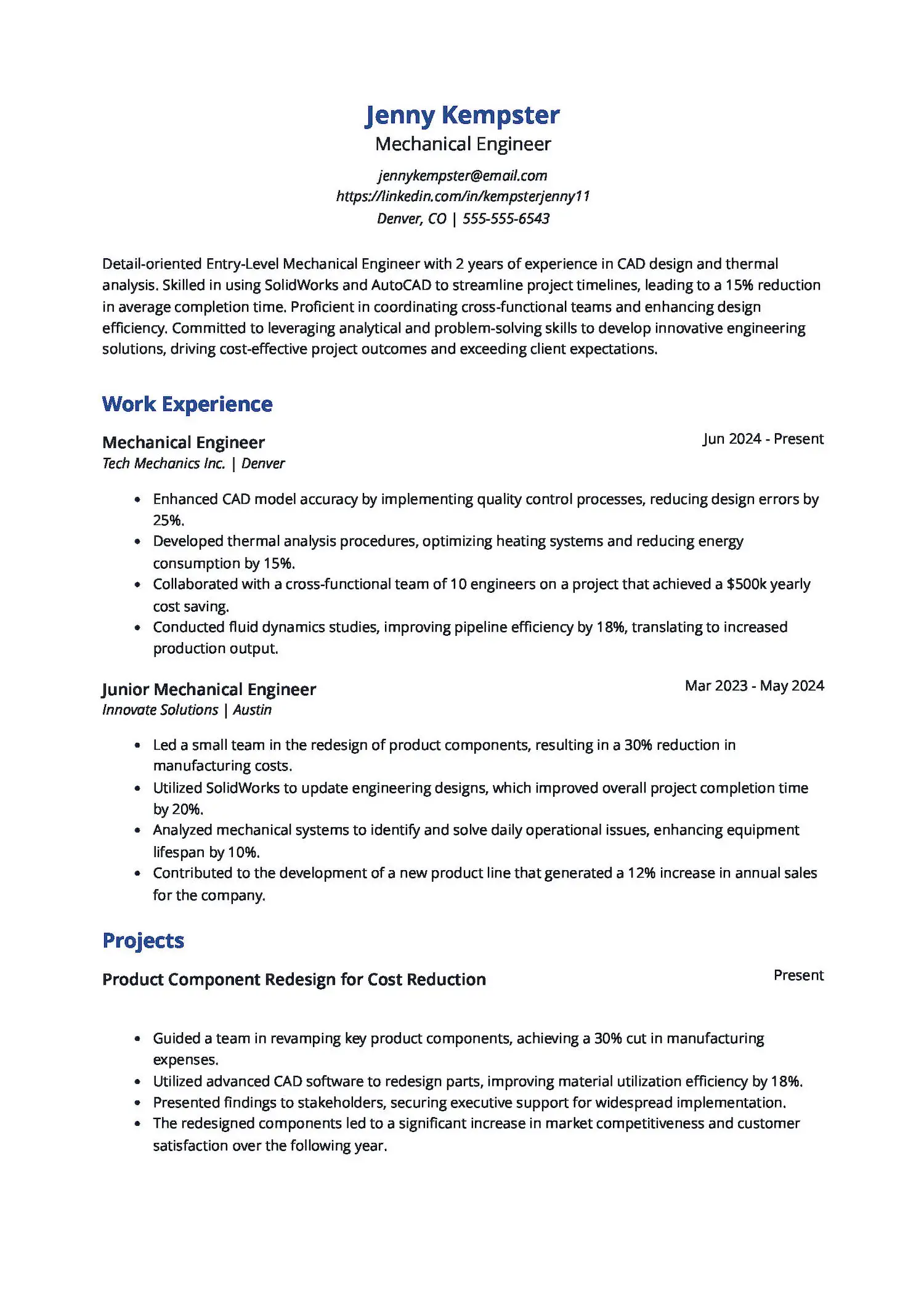


As the demand for skilled mechanical engineers grows in 2025, so does the competition in the job market. That’s where a strong, professional resume becomes essential. This blog is your go-to guide for writing a standout mechanical engineer resume that highlights your technical skills, engineering projects, and relevant work experience, while meeting industry standards and passing applicant tracking systems (ATS).
Whether you’re a junior mechanical engineer, a mechanical design engineer, or aiming for an engineering manager role, we’ll walk you through the best practices, offer engineering resume examples, and help you tailor your resume to land the specific role you’re targeting.
Ready to take the first step toward your next opportunity? Let’s dive in.
Mechanical engineer resume example
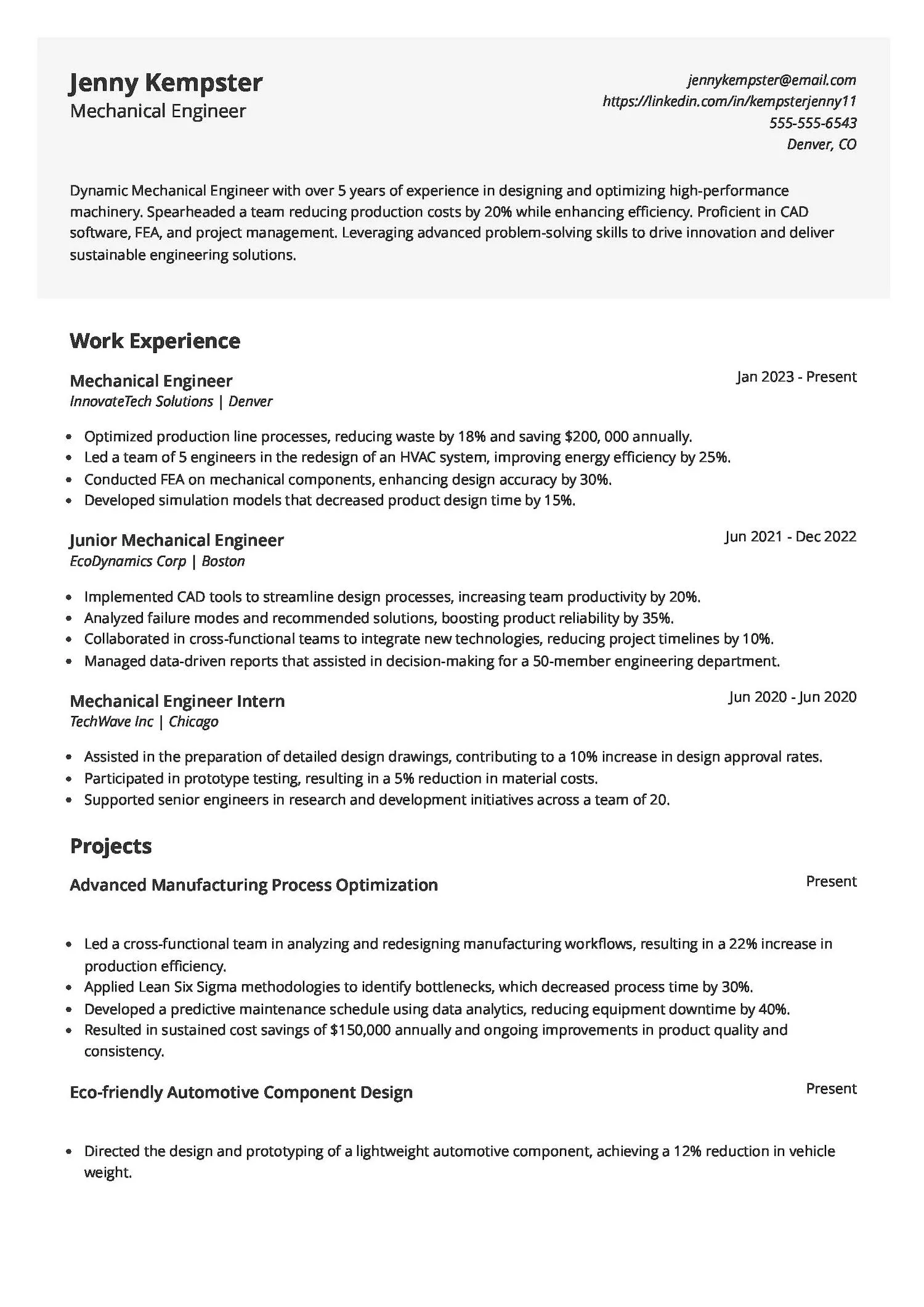
Writing a resume that gets noticed takes more than just listing skills. That’s why we’ve included a strong example below—check it out and use it as inspiration to create a version that highlights your best work.

A great mechanical engineering resume should clearly show technical skills, project impact, and leadership. Employers want problem-solvers who can manage systems, lead teams, and drive results. If you’re aiming for a competitive role, make sure your resume shows what you bring to the table—clearly and confidently.
With a clear focus on results and innovation, this resume presents the candidate as a mechanical engineer who’s not just technically strong but also impact-driven. From improving HVAC efficiency by 25% to saving $200K annually through process optimization, every detail highlights measurable success.
The candidate’s strong foundation in CAD, FEA, and cross-functional collaboration, paired with prestigious education and leadership roles, makes this an ideal example for professionals aiming to stand out.
Entry-level mechanical engineer resume example
Feeling stuck on how to build your entry-level mechanical engineering resume? You’re not alone—especially when you’re just starting out. Check out our resume example and use it to get ideas, structure your own resume, or even borrow a few lines to help tell your story better.
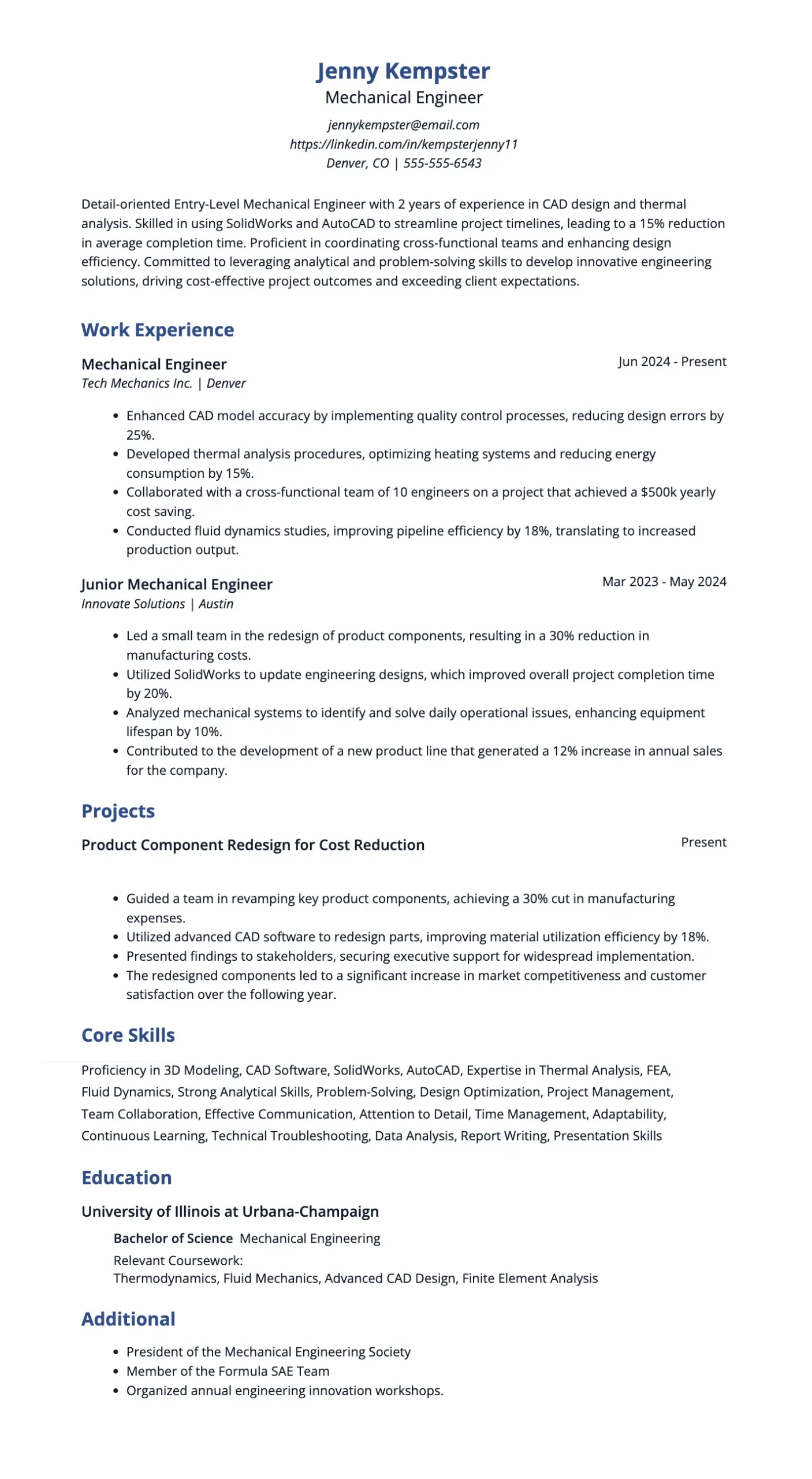
Entry-level roles look for candidates who can apply technical knowledge, collaborate across teams, and contribute to efficiency. Show how you solve problems and support project goals. Keep it simple, relevant, and focused—you’re more ready than you think.
This resume effectively positions an early-career mechanical engineer with a clear focus on results and technical skill. The summary is concise and highlights proven impact in CAD design and thermal analysis. Meanwhile, the work experience is packed with quantifiable achievements like a 30% cost reduction and $500K in savings—strong indicators of value.
Furthermore, the core skills section is well-balanced, blending technical software expertise with soft skills like communication and adaptability, making this an excellent model for entry-level roles.
Senior mechanical engineer resume example
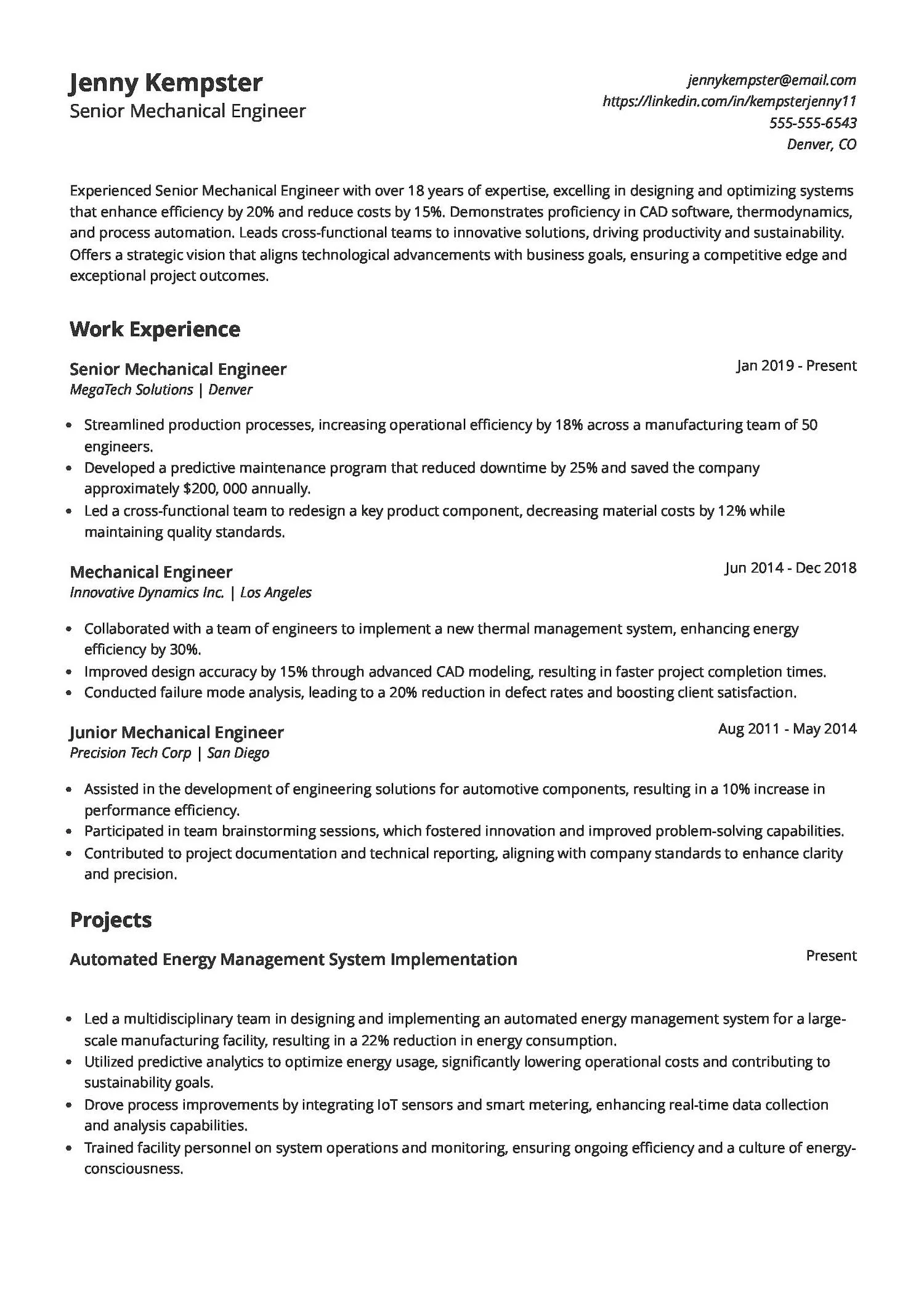
If you’re a seasoned mechanical engineer wondering how to show your years of experience without sounding repetitive or outdated, this resume example is for you. Take inspiration from it, borrow a few lines, or use it as a guide to update your own resume with confidence.
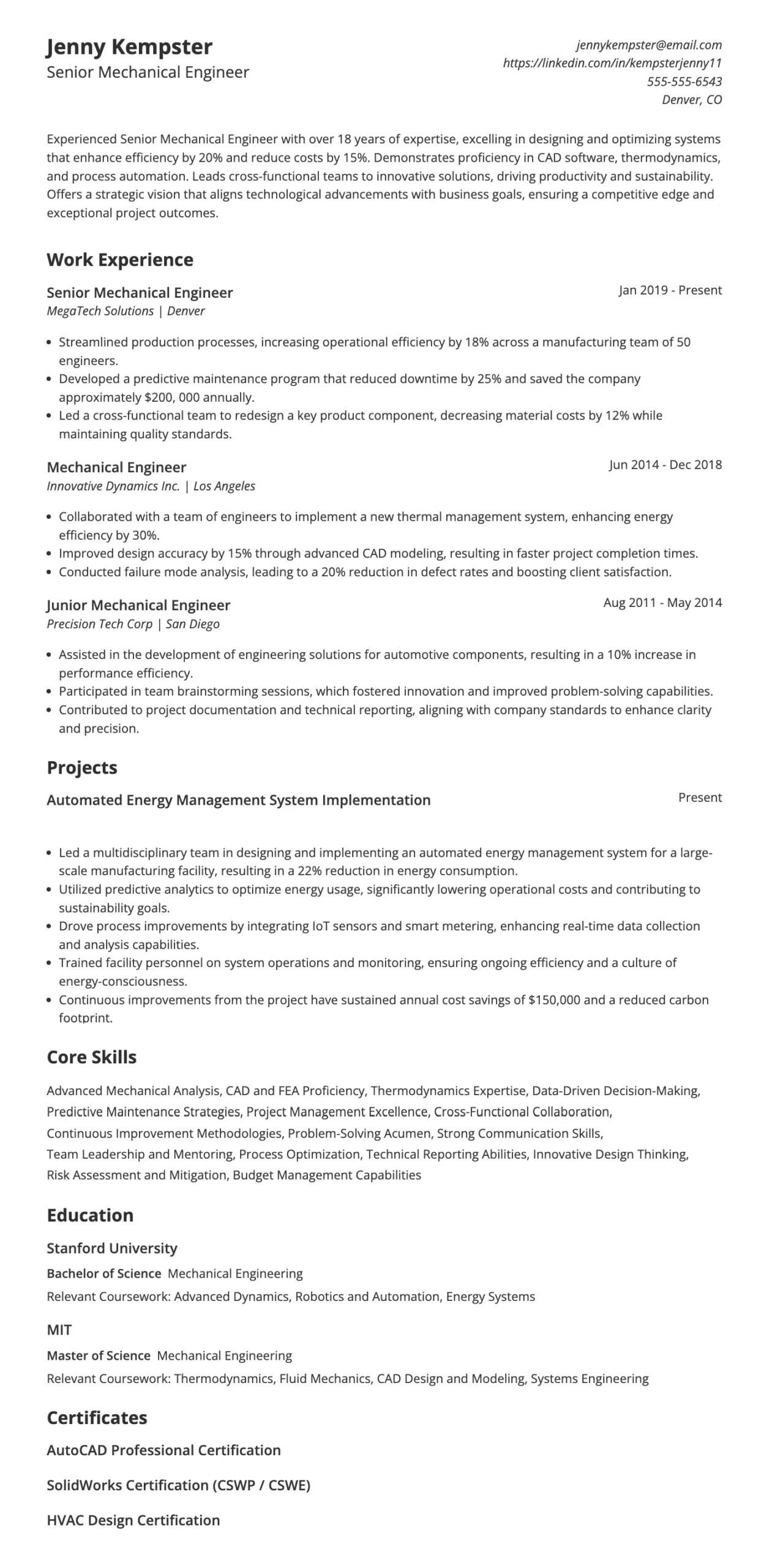
Senior mechanical engineering roles demand more than just technical skills—they expect strategy, team leadership, and measurable results. Your resume should reflect how you’ve led complex projects, improved processes, and delivered real business value. Show how you connect engineering with impact, and don’t shy away from showcasing the big wins.
The resume stands out by showcasing real-world impact through a detailed project section that highlights leadership in sustainable energy management and integration of IoT solutions—exactly what today’s engineering roles demand. Certifications in AutoCAD, SolidWorks, and HVAC Design further reinforce technical credibility and job readiness.
This blend of hands-on innovation and verified skills demonstrates not just experience but continuous growth and relevance, positioning the candidate as a strong fit for senior-level mechanical engineering roles.
How to write a mechanical engineer resume that will get you an interview
To land interviews in today’s competitive job market, mechanical engineering job seekers must do more than list their education and work experience—they need to optimize their resumes for Applicant Tracking Systems (ATS). An ATS is a software tool used by most companies to screen resumes before they even reach a human recruiter. Think of it as a search engine: it scans resumes for keywords, job titles, and technical skills to determine whether a candidate is a good fit. Understanding how ATS works is the first step toward writing a resume that gets seen—and gets interviews.
Here’s how ATS works:
- Job posting setup: Hiring teams input the job title, key skills, and qualifications into the ATS.
- Resume scanning: The ATS scans submitted resumes and extracts important information like your skills section, relevant certifications, and job titles.
- Searchable database: Resumes are stored in a searchable database, where recruiters search using specific keywords—like “mechanical design,” “CAD software,” or “certified energy manager.”
To make sure your resume doesn’t get lost in the system, using the right tools is essential. Jobscan’s Free Resume Builder is designed specifically to help job seekers write ATS-friendly resumes that meet modern industry standards. Try it today and start creating a great resume that actually gets results.

Key elements of a mechanical engineer resume
A strong mechanical engineering resume is more than a list of jobs—it’s a strategic tool that shows recruiters you’re the right fit for the engineering role they need to fill. Including the right elements ensures your resume aligns with industry expectations, highlights your strengths, and stands out in a competitive job hunt. Here are the key sections every mechanical engineer should include:
- Contact information: This is a must-have at the top of your resume. Include your full name, phone number, email address, LinkedIn profile, and location (city and state). It makes it easy for recruiters to reach out and verify your details.
- Professional summary: A short, impactful paragraph that highlights your years of experience, core skills, and what makes you a strong fit for the role. This replaces the outdated resume objective.
- Key skills: Include a concise list of relevant skills. This section boosts your visibility in ATS by mirroring keywords from the job post.
- Work experience: Detail your past roles using strong action verbs to describe accomplishments. Emphasize mechanical systems work, team collaboration, and quantifiable results—especially if you’ve been part of an engineering team or served as a mechanical project engineer or quality engineer.
- Projects: Highlight standout engineering projects that demonstrate your innovation, problem-solving, or leadership.
- Certifications and education section: Include your Bachelor of Science in Mechanical Engineering or related degrees. Add certifications like Certified Manufacturing Engineer if applicable, as they add weight to your qualifications.
Write a strong professional summary
A professional summary is a brief section at the top of your mechanical engineering resume that gives hiring managers a quick snapshot of your experience, skills, and career highlights. It sets the tone for the rest of your resume, showing you’re a qualified and confident candidate from the start. In a competitive job market, a well-written summary helps you stand out, especially when optimized with the right keywords for ATS.
Good examples of a resume summary
- “Detail-oriented mechanical engineer with 7+ years of experience in HVAC systems, product development, and project management. Proven track record of improving energy efficiency and leading cross-functional engineering teams. Skilled in CAD software, fluid mechanics, and collaborating with stakeholders in high-pressure environments.”
- “Licensed Professional Engineer with 10 years of experience in the aerospace industry and mechanical systems design. Expertise in quality engineering, regulatory compliance, and mentoring senior engineers. Adept at driving professional development initiatives and delivering cost-effective engineering solutions.”
Bad examples of a resume summary
- “I am a mechanical engineer looking for a job where I can use my skills. I’m hardworking, motivated, and eager to learn.”
- “Mechanical engineering graduate. Want to work in a company that values innovation. Willing to do any job.”
Check out Jobscan’s Summary Generator—a powerful tool that writes compelling, keyword-optimized summaries tailored to your job application. It’s a game-changer for resume writing and a perfect companion to your mechanical engineer resume.
Demonstrate key mechanical engineer skills
Clearly showcasing both hard and soft skills in your resume highlights your technical expertise, adaptability, and ability to collaborate within an engineering team. It also helps your resume align with the job post and stand out in today’s competitive job market.
Hard skills for mechanical engineers
- CAD Software (e.g., AutoCAD, SolidWorks)
- Fluid Mechanics
- Thermodynamics
- HVAC Systems Design
- Product Development
- Energy Efficiency Analysis
- Finite Element Analysis (FEA)
- Mechanical Systems Design
- Manufacturing Processes
- Project Management
- Technical Documentation
- Simulation and Modeling
- Quality Control and Testing
- Prototyping
- Material Science
Soft skills for mechanical engineers
- Problem Solving
- Communication
- Critical Thinking
- Team Collaboration
- Adaptability
- Time Management
- Leadership
- Creativity
- Attention to Detail
- Conflict Resolution
- Decision Making
- Initiative
Be sure to list these skills in bullet points to make them easy for hiring managers—and ATS—to scan. Keep reading for examples of good and bad mechanical engineer resume bullet points to help you write yours with confidence.
4. Write impactful resume bullet points for a mechanical engineer
Resume bullet points are the core of your experience section. They should clearly communicate your skills, the impact you’ve made, and the value you bring to a team. Instead of listing tasks, focus on what you accomplished using specific tools, action verbs, and measurable results. Here’s what that looks like:
Good examples of resume bullet points
- “Led a cross-functional engineering team to develop an energy-efficient HVAC system, reducing energy costs by 18%.”
- “Designed and tested components for a mechanical systems upgrade, improving system reliability by 25%.”
- “Managed a $1.2M product development project from concept to launch, delivering under budget and ahead of schedule.”
- “Implemented quality control procedures that cut product defects by 30%, enhancing customer satisfaction in a manufacturing environment.”
Bad examples of resume bullet points
- “Worked on a mechanical engineering project.”
- “Responsible for managing HVAC systems.”
- “Helped with product design.”
- “Did some testing and documentation.”
Whether you’re applying as a mechanical project engineer, industrial engineer, or quality engineer, Jobscan’s Bullet Point Generator will help you write powerful, keyword-optimized bullet points tailored to the job post.
Highlight your achievements as a mechanical engineer
When it comes to standing out in a competitive job market, listing your responsibilities isn’t enough—employers want to see results. Highlighting your achievements on your mechanical engineering resume shows the value you’ve delivered in past roles and proves you’re ready to contribute to your next engineering team. Achievements make your resume more compelling, especially when backed by numbers, outcomes, or improvements in efficiency, product development, or mechanical systems.
Here’s how you can highlight your achievements:
- “Improved energy efficiency of industrial cooling systems by 22% through redesign and material optimization.”
- “Led the project management of a $500K product development initiative, launching a new component for the aerospace industry six weeks ahead of schedule.”
- “Reduced mechanical failure rates by 35% by implementing predictive maintenance strategies and optimizing fluid mechanics systems.”
- “Spearheaded cross-department collaboration during a major HVAC systems upgrade, resulting in a 40% improvement in overall system performance.”
Tailor your resume to the job description
One of the most effective ways to land more job opportunities is by tailoring your mechanical engineering resume to match each job post. A generic resume won’t cut it—especially with most companies using Applicant Tracking Systems (ATS) to screen candidates. Customizing your resume helps highlight your most relevant skills, experiences, and achievements that align with what the employer is looking for, increasing your chances of getting noticed.
Here’s how to tailor your resume to the job description:
- Use keywords: Pull out exact terms from the job description (e.g., project management, HVAC systems, fluid mechanics).
- Match skills section: Mirror the skills listed in the post—don’t reword.
- Edit your summary: Align your professional summary with the specific engineering role.
- Focus achievements: Highlight work experience that directly relates to the job.
- Clarify job titles: Add context if your past titles differ but your duties match.
- Use action verbs: Lead bullet points with strong verbs like “designed,” “optimized,” or “led.”
Include relevant education and certifications
Your education and certifications prove you have the foundational knowledge and specialized training needed for a mechanical engineering role. Including them shows you’re qualified, keeps your resume aligned with industry standards, and boosts your credibility—especially if you have licenses like Professional Engineer (PE) or certifications like Certified Manufacturing Engineer.
How to include education and certifications effectively:
- List your highest degree first.
- Include the institution’s name, graduation year, and location.
- Mention honors or relevant coursework if you’re an entry-level candidate.
- Add certifications in a separate section titled “Certifications” or “Licenses.”
- Only list relevant certifications.
- Include expiration dates if applicable to show current qualifications.
- Align certifications with the job requirements mentioned in the job post.
Top mechanical engineer certifications
Here are some top mechanical engineer certifications that can enhance your resume:
- Professional Engineer (PE) License
- Certified Manufacturing Engineer (CMfgE)
- Certified Energy Manager (CEM)
- Certified Engineering Manager (CEM)
- Six Sigma Certification (Green Belt / Black Belt)
- AutoCAD Professional Certification
- SolidWorks Certification (CSWP / CSWE)
- HVAC Design Certification
- Project Management Professional (PMP)
- ASME Certification
- Certified Maintenance & Reliability Professional (CMRP)
- Lean Six Sigma Certification
- OSHA Safety Certification
Mechanical engineer resume tips
Follow the tips below to write a standout mechanical engineer resume:
- Tailor your resume to each job by using keywords from the job description.
- Start with a strong professional summary that highlights your core skills and years of experience.
- Use action verbs like “designed,” “led,” “optimized,” and “implemented” to show impact.
- Focus on achievements, not just responsibilities—quantify results wherever possible.
- Highlight technical skills such as CAD software, fluid mechanics, HVAC systems, and FEA tools.
- Include relevant certifications like PE, CEM, or Six Sigma to boost credibility.
- Keep formatting clean and professional, with consistent fonts and bullet points.
- List your education clearly, starting with your highest degree.
- Optimize for ATS by using standard section headings and matching keywords from the job post.
- Limit your resume to 1–2 pages, especially if you have under 10 years of experience.
- Include soft skills like problem-solving, teamwork, and communication where relevant.
- Always proofread to eliminate typos or formatting issues.
Include a cover letter with your mechanical engineer resume
Think your resume can do all the talking? Think again! A well-written cover letter is your chance to add personality, explain why you’re the right fit, and highlight achievements that align with the job. It’s especially powerful when applying for competitive roles like mechanical project engineer or quality engineer.
Tips for writing a strong mechanical engineer cover letter:
- Start with a strong opening: Mention the job title and why you’re excited about the position.
- Showcase key achievements: Focus on specific results (e.g., improved energy efficiency, led a project team).
- Explain why you’re a good fit: Show how your experience aligns with the company’s goals or projects.
- Keep it concise: Aim for 3–4 short paragraphs, max one page.
- Close with a call to action: Express interest in an interview and thank them for their time.
Not sure where to start? Make the most of Jobscan’s Cover Letter Generator to make your application even stronger!
From skills to success: Power up your resume with Jobscan
You’ve got the skills. You’ve tackled challenging projects. Now it’s time to showcase all of that in a way that gets noticed. A resume isn’t just a document—it’s your personal marketing tool in a fast-moving, tech-driven job market. Whether you’re targeting your first engineering role, shifting into project management, or eyeing a mechanical engineering manager position, your resume needs to speak the language of both recruiters and technology.
That’s where Jobscan comes in. With powerful tools like the Resume Builder, Summary Generator, and Bullet Point Generator, Jobscan helps you create a resume that’s tailored, optimized, and built to perform—just like a well-designed machine. Don’t leave your job hunt to chance. Let Jobscan guide you every step of the way and turn your next job application into your next big opportunity.