Legal Secretary Resume Examples & Tips for 2025
Want a resume that grabs recruiters' attention in seconds? Use our proven legal secretary resume examples for 2025 to land interviews faster and showcase your full potential.

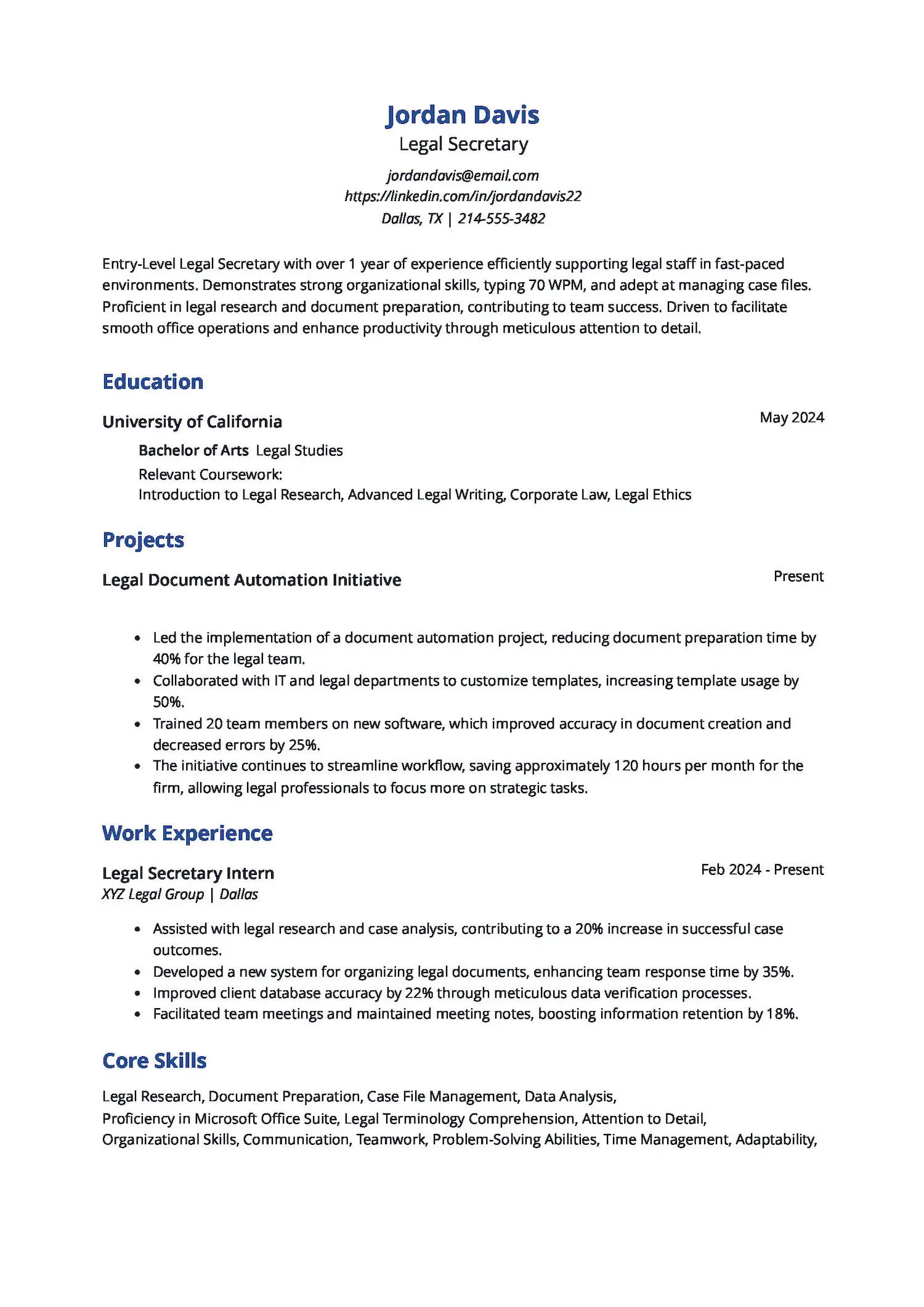


Legal secretaries are the backbone of legal teams, handling everything from drafting correspondence and managing case files to coordinating with clients and keeping attorneys organized. But even with years of experience and a diverse skill set, many legal secretaries find themselves overlooked during the job hunt simply because their resumes don’t reflect the true value they bring.
Your current resume may be outdated, doesn’t showcase your legal software proficiency, or fails to highlight your ability to juggle high-pressure deadlines with precision. If you’re nodding along, this guide is here to help.
This guide is designed to show you how to structure a standout legal secretary resume, what hiring managers are looking for, and how to tailor your experience to today’s legal industry standards. Let’s turn your resume into a powerful tool that opens doors.
Entry-level legal secretary resume example
Ready to take that first big step into the legal field, but not sure how to show off your skills on paper? You’re not alone—entry-level roles are competitive, and the right resume can make all the difference. That’s why this entry-level legal secretary resume example is worth checking out.
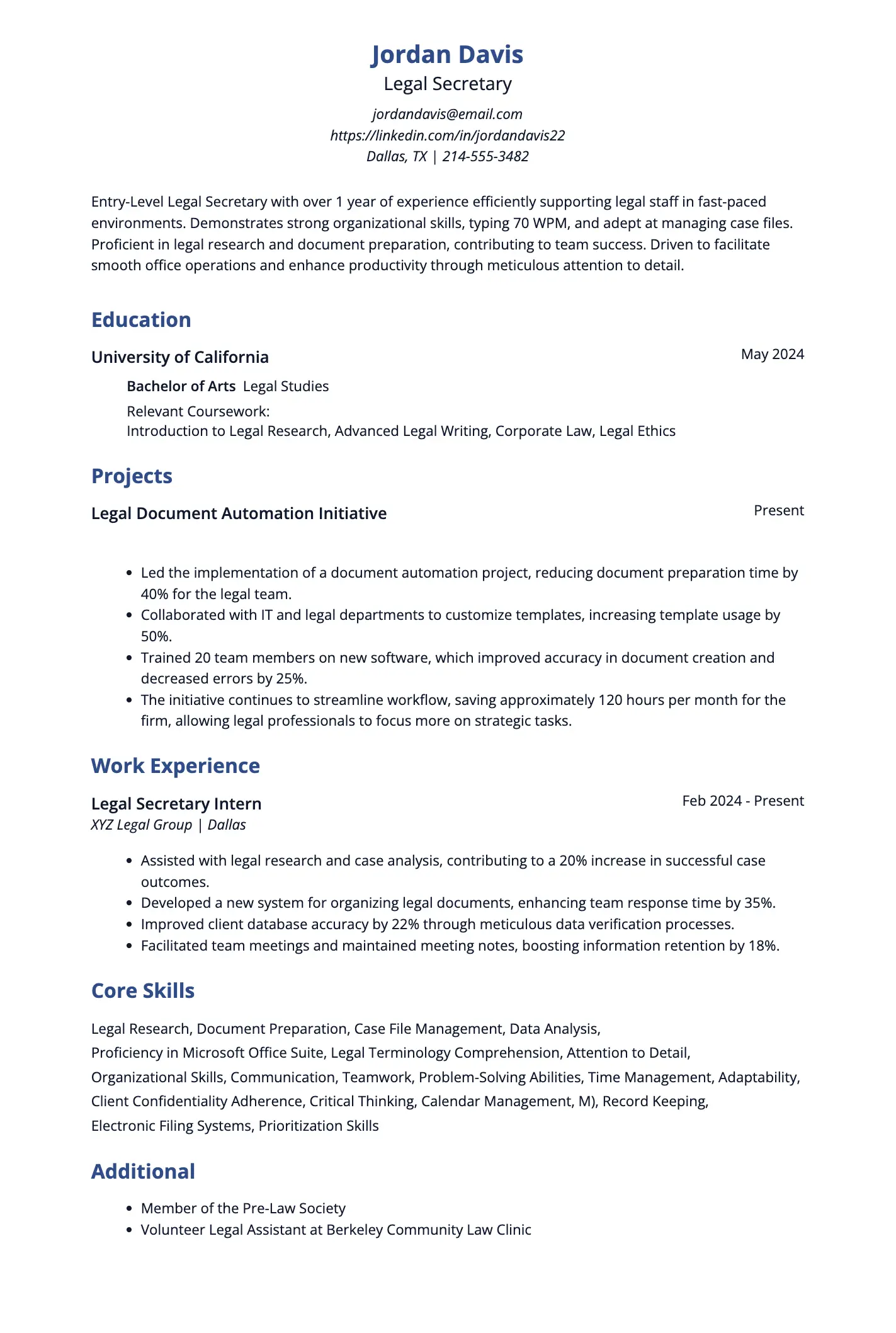
A resume for this kind of role should highlight more than just your education—it needs to show you’re organized, adaptable, and ready to support a busy legal team. Hiring managers want to see strong communication, time management, and an understanding of legal procedures, even if you’re just getting started. Show how your past experience (even internships and school projects) proves you can handle the day-to-day demands of a fast-paced law office. Keep it simple, relevant, and results-driven.
With quantifiable achievements like improving case outcomes by 20% and reducing document prep time by 40%, this resume shows how the candidate delivers results, even early in their career. It highlights key skills such as legal research, document automation, and organization, backed by real project outcomes.
The clear structure, relevant coursework, and strong academic performance position the candidate as a capable and efficient legal support professional.
Junior legal secretary resume example
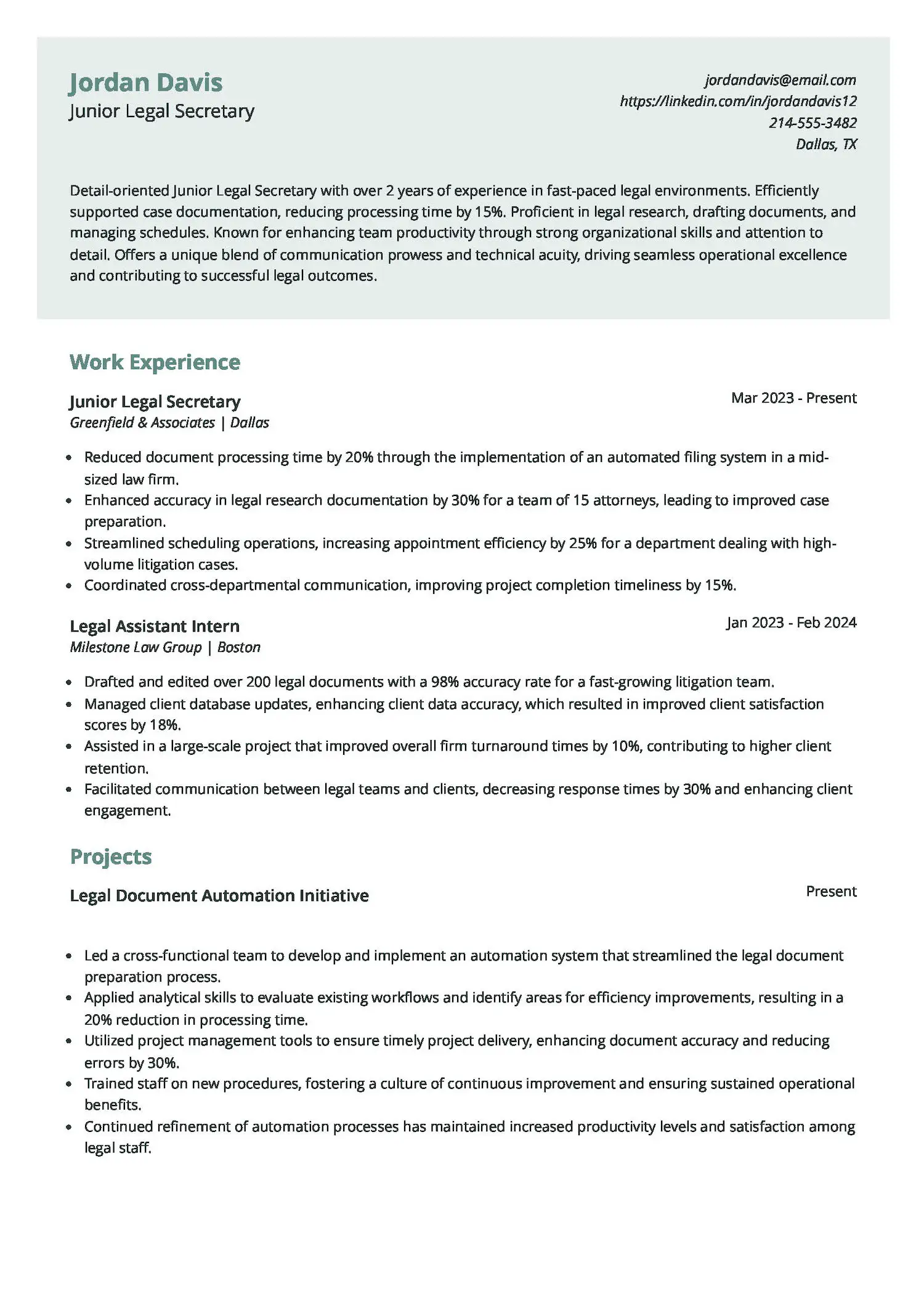
Starting out in the legal field can feel overwhelming, especially when trying to assemble a resume that shows your value. Don’t worry, we have got you covered! If you’ve got an internship or entry-level experience, check out the resume example shared below that shows how to turn your experiences into something that gets noticed.
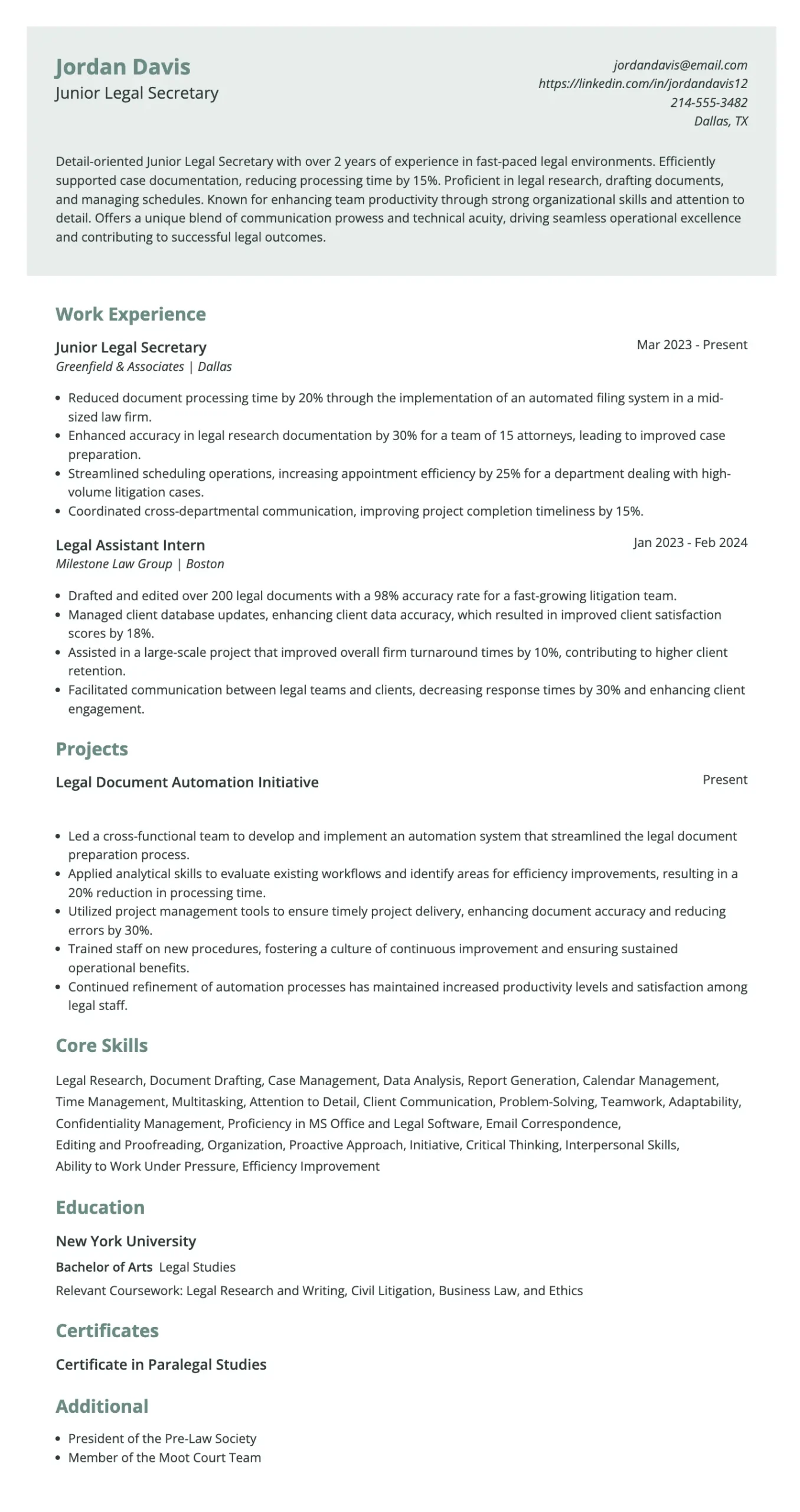
For a junior legal secretary role, your resume should show that you can handle the day-to-day responsibilities that keep a legal office running smoothly. Employers want someone who’s organized, detail-oriented, and good at managing both people and processes. Show how you’ve supported legal teams, handled document prep, and helped make operations more efficient—that’s what hiring managers are really looking for.
This resume immediately showcases a well-rounded legal support professional with proven results, such as improving document processing time by 20% and boosting research accuracy by 30%. The professional summary highlights a strong mix of organizational and communication skills.
The project section further strengthens the resume by showing leadership in automation and workflow improvement. Together, these elements demonstrate readiness to take on high-responsibility roles in any legal environment.
Experienced legal secretary resume example
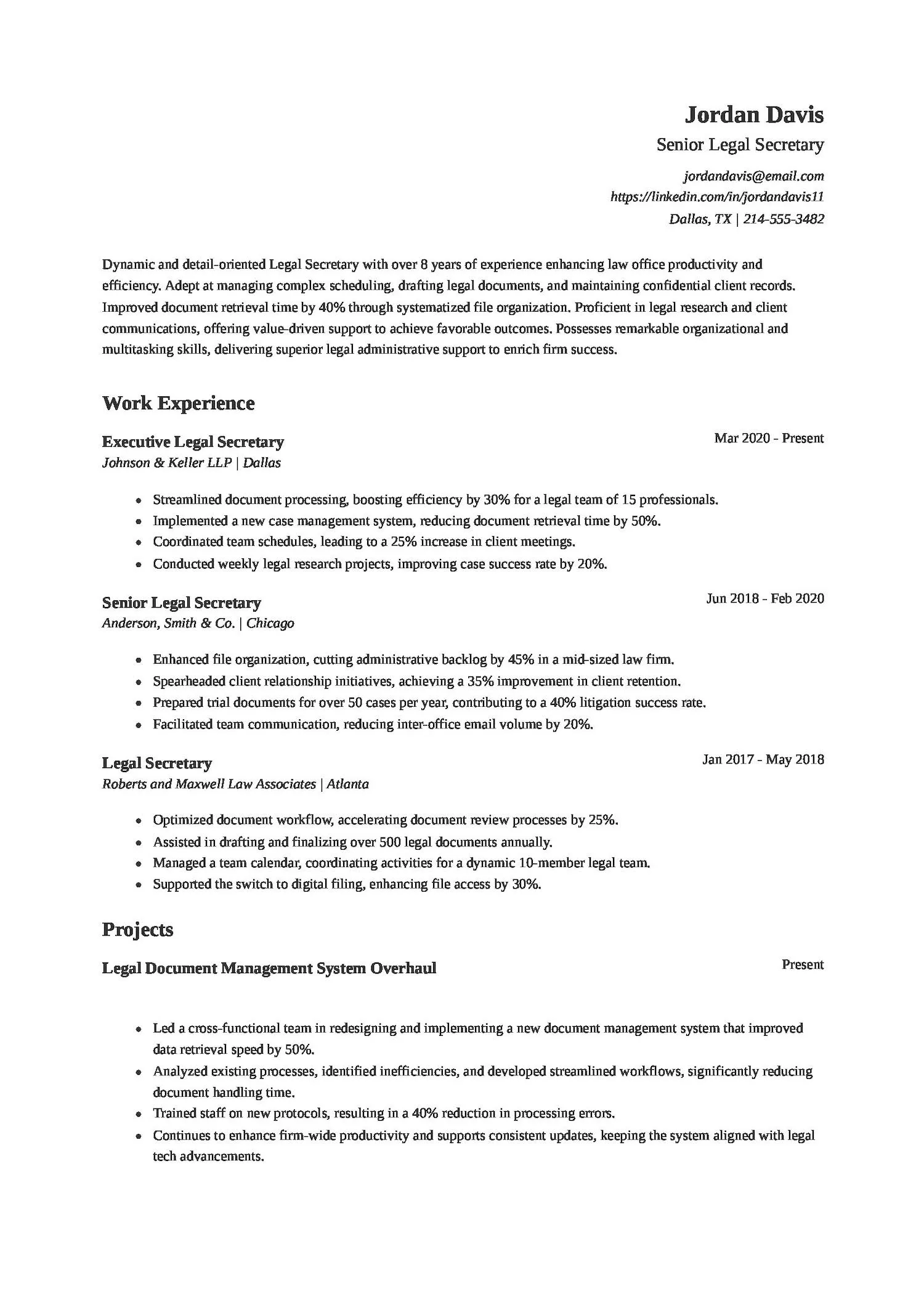
Breaking into the legal world is one thing—growing and thriving in it is another. Check out our experienced legal secretary resume template if you’ve been working in legal support for years and want to move up or stand out. Learn how to show your experience translates into tangible results without overloading with fluff.
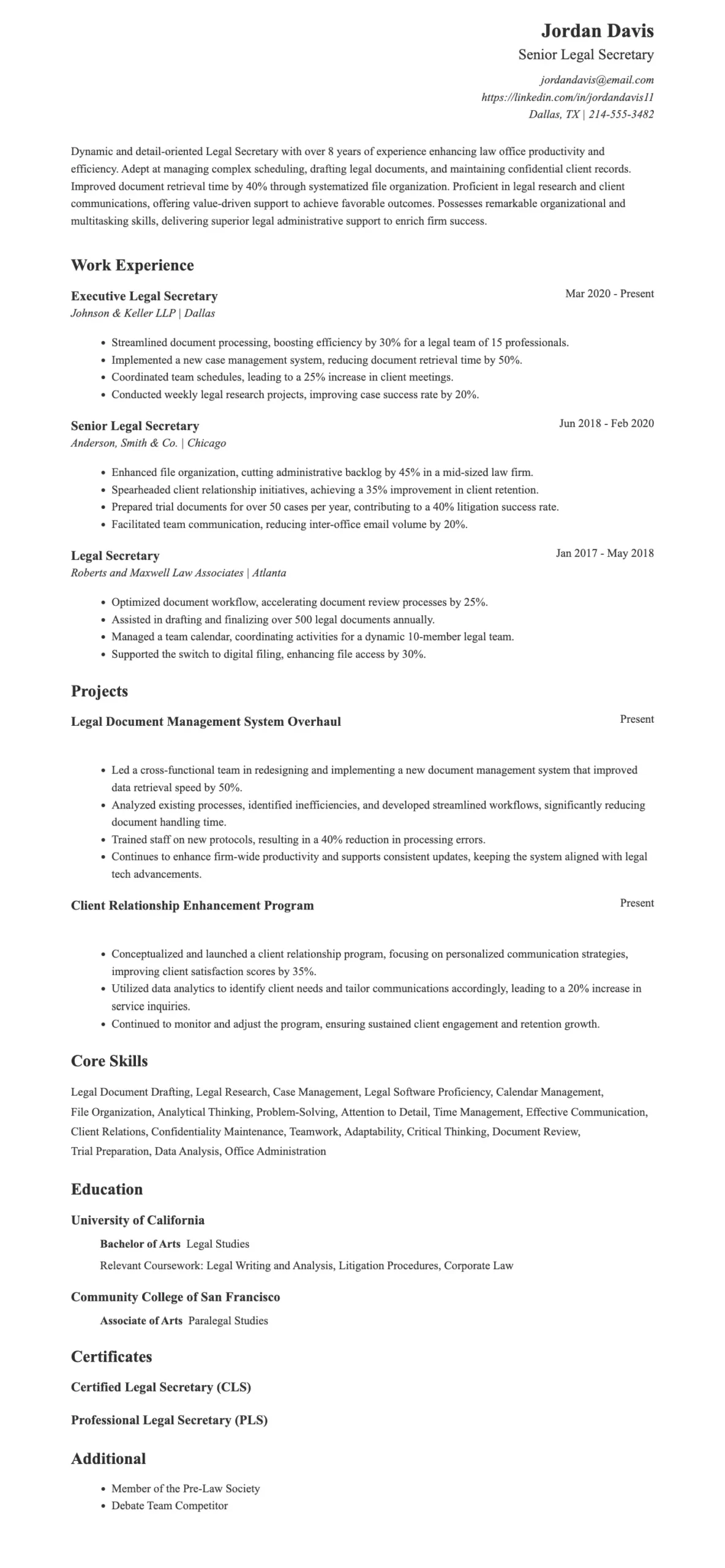
Legal secretary roles at the senior level call for more than just administrative support—they require problem-solving, proactive thinking, and the ability to improve workflows and team efficiency. Hiring managers want to see proof that you can handle multiple cases, protect sensitive information, and keep the legal team organized and running smoothly. Your resume should reflect real outcomes—improved processes, better communication, and stronger client relations. That’s what separates experienced candidates from the rest.
With extensive experience in legal administration and certifications like CLS and PLS, this resume reflects deep expertise and career commitment. The work history showcases quantifiable achievements, such as improving document processing by 30% and client retention by 35%, demonstrating consistent impact.
Combined with a strong academic foundation from UC Berkeley and specialized training in paralegal studies, the resume positions the candidate as a highly capable and experienced legal support professional.
How to write a legal secretary resume that will get you an interview
In today’s competitive job market, simply listing your skills and experience isn’t enough to land your dream legal secretary role. Your resume needs to be a strategic tool that impresses human eyes and also navigates the increasingly common applicant tracking system (ATS).
Think of an ATS as the initial database where hundreds, even thousands, of applications are stored. If your resume isn’t structured and formatted in a way that the ATS can easily read and parse, your application might be overlooked, regardless of how perfect your qualifications are. By understanding the mechanics of an ATS, you can tailor your resume to speak its language, significantly increasing your chances of landing an interview.
Here’s how ATS works, step-by-step:
- Job posting setup: The hiring team inputs crucial job details into the ATS, including the job title, essential skills, and required qualifications. This forms the basis for what the ATS will look for in submitted resumes.
- Resume scanning: When you submit your resume, the ATS scans it to extract key information such as your work history, education, skills, and contact details.
- Searchable database: All the resumes scanned by the ATS are stored in a searchable database. Recruiters then use this database to find potential candidates by searching for specific keywords.
Feeling overwhelmed by the thought of writing an ATS-friendly resume while also making it compelling for a human reader? You’re not alone. Jobscan’s Free resume builder is designed to take the guesswork out of this process. It understands the intricacies of ATS and guides you in creating a resume that is ATS-friendly and showcases your unique skills and experiences in a clear and impactful way.

Key elements of a legal secretary resume
A strong legal secretary resume needs to be more than just a record of past roles—it should strategically highlight your most relevant skills, experiences, and accomplishments with clarity and specificity. Here are the key elements that every legal secretary resume should include:
- Contact information: Include your full name, phone number, email address, and location. Make sure your contact details are professional and easy to find.
- Professional summary: A concise 2–3 sentence overview that highlights your experience, key accomplishments, and what makes you adept at legal administrative tasks.
- Core skills: A bullet list of your top relevant skills, such as legal terminology, court procedures, delivery of legal correspondence, scheduling, and use of specific tools like Clio or MyCase.
- Work experience: Detail your past roles with a focus on duties that demonstrate your support in legal settings—highlight things like managing case files, coordinating travel arrangements, and preparing legal documents.
- Projects: Include notable projects that show initiative or problem-solving, such as streamlining a case filing system or supporting a high-profile trial from start to finish.
- Education: List your highest level of education. If it’s directly related to legal studies or office management, be sure to highlight its relevance.
- Certifications: Mention any relevant certifications, such as a Legal Secretary Certificate or training in legal software. These boost your credibility and show specialized knowledge.
- Honors and awards: Showcase achievements that recognize your excellence, whether for outstanding administrative support, teamwork, or legal office efficiency.
Write a strong professional summary
Your professional summary is the first impression recruiters will get from your resume—make it count. For legal secretaries, this short paragraph should quickly convey your level of experience, key strengths, and how you’re equipped to support legal teams with precision and relevant skills. Here’s a look at what makes a strong summary—and what to avoid:
Good examples of a resume summary
- “Detail-oriented Legal Secretary with 5+ years of experience supporting attorneys in fast-paced litigation firms. Skilled in legal research, drafting legal documents, and managing court procedures with accuracy and efficiency.”
- “Adept Legal Secretary known for delivering exceptional administrative support and coordinating travel arrangements, scheduling, and case management. Proficient in legal software and committed to improving office workflows.”
Bad examples of a resume summary
- “Looking for a job where I can grow and learn new things. I’m a hard worker and get along with everyone.”
- “I have worked in an office before and know how to use Microsoft Word. I think I’d be a good fit for any job.”
Not sure how to write your strong summary? Try Jobscan’s Summary Generator. It analyzes the job description and helps you create a tailored, keyword-optimized summary that aligns with what hiring managers are looking for. It’s a fast, easy way to level up your resume and get noticed.
Demonstrate key legal secretary skills
As a legal secretary, you’ll be expected to handle everything from complex legal documents and court procedures to client communication and office management. Your resume should highlight both hard skills that show your legal expertise and soft skills that reflect your professionalism and adaptability.
Hard skills for legal secretary
- Legal Research and Writing
- Drafting and Filing Legal Documents
- Knowledge of Court Procedures
- Legal Software (e.g., Clio, MyCase, PracticePanther)
- Document Management Systems
- Travel Arrangements and Calendar Management
- Delivery of Legal Correspondence
- Billing and Timekeeping Software
- Records and Case File Management
- Legal Terminology and Formatting
Soft skills for legal secretary
- Attention to Detail
- Strong Written and Verbal Communication
- Time Management
- Adaptability in Fast-Paced Environments
- Confidentiality and Discretion
- Multitasking and Prioritization
- Team Collaboration
- Professionalism and Client-Facing Etiquette
- Problem-Solving
- Organization and Follow-Through
Including the right combination of hard and soft skills in bullet points helps show that you’re not only technically capable but also a dependable, well-rounded member of any legal team. Here are some good and bad examples to inspire you to write compelling bullet points that make your resume stand out.
Write impactful resume bullet points for a legal secretary
Resume bullet points are the core of your experience section. They should clearly communicate your skills, the impact you’ve made, and the value you bring to a team. Instead of listing tasks, focus on what you accomplished using specific tools, action verbs, and measurable results. Here’s what that looks like:
Good examples of resume bullet points
- “Drafted and filed legal documents including subpoenas, motions, and discovery requests with 100% accuracy.”
- “Coordinated travel arrangements and managed complex attorney calendars for multi-state litigation cases.”
- “Assisted in legal research and maintained detailed case files, improving case preparation efficiency by 25%.”
- “Communicated with clients regarding case updates and deadlines, ensuring timely delivery of legal correspondence.”
Bad examples of resume bullet points
- “Helped with stuff around the office.”
- “Typed things and answered phones.”
- “Did legal things when needed.”
- “Worked with lawyers to do tasks.”
Need help writing bullet points that stand out? Try Jobscan’s Bullet Point Generator. It enables you to turn basic job duties into powerful, keyword-optimized statements that align with your target role, making your resume more compelling and ATS-friendly.
Highlight your achievements as a legal secretary
Achievements help set you apart from other candidates by showing the impact of your work, not just the tasks you completed. Instead of simply stating what you did, highlight how your contributions benefited the legal team, improved efficiency, or supported successful outcomes. Focus on measurable results, specific improvements, and moments where your expertise made a difference.
Here are some strong examples:
- “Reduced case filing errors by 30% through the implementation of a new digital document management system.”
- “Recognized by senior partners for consistently maintaining 100% accuracy in legal document preparation over 12 months.”
- “Played a key role in supporting a high-stakes trial, organizing over 500 pages of discovery documents and coordinating with expert witnesses.”
- “Streamlined scheduling and travel arrangements for a five-attorney litigation team, reducing administrative time by 20%.”
- “Assisted in legal research contributing to a successful motion for summary judgment in a multi-million-dollar case.”
Tailor your resume to the job description
A generic resume won’t highlight your most relevant skills or show hiring managers that you’re a strong fit for their specific needs. Tailoring your resume ensures that your experience aligns with the role and boosts your chances of being searchable in the ATS.
Here’s how to tailor your resume to the job description:
- Read the job posting carefully and highlight important keywords and skills.
- Add those keywords to your summary, skills, and experience sections.
- Use the same wording as in the job post (e.g., “case management” vs. “file handling”).
- Focus on experience and accomplishments that match the job requirements.
- Rewrite your professional summary to align with the role’s priorities.
- Mention specific tools and certifications listed in the posting.
Include relevant education & certifications
Including relevant education and certifications on your resume shows employers that you have the necessary qualifications to excel in a legal secretary role. Whether it’s a formal degree or a specialized certification, these credentials can help set you apart.
Here’s how to include relevant education and certifications in your resume:
- List your highest level of education first, including any legal studies or related coursework.
- Include the name of the institution, degree, and graduation date. If you completed relevant coursework, such as legal writing or office management, mention it.
- Highlight certifications that demonstrate specialized legal knowledge or administrative skills.
- Ensure certifications are up to date and include details about the issuing organization.
- Place certifications prominently in a dedicated section to make them easy to find.
Top legal secretary certifications
Listing industry certifications can set you apart and enhance your resume:
- Certified Legal Secretary (CLS)
- Professional Legal Secretary (PLS)
- Certified Legal Assistant (CLA)
- National Association of Legal Secretaries (NALS) Certification
- Legal Secretary Certification (LSC)
- Paralegal Certification
- Notary Public Certification
Legal secretary resume tips
To land a legal secretary role, your resume must be clear, concise, and results-driven. Follow these expert tips to create a compelling resume that grabs attention:
- Use action verbs to describe your accomplishments (e.g., drafted, coordinated, managed).
- Keep your resume clear, concise, and organized—use bullet points for easy readability.
- Tailor your resume to the specific job description by matching keywords and skills.
- Avoid vague phrases like “responsible for”—be specific about what you did and the impact.
- Use numbers and metrics to quantify your results (e.g., “processed 100+ legal documents weekly”).
- Proofread carefully to avoid errors—attention to detail is crucial in the legal field.
- To preserve formatting, save your resume as a PDF unless the job posting says otherwise.
Include a cover letter with your legal secretary resume
Don’t skip the cover letter—it’s your chance to speak directly to the hiring manager and show them why you’re the right fit before they even open your resume. A tailored, well-written cover letter can make all the difference in a competitive legal job market. It’s where you connect the dots between your relevant skills, certifications, and experience with what the employer is looking for.
Here are some tips to remember:
- Open with a compelling sentence that shows your enthusiasm for the role and the firm.
- Mention the job title and a few key responsibilities or qualifications from the posting.
- Highlight a few achievements or experiences that prove you’re adept at handling legal tasks like legal research, delivery of legal correspondence, or managing court procedures.
- Aim for 3–4 short paragraphs. Respect their time and keep it easy to scan.
- Address it to a specific person if possible and mention why you’re interested in working with their firm.
- End with a call to action, like expressing interest in an interview or thanking them for considering your application.
Need help writing one that’s tailored, keyword-optimized, and professionally formatted? Check out Jobscan’s Cover Letter Generator. It helps you build a customized letter that aligns perfectly with the job description, so your application gets noticed from the first line.
Final words
Ready to land that legal secretary role you’ve been working toward? Your resume is more than just a list of jobs—it’s your personal marketing tool, and it deserves the same level of precision and professionalism you bring to every legal task. By showcasing your most relevant skills, tailoring your experience to each job description, and presenting your achievements with clarity and impact, you’ll stand out in a competitive legal market.
And if you want an edge that grabs the attention of hiring managers, Jobscan is your best ally. From resume and cover letter builders to summary and bullet point generators, Jobscan equips you with powerful tools to write applications that get results. Don’t leave your next opportunity to chance—use Jobscan to create a legal secretary resume that works just as hard as you do.