Best Brand Manager Resume Examples for 2026
Build a Brand Manager resume for 2026 that proves brand growth, campaign ROI, and cross-functional leadership, with the keywords ATS scans for.



A Brand Manager owns how a product or company shows up in the market: positioning, messaging, campaigns, pricing input, and the cross-functional work that turns strategy into shelf and screen presence. Hiring managers are not looking for someone who ‘manages a brand’ in the abstract. They want proof that you grew share, lifted awareness, and moved revenue.
That means your resume has to lead with outcomes, not responsibilities. Quantify the campaigns you ran, the launches you owned, and the budgets you controlled, then back them with the tools and frameworks that signal you operate at a modern bar: brand tracking, A/B testing, agency management, GTM planning, and the analytics platforms behind them. Before a person reads any of it, an applicant tracking system scans for those exact terms, so the right keywords decide whether you make the shortlist.
The examples below show how strong Brand Manager resumes are built at every level, from associate to global scope. Use them to frame your own wins, match the language of the roles you want, and clear ATS the first time.
Ready to build yours? Try our ATS-friendly resume builder or scan your draft against the job description.
Brand Manager resume example
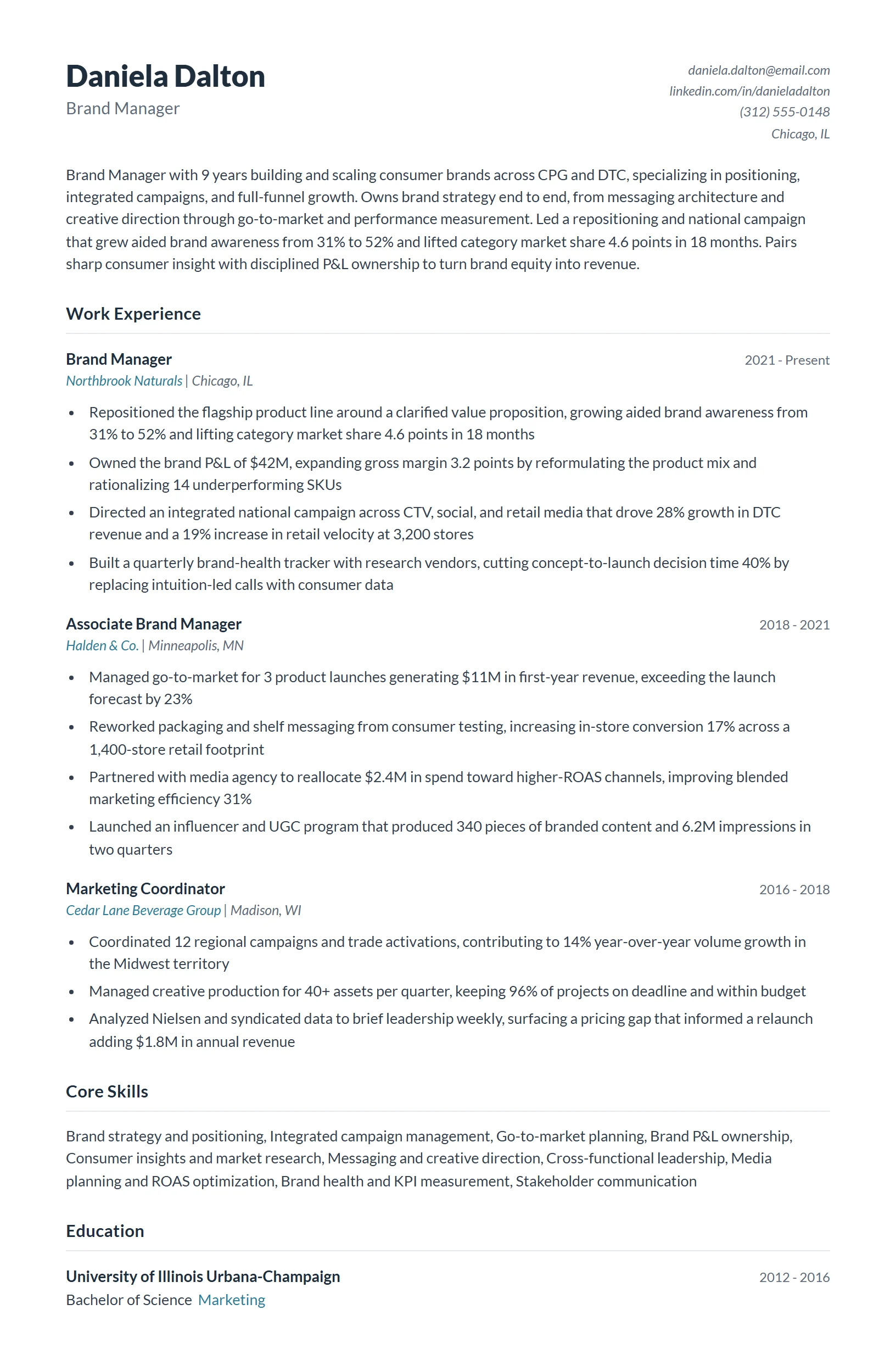
A mid-level Brand Manager resume that pairs brand strategy with measurable business results across the full marketing mix.
This resume works because every bullet ties a brand activity to an outcome: share gain, awareness lift, or revenue. It names the stack hiring managers expect (brand tracking, GTM planning, agency and budget management) and front-loads the keywords ATS screens for, so it reads as a strategist who also ships.
Associate Brand Manager resume example
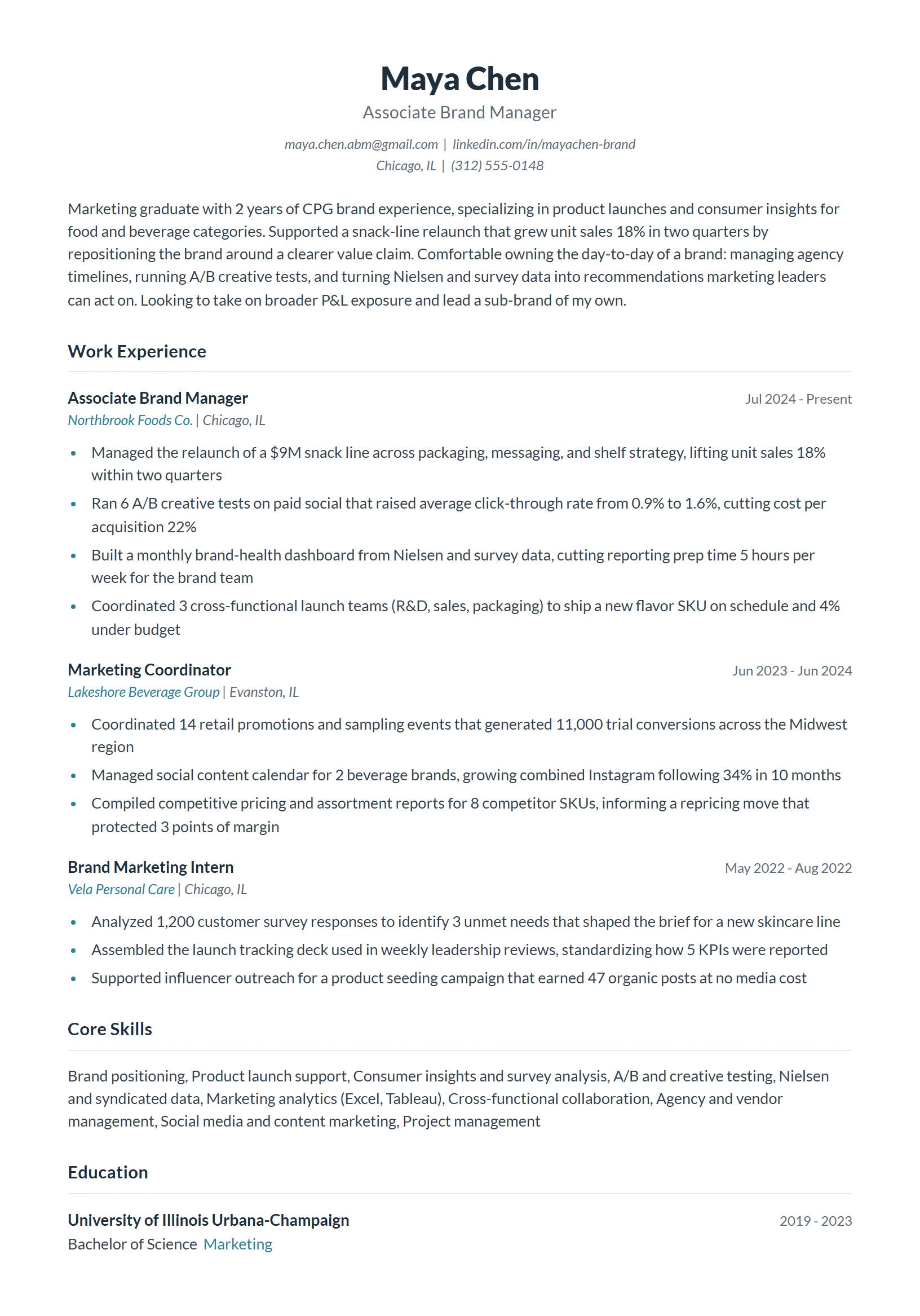
An entry-level resume for the classic ABM pipeline role, built to show high potential before a long track record exists.
Early-career candidates win by quantifying contributions to bigger initiatives rather than claiming sole ownership. This example highlights campaign support, consumer research, and cross-functional coordination, then leans on internships, coursework, and tools to clear ATS keyword checks when experience is thin.
Senior Brand Manager resume example
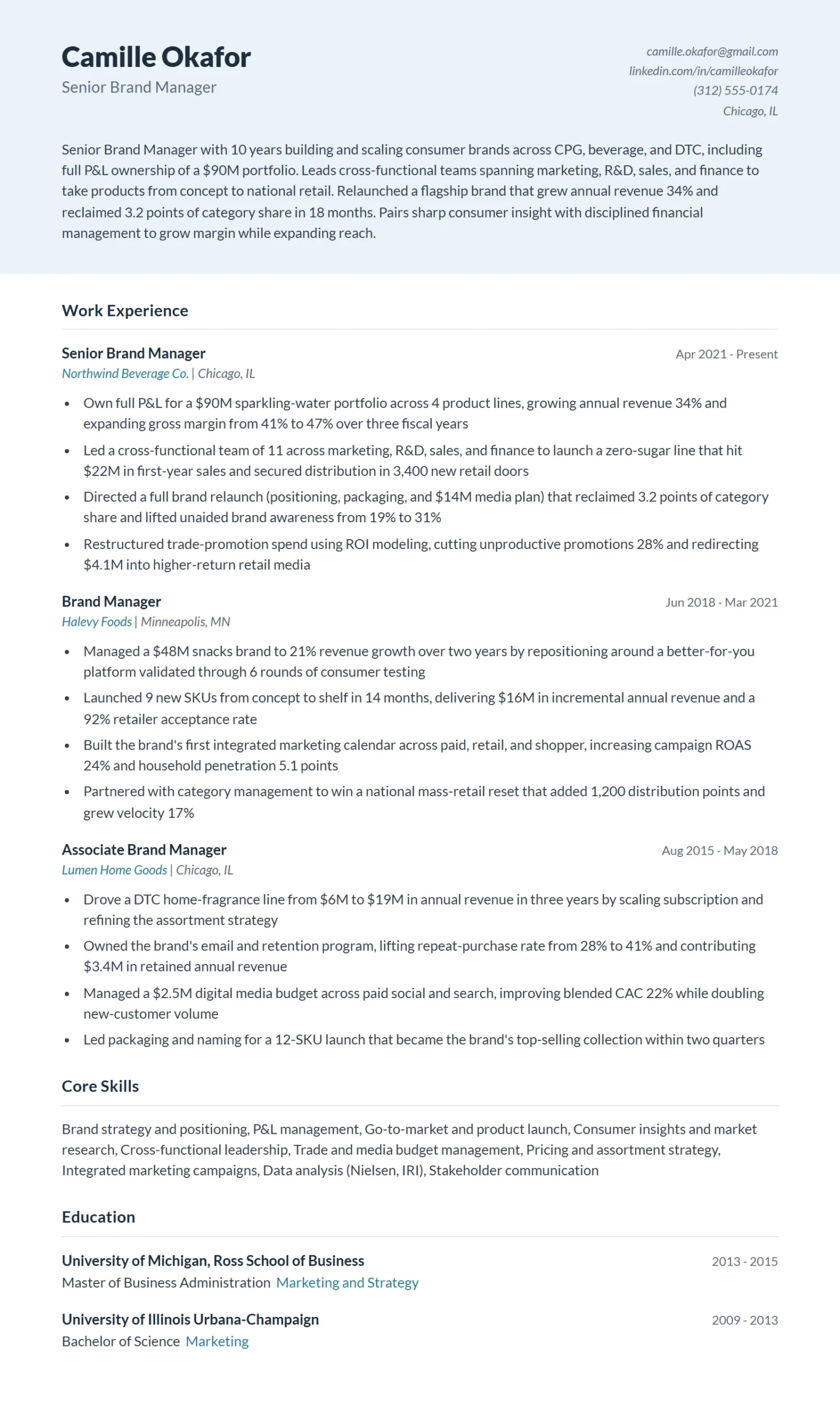
A senior resume that signals portfolio ownership, P&L responsibility, and the leadership scope hiring panels expect at this level.
At the senior tier, recruiters look for scale and accountability. This example leads with P&L impact, multi-brand or multi-market portfolios, and teams led, framing the candidate as a leader who sets brand direction rather than executing someone else’s plan.
Brand Marketing Manager resume example
A sibling-role resume that tilts toward campaign strategy, demand generation, and channel performance over pure brand stewardship.

This variant works by emphasizing the campaign-to-revenue line: integrated campaigns, channel ROI, and marketing-qualified pipeline. It keeps brand fundamentals visible while loading the performance and martech keywords that distinguish a marketing-led role from a product-led one.
Global Brand Manager resume example
A scope-driven resume for managing a brand across regions, markets, and local teams.
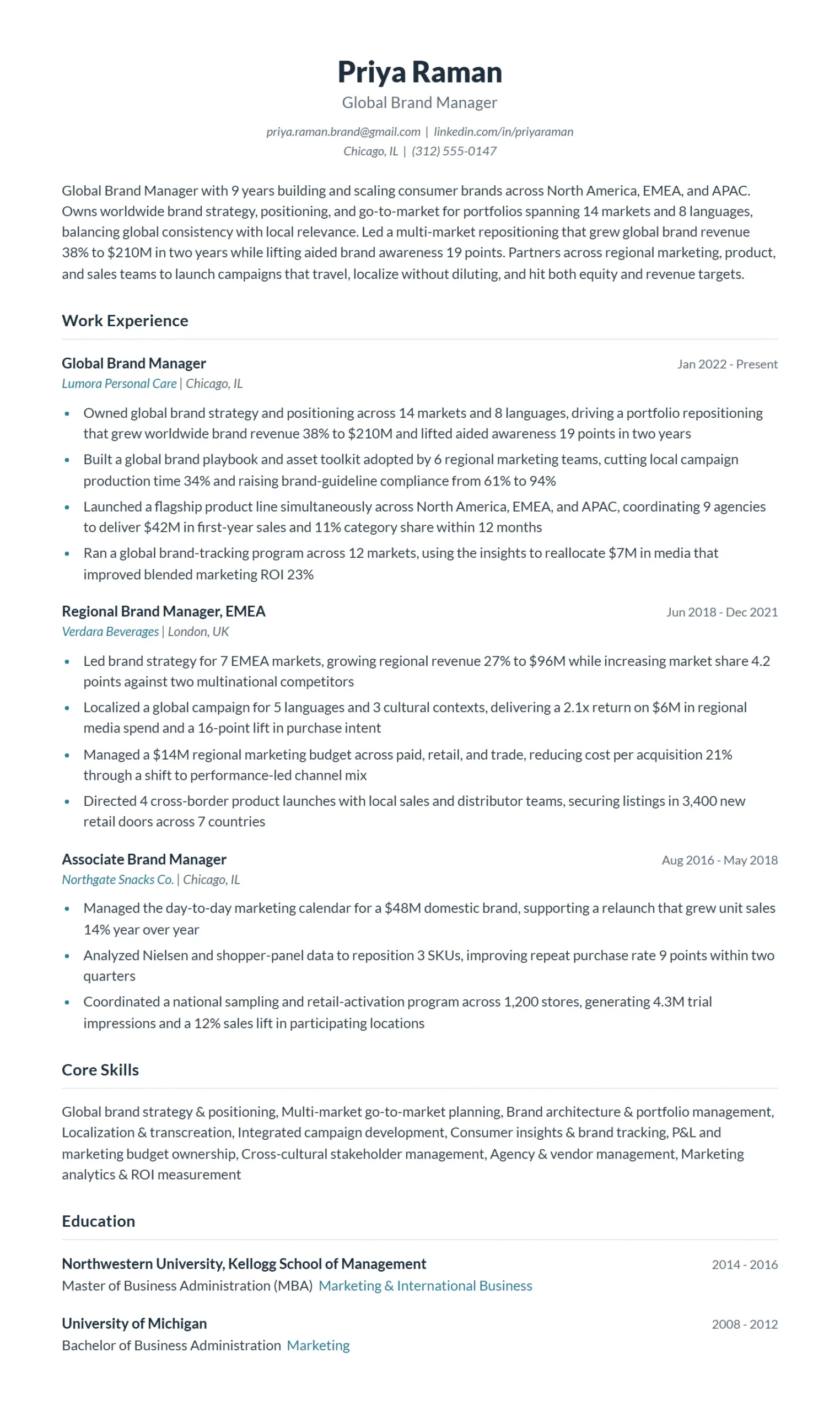
Global roles demand evidence of consistency at scale. This example highlights multi-market launches, localization and regional adaptation, and coordination across distributed teams, then names the international scope and stakeholder-management keywords that set a global mandate apart from a single-market one.
How to write a Brand Manager resume that gets interviews
Brand Manager roles draw applicants from marketing, product, and agency backgrounds, so a generic marketing resume blends into the pile. Recruiters and ATS scans want proof you can own a brand end to end: set positioning, run campaigns, manage budget and agencies, and move brand health and revenue. Lead with outcomes, mirror the exact language in the job description, and quantify everything you can.
- Open with brand-level scope, not task lists: Recruiters read the top third first. State the brand or portfolio you owned, its revenue or category size, and the headline result. “Led brand strategy for a $40M skincare portfolio” tells them more than “responsible for marketing initiatives.”
- Quantify brand impact, not just activity: Tie your work to numbers a hiring manager cares about: brand awareness lift, market share points, revenue, NPS, repeat purchase rate, or share of voice. “Grew aided awareness from 22% to 38% in 18 months” beats “increased brand awareness” every time.
- Mirror the job description’s keywords exactly: ATS scans match against the posting’s terms. If it says “brand positioning,” “go-to-market,” “P&L,” or “360 campaigns,” use those exact phrases where they are true for you. Scan your resume against the listing before you apply so the match is obvious.
- Show cross-functional and agency leadership: Brand Managers rarely execute alone. Name the functions you steered (product, sales, creative, media, R&D) and the agencies or budgets you directed. “Managed three creative and media agencies against a $6M annual budget” signals you can operate at the level the role needs.
- Prove you used data and research to make decisions: Strong brand work is evidence-based. Reference the research and tools behind your calls: brand tracking studies, consumer segmentation, A/B tests, Nielsen or Circana data, or analytics platforms. It separates a strategist from someone who just ran promotions.
- Tailor the resume to the brand’s stage and category: A challenger DTC startup and a legacy CPG company want different stories. For high-growth, emphasize launches and speed. For established brands, emphasize equity, repositioning, and defending share. Reframe the same wins to match what the role is actually solving for.

Brand Manager resume summary examples
Your summary is the first thing a recruiter reads. Lead with your specialty, years of experience, and a quantified win.
Good brand Manager resume summary examples
- Brand Manager with 7 years building consumer brands across CPG and DTC. Led repositioning of a $40M skincare line that grew aided awareness from 22% to 38% and lifted category market share 4 points in 18 months. Owns full-funnel brand strategy, agency management, and a $6M annual budget.
- Results-driven Brand Manager specializing in challenger brands in food and beverage. Launched two product lines that reached $12M combined revenue in year one and grew Amazon subscribe-and-save retention to 61%. Skilled in positioning, go-to-market, and consumer insights.
- Senior Brand Manager with a P&L track record across a $90M household-care portfolio. Drove a 9-point gain in unaided awareness and a 14% revenue increase through a 360 campaign spanning TV, retail media, and social. Manages cross-functional teams and three external agencies.
What to avoid
- Hardworking and passionate marketing professional looking for a Brand Manager role where I can use my skills and grow with a great company. (Objective statement about what the candidate wants, with zero brand scope, no metrics, and filler adjectives. Recruiters learn nothing about what you can own.)
- Brand Manager experienced in branding, marketing, advertising, social media, and campaigns who is a team player and a strategic thinker. (A keyword pileup with no proof. Lists functions instead of results, and “team player” and “strategic thinker” are unverifiable claims that every applicant makes.)
Brand Manager resume skills
Pull the exact skills the job description names and place them where they are true in your summary and bullets; a fuller breakdown lives on our Brand Manager skills page.
Hard skills for a brand Manager resume
- Brand strategy and positioning
- Go-to-market and product launch
- Brand P&L and budget management
- Consumer insights and market research
- Campaign management (360 / integrated)
- Brand health and tracking metrics
- Competitive and category analysis
- Marketing analytics (GA4, Nielsen / Circana)
- Agency and vendor management
- Product and packaging development
Soft skills for a brand Manager resume
- Cross-functional leadership
- Storytelling and communication
- Strategic thinking
- Stakeholder management
- Decisiveness under ambiguity
Brand Manager resume work experience bullet point examples
Lead each bullet with a strong verb and a measurable result.
Good bullet point examples
- Repositioned a $40M skincare brand around a clinical-results message, growing aided awareness from 22% to 38% and adding 4 points of category market share in 18 months.
- Launched a DTC supplement line from concept to market in 5 months, reaching $7.2M in first-year revenue and a 3.1x return on ad spend across paid social and search.
- Directed three creative and media agencies against a $6M annual budget, cutting cost per acquisition 27% while increasing share of voice from 11% to 19%.
- Ran quarterly brand tracking and segmentation research that reframed the target audience, lifting campaign click-through 41% and repeat purchase rate from 34% to 49%.
Bad bullet point examples
- Responsible for managing the brand and working with different teams on various marketing projects. (Describes duties, not results. “Various” and “different” hide the actual scope, and there is no number a hiring manager can evaluate.)
- Helped increase brand awareness and improve overall marketing performance. (No baseline, no figure, and “helped” buries your actual role. “Improve overall performance” could mean anything, so it reads as nothing.)
- Worked on social media, email, and advertising to support company goals. (A channel list with no outcome. It shows where you spent time, not what changed because you were there.)
Brand Manager resume tips
A polished Brand Manager resume proves you can own the full brand lifecycle, from positioning and launch to P&L and measurable brand health.
- Mirror Job Description Language: Copy exact phrases from the posting (such as “brand positioning,” “go-to-market strategy,” or “integrated campaign management”) because ATS systems score keyword frequency before a human ever reads your resume.
- Quantify Brand Impact: Anchor every bullet to a metric that brand hiring managers recognize: brand awareness lift, Net Promoter Score change, market share gain, campaign ROI, or budget managed, because revenue alone undersells brand-specific contribution.
- Name Your Tools Explicitly: List analytics and research platforms by name (GA4, Nielsen, Circana, Kantar, Mintel, Sprinklr) in a dedicated skills section so ATS parsers register them as exact-match keywords rather than burying them in bullet prose.
- Separate Hard and Soft Skills: Create two distinct skills rows, one for hard competencies like brand P&L management and consumer insights, and one for soft skills like cross-functional leadership, so recruiters can verify both fit requirements at a glance.
- Show Agency Management: Brand Manager roles almost always involve directing external creative, media, or research agencies, so include at least one bullet that names the agency type, the scope of the engagement, and the outcome to signal you can manage partners, not just internal teams.
- Keep It to Two Pages: Brand Managers with under eight years of experience should target one page, while senior candidates managing multi-brand portfolios or significant P&Ls can justify two pages, but cut any bullet that lacks a number or a named brand asset.
Pair your brand Manager resume with a cover letter
A strong resume goes further with a tailored cover letter. Browse our cover letter examples to round out your application.
Brand Manager resume frequently asked questions
Write 2 or 3 sentences that name your level, the categories or industries you have managed, and one quantified result tied to brand growth. For example: “Brand manager with 6 years in CPG, leading positioning and go-to-market for a $40M portfolio that grew market share 5 points in two years.” Mirror the exact job title and a few keywords from the posting so the recruiter and the ATS both register an instant match. Lead with business outcomes, not adjectives like “creative” or “passionate.”
Use numbers that connect your brand work to revenue, share, and awareness. Strong options include market share gains, revenue or volume growth, brand awareness or consideration lift, campaign ROI and ROAS, NPS movement, and budget size managed. If you cannot share exact figures, use percentages or ranges (for example, “grew category sales roughly 20 percent year over year”). Tie each metric to a specific action you led so the result reads as your impact, not the team’s.
Frame bullets around the decision and the outcome, not the task. Instead of “managed social media campaigns,” write “repositioned the brand around value messaging, which lifted consideration 12 points and drove a 9 percent sales increase.” Highlight work like positioning, segmentation, pricing, portfolio architecture, and go-to-market planning to signal strategic ownership. Reserve execution details for cases where the scale or budget makes them impressive on their own.
Balance the strategic, analytical, and cross-functional skills the role demands. For hard skills name brand strategy, positioning, go-to-market planning, market research, consumer insights, P&L or budget management, and the tools you use (Nielsen, Google Analytics, Tableau, Asana). For soft skills highlight cross-functional leadership, stakeholder management, and the ability to align sales, product, and creative around one brand vision. Match the exact terms in the job description, since those are often what the ATS scans for first.
One page is the standard for most brand managers, and it forces you to feature only your highest-impact work. Move to two pages only if you have roughly 10 or more years of experience or a string of senior and director-level roles that genuinely add value. Keep each role to 3 to 5 outcome-focused bullets and cut early-career detail that no longer differentiates you. Hiring managers often spend under a minute on the first pass, so density and clarity win.
Read the posting and pull out the recurring language: the category, the seniority, and the priorities like growth, repositioning, or new product launches. Reflect those exact phrases in your summary, skills, and top bullets so a recruiter sees the fit in seconds and the ATS registers the keyword match. Reorder your bullets to put the most relevant wins first for each application rather than sending one generic version. Scan the final draft against the job description with a tool like Jobscan to confirm your match rate and surface any missing keywords.