Best Social Media Manager Resume Examples for 2026
Recruiters want proof you move metrics. These 2026 social media manager resume examples show how to frame strategy, content, and growth so your resume gets past ATS.



Landing your dream social media manager position starts with a resume that captures attention and effectively communicates your expertise to potential employers and navigates applicant tracking systems (ATS).
With evolving hiring trends and increasing reliance on analytics tools, having a well-structured resume that highlights your relevant skills, from community management to data analytics, is more important than ever.
But what exactly sets a standout resume apart in 2025? This blog will guide you through best practices, power-packed action verbs, and real-world resume examples to help you land interviews and secure your next big opportunity. Let’s dive in!
Social media manager resume example
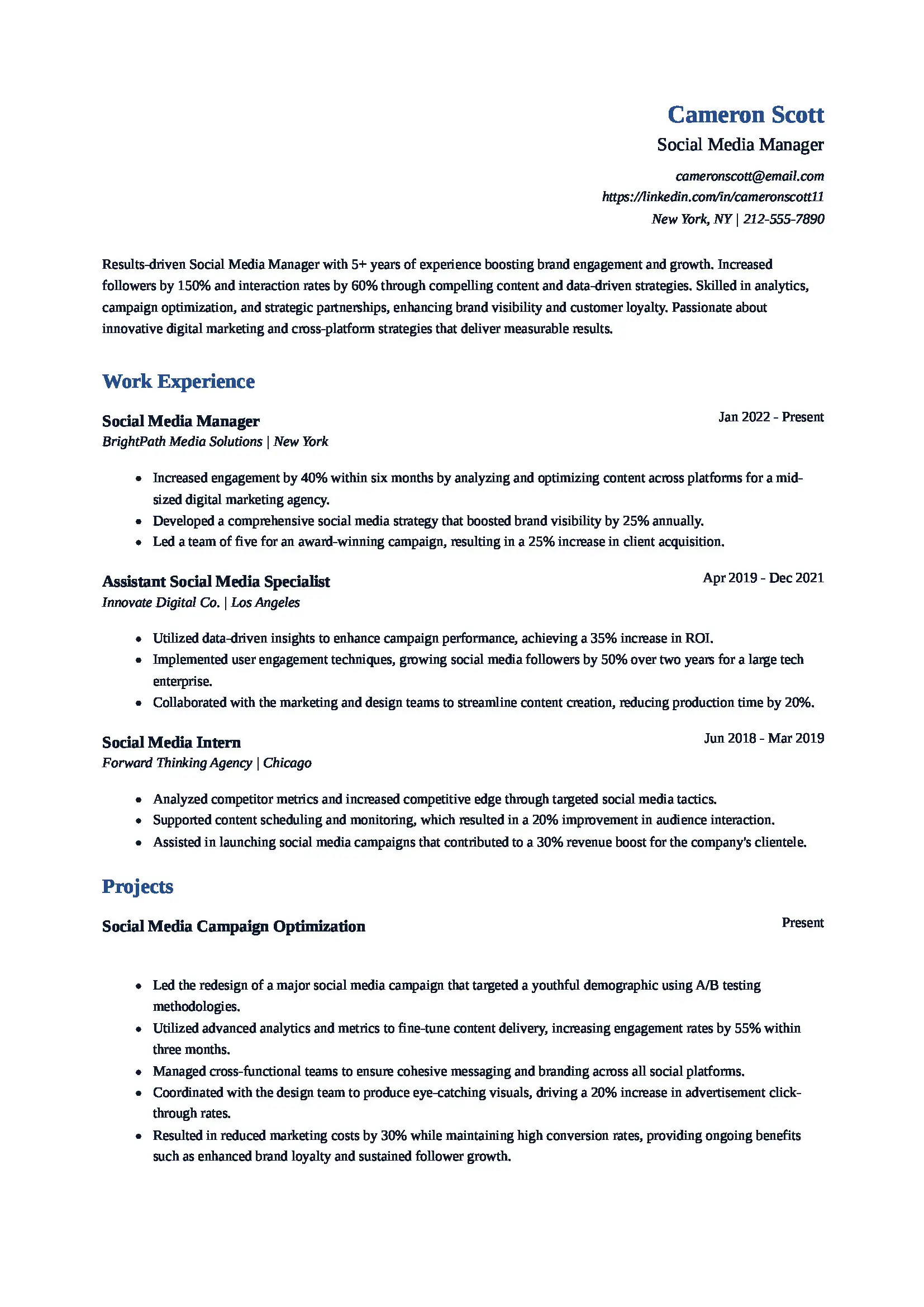
Landing your dream social media manager job requires more than a skills list; it demands proof of your impact. Your resume should show real impact, just like this strong example resume shared below. Use it as a guide to write a resume that stands out.
A winning resume should highlight strategy, analytics, and creativity. Employers look for candidates who can boost brand visibility, optimize campaigns, and collaborate across teams. Showcase metrics-driven success, social media expertise, and leadership skills to prove you’re the right fit for the role.
This social media manager resume stands out by combining measurable achievements, strategic planning, and an ATS-friendly format that’s easy to scan. The projects section is a game-changer, showcasing real-world success in social media growth, A/B testing, and data analysis, proving the candidate’s ability to optimize social media channels effectively.
Further, the education section reinforces credibility, with a strong track record in digital marketing and leadership roles. This resume isn’t just a list of jobs—it tells a compelling story of expertise, adaptability, and results-driven impact, making it an ideal example for job seekers aiming to impress recruiters.
Social media marketing resume example
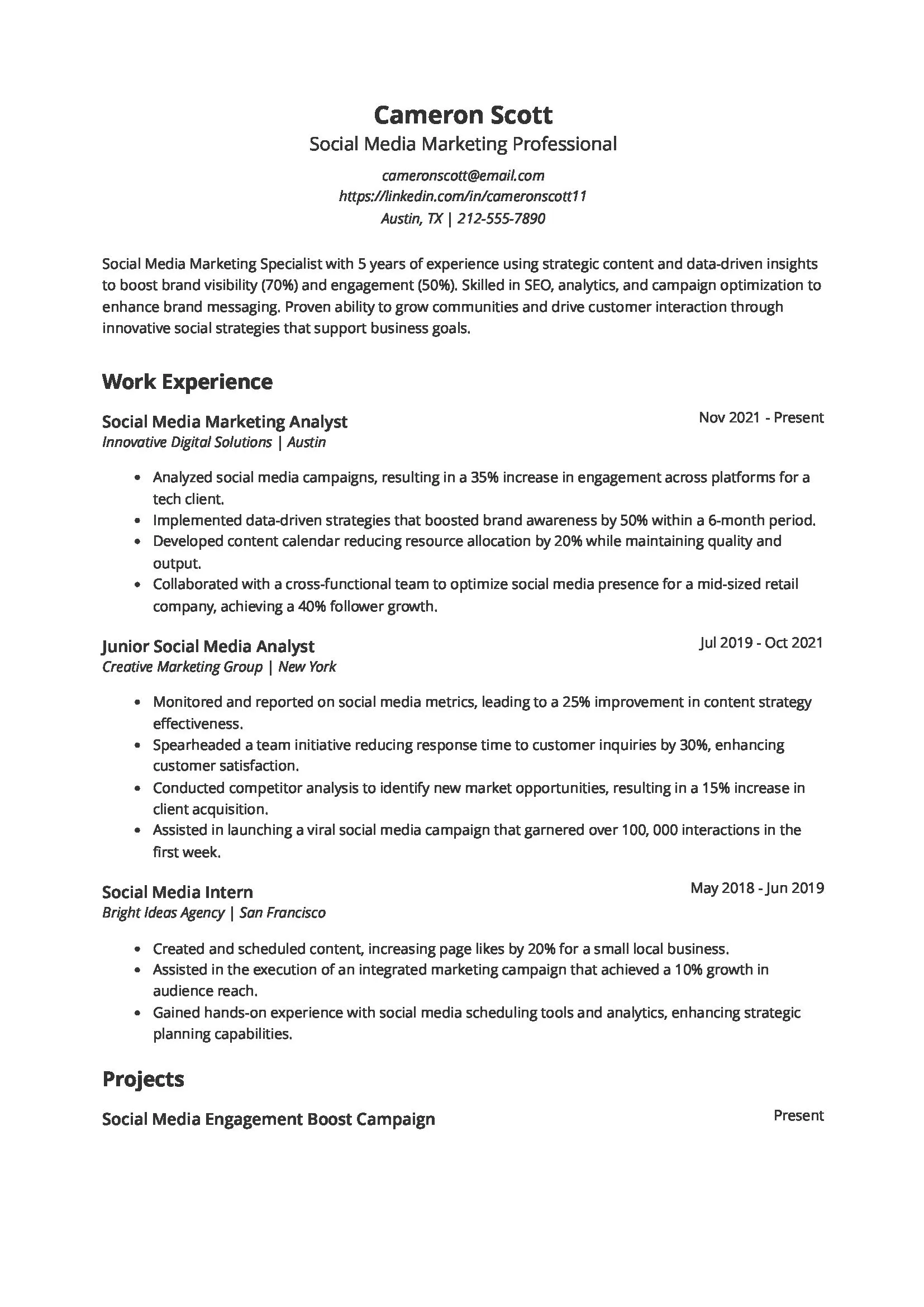
Feeling overwhelmed by the social media job hunt? You’re not alone. It’s tough to show your impact in a way that truly resonates. That’s why we’re sharing a social media marketing resume—it’s a fantastic example of how to showcase your social media prowess.
For a social media marketing manager role, your resume should highlight analytics, SEO, content strategy, and audience engagement. Show measurable results, collaboration skills, and adaptability. Employers seek candidates who analyze data, manage campaigns, and drive brand success. Keep it clear, results-driven, and tailored to the job.
A recruiter’s first impression starts with the professional summary, and this one instantly delivers. It highlights technical skills like search engine optimization, data analysis, and campaign optimization, which are essential for a social media marketing manager role. The candidate’s ability to boost brand visibility by 70% and engagement by 50% makes this resume results-driven and compelling.
With a solid mix of content marketing, audience growth strategies, and collaboration with a marketing team, this resume positions the candidate as an individual ready to thrive in today’s evolving social platforms landscape.
Social media coordinator resume example
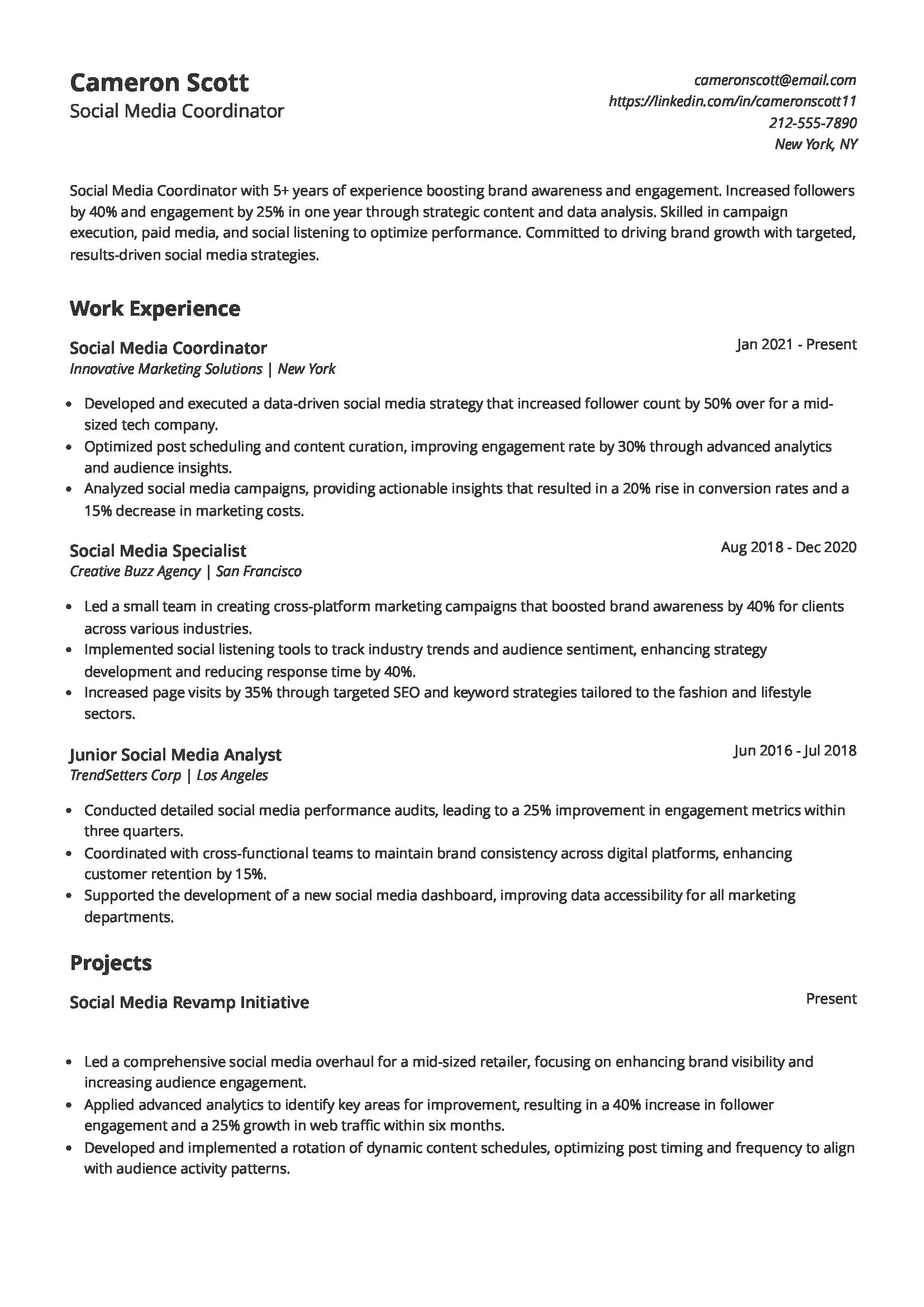
Breaking into the social media field? Your resume should prove you can increase engagement, analyze data, and create content that connects with audiences. Not sure where to start? Use our resume example as a guide to write a compelling, results-driven application.
A great social media coordinator resume highlights strategy, analytics, and creativity. Employers want candidates who can manage campaigns, track performance, and drive brand growth. Showcase measurable results, platform expertise, and problem-solving skills to stand out. Keep it clear, concise, and tailored to the job.
The core skills section of this resume highlights the candidate’s expertise in social listening, SEO, audience engagement, and analytics, making it a powerhouse for any social media coordinator role. Additionally, HubSpot Social Media Marketing and Hootsuite Social Marketing certifications prove a commitment to industry best practices.
With a balance of brand awareness, campaign execution, and cross-functional collaboration, this resume presents the candidate as well-equipped to elevate any company’s social presence.
Social media content creator resume example
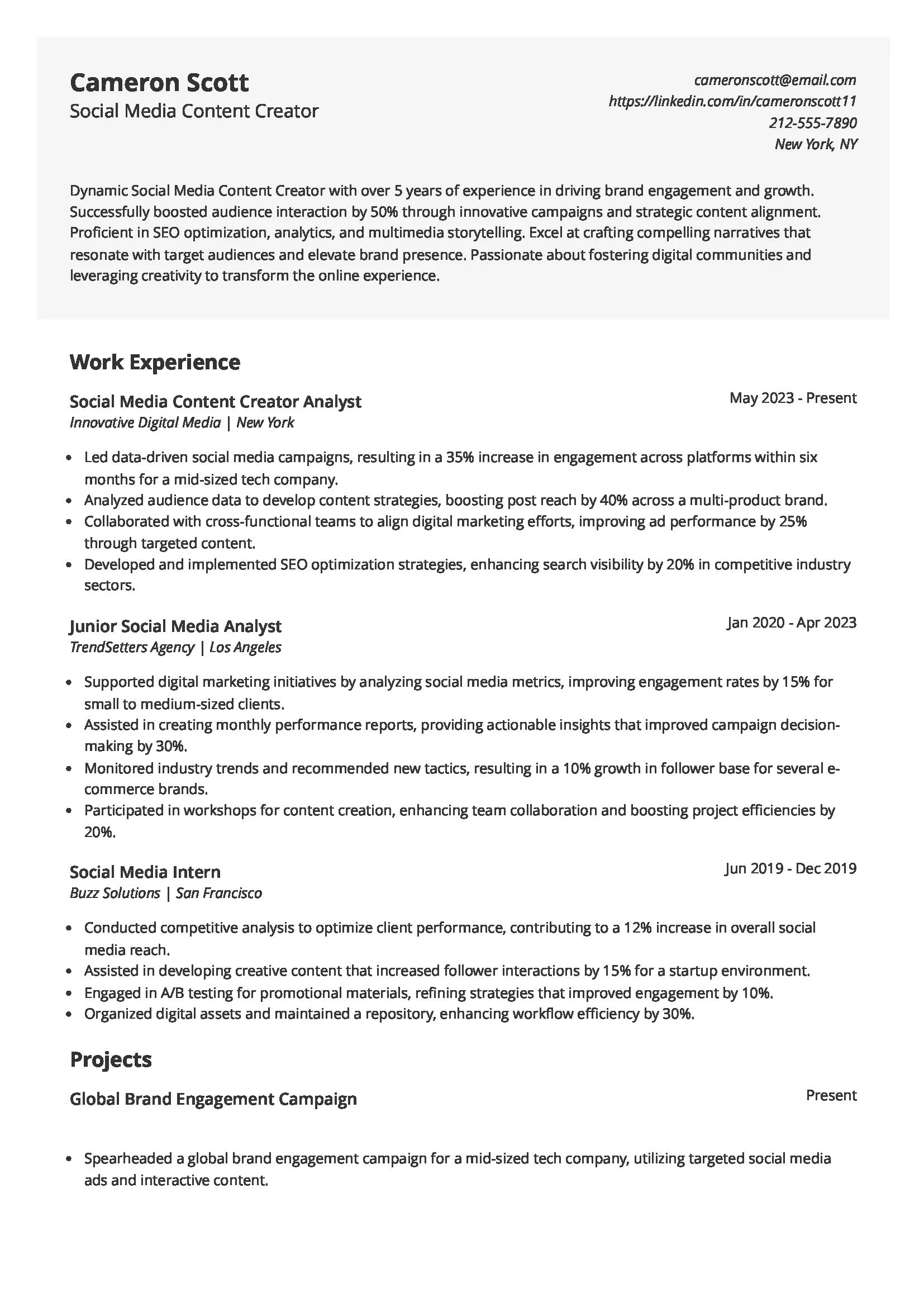
If you are looking for a social media content creator role and are unsure how to frame your experience, below is an excellent resume example of how to highlight measurable success in engagement, content strategy, and audience growth.
For this role, employers seek candidates who can analyze trends, optimize content for SEO, and create engaging multimedia. Showcase your storytelling skills, platform expertise, and ability to drive brand visibility with real metrics to make your resume stand out.
Driving engagement requires more than just creativity—it demands strategic execution and measurable impact. This resume reflects both, with a work experience section demonstrating expertise in SEO optimization, data-driven content strategies, and audience segmentation.
Tangible achievements, such as a 40% increase in post reach and a 25% boost in ad performance, showcase the candidate’s ability to deliver results. The projects section further reinforces this by highlighting a global brand engagement campaign, proving leadership, collaboration, and an innovative approach to digital storytelling.
How to write a social media manager resume that will get you an interview
If you want your social media manager resume to land in the hands of hiring managers, you need to understand one crucial thing: Applicant Tracking Systems (ATS).
An ATS is a software tool that many companies use to streamline the hiring process. Think of it like a search engine for resumes. When recruiters are looking for candidates, they don’t manually sift through stacks of applications. Instead, they enter relevant keywords into the ATS, which pulls up resumes matching those terms.
For example, if a company is hiring a social media manager, they may search for terms like “social media strategy,” “content creation,” or “Google Analytics.” Resumes that contain these keywords will appear in the search results, while those missing them may never be seen.
Let’s understand the complete process:
- Employers enter job details, including job title, required skills, and qualifications.
- The ATS scans submitted resumes, analyzing and storing relevant information in the database.
- Hiring managers can search for specific keywords or review ranked candidate results.
Writing an ATS-friendly resume can be challenging, but tools like Jobscan make it easier.Jobscan’s free resume builder helps you create an optimized resume from scratch, ensuring it meets ATS requirements while highlighting your strengths. Try it now to increase your chances of landing interviews and securing your dream job.

Key elements of a social media manager resume
In this section, we have discussed some key elements of a social media manager resume! Continue reading to learn more.
- Contact information: Include your name, phone number, email address, and LinkedIn profile to make it easy for recruiters to reach you.
- Professional summary: A concise, compelling summary highlighting your experience, core skills, and achievements in social media management.
- Skills section: List key skills such as content creation, social media strategy, analytics, paid advertising, and community engagement.
- Work experience: Detail your previous roles, focusing on responsibilities and measurable achievements, such as increased engagement or follower growth.
- Education: Include your degree, certifications, and any relevant coursework in marketing, communications, or related fields.
- Certifications & training: Highlight certifications like Meta (Facebook) Blueprint, Google Analytics, or HubSpot Social Media Marketing to showcase your expertise.
Write a strong professional summary
Your professional summary, also known as a resume summary or career summary, is your elevator pitch on paper. It’s a concise, compelling paragraph at the top of your resume that highlights your key skills, experience, and career goals. Its purpose is to grab the hiring manager’s attention and persuade them to read further.
Good examples of a resume summary
- “Results-driven Social Media Manager with 5+ years of experience developing and executing high-impact digital campaigns. Skilled in content creation, paid social advertising, and analytics, leading to a 40% increase in brand engagement. Adept at managing cross-platform strategies and leveraging data insights to optimize performance.”
- “Creative and analytical Social Media Strategist with a strong background in content marketing and data analytics. Successfully led campaigns that increased brand visibility by 40% and social media interactions by 35%. Proficient in Sprout Social, Google Analytics, and cross-platform marketing strategies. Adept at strategic planning, audience segmentation, and community engagement to maximize digital growth.”
Bad examples of a resume summary
- “I love social media and have experience posting on Instagram and Facebook. Looking for an opportunity to work with a fun team and grow my skills.”
- “Experienced in managing Facebook, Instagram, and Twitter. Posted content daily and engaged with followers. Familiar with basic analytics tools.”
Jobscan’s resume summary maker analyzes your resume and the job description to identify key skills and keywords, then generates a tailored summary that highlights your strengths. This feature can help you quickly create a strong and effective summary that will grab the attention of hiring managers and increase your chances of landing an interview. Try this feature of our resume builder today to take your resume to the next level!
Demonstrate key social media manager skills
A great social media manager resume isn’t just about listing experience—it’s about showcasing the right skills that prove you can drive engagement, increase brand awareness, and generate results.
Hard skills for social media manager
- Social Media Strategy & Campaign Management
- Content Creation & Copywriting (Short-Form & Long-Form)
- Paid Social Advertising (Facebook Ads, LinkedIn Ads, TikTok Ads)
- Analytics & Performance Tracking (Google Analytics, Meta Business Suite)
- Community Engagement & Reputation Management
- Influencer Marketing & Brand Partnerships
- SEO & Hashtag Optimization
- Graphic Design Tools (Canva, Adobe Photoshop)
Soft skills for social media manager
- Creativity & Storytelling
- Strong Communication Skills
- Data-Driven Decision-Making
- Adaptability in a Fast-Paced Digital Landscape
- Collaboration & Teamwork
- Problem-Solving & Crisis Management
- Time Management & Ability to Juggle Multiple Campaigns
Highlighting essential social media manager skills in your resume bullet points allows you to showcase your expertise and accomplishments effectively. Below are examples of good and bad social media manager resume bullet points to guide you. Use them as inspiration to create your own!
Write impactful resume bullet points for a social media manager
Resume bullet points are the core of your experience section. They should clearly communicate your skills, the impact you’ve made, and the value you bring to a team. Instead of listing tasks, focus on what you accomplished using specific tools, action verbs, and measurable results. Here’s what that looks like:
Good examples of resume bullet points
- “Developed and executed a content strategy that increased Instagram engagement by 45% and follower count by 30% within six months.”
- “Managed a $50K annual paid advertising budget, optimizing ad performance to achieve a 3.5x ROAS.”
- “Spearheaded a viral TikTok campaign, generating 2 M+ views and a 20% increase in product sales.”
Bad examples of resume bullet points
- “Posted content on Instagram and Facebook regularly.”
- “Ran some ads to get more engagement.”
- “Helped with social media marketing.”
Let’s be real—writing powerful, results-driven bullet points can be time-consuming and frustrating. That’s where Jobscan’s resume bullet point generator comes to the rescue. Simply input your experience, and it writes keyword-optimized, impactful resume bullet points that recruiters want to see. No more struggling to phrase your achievements—Let Jobscan do it for you.
Highlight your achievements as a social media manager
Recruiters prioritize demonstrable impact over mere task descriptions. Therefore, when articulating your social media management experience, focus on measurable achievements. Emphasize how your strategies directly contributed to brand growth, heightened audience engagement, or increased revenue streams. By quantifying your successes, you provide concrete evidence of your ability to drive tangible results, showcasing your value as a strategic social media professional.
Here are some examples of how to showcase your achievements effectively:
- “Increased Instagram engagement by 60% and grew followers from 10K to 50K in 12 months through a targeted content strategy and influencer partnerships.”
- “Managed a $100K annual paid social budget, improving ROI by 40% through A/B testing and audience segmentation.”
- “Developed a viral TikTok campaign that generated 3 M+ views and led to a 25% increase in online sales.”
Tailor your resume to the job description
A one-size-fits-all resume won’t cut it—customizing your resume for each job application dramatically increases your chances of getting hired. Employers and Applicant Tracking Systems (ATS) search for specific keywords and skills from the job description. Your resume might never get noticed if it doesn’t match what they’re looking for.
This small effort can make a big difference in landing interviews. Here’s how to do it effectively:
- Analyze the job description: Identify key skills, qualifications, and responsibilities mentioned in the posting.
- Use relevant keywords: To align with ATS requirements, incorporate industry-specific terms like “social media strategy,” “analytics,” or “content creation.”
- Highlight matching experience: Emphasize past roles, projects, and achievements directly related to the job’s requirements.
- Customize your summary: Tailor your professional summary to reflect the company’s goals and the specific role.
- Align your projects section: Feature campaigns or initiatives similar to those the company runs.
- Personalize your cover letter: Reference the company’s mission and how your expertise supports it.
7. Include relevant education & certifications
While hands-on experience is crucial for a social media manager, having the proper education and certifications can give you a competitive edge. A degree in marketing, communications, or a related field can help, but industry-recognized certifications prove your expertise in social media strategy, advertising, and analytics. However, if you don’t have a formal degree in marketing or communications, you can highlight relevant coursework, projects, or hands-on experience.
Here’s how you can include your education and certifications:
- List your degree: Include your degree, major, and university, especially related to marketing, communications, or business.
- Highlight relevant coursework: Mention courses like digital marketing, content strategy, social media analytics, or consumer behavior.
- Add industry certifications: Showcase certifications such as Meta (Facebook) Blueprint, Google Analytics, HubSpot Social Media, or Hootsuite Social Marketing.
- Prioritize recent and advanced training: Emphasize ongoing education or specialized certifications that enhance your expertise.
- Include workshops & online courses: If applicable, list relevant training from platforms like Coursera, LinkedIn Learning, or Google Digital Garage.
Top social media manager certifications
- Meta (Facebook) Blueprint Certification
- Google Analytics Certification
- HubSpot Social Media Marketing Certification
- Hootsuite Social Marketing Certification
- Twitter Flight School Certification
- YouTube Certified Program
- LinkedIn Marketing Solutions Fundamentals
Social media manager resume tips
To land your next role, your resume needs to be visually appealing, keyword-optimized, and results-driven. Follow these tips to make your application stand out:
- Use a clean and professional layout: Choose a modern, easy-to-read template with clear headings, bullet points, and white space to enhance readability. Avoid cluttered designs that make your resume hard to skim.
- Tailor your resume to the job description: Incorporate keywords and skills from the job posting to make your resume ATS-friendly and show recruiters you’re the perfect fit for the role.
- Highlight achievements, not just responsibilities: Instead of saying you “managed social media accounts,” showcase impact: “Increased Instagram engagement by 60% through a data-driven content strategy.”
- Quantify your success: Use numbers to back up your accomplishments—mention follower growth, engagement rate improvements, ad ROI, or conversions.
- Showcase technical and soft skills: Balance hard skills like paid advertising, analytics, and SEO with soft skills like creativity, communication, and adaptability.
- Keep it concise (1-2 Pages max): Recruiters spend just a few seconds on each resume. Stick to the most relevant experience and skills, and remove unnecessary details.
- Add links to your portfolio or social profiles: If applicable, include links to your LinkedIn, personal website, or portfolio showcasing successful campaigns, content samples, or case studies.
- Include certifications to boost credibility: Certifications like Meta Blueprint, Google Analytics, and HubSpot Social Media Marketing demonstrate your expertise and commitment to professional growth.
- Proofread for grammar and formatting errors: Even minor mistakes can make a bad impression. Use Grammarly or have a friend review your resume before submitting it.
Include a cover letter with your social media manager resume
A strong cover letter can set you apart from other candidates by adding a personal touch to your application. While your resume highlights your skills and achievements, your cover letter allows you to tell your story, showcase your passion for social media, and explain why you’re the perfect fit for the role.
Here are a few things you must include in your cover letter:
- A strong opening that grabs attention.
- Specific achievements and how they align with the company’s goals.
- Why you are excited about the role and the brand’s mission?
- A compelling call to action, encouraging the hiring manager to connect.
Writing a compelling cover letter, however, can be time-consuming. That’s where Jobscan’s cover letter creator can streamline the process. It takes the stress out of the process by writing a customized, professional cover letter in seconds, optimized for the job description.
Final thoughts
Writing a standout Social Media Manager resume in 2025 isn’t just about listing experience—it’s about telling your story, showcasing impact, and proving you can drive engagement in a fast-evolving digital world. You’ll position yourself ahead of the competition by tailoring your resume, quantifying your achievements, and optimizing it for ATS.
Ready to land your dream job? Fine-tune your resume, perfect your cover letter, and boost your chances with Jobscan. Start optimizing now and get hired faster!

Social media manager common interview questions
Answer:
“I start by understanding the brand’s goals—increasing engagement, driving website traffic, or boosting conversions. Then, I conduct audience research to identify key demographics and their behaviors. Next, I perform a competitor analysis to see what’s working in the industry. Based on this, I develop a content plan that aligns with the brand’s voice and utilizes organic and paid strategies. Finally, I set KPIs, track performance using tools like Google Analytics and Meta Business Suite, and adjust the strategy based on data insights.”
Answer:
“I measure success by aligning KPIs with campaign objectives. If the goal is brand awareness, I track metrics like reach, impressions, and follower growth. I monitor likes, shares, comments, and save rates for engagement-focused campaigns. If conversions are the target, I analyze click-through rates (CTR), conversion rates, and return on ad spend (ROAS). I use tools like Google Analytics, Meta Insights, and UTM tracking to assess performance and refine strategies accordingly.”
Answer:
“First, I assess the situation to determine if it’s a genuine complaint, a misunderstanding, or trolling. For valid concerns, I respond promptly and professionally, acknowledging the issue and offering a solution. If necessary, I take the conversation offline. In the case of a larger crisis, I collaborate with internal teams to write a transparent response that aligns with the brand’s values. Monitoring sentiment and responding promptly and empathetically is key to maintaining brand reputation.”
Answer:
“It depends on your target audience and business goals. For a B2B brand, LinkedIn would be a priority due to its professional networking capabilities. For an e-commerce brand, Instagram and TikTok are essential for visual storytelling and influencer collaborations. If customer service is a focus, Twitter is great for real-time engagement. I would analyze your audience insights and competitors to determine which platforms will impact your brand most.”
Answer:
“Yes, I have experience managing paid campaigns on Facebook, Instagram, LinkedIn, and TikTok. To optimize ad performance, I start with audience segmentation and A/B testing different creatives and ad copy. I monitor key metrics like CTR, CPC, and ROAS, making adjustments based on performance data. I also refine targeting using lookalike audiences, retargeting strategies, and budget allocation to maximize ad spend efficiency.”
Social media manager resume frequently asked questions
Your resume should highlight hard and soft skills that demonstrate your ability to grow a brand’s online presence. Key hard skills include social media strategy, content creation, analytics, paid ads, SEO, and platform expertise. Important soft skills include creativity, adaptability, communication, and trend awareness. Tailor your skills to the job description to stand out.
List your degree, university, and graduation year under the education subheading. If unrelated to marketing, highlight relevant coursework or certifications like Meta Blueprint, Google Analytics, or HubSpot to showcase industry expertise.
Highlight transferable skills from personal projects, freelance work, internships, or volunteering. Showcase content creation, engagement growth, or strategy implementation with metrics. Certifications and a strong social media presence can boost credibility.