Best SEO Specialist Resume Examples for 2026
An SEO specialist resume needs to prove organic results, not just list tools. See 2026 SEO specialist resume examples and the keywords ATS scan for.



SEO specialists grow a site’s organic visibility, turning keyword research, technical fixes, and content optimization into rankings, traffic, and revenue. The role spans three fronts at once: on-page work like titles and internal linking, technical health like crawlability and site speed, and content that earns links and answers real search intent. Whatever you focus on, your resume has to show you can move the metrics that matter, not just run audits.
Hiring managers skim an SEO resume for proof. They want to see outcomes (organic traffic up 60 percent, a page-one ranking won, conversions lifted from search) tied to the work that produced them. Before a person reads it, though, an applicant tracking system scans for the right signals: tools like Google Search Console, GA4, Ahrefs, and Semrush, skills like technical SEO, keyword research, and link building, and role keywords pulled straight from the job description. A resume that clears the ATS and frames your results clearly is what earns the interview.
The five examples below show how SEO professionals at every level present their experience, from a first specialist role to senior strategy and management. Use them as a starting point, then run your own resume through Jobscan to match it against the job description and surface the keywords you are missing before you apply.
Ready to build yours? Try our ATS-friendly resume builder or scan your draft against the job description.
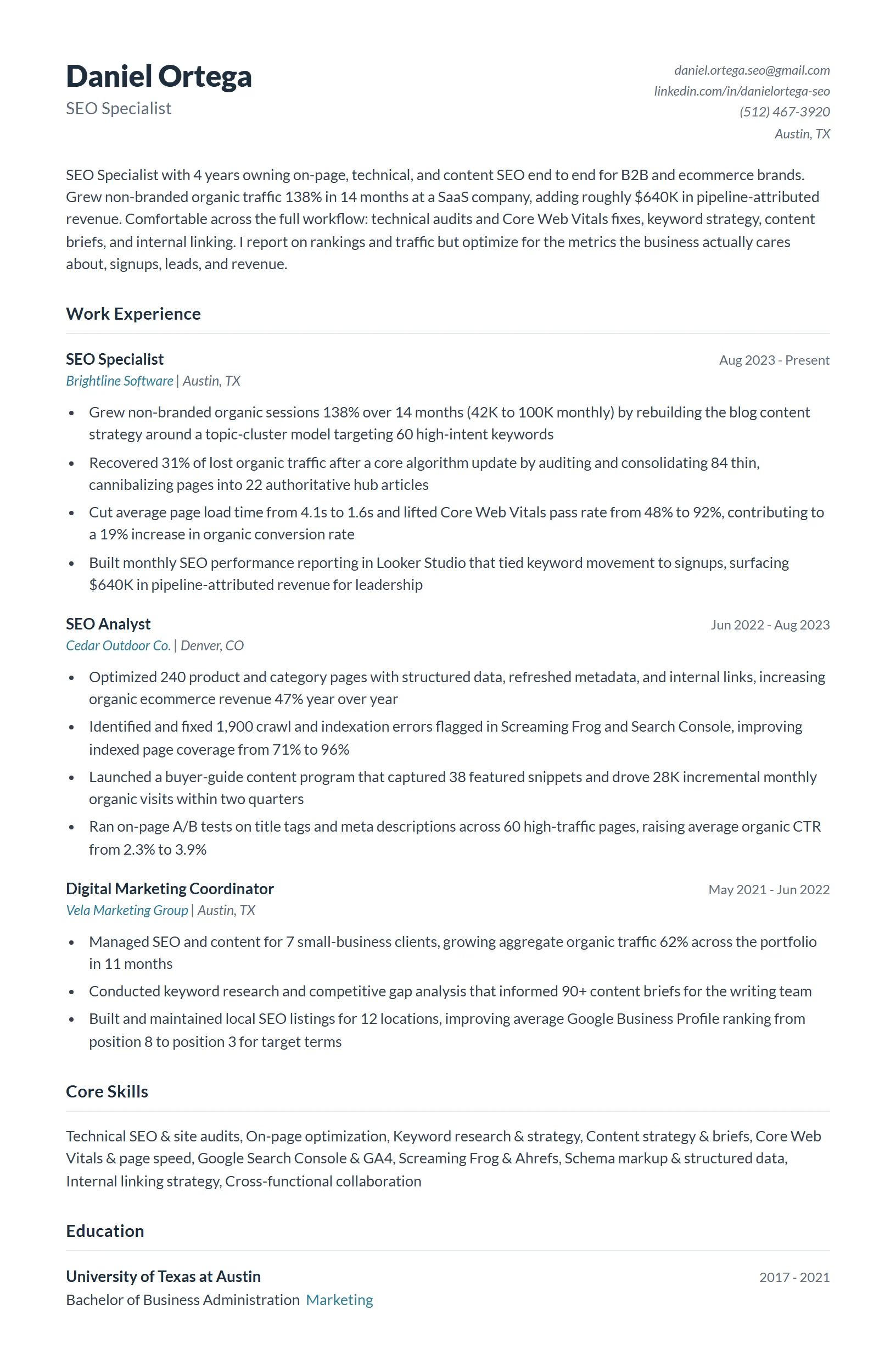
SEO Specialist resume example
Not sure how to fit technical, on-page, and content work onto one page without it reading like a tool checklist? This SEO specialist resume example shows how to balance breadth with concrete results.
This resume works because it pairs each initiative with a measurable outcome, like a 60 percent lift in organic sessions or a cluster of keywords moved to page one, instead of just naming tasks. It leads with a focused skills section that surfaces ATS keywords such as technical SEO, keyword research, and Google Search Console, then backs them up with experience that shows the full optimization process. A clean, single-column format keeps it easy for both recruiters and the ATS to scan.
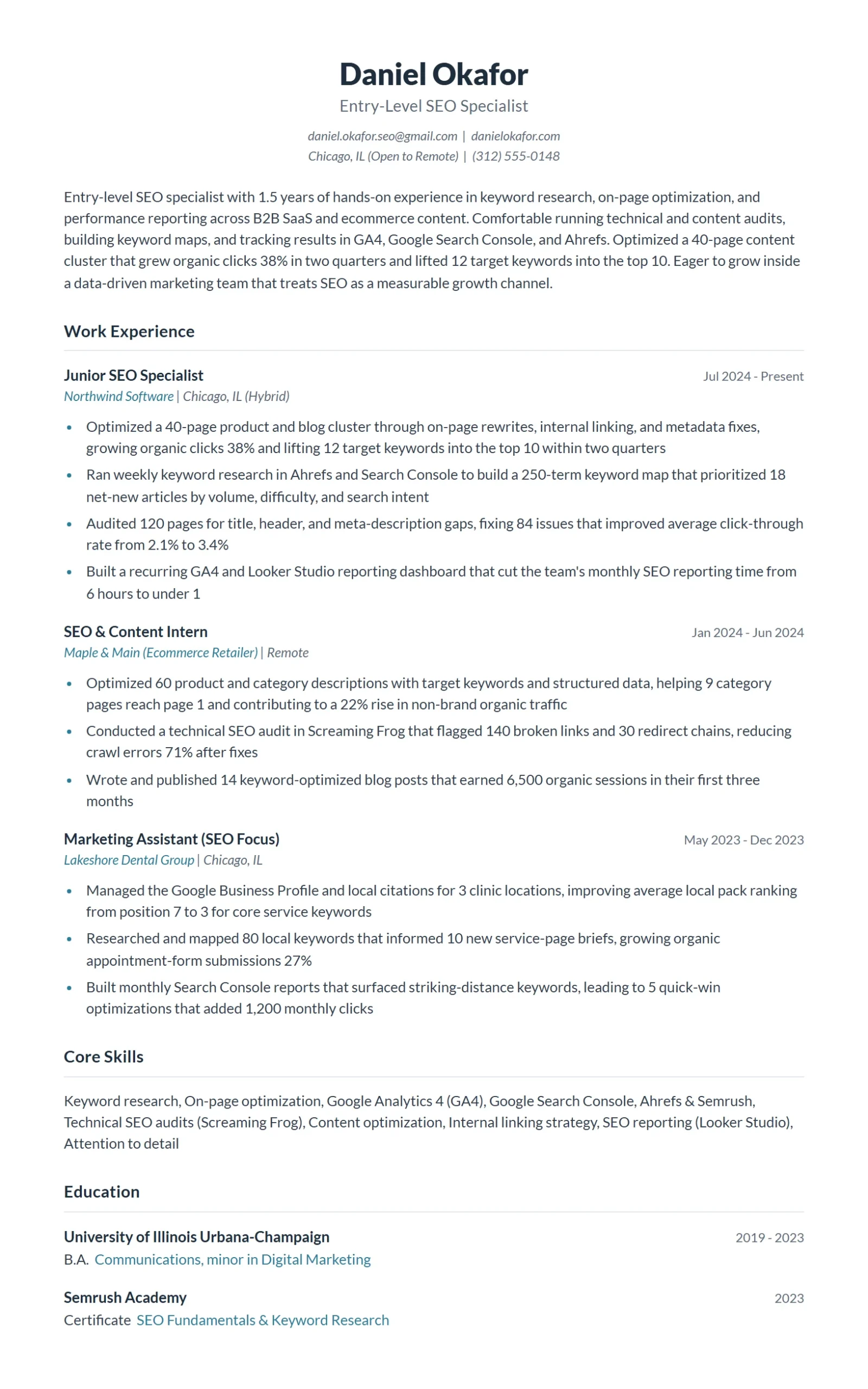
Entry-Level SEO Specialist resume example
Breaking into SEO with limited paid experience? This entry-level SEO specialist resume example shows how to turn coursework, internships, and side projects into credible proof.
This resume works because it leads with demonstrated skills and tool fluency rather than years on the job, featuring keyword research, on-page optimization, and reporting in GA4 and Search Console. It quantifies early wins, like growing a personal blog’s organic traffic or improving a client’s page rankings during an internship, so a thin work history still reads as results-driven. Certifications and a clear skills section give the ATS plenty to match against.
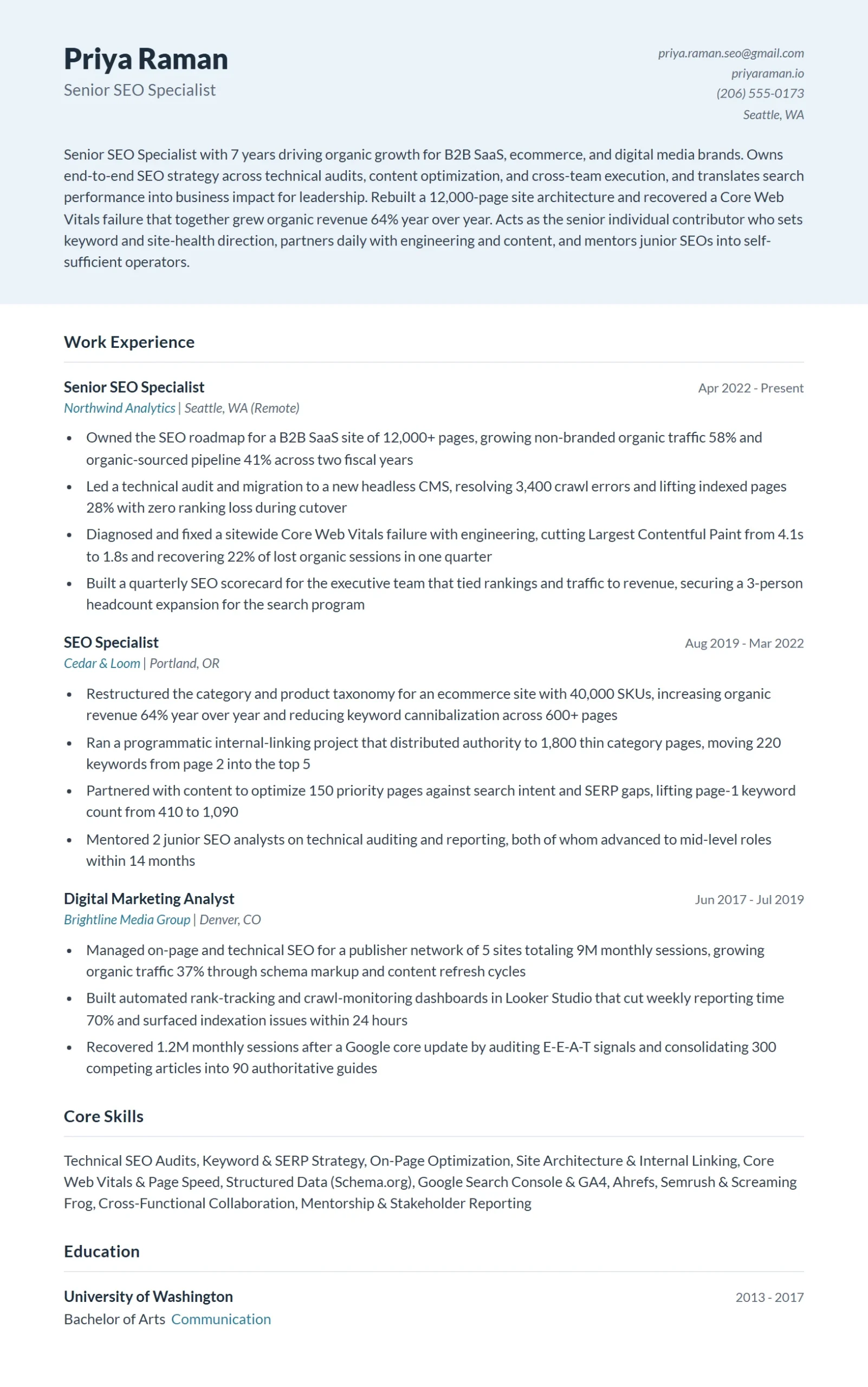
Senior SEO Specialist resume example
Stepping into a senior role means showing strategy and ownership, not just execution. This senior SEO specialist resume example frames experience around impact and leadership.
This resume works because it opens with a strategic summary and leads each role with business outcomes, like recovering traffic after an algorithm update or driving a multi-quarter organic growth program. It demonstrates depth in technical audits and cross-team execution while signaling mentorship and influence with leadership. The keywords stay senior-level (SEO strategy, technical audits, growth) so the ATS reads it as a fit for higher-scope roles.
SEO Analyst resume example
Want to position yourself around data and measurement rather than hands-on optimization? This SEO analyst resume example centers performance analysis and reporting.
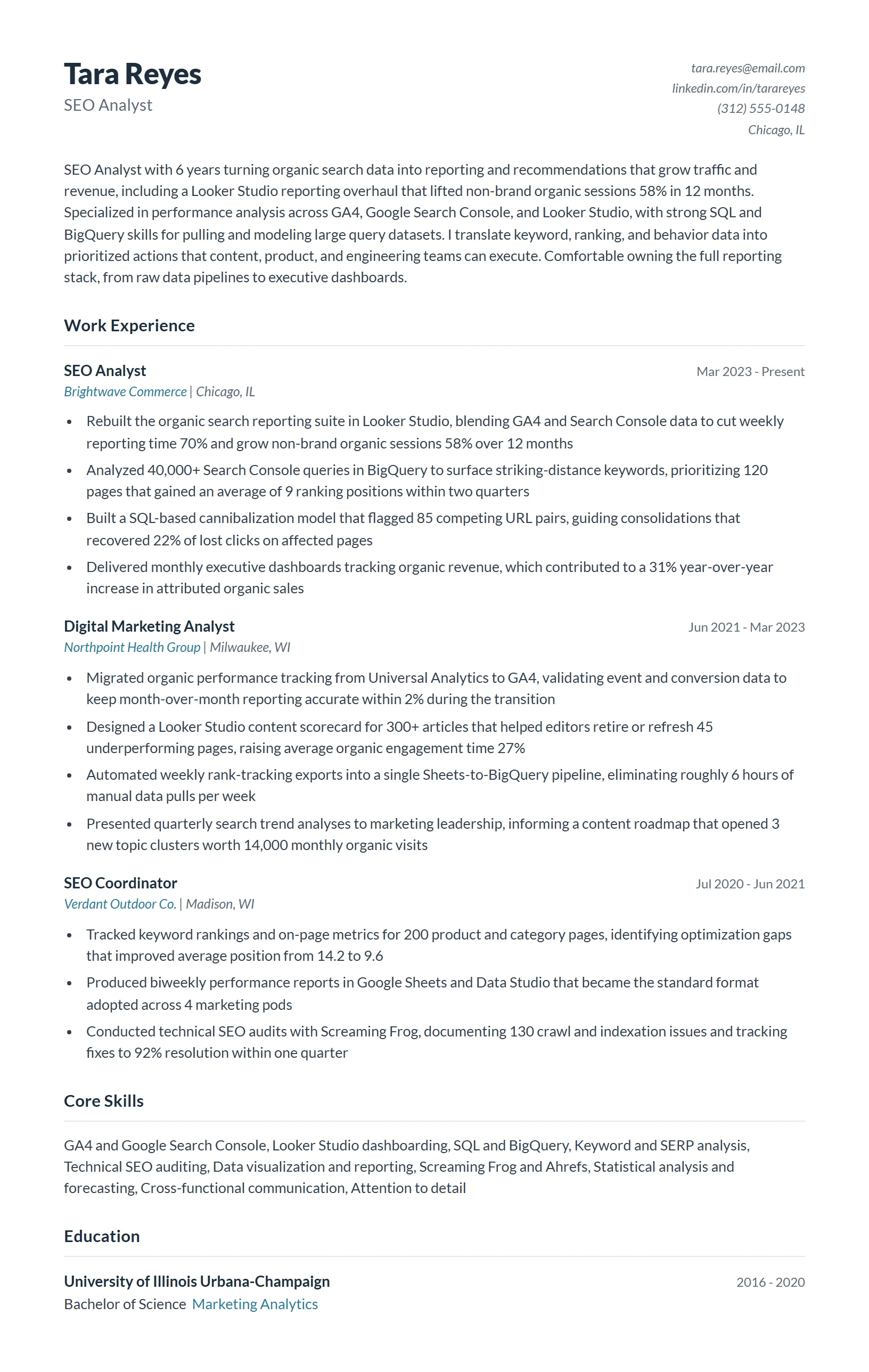
This resume works because it foregrounds analytical impact, showing how search data turned into recommendations that leadership acted on. It surfaces tools that matter for the role (GA4, Looker Studio, Search Console, and SQL) and pairs them with outcomes like identifying a content gap that captured thousands of new monthly visits. The structure reads more like an analyst’s than a generalist’s, which signals fit to both the recruiter and the ATS.
SEO Manager resume example
Moving from doing the work to owning the strategy and the team? This SEO manager resume example shows how to lead with roadmap ownership and managed results.

This resume works because it frames experience around scope and leadership: owning an SEO roadmap, managing specialists or agencies, and reporting organic growth to executives. Each role leads with program-level outcomes, like building an SEO function from scratch or scaling organic revenue, rather than task lists. Management keywords (SEO strategy, team leadership, stakeholder reporting) tell the ATS this is a leadership-level resume, not an individual-contributor one.
How to write a SEO Specialist resume that gets interviews
Hiring managers and marketing leads skim an SEO resume for one thing: proof that your work moved real numbers. They want rankings, organic traffic, and revenue tied to specific projects, not a list of tools and certifications. Most companies also run your resume through an Applicant Tracking System (ATS) first, so the language has to mirror the job description before a human ever reads it. The tips below show you how to do both: clear the ATS scan and convince the marketer reading next.
- Lead with traffic and revenue, not tasks: Anyone can say they “managed SEO.” Show the result: “grew organic sessions 142% in 12 months,” “drove 3.1M annual organic visits worth an estimated $480K in equivalent paid spend,” or “moved 28 target keywords from page 2 into the top 3.” Tie your work to the metrics SEO is judged on: organic traffic, keyword rankings, organic-attributed revenue or leads, click-through rate, and conversion rate. If you cannot share absolute numbers under NDA, use percentages and relative lift.
- Separate technical, on-page, and off-page SEO so your range is obvious: SEO is a wide discipline, and job descriptions rarely want a generalist who is shallow everywhere. Group your bullets so a hiring manager can see depth: technical work (site audits, Core Web Vitals, crawl budget, schema, indexation), on-page and content (keyword research, content briefs, internal linking, on-page optimization), and off-page (link building, digital PR, authority growth). Showing all three signals you can own a strategy end to end, not just publish blog posts.
- Name your tools, but pair every tool with an outcome: ATS scans for specific terms, so list the stack you actually use: Google Search Console, Google Analytics 4, Ahrefs, Semrush, Screaming Frog, Sitebulb, and Google Looker Studio. Then prove you can drive results with them, not just open them. “Used Screaming Frog to find and fix 1,200 broken internal links, recovering 18% of lost crawl equity” beats a bare tools list every time. Mirror the exact tool names in the posting; if they say “Semrush” and you know it, write Semrush, not “SEO platforms.”
- Show you survived an algorithm update or a migration: Real SEO experience shows up in the hard moments. If you recovered traffic after a Google core or helpful-content update, replatformed a site without losing rankings, or executed a domain migration with clean redirects, feature it. “Led a 4,000-URL site migration with zero ranking loss” or “recovered 60% of traffic within two updates after a helpful-content hit” tells a hiring manager you can operate when the algorithm changes under your feet, which is exactly what they are scared of.
- Speak the business, not just the SERP: Marketing leaders fund SEO that ties to pipeline and revenue, so frame your impact in their language. Connect rankings to conversions, organic traffic to qualified leads or signups, and content to assisted revenue. Use bullets that name the partnership and the payoff: “Partnered with content and dev teams to ship a programmatic SEO template that added 2,400 indexed pages and 90K monthly organic visits.” This signals you can defend an SEO roadmap to a CMO, not just an SEO peer.
- Tailor to the role and keep the format ATS-friendly: A technical SEO role, a content-led SEO role, and an SEO manager role reward different keywords and case studies. Reorder your skills and swap your headline wins to match each posting. Then keep the layout clean: standard section headings (Experience, Skills, Education), no text boxes or multi-column designs that scramble parsing, and a single column. Run it through Jobscan to check your match rate against the job description and surface the keywords you are missing before you apply.

SEO Specialist resume summary examples
Your summary is the first thing a recruiter reads. Lead with your specialty, years of experience, and a quantified win.
Good sEO Specialist resume summary examples
- Data-driven SEO Specialist with 6 years growing organic traffic for B2B SaaS and e-commerce brands. Grew organic sessions 142% in 18 months and drove an estimated $1.2M in organic-attributed pipeline through technical fixes, content strategy, and link building. Fluent in Ahrefs, Semrush, GSC, and GA4, with a track record of surviving core updates without traffic loss.
- Technical SEO Specialist focused on large, complex sites. Owns site audits, Core Web Vitals, schema, and indexation at scale, recently leading a 12,000-URL migration with zero ranking loss and improving crawl efficiency 40%. Pairs Screaming Frog and log-file analysis with a clear roadmap that engineering teams actually ship.
- Content-led SEO Specialist who turns keyword research into traffic and revenue. Built a topic-cluster strategy that lifted blog organic traffic 210% year over year and moved 34 commercial keywords into the top 3. Known for partnering closely with writers and developers to ship work that ranks and converts.
What to avoid
- Hardworking SEO professional passionate about search engines and looking for a great opportunity to grow with an innovative company. (It is all about what the candidate wants, not what they deliver. There is no specialization, no tools, no metrics, and no evidence of impact. A hiring manager learns nothing they can act on.)
- SEO expert with experience in keywords, rankings, and Google who can improve your website traffic and get you to page one. (Vague buzzwords with zero proof. “Improve traffic” and “get you to page one” are promises anyone can type, with no numbers, no tools named, and no track record. It reads as filler the ATS and the recruiter both skip.)
SEO Specialist resume skills
Mirror the exact tools and methods named in each job description, then list your strongest, most role-relevant skills here. This is a quick resume snapshot, so keep it tight rather than dumping every tactic you know.
Hard skills for a sEO Specialist resume
- Keyword Research
- Technical SEO
- On-Page Optimization
- Google Search Console
- Google Analytics 4 (GA4)
- Ahrefs / Semrush
- Screaming Frog
- Link Building
- Content Strategy
- Core Web Vitals
Soft skills for a sEO Specialist resume
- Analytical Thinking
- Communication
- Cross-Functional Collaboration
- Prioritization
- Adaptability
SEO Specialist resume work experience bullet point examples
Lead each bullet with a strong verb and a measurable result.
Good bullet point examples
- Grew organic traffic 142% in 12 months (from 180K to 436K monthly sessions) by rebuilding the site’s topic-cluster architecture and refreshing 60 underperforming pages.
- Led a 4,000-URL platform migration with a full redirect map and post-launch monitoring, retaining 98% of organic rankings and recovering the remaining 2% within six weeks.
- Ran a technical audit in Screaming Frog and GSC that fixed indexation and Core Web Vitals issues across 1,200 pages, lifting mobile organic clicks 31% in one quarter.
- Built a digital-PR link-building program that earned 85 referring domains from DR 60+ sites, raising domain rating from 48 to 61 and pushing 22 commercial keywords into the top 3.
Bad bullet point examples
- Responsible for the SEO of the company website. (“Responsible for” describes a job title, not an accomplishment. It shows no specific action, no tools, and no measurable impact. Lead with a strong verb (Grew, Audited, Led) and end with a result instead.)
- Did keyword research and optimized pages using Ahrefs and Semrush. (Names tasks and tools but no outcome. There is no traffic lift, no ranking change, and no scale. It tells the reader you opened the software but not whether your work actually moved the needle.)
- Helped improve the website’s Google rankings and search visibility. (Vague and unquantified. “Helped improve” hides your actual contribution, and “rankings” with no number proves nothing. Replace it with the specific keywords, positions, or traffic gain you delivered, such as moving 15 terms from page 2 to page 1.)
SEO Specialist resume tips
A strong SEO Specialist resume proves to both algorithms and hiring managers that you can turn search data into measurable business growth.
- Mirror Job Description Keywords: Copy exact phrases from the posting, such as “technical SEO audit,” “keyword research,” or “organic traffic growth,” into your resume so ATS parsers score you as a match before a human reads a single line.
- Lead With SEO Metrics: Anchor every bullet to numbers that SEO hiring managers actually care about: percentage increases in organic sessions, keyword ranking improvements (position moved from X to Y), and revenue or leads attributed to organic search.
- Name Your Tools Explicitly: Spell out every platform in full, including Google Search Console, Google Analytics 4, Ahrefs, Semrush, and Screaming Frog, because ATS systems match on exact tool names and abbreviations can cause misses.
- List Relevant Certifications: Add Google Analytics 4 certification, Google Search Essentials acknowledgment, or Semrush Academy credentials in a dedicated certifications line so ATS and recruiters can confirm technical credibility at a glance.
- Separate Technical From On-Page: Split your skills section into subcategories such as Technical SEO (site speed, crawl budget, structured data) and On-Page Optimization (content strategy, internal linking) so recruiters scanning for a specialist niche find their answer immediately.
- Show Cross-Team Impact: SEO roles require constant collaboration with developers, content writers, and paid search teams, so include at least one bullet that names the team you partnered with and the shared outcome, demonstrating the cross-functional collaboration that separates senior candidates from junior ones.
Pair your sEO Specialist resume with a cover letter
A strong resume goes further with a tailored cover letter. Browse our seo specialist cover letter examples to round out your application.
SEO Specialist resume frequently asked questions
Lead with the technical and analytical skills hiring managers screen for: keyword research, on-page and technical SEO, link building, and content optimization. Name your tools explicitly (Google Search Console, GA4, Ahrefs, Semrush, Screaming Frog) and pair them with measurable wins, like growing organic traffic or improving rankings for target terms. Add the methods that show breadth, such as site audits, schema markup, internal linking, and Core Web Vitals work. Match the exact tools and terms in the job description, since those are often the keywords an ATS scans for.
Tie every bullet to a metric that proves business impact, not just activity. Use numbers like organic traffic growth (“grew organic sessions 64 percent in 9 months”), keyword rankings (“moved 40 priority terms onto page one”), or revenue and leads from organic search. If you cannot share exact figures because of confidentiality, use percentages or ranges instead of raw numbers. Recruiters skim fast, so put the result at the front of the bullet where it gets seen first.
A specialist resume emphasizes hands-on execution: audits, keyword research, on-page changes, and the tools you run daily. A manager resume shifts toward strategy, team leadership, budget ownership, and cross-channel results. If you are targeting a step up, keep your execution proof but add bullets that show you set direction, mentored others, or owned a roadmap. Mirror the level in the job title and summary so both the recruiter and the ATS see the right match.
Yes, and be specific rather than writing “SEO tools.” Applicant tracking systems and recruiters search for exact tool names, so listing Google Search Console, GA4, Ahrefs, Semrush, Screaming Frog, and Looker Studio helps you surface in searches and pass keyword screens. List only the tools you can actually discuss in an interview, and prioritize the ones named in the job posting. Where it fits, show the tool in context, such as “ran technical audits in Screaming Frog that fixed 200 crawl errors.”
Lead with proof of skill rather than job titles. Feature real results from freelance clients, a personal blog or site you ranked, a certification project, or volunteer work, and describe each with the problem, your approach, and the measurable outcome. List certifications like Google Analytics or HubSpot SEO and the tools you have actually used, even in a learning context. A small site you grew from zero traffic often reads stronger than a vague claim of “SEO knowledge.”
It will if you format it for parsing and load it with the right keywords. Use a clean single-column layout, standard section headings (Experience, Skills, Education), real selectable text instead of images, and a .docx or text-based PDF. Naturally work in the exact skills and tools from the job description, since SEO roles are heavy on specific keywords like “technical SEO,” “keyword research,” and named platforms. As an SEO specialist you already think about optimization, so scan your resume against the posting with a tool like Jobscan to confirm your match rate and formatting before you apply.