Best Content Marketing Manager Resume Examples for 2026
Content marketing manager resume examples for 2026 that show campaign metrics, SEO and content strategy wins, plus the keywords ATS scans for.



A content marketing manager owns the engine that turns content into pipeline: editorial planning, SEO, distribution, and the metrics that prove it worked. Your resume has to do the same thing your content does, which is earn attention fast and back every claim with a number.
Hiring managers skim for outcomes, not task lists. They want to see traffic growth, lead volume, ranking gains, and the channels and tools you ran. Applicant tracking systems read first, so the resume has to name the right skills (SEO, content strategy, marketing automation, analytics) in plain language before a person ever sees it.
The examples below show how to do both at once. Use them to frame your wins, mirror the language of the job description, and build a content marketing manager resume that clears the filter and reads like a hire.
Ready to build yours? Try our ATS-friendly resume builder or scan your draft against the job description.
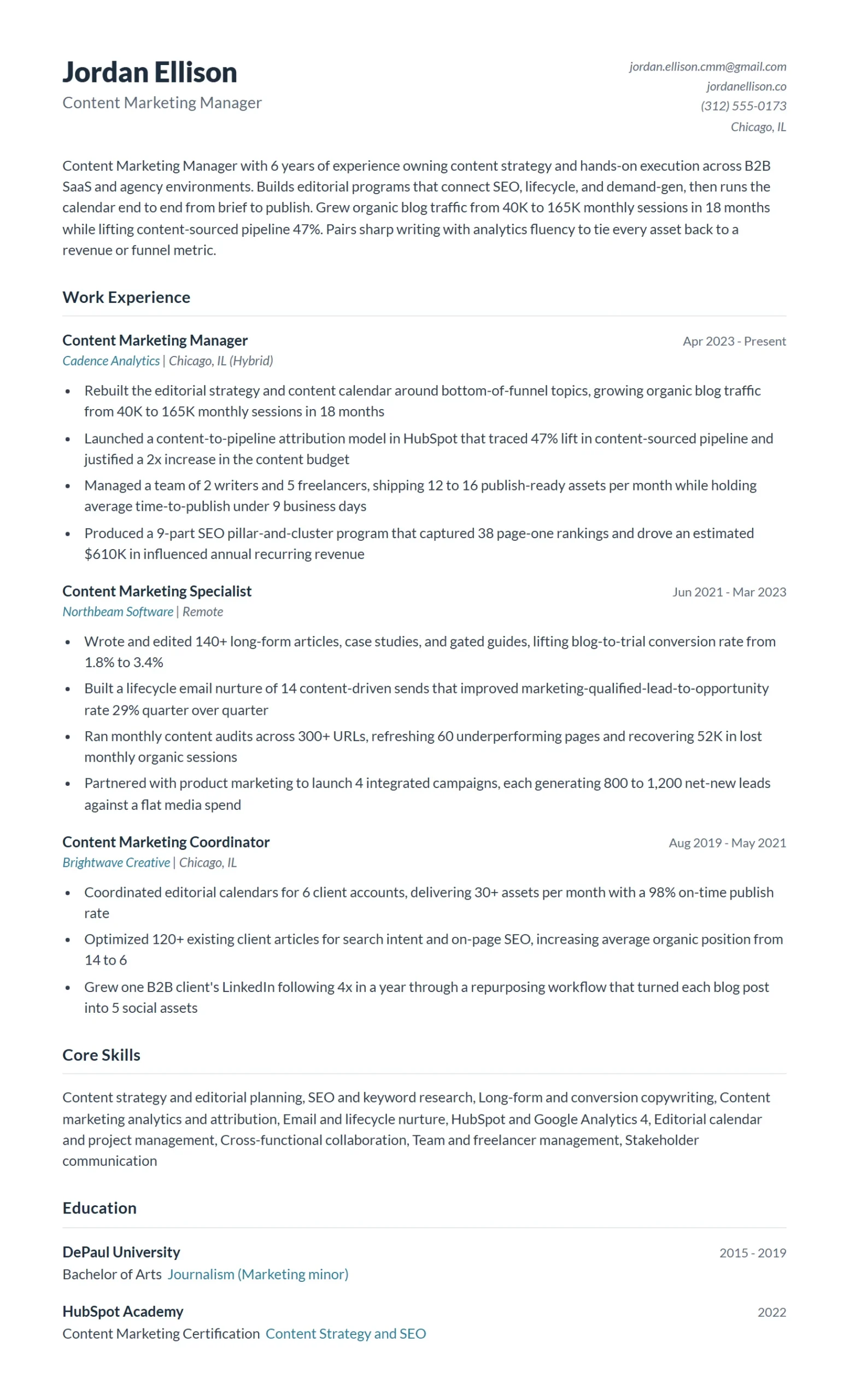
Content Marketing Manager resume example
A full content marketing manager resume built for 2026, with annotated guidance on framing strategy, execution, and results.
This resume works because it leads with outcomes (traffic, leads, rankings) and ties each one to a campaign or program the candidate owned. It names the SEO, analytics, and automation tools recruiters search for, so it reads as strategic to a hiring manager and keyword-complete to the ATS.
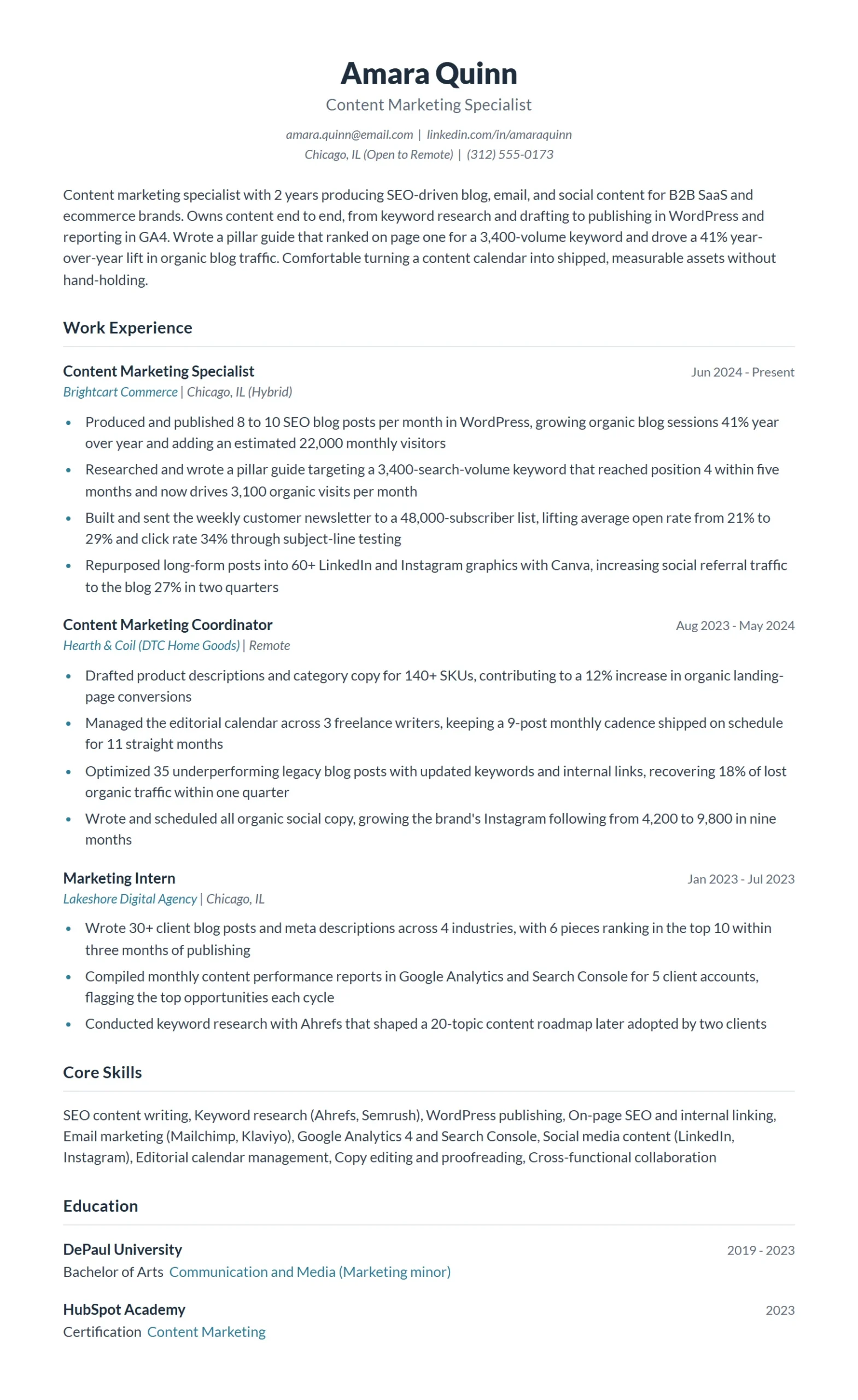
Content Marketing Specialist resume example
An early-career example for specialists ready to step toward management, weighted toward hands-on content production.
A specialist resume earns interviews by quantifying output and impact at the individual-contributor level: articles shipped, keywords ranked, engagement lifted. It signals readiness to manage by showing ownership of a channel or content type, even without direct reports yet.
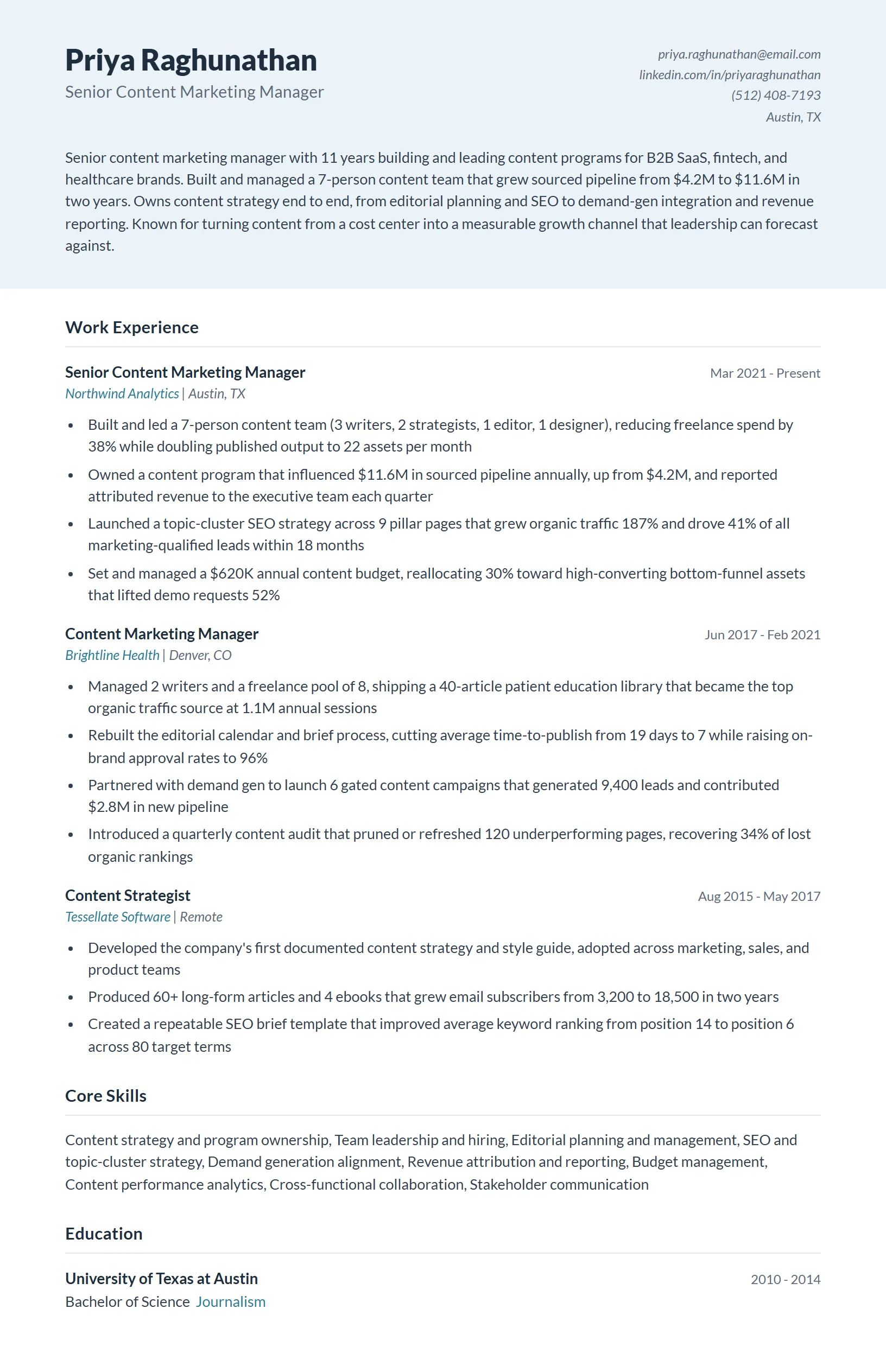
Senior Content Marketing Manager resume example
A senior-level example that adds team leadership, program ownership, and revenue accountability to the core role.
This version proves scope. It pairs content metrics with business outcomes (pipeline influenced, revenue attributed) and shows the candidate building and leading a team. That mix of strategy, leadership, and dollars is what separates a senior hire from a manager.
Content Strategist resume example
A strategy-led sibling example for roles centered on planning, audience research, and editorial direction over campaign execution.

A strategist resume wins by foregrounding frameworks and judgment: content audits, audience and keyword research, editorial roadmaps, and the measurable lift those plans produced. It shows you set direction, not just fill a calendar, which is exactly what these roles screen for.
Content Marketing Director resume example
A leadership example for candidates owning the full content function, including team, budget, and cross-functional strategy.

A director resume reads at the level of the business, not the task. It quantifies team growth, budget managed, and content’s contribution to revenue and brand, then connects content strategy to company goals. Hiring committees look for that altitude plus proof you can lead leaders.
Digital Content Manager resume example
An adjacent example for a broader cross-channel remit spanning web, social, video, and other digital content.

This resume works by showing range across formats and channels while still tying everything to engagement and conversion metrics. It names the CMS, social, and analytics platforms ATS screens for, so a multi-channel background reads as an asset rather than a lack of focus.
How to write a Content Marketing Manager resume that gets interviews
Hiring managers skim a Content Marketing Manager resume for one thing: proof that your content moved the business, not just that you published a lot of it. They want traffic and pipeline tied to numbers, evidence you can own a strategy and a calendar, and signs you can lead writers, freelancers, and cross-functional partners. Most marketing teams also run your resume through an Applicant Tracking System (ATS) first, so the language has to mirror the job description before a human reads it. The tips below show you how to do both: clear the ATS scan and convince the marketing leader reading next.
- Lead with business outcomes, not output volume: Anyone can say they “managed the blog.” Show what the content did: “grew organic traffic 140% in 12 months,” “sourced $1.2M in pipeline from gated content,” or “lifted blog-to-trial conversion from 1.8% to 3.4%.” Tie your work to traffic, leads, pipeline, MQLs, conversion rate, or retention. Volume metrics (posts published, words written) belong in a supporting clause, never as the headline result.
- Prove you own strategy, not just execution: A Content Marketing Manager is hired to set direction. Reference the strategic arc in your bullets: keyword and topic research, editorial calendar ownership, content briefs, distribution across channels, and measurement against a goal. Show you decided what to create and why, then measured whether it worked. A resume that only lists “wrote articles and social posts” reads as a contributor, not a manager.
- Quantify SEO and demand gen results separately: Content marketing splits into two value stories, and hiring managers want both. For SEO and organic, cite rankings, organic sessions, and traffic-driven conversions (“took 30 target keywords to page one,” “3x’d organic-sourced signups”). For demand gen, cite leads, pipeline, and influenced revenue. Naming the exact channel and metric tells a marketing leader which kind of content marketer you are.
- Show you can lead a content engine and a team: Managers manage. Name the writers, freelancers, agencies, and designers you directed and the throughput you unlocked: “Managed 5 freelance writers and an editorial calendar of 12 pieces a month, doubling output without adding headcount.” Include cross-functional partnerships with SEO, product marketing, demand gen, and sales, since CMM roles live at the center of those teams.
- Match tools and keywords to the job description: ATS scans for specific terms. List the stack you actually use (HubSpot, Marketo, WordPress, Webflow, Ahrefs, Semrush, Google Analytics 4, Asana) and the methods named in the posting (content strategy, SEO, editorial calendar, lead generation, content distribution, brand voice). If the role says “demand generation” and you have run gated-content campaigns, use that exact phrase. Skip outdated tools and never keyword-stuff. Recruiters can tell.
- Tailor to the company’s content motion and keep it clean: An SEO-led blog role, a thought-leadership role, and a demand-gen content role reward different keywords and case studies. Reorder your skills and swap your headline results to mirror each posting. Then keep the format ATS-friendly: standard section headings, no text boxes or multi-column layouts that scramble parsing, and one clean column. Run it through Jobscan to check your match rate against the job description before you apply.

Content Marketing Manager resume summary examples
Your summary is the first thing a recruiter reads. Lead with your specialty, years of experience, and a quantified win.
Good content Marketing Manager resume summary examples
- Content Marketing Manager with 7 years building organic-growth engines for B2B SaaS. Grew organic traffic 180% in 18 months and built a content program that sourced $2.4M in pipeline. Owns strategy end to end, from keyword research and editorial calendar to a team of 6 writers, and reports results in HubSpot and GA4.
- Demand-focused content marketer specializing in gated assets and full-funnel campaigns. Built a content-to-MQL system that lifted lead volume 62% and improved blog-to-trial conversion from 1.9% to 3.6%. Pairs SEO discipline with sales alignment to ship content that the revenue team actually uses.
- SEO-led Content Marketing Manager who turns search demand into pipeline. Took 40+ target keywords to page one, tripled organic-sourced signups, and managed a 15-piece-per-month editorial calendar across blog, resource hub, and email. Fluent in Ahrefs, WordPress, and content briefs that scale freelance output.
What to avoid
- Creative content marketing professional looking for an exciting role where I can use my passion for storytelling and grow with a great team. (It is all about what the candidate wants, not what they deliver. There is no specialty, no tools, no metrics, and no evidence the content drove results. A hiring manager learns nothing they can act on.)
- Experienced content manager responsible for blogs, social media, and email with strong writing skills and attention to detail. (Lists channels and adjectives with zero proof. “Responsible for” describes a job description, not impact, and “strong writing skills” is a claim anyone can make. It names no strategy, no results, and no business metric, so the ATS and the recruiter both skip it.)
Content Marketing Manager resume skills
Pull the exact tools and methods from each job description, then mirror that language here. This is a quick resume snapshot, so keep it to your strongest, role-relevant skills rather than an exhaustive list.
Hard skills for a content Marketing Manager resume
- Content Strategy
- SEO (Keyword Research, On-Page)
- Editorial Calendar Management
- Demand Generation
- Content Analytics (GA4)
- HubSpot / Marketo
- WordPress / Webflow CMS
- Ahrefs / Semrush
- Email Marketing
- Copywriting & Editing
Soft skills for a content Marketing Manager resume
- Cross-Functional Collaboration
- Project Management
- Team Leadership
- Stakeholder Communication
- Strategic Thinking
Content Marketing Manager resume work experience bullet point examples
Lead each bullet with a strong verb and a measurable result.
Good bullet point examples
- Grew organic blog traffic from 45K to 126K monthly sessions in 14 months by rebuilding the content strategy around high-intent keyword clusters, driving a 3x increase in organic-sourced trials.
- Built and owned an editorial calendar of 12 pieces per month, managing 5 freelance writers and 1 editor, which doubled publishing output while holding cost per article 30% below the prior agency rate.
- Launched a gated-content and nurture program (ebooks, webinars, email sequences) that generated 1,400 MQLs and sourced $1.8M in pipeline across two quarters.
- Partnered with SEO, product marketing, and sales to launch a comparison-page initiative that ranked for 25 bottom-funnel keywords and lifted demo requests 41%.
Bad bullet point examples
- Wrote and published blog posts and managed the company social media accounts. (Lists tasks with no outcome. There is no metric, no strategy, and no sign the work mattered. It tells the reader what you touched but not whether it moved traffic, leads, or revenue.)
- Responsible for the content calendar and working with the marketing team. (“Responsible for” describes a job title, not an accomplishment. It shows no specific action, no scale (how many pieces, how many people), and no measurable result. Lead with a verb and end with a number instead.)
- Helped increase brand awareness and engagement through high-quality content. (Vague and unquantified. “High-quality” and “brand awareness” are opinions with no proof. Replace them with the metric that backs the claim, such as organic traffic growth, share of voice, or engagement rate with a before-and-after number.)
Content Marketing Manager resume tips
A strong Content Marketing Manager resume proves you grow audiences and pipelines, and these six tips will help yours clear the ATS and land on the hiring manager’s shortlist.
- Mirror Job Description Keywords: Pull exact phrases from each posting (such as “content strategy,” “editorial calendar management,” or “demand generation”) and use them verbatim in your skills section and bullet points, because ATS systems score on literal matches, not synonyms.
- Lead With Traffic Metrics: Prioritize the numbers content leaders care about most: organic sessions, keyword rankings, conversion rate, pipeline influenced, and email open rate, so your impact is immediately legible to a marketing executive.
- Name Your Tools Explicitly: List specific platforms you used (GA4, HubSpot, Ahrefs, Semrush, WordPress, Webflow, Marketo) by their actual product names, because ATS filters and hiring managers both scan for them and abbreviations or vague references will cost you points.
- Add Relevant Certifications: Include certifications such as HubSpot Content Marketing, Google Analytics, or Semrush SEO Toolkit in a dedicated line near your skills, since they signal verified platform fluency and often appear as filters in ATS systems.
- Highlight Editorial Leadership: Specify the size of the teams or freelancer networks you managed and the volume of content you oversaw (for example, “managed five freelance writers producing 20 articles per month”), because this role is evaluated on operational scale, not just writing ability.
- Keep It to One Page or Two: Use one page if you have fewer than seven years of experience and two pages maximum if you have more, because content marketing leaders value concision and a bloated resume signals poor editorial judgment.
Pair your content Marketing Manager resume with a cover letter
A strong resume goes further with a tailored cover letter. Browse our content marketing manager cover letter examples to round out your application.
Content Marketing Manager resume frequently asked questions
Lead with outcomes that tie content to business results, not output counts like “published 50 blog posts.” Quantify organic traffic growth, keyword rankings, lead or MQL generation, email list growth, and influenced pipeline or revenue where you have it. For example, “grew organic blog traffic 140 percent in 12 months” or “built a content engine that sourced 2,300 marketing-qualified leads per quarter.” If you cannot share exact revenue, percentages and before-and-after comparisons still prove impact.
Yes, and they do different jobs. The resume proves you can drive strategy and results, while the portfolio shows the actual quality of your writing and campaigns. Recruiters and ATS software screen the resume first, so put your portfolio or personal site URL in the header next to your email and LinkedIn. Link to 3 to 5 of your strongest pieces, ideally ones with performance data attached.
Blend strategy, execution, and the tools employers scan for. Name your SEO and analytics stack (Google Analytics, Search Console, Ahrefs or Semrush), your CMS and marketing platforms (WordPress, HubSpot, Marketo), and core competencies like editorial planning, content strategy, SEO, copywriting, and team or freelancer management. Mirror the exact tools and phrases from the job description, since an ATS often scans for those specific terms. Round it out with the soft skills the role actually needs: cross-functional collaboration, stakeholder communication, and data-driven decision making.
Write 2 to 3 sentences that name your specialty, your years of experience, and one quantified result that proves your value. For example, “Content marketing manager with 6 years building SEO-led content programs for B2B SaaS, including a strategy that doubled organic traffic and sourced 30 percent of inbound pipeline.” Match the exact job title and a few keywords from the posting so both the recruiter and the ATS see an immediate fit. Skip generic phrases like “passionate storyteller” and lead with evidence instead.
Reframe your experience around strategy and ownership, not just the writing itself. Highlight moments where you set the editorial calendar, owned a channel, managed freelancers or an agency, ran an SEO project, or reported results to leadership. Use bullets that show outcomes and scope, such as “owned the company blog strategy and grew it from 4 to 40 pieces per quarter while lifting conversions 22 percent.” Even informal leadership counts, so surface any time you guided process, mentored a teammate, or drove a cross-team initiative.
Yes, because most companies filter resumes through an ATS before a human reads them. Pull the specific skills, tools, and responsibilities from each job description and work the matching terms naturally into your summary, skills section, and bullets. If a posting emphasizes “demand generation,” “content strategy,” or “HubSpot,” use those exact phrases rather than synonyms. As a content marketer you already understand keyword matching, so apply that same discipline to your own resume.