Best Communications Resume Examples for 2026
Communications resume examples for 2026 across roles like specialist, manager, and PR, with the messaging and media skills hiring managers and ATS look for.



Communications roles cover a wide field, from writing press releases and managing internal messaging to running PR campaigns and shaping a company’s public voice. Whether you are a coordinator, a specialist, or a manager, your resume has to prove you can deliver clear messaging that moves an audience.
Hiring managers want evidence, not adjectives. They look for measurable results (campaign reach, engagement lifts, media placements) and proof you can write, plan, and manage stakeholders. Before a human reads it, an ATS scans your resume for role-specific terms like media relations, content strategy, internal communications, and crisis communications, so the right keywords have to be on the page.
The examples below show how communications professionals at every level structure their resumes, quantify their impact, and use the keywords that clear the filters. Use them as a starting point, then tailor your resume to each job description to give yourself the best shot at an interview.
Ready to build yours? Try our ATS-friendly resume builder or scan your draft against the job description.
Communications resume example
A general communications resume that works across the function, covering writing, messaging, and audience engagement. A strong starting point if your title is simply Communications or you wear several hats.
This resume leads with measurable communication wins instead of vague duties, so the impact is clear in seconds. It balances writing, planning, and stakeholder skills to show range across the function. The skills section pulls in core terms like content strategy and media relations that ATS filters scan for.
Communications Manager resume example
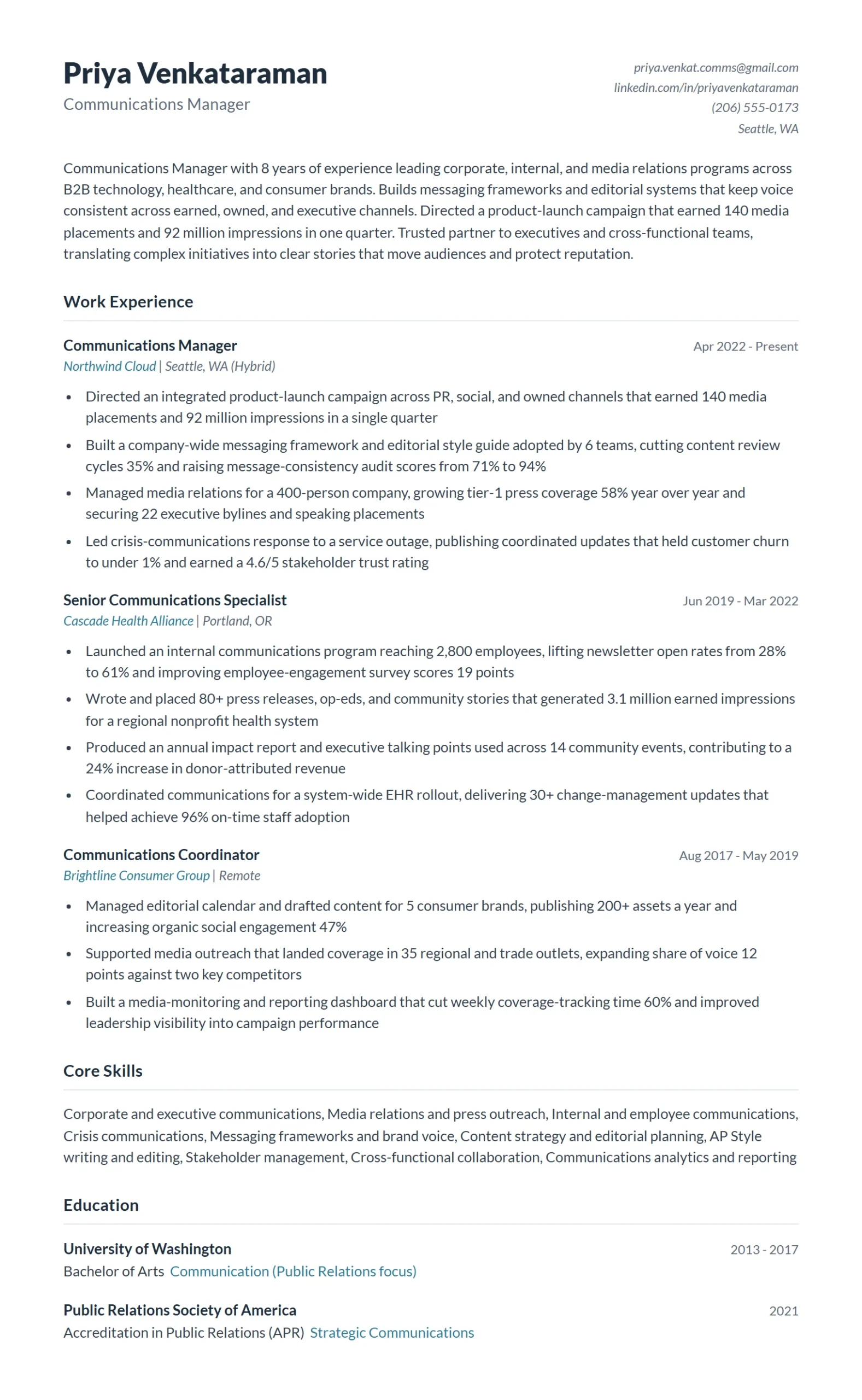
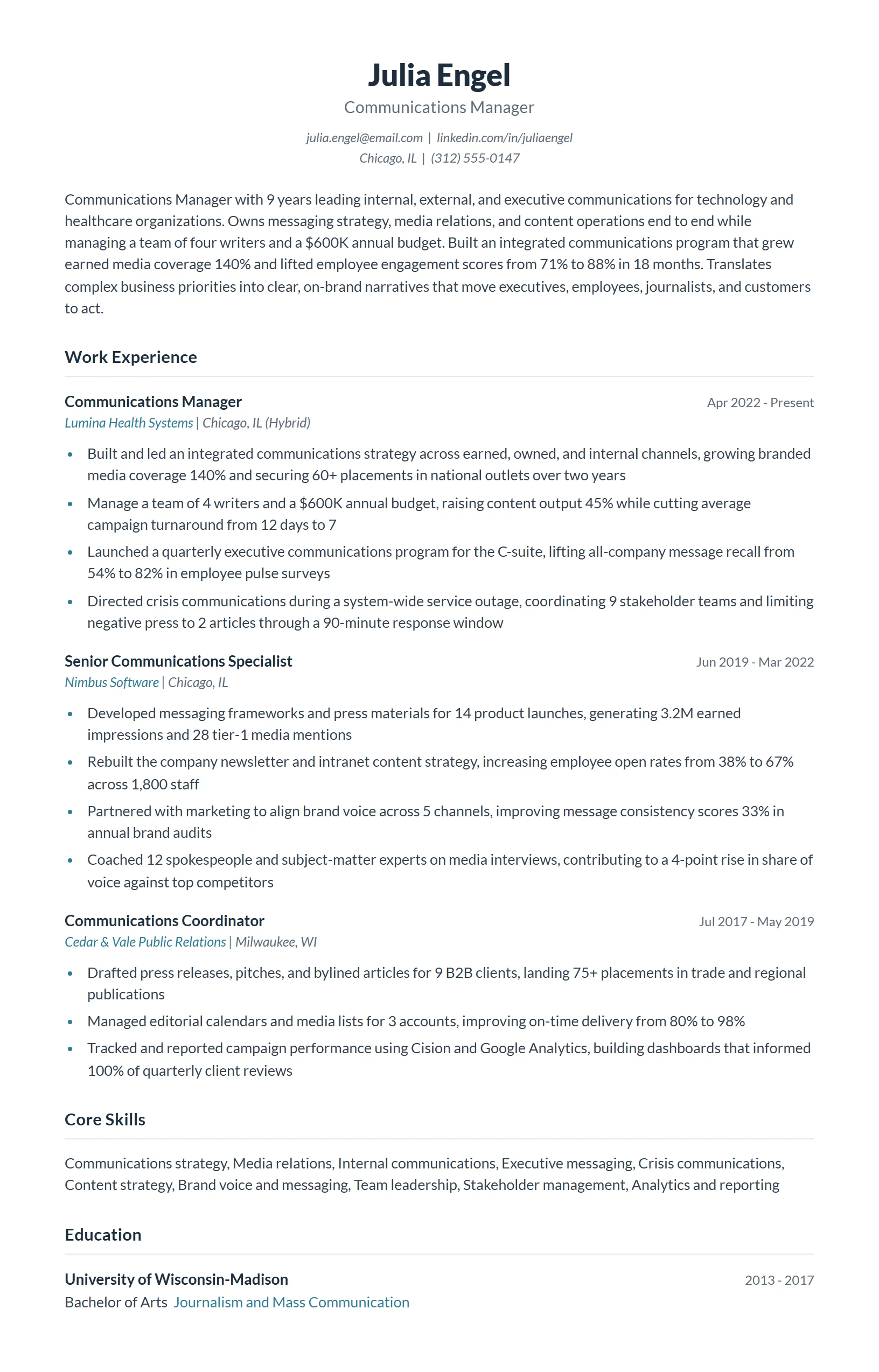
A communications manager resume built for candidates who own strategy and lead a team or program. It pairs hands-on messaging work with leadership and budget results.
This resume shows ownership: campaigns launched, teams led, and budgets managed, with numbers attached to each. It frames the candidate as a strategist who also executes, which is exactly what hiring managers want at this level. Leadership keywords like communications strategy and team management sit alongside the tactical terms ATS expects.
Communications Specialist resume example
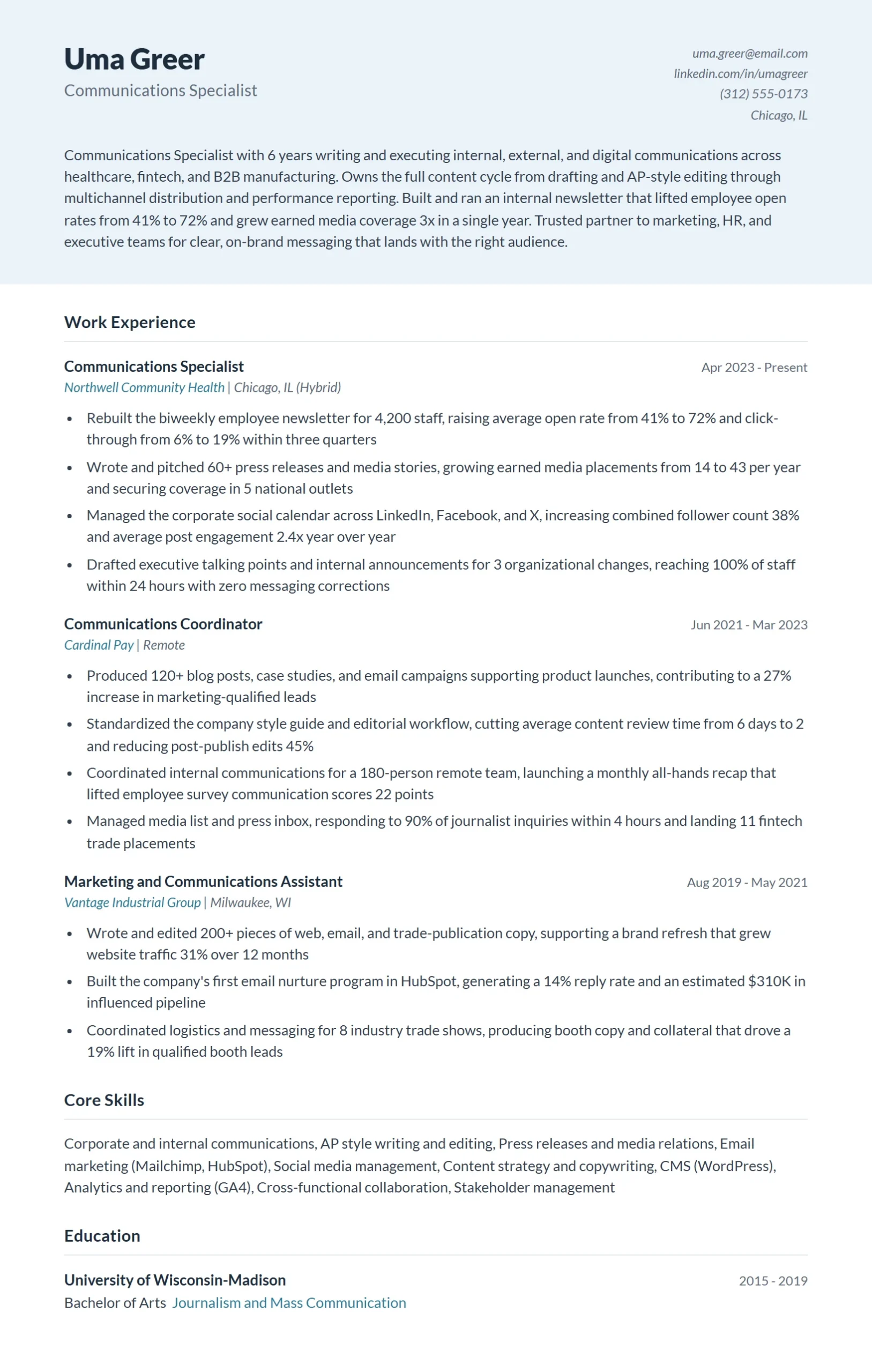
A communications specialist resume for individual contributors who produce the content and run the day-to-day messaging. It highlights execution and craft over management.
This resume centers on output: content produced, channels managed, and engagement gains, all quantified. It proves depth in writing and channel work without overreaching into management claims that do not fit the role. Specialist-level keywords like copywriting, email campaigns, and social media keep it ATS-aligned.
Communications Coordinator resume example
An entry-level communications coordinator resume for early-career candidates and recent grads. It turns internships, projects, and coursework into credible experience.

This resume makes limited experience count by quantifying coordinator tasks like scheduling, drafting, and event support. It leans on transferable skills and relevant projects so a thin work history still reads as capable. Foundational keywords like content scheduling and administrative support help it clear ATS screens for entry roles.
Public Relations Specialist resume example
A PR specialist resume focused on media relations, press coverage, and reputation work. Built for candidates who pitch, place, and manage public messaging.

This resume foregrounds media results: placements landed, journalists built relationships with, and coverage earned. It shows the candidate can shape a narrative and protect a brand under pressure. PR-specific keywords like media relations, press releases, and crisis communications match what ATS filters and PR hiring managers scan for.
Marketing Communications Manager resume example
A marketing communications resume for candidates who sit between marketing and comms, running campaigns that drive both awareness and demand. It blends creative messaging with measurable marketing outcomes.

This resume ties messaging to business results, pairing campaign work with metrics like leads, pipeline, and engagement. It shows fluency in both brand voice and marketing performance, the dual skill set these hybrid roles demand. Keywords like integrated campaigns, brand messaging, and demand generation keep it aligned to the job description and ATS.
Corporate Communications resume example
A corporate communications resume for internal comms, executive messaging, and large-organization environments. Built for candidates who manage messaging across departments and leadership.
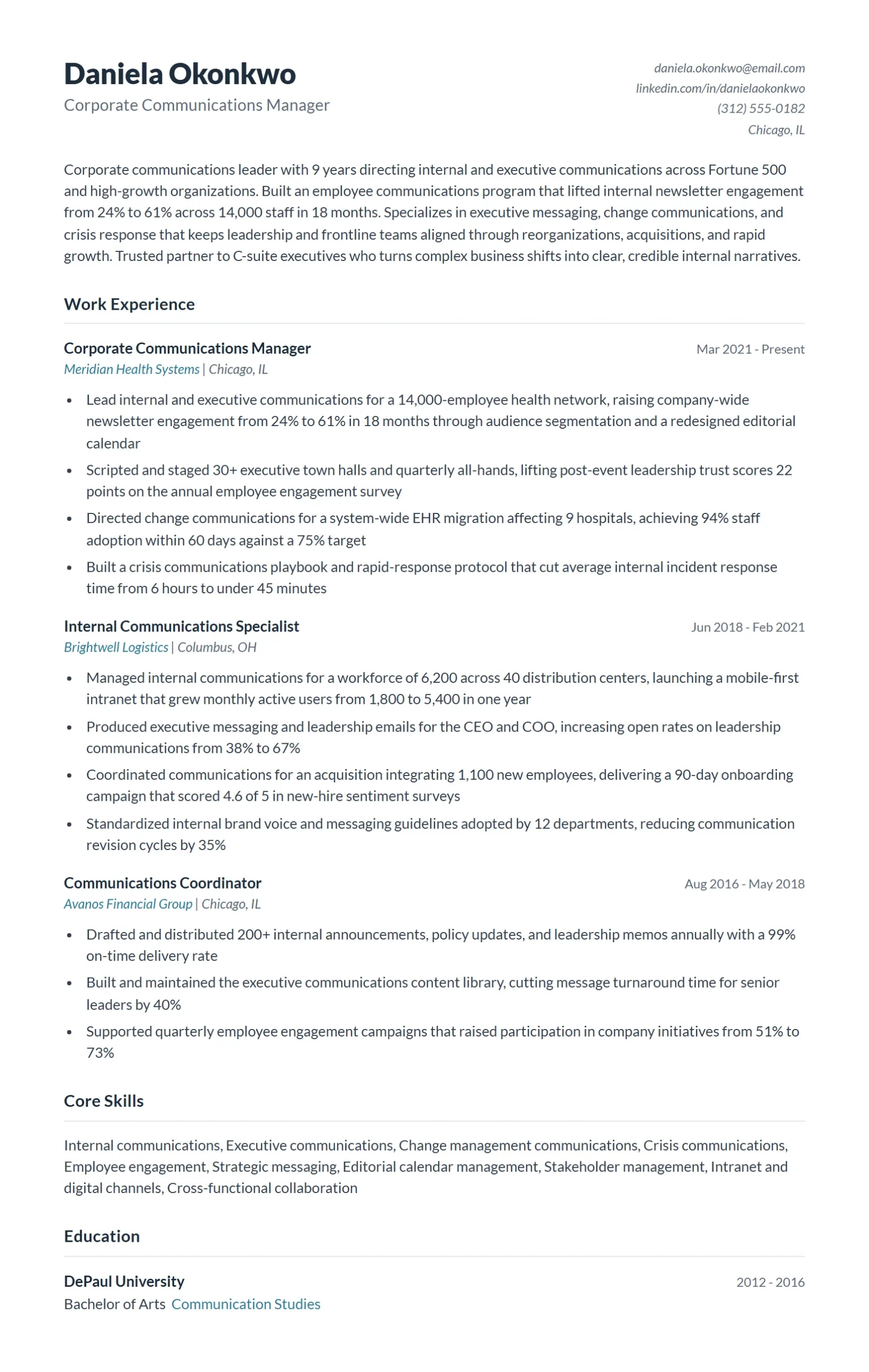
This resume highlights internal reach: employee communications, executive support, and change messaging delivered at scale. It shows the candidate can navigate a complex organization and keep messaging consistent across audiences. Enterprise keywords like internal communications, executive communications, and change management signal the right fit to ATS and hiring teams.
How to write a Communications resume that gets interviews
A communications resume has to prove one thing fast: that you can shape a message, get it in front of the right audience, and move a number. Hiring managers in PR, corporate comms, and internal comms skim for earned coverage, audience reach, engagement lifts, and the campaigns you ran end to end. Most companies also screen your resume through an Applicant Tracking System (ATS) before a person reads it, so your language has to match the job description first. The tips below help you do both: clear the ATS scan and convince the comms leader reading next.
- Lead every bullet with a result, not a responsibility: Communications work is easy to describe vaguely (“managed social media,” “wrote press releases”) and that is exactly what gets skimmed past. Open with the outcome: media placements landed, impressions or reach generated, engagement rate gained, share of voice won, or earned media value created. “Secured 40+ placements in tier-1 outlets including Forbes and TechCrunch” beats “handled media outreach” every time. If you ran it, attach the number it produced.
- Quantify reach, engagement, and earned media: Comms has real metrics, so use them: impressions, reach, engagement rate, open and click rates, share of voice, sentiment shift, earned media value (EMV), and message pull-through in coverage. Examples: “grew LinkedIn following 180% to 95K,” “lifted email open rate from 18% to 31%,” “earned $2.3M in EMV across a product launch.” If a campaign drove a business result (signups, pipeline, donations, attendance), tie your message to that number too.
- Name the channel and the discipline you own: “Communications” covers a wide field, and recruiters screen for the specific kind. Make your focus obvious: media and press relations, internal and employee communications, executive and thought-leadership ghostwriting, crisis and issues management, product or brand PR, or integrated campaign management. Mirror the exact discipline in the job posting. A candidate who says “internal communications” when the role asks for it reads as a fit; a generic “communications professional” reads as a maybe.
- Show you can manage messaging across stakeholders: Senior comms roles are won on judgment, not just output. Show that you advised leaders, aligned messaging across teams, and held the line on brand voice under pressure. Use bullets that name the partnership and the result: “Partnered with the CEO and legal to issue a crisis statement within 90 minutes, holding negative sentiment under 12% through the news cycle.” That signals you can be trusted with the message, not just asked to write it.
- Match keywords and tools to the job description: ATS scans for specific terms. List the tools you actually use (Cision, Muck Rack, Meltwater, Hootsuite or Sprout Social, Mailchimp, Google Analytics) and the skills named in the posting (media relations, press release writing, crisis communications, internal comms, content strategy, AP Style). If the role says “media relations” and you have a placement record, use that exact phrase. Skip buzzwords like “storyteller” on their own and never keyword-stuff.
- Tailor the resume and keep the writing tight: A PR role, an internal comms role, and an executive-comms role reward different keywords and headline wins. Reorder your skills and swap your top examples to mirror each posting. Then practice what you preach: a comms resume riddled with typos, passive voice, or AP Style errors is an instant no. Keep the format ATS-friendly with standard headings and a single clean column, then run it through Jobscan to check your match rate against the job description before you apply.

Communications resume summary examples
Your summary is the first thing a recruiter reads. Lead with your specialty, years of experience, and a quantified win.
Good communications resume summary examples
- Corporate communications specialist with 7+ years across media relations and executive comms in B2B tech. Secured 120+ earned placements in tier-1 outlets and grew share of voice 34% against three named competitors. Built the messaging framework adopted company-wide and ghostwrote thought-leadership that drove 2.1M LinkedIn impressions in a year.
- Internal communications manager who turns dense company change into messages employees actually read. Led comms for a 1,200-person reorg with a 92% email open rate and zero leak to press. Owns the intranet, all-hands narrative, and leadership messaging, and lifted employee engagement-survey comms scores 19 points in 18 months.
- PR and media relations pro specializing in product launches and crisis response. Earned $2.3M in media value across a single launch and held negative sentiment under 10% through a product recall. Fluent in Cision, Muck Rack, and AP Style, with a press list spanning consumer tech, finance, and trade media.
What to avoid
- Creative communications professional and passionate storyteller seeking an opportunity to use my excellent writing and communication skills with a dynamic team. (It is all claims and no proof. “Passionate storyteller” and “excellent communication skills” are unverifiable, there is no discipline (PR? internal? crisis?), no tools, and not a single result. A comms leader learns nothing they can act on, and the ATS finds no keywords to match.)
- Communications graduate with strong written and verbal skills, a team player who is detail-oriented and works well under pressure. (Pure adjectives a recruiter has read a thousand times. It names no channel, no campaign, no metric, and no tool. Even an early-career summary can cite an internship placement, a campaign reach number, or a publication. Without one, this reads as filler both the scanner and the reader skip.)
Communications resume skills
Pull the exact disciplines and tools from each job description (PR, internal comms, or crisis), then mirror that language here. This is a quick resume snapshot, so keep it to your strongest, role-relevant skills.
Hard skills for a communications resume
- Media Relations
- Press Release Writing
- Crisis Communications
- Internal Communications
- Content Strategy
- Public Relations
- AP Style
- Social Media Management
- Cision / Muck Rack
- Media Monitoring & Analytics
Soft skills for a communications resume
- Written & Verbal Communication
- Stakeholder Management
- Strategic Thinking
- Composure Under Pressure
- Cross-Functional Collaboration
Communications resume work experience bullet point examples
Lead each bullet with a strong verb and a measurable result.
Good bullet point examples
- Secured 45+ earned placements in tier-1 outlets including The Wall Street Journal and Forbes, generating 180M impressions and $1.9M in earned media value across a single product launch.
- Led internal communications for a company-wide reorg affecting 1,200 employees, achieving a 92% email open rate and a 19-point lift in engagement-survey comms scores, with zero leaks to press.
- Ghostwrote executive thought-leadership (op-eds, LinkedIn, keynotes) that grew the CEO’s following 210% to 88K and drove 2.4M annual impressions, directly supporting two enterprise deals.
- Managed crisis response to a product recall, issuing an approved statement within 90 minutes and holding negative sentiment under 11% across a 10-day news cycle.
Bad bullet point examples
- Responsible for managing the company’s social media accounts and writing press releases. (“Responsible for” describes a job description, not an accomplishment. There is no scale (how many channels, how many releases?), no reach, and no result. Lead with a verb and end with a number: followers gained, engagement lifted, or placements landed.)
- Wrote and distributed various communications to internal and external audiences. (“Various communications” is vague and “wrote and distributed” is a task, not an outcome. It tells the reader you produced something but never whether it landed, was read, or changed anything. Name the channel and attach an open rate, reach, or business result.)
- Helped improve brand awareness and communication across the organization. (“Helped” hides your actual contribution and “improve brand awareness” is an unquantified claim. Replace it with the specific metric that proves it, such as a share-of-voice gain, an impressions number, or a sentiment shift you can point to.)
Communications resume tips
A strong communications resume signals instantly that you control the message, own the metrics, and know how to move an audience.
- Mirror Job Description Language: Pull exact phrases from each posting, such as ‘media relations,’ ‘crisis communications,’ or ‘internal communications,’ and place them in your skills section and bullet points so ATS scanners score your resume as a strong match before a human reads it.
- Quantify Coverage and Reach: Replace vague claims with numbers that matter in comms: media placements secured, outlet domain authority, audience reach in impressions, email open rate lifts, or engagement percentage increases from a campaign you managed end to end.
- Name Your Tools Explicitly: List platforms and tools by their actual names, including Cision, Meltwater, Sprout Social, Slack, SharePoint, or any CMS you have used, because hiring managers and ATS systems search for these specific strings, not general phrases like ‘media monitoring software.’
- Claim AP Style Fluency: If you write to AP Style standards, say so explicitly in your skills section using the exact phrase ‘AP Style,’ since editors and PR directors treat it as a baseline credibility signal and ATS filters often screen for it by name.
- Separate Hard and Soft Skills: List technical skills such as press release writing, content strategy, and social media management in a dedicated skills section, then demonstrate soft skills like stakeholder management and cross-functional collaboration through bullet point accomplishments rather than labeling them outright.
- Show Crisis Experience Carefully: If you have handled crisis communications, name the situation type without violating confidentiality, for example ‘led communications response for a product recall affecting 200K customers,’ because this rare competency immediately differentiates you from candidates with only routine PR backgrounds.
Pair your communications resume with a cover letter
A strong resume goes further with a tailored cover letter. Browse our communications cover letter examples to round out your application.
Communications resume frequently asked questions
Lead with a short summary that names your specialty (corporate communications, public relations, internal comms, or media relations) and one measurable result. Then build out experience bullets around the work hiring managers screen for: press releases, media pitches, executive messaging, internal campaigns, crisis response, and the channels you manage. List tools like Cision, Muck Rack, Meltwater, and your CMS, and name the audiences you write for, such as employees, press, or executives. Mirror the exact job title and a few keywords from the posting so the recruiter and the ATS both see an immediate match.
Communications produces more numbers than people expect, so tie your work to outcomes you can count. Use media placements secured, earned coverage and impressions, share of voice, email open and click rates, social engagement and follower growth, internal campaign reach or readership, and event attendance. If you supported a launch or a crisis, note the volume (“managed messaging across 40+ media inquiries in 72 hours”) and the result (“protected brand sentiment, with 90 percent neutral-to-positive coverage”). Even a percentage or a before-and-after comparison is stronger than a vague claim like “improved communications.”
Yes, because communications is a writing-first field and hiring managers want proof. Keep the resume to one page, then link to a portfolio or a short set of samples in your header next to your email and LinkedIn. Choose pieces that match the role: press releases and media coverage for a PR job, intranet posts and leadership messaging for internal comms, bylined articles or social campaigns for content roles. Lead the resume with impact and outcomes, and let the samples carry the depth.
They overlap, but the emphasis differs, and you should tailor to the title on the posting. A communications resume centers on messaging, media relations, reputation, internal and executive communication, and earned coverage, with metrics like placements, impressions, and sentiment. A marketing resume leans toward demand generation, campaigns, conversion, and revenue, with metrics like leads, pipeline, and ROI. Read the job description closely and reframe the same experience toward whichever set of outcomes that role actually rewards.
Translate the communications work you already do, since most roles involve writing, presenting, and managing messages even if “communications” was not in your title. Pull out moments where you wrote for an audience, ran internal updates, handled stakeholder messaging, managed a newsletter or social account, or shaped how information was delivered. Frame these as accomplishments with results, add a summary that positions you for the target role, and list relevant tools and skills like media relations, copywriting, AP style, and content management. A few strong, on-point examples beat a long history of loosely related tasks.
Use a clean single-column layout with standard headings (Summary, Experience, Skills, Education), real selectable text instead of text inside graphics, and a .docx or text-based PDF. Work in the exact terms from the posting, such as “media relations,” “internal communications,” “stakeholder messaging,” “AP style,” and any named tools, because those are often the precise keywords the system scans for. Spell out an acronym at least once (“public relations (PR)”) so both the long and short form register. Before you apply, scan your resume against the job description with a tool like Jobscan to confirm your keywords and formatting pass.