Best Content Creator Resume Examples for 2026
See real Content Creator resume examples that get past the ATS and land interviews, plus expert tips to showcase your portfolio, reach, and results.

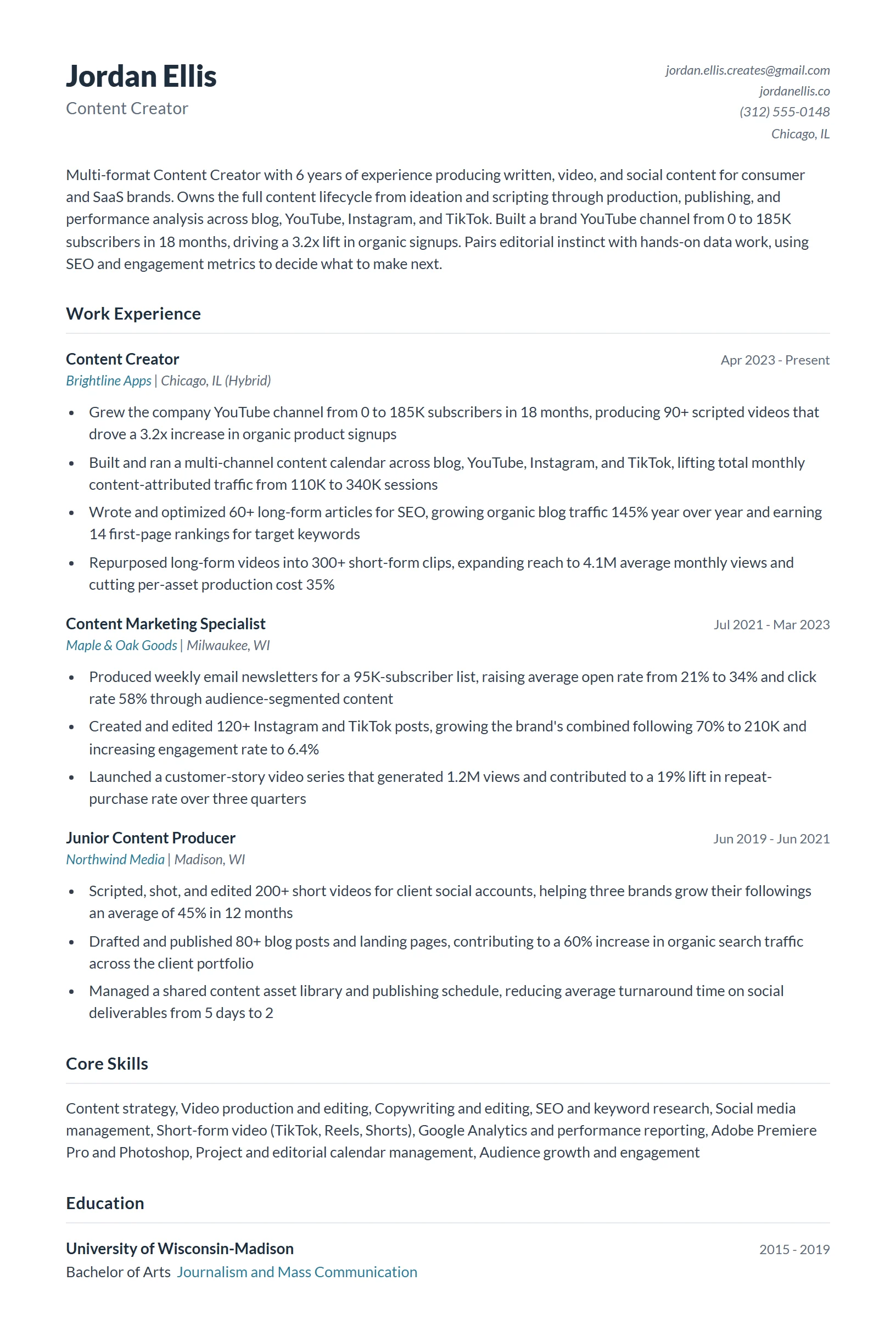
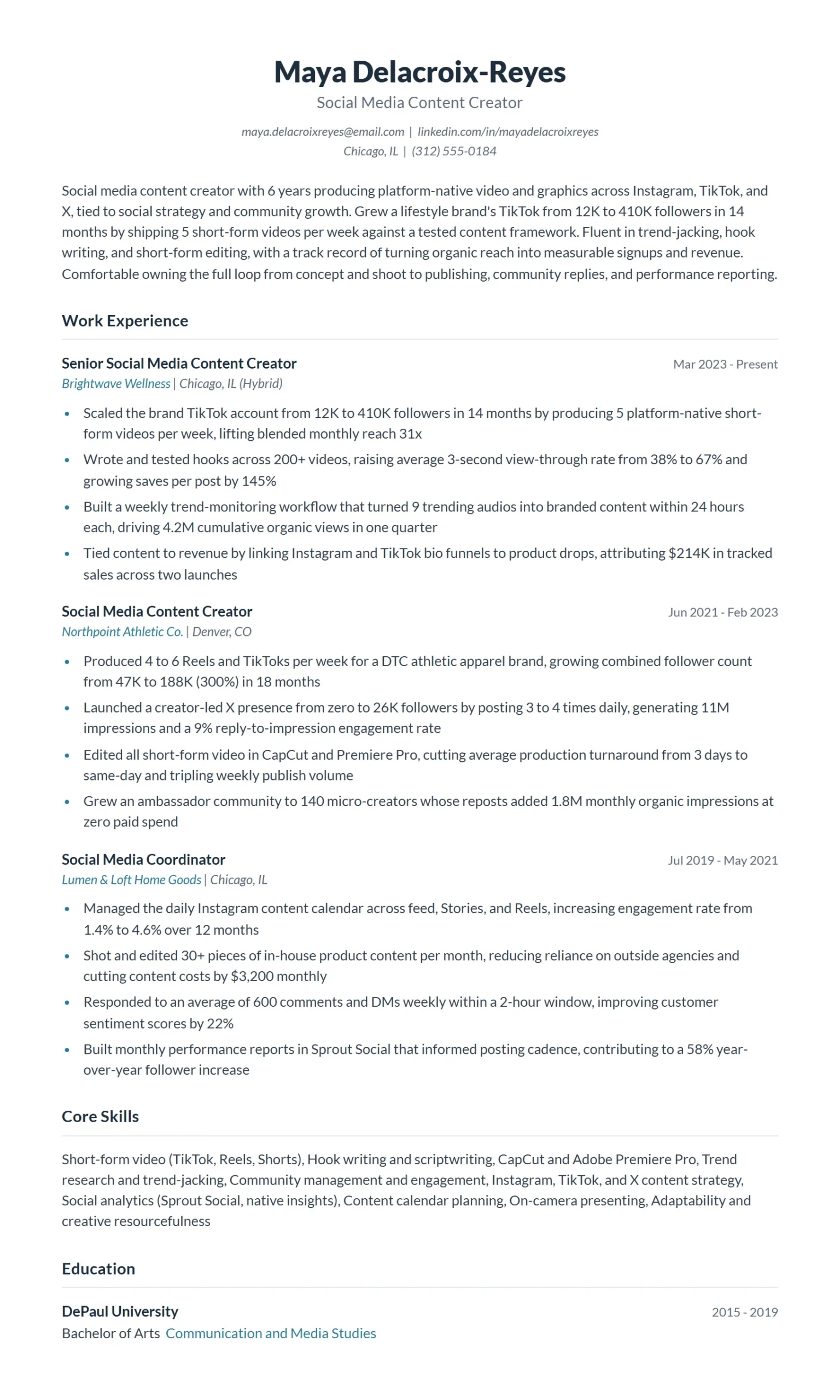
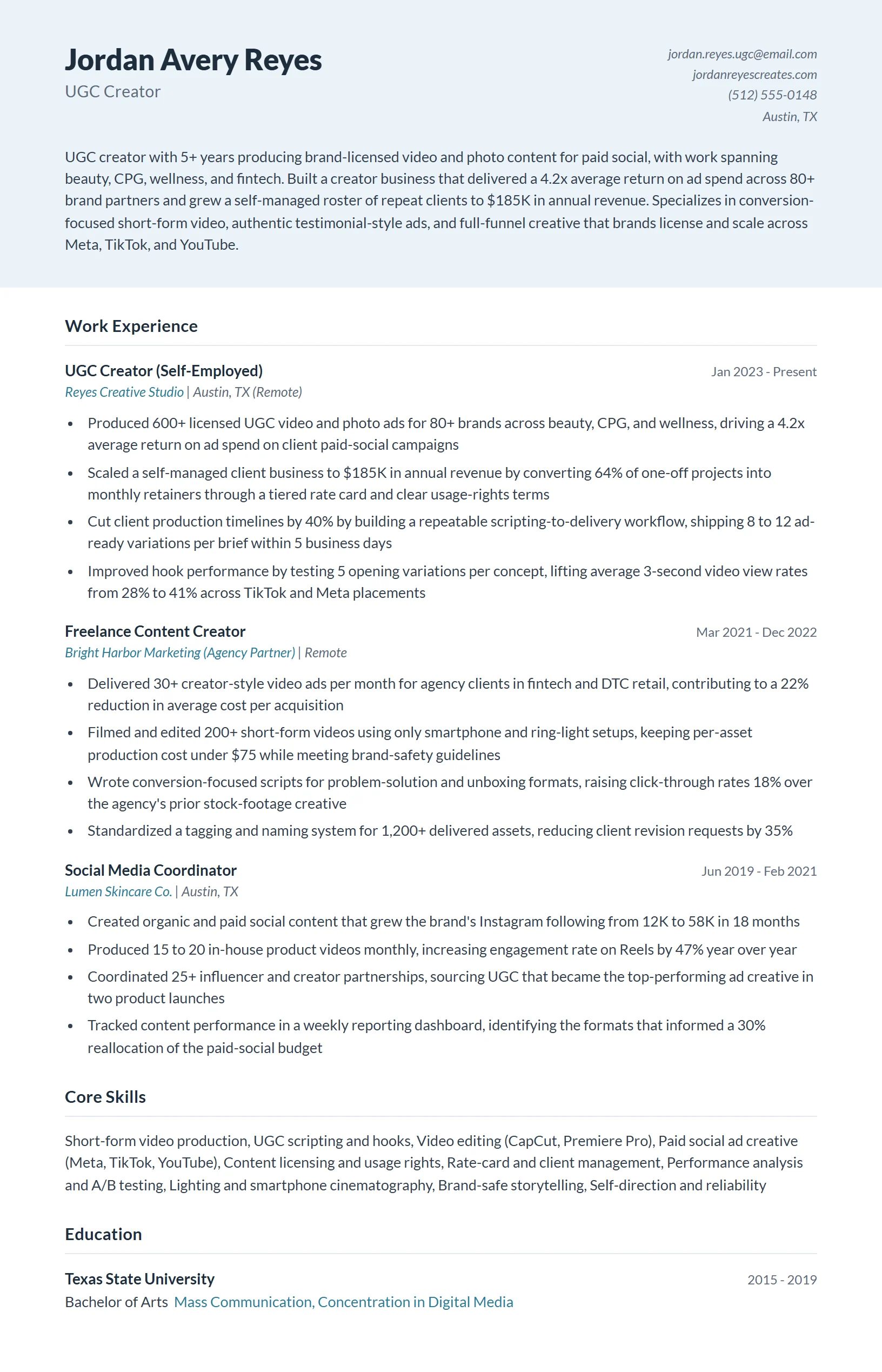


Content creators turn ideas into posts, videos, and campaigns that build audiences and move brands forward. The title covers a wide range, from social media and UGC to video, YouTube, and in-house marketing content, so your resume has to make your specific lane obvious fast.
Hiring managers want proof, not adjectives. They look for the platforms you create for, the tools you use, the content volume you ship, and the numbers behind it: views, followers gained, engagement rate, watch time, and conversions. Applicant tracking systems scan for those same skills and keywords, so the terms in the job description need to show up naturally in your resume.
The examples below show how to frame your experience around measurable results and the exact skills employers search for. Match your resume to the role you want, lead with your strongest metrics, and you will give both the ATS and the hiring manager a clear reason to keep reading.
Ready to build yours? Try our ATS-friendly resume builder or scan your draft against the job description.
Content Creator resume example
A versatile resume for a creator who produces across formats and platforms and wants to keep options open across social, video, and brand work.
It leads with a summary that names the creator’s core platforms and a headline result, so recruiters grasp the scope in seconds. Each role pairs the type of content produced with a concrete outcome, like audience growth or engagement lift, instead of listing tasks. A clean skills section mirrors common job-description keywords, which helps it clear ATS filters before a human ever reads it.
Social Media Content Creator resume example
Built for a creator who lives in the platform feeds and ties content directly to follower growth and engagement.
It quantifies reach the way social teams evaluate it: follower gains, engagement rate, and top-performing post results by platform. Listing specific tools like Canva, CapCut, and native schedulers signals hands-on fluency that ATS keyword scans reward. Tying content to community and campaign goals shows the creator thinks past vanity metrics, which separates strong candidates from hobbyists.
UGC Creator resume example
Tailored for a creator who produces user-generated content that brands license and run as paid ads.
It treats the resume like a client-facing case study, leading with brands worked with and the ad performance the content drove. Calling out deliverable types, hooks, and conversion or click-through results speaks the language brand and performance marketers use. A link to a portfolio or media kit gives reviewers an instant way to judge production quality, which matters more here than a long work history.
Video Content Creator resume example
For a creator whose core skill is shooting and editing video across short-form and long-form.

It foregrounds the full production stack, from scripting and filming to editing in Premiere or DaVinci Resolve, so the technical fit is clear at a glance. Results are framed in video terms reviewers care about: view counts, watch time, and retention rate rather than generic engagement. Grouping work by content type and platform makes the breadth of formats easy to scan without burying the standout projects.
YouTube Content Creator resume example
Centered on a creator who builds and grows a YouTube channel through long-form video and consistent publishing.
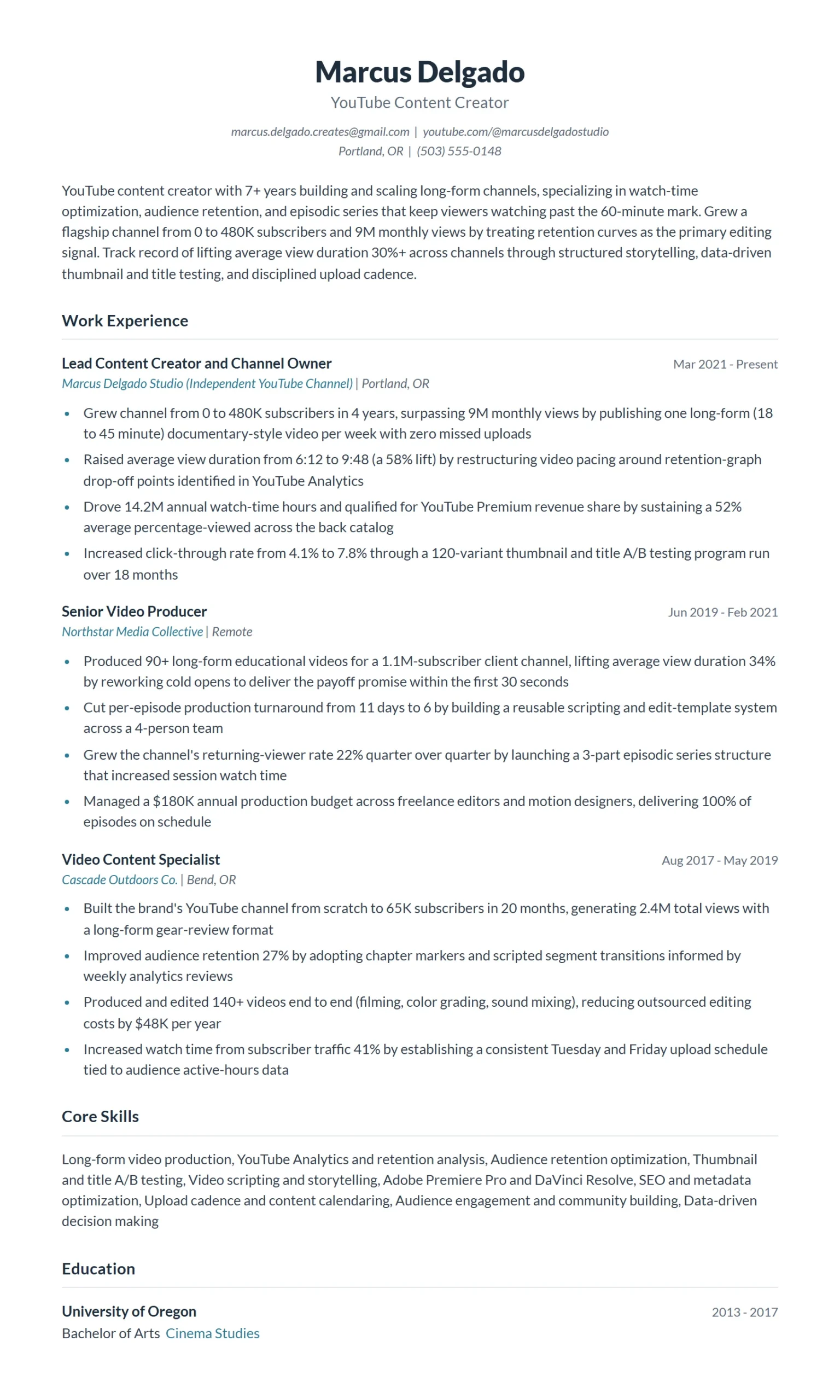
It puts channel-level metrics up top, like subscriber growth, average view duration, and total watch hours, the numbers YouTube-focused roles screen for first. Demonstrating a publishing cadence and a content strategy shows the discipline that channel growth actually requires. Noting monetization or sponsorship results, where they exist, proves the creator understands the business side, not just the views.
Content Creator (Marketing Team) resume example
For a creator working inside an in-house or agency marketing team, producing branded content against campaign goals.

It connects content output to marketing outcomes like lead generation, campaign reach, and pipeline contribution, which is what hiring managers on these teams reward. Referencing collaboration with designers, strategists, and brand guidelines signals the candidate can operate inside a structured team. Mirroring marketing job-description language, from content calendars to SEO and brand voice, keeps the resume aligned with the exact keywords the ATS is scanning for.
How to write a Content Creator resume that gets interviews
Recruiters and marketing managers skim a Content Creator resume for one thing: proof you can grow an audience and move a metric, not just “make posts.” They want to see the platforms you own, the content formats you produce, and the numbers your work drove (followers, views, engagement rate, conversions). Most companies also run your resume through an Applicant Tracking System (ATS) first, so your wording has to match the job description before a human reads it. The tips below help you do both: clear the ATS scan and convince the person reading next.
- Lead with audience growth and engagement numbers: “Created content for social media” tells a recruiter nothing. Quantify the result instead: “grew Instagram from 12K to 85K followers in 14 months,” “averaged a 6.2% engagement rate (3x the industry benchmark),” or “produced TikToks that drove 4.1M views in a quarter.” If you do not have follower numbers, use views, watch time, click-through rate, email signups, or revenue. The number is what separates a creator who guesses from one who knows what works.
- Name your platforms and formats specifically: A Content Creator who only writes is very different from one who shoots and edits video. Be explicit: short-form video (TikTok, Instagram Reels, YouTube Shorts), long-form YouTube, blog and SEO articles, email newsletters, podcasts, or branded social. List the exact channels you have run and the formats you can produce end to end. This tells the hiring manager what you can own on day one and helps the ATS match you to the role.
- Show the full content workflow, not just the output: Strong creators own the whole loop: research and ideation, scripting or writing, filming or design, editing, publishing on a content calendar, and analyzing performance to inform the next piece. Reference that arc in your bullets so it is clear you do not just hit publish, you test, read the data, and improve. A resume that lists only “created posts” reads as task work; one that shows a strategy-to-analytics loop reads as a creator who compounds results.
- Prove you can match content to a brand and a goal: Companies hire creators to serve a business objective: awareness, signups, sales, or retention. Tie your work to that: “produced a product-launch video series that drove 1,200 trial signups” or “wrote a newsletter that lifted click-through 38% and supported a 15% MoM revenue increase.” Also show you can hold a brand voice across channels and adapt tone per platform. That signals you create on purpose, not just for likes.
- List the tools and skills the job description names: ATS scans for specific terms. List the tools you actually use (CapCut, Premiere Pro, Final Cut, Canva, Adobe Creative Suite, Figma, Notion, Later, Hootsuite, Google Analytics) and the skills the posting calls out (content strategy, copywriting, SEO, video editing, social media management, community management). If the role says “short-form video editing” and that is your strength, use that exact phrase. Skip tools you barely touch, and never keyword-stuff.
- Link your portfolio and tailor to each role, then keep it ATS-clean: Put a clickable link to your best work in the header: a portfolio site, a channel, or a one-page reel of top pieces. Then tailor each application. A social-first role, a YouTube role, and a content-marketing role reward different keywords and sample work, so reorder your skills and swap your headline metrics to mirror the posting. Keep the format ATS-friendly: standard headings, one clean column, no text boxes that scramble parsing. Run it through Jobscan to check your match rate before you apply.

Content Creator resume summary examples
Your summary is the first thing a recruiter reads. Lead with your specialty, years of experience, and a quantified win.
Good content Creator resume summary examples
- Multi-platform Content Creator with 5+ years producing short-form video, written, and social content for DTC and SaaS brands. Grew a brand TikTok and Instagram from 20K to 240K combined followers in 18 months and averaged a 5.8% engagement rate. Owns the full workflow from ideation and scripting to filming, editing in Premiere Pro, and performance analysis.
- YouTube-focused Content Creator specializing in long-form educational video and channel growth. Scripted, filmed, and edited 120+ videos that drove 9M+ lifetime views and grew subscribers from 8K to 110K. Translates analytics into a repeatable content strategy, lifting average watch time 34% year over year.
- Content Creator and copywriter with a background in SEO and email. Built a newsletter from 0 to 30K subscribers with a 42% average open rate, and produced blog content that ranks on page one for 60+ target keywords. Pairs editorial instinct with data, tying every content series to a measurable signup or revenue goal.
What to avoid
- Passionate content creator who loves making fun, engaging content and growing brands on social media. (All adjectives, zero proof. “Fun” and “engaging” are claims anyone can make. It names no platforms, no formats, no tools, and no result, so a hiring manager learns nothing they can act on and the ATS finds nothing to match.)
- Creative individual seeking an exciting content role where I can use my skills and grow with a great team. (It is about what the candidate wants, not what they deliver. There is no specialization (video? writing? social?), no metric, and no evidence the candidate can grow an audience or move a number.)
Content Creator resume skills
Pull the exact platforms, tools, and formats from each job description, then mirror that language here. This is a quick resume snapshot, so keep it to your strongest, role-relevant skills rather than an exhaustive list.
Hard skills for a content Creator resume
- Content Strategy
- Short-Form Video Editing
- Copywriting
- Social Media Management
- Video Production
- SEO
- Adobe Creative Suite (Premiere Pro, Photoshop)
- CapCut / Final Cut Pro
- Canva
- Analytics (Google Analytics, native platform insights)
Soft skills for a content Creator resume
- Creativity
- Storytelling
- Communication
- Adaptability
- Time Management
- Collaboration
Content Creator resume work experience bullet point examples
Lead each bullet with a strong verb and a measurable result.
Good bullet point examples
- Grew the brand’s TikTok and Instagram from 20K to 240K combined followers in 18 months by producing 4-6 short-form videos weekly, hitting a 5.8% average engagement rate (3x industry benchmark).
- Scripted, filmed, and edited a 12-part YouTube product series in Premiere Pro that drove 1.4M views and generated 1,200 free-trial signups in its first quarter.
- Built and ran a weekly content calendar across 4 channels, cutting production turnaround 40% and increasing total monthly reach from 600K to 2.1M.
- Wrote and designed a weekly newsletter that grew from 0 to 30K subscribers in 10 months, sustaining a 42% open rate and a 38% lift in click-through to product pages.
Bad bullet point examples
- Created content for the company’s social media accounts. (Lists a task with no platform, no format, no volume, and no result. It tells the reader you posted things but not whether anything grew or performed. Lead with a verb and end with a number instead.)
- Responsible for posting on Instagram, TikTok, and YouTube. (“Responsible for” describes a duty, not an accomplishment. It shows the channels but no strategy, no output volume, and no measurable impact like follower growth or engagement.)
- Made videos that got a lot of views and engagement. (Vague and unquantified. “A lot” is not a number. Replace it with the actual figure (views, watch time, engagement rate) so the claim is backed by evidence the recruiter can trust.)
Content Creator resume tips
A strong Content Creator resume proves you can build audiences and hit metrics across every platform a hiring team cares about.
- Mirror Job Description Keywords: Pull exact terms from the posting, such as ‘short-form video editing,’ ‘content strategy,’ or ‘social media management,’ and place them in your skills section and bullet points so the ATS scores your resume as a strong match before a human ever reads it.
- Quantify Platform Performance: Attach real numbers to every major result: follower growth percentages, average view counts, engagement rates, click-through rates, or revenue driven by a campaign, because those are the metrics hiring managers use to judge content ROI.
- List Tools by Name: Name the exact software you used, including Premiere Pro, Photoshop, CapCut, and Final Cut Pro, rather than writing ‘video editing tools,’ so the ATS can match those specific strings to job requirements.
- Tailor Per Platform: If the role focuses on TikTok and YouTube Shorts, lead with short-form video experience and relevant metrics rather than burying them below blog or podcast work that is less relevant to the position.
- Add Certifications and Courses: Include recognized credentials such as a Google Analytics certification, Meta Blueprint badge, or HubSpot Content Marketing certification in a dedicated section, since these signal technical credibility and often appear as ATS filters in marketing job postings.
- Include a Portfolio Link: Place a clean, clickable URL to your portfolio, channel, or case studies directly in your contact header, because content work is visual and a recruiter who can verify your style and results in one click is far more likely to move you forward.
Pair your content Creator resume with a cover letter
A strong resume goes further with a tailored cover letter. Browse our content creator cover letter examples to round out your application.
Content Creator resume frequently asked questions
Yes, and it should be one of the first things a hiring manager sees. Put a single link to your portfolio, website, or best-performing channel in the header next to your email and LinkedIn, and make sure it opens to curated, relevant work rather than everything you have ever posted. The resume proves impact in words, but content roles are visual, so the link is what closes the gap. If your strongest proof lives on Instagram, TikTok, YouTube, or a blog, link directly to that profile.
Treat your own channels, freelance gigs, and personal projects as real experience, because they are. List your blog, social accounts, or YouTube channel as a role with a title like “Content Creator, Self-Published,” then describe what you produced and the results you drove (follower growth, average views, engagement rate). Add a short summary that frames you as a content creator, plus tools and platforms you know. A channel you grew from zero to 10,000 followers often reads stronger than an unrelated part-time job.
Lead with numbers that show reach and results, since content roles are judged on outcomes. Strong options include follower or subscriber growth, average views or impressions, engagement rate, watch time, click-through rate, email list size, and any revenue or conversions you influenced. Frame each as a before-and-after or a percentage so the impact is obvious, for example “grew Instagram from 2,000 to 45,000 followers in 11 months.” If a number is confidential, use a percentage or a range instead of an exact figure.
Balance creative production, platform knowledge, and the strategy skills that prove you can drive results, not just post. Name your tools (Adobe Premiere, CapCut, Canva, Figma, Lightroom), the platforms you specialize in (TikTok, Instagram, YouTube, LinkedIn), and core skills like copywriting, video editing, SEO, content strategy, and analytics. Add the soft skills that matter for the role, such as audience research, brand voice, and cross-team collaboration. Match the exact tools and platforms named in the job description, since those are often the terms an ATS scans for.
Yes, brand partnerships and freelance work are some of your strongest proof, so feature them clearly. Group them under a heading like “Brand Partnerships” or “Freelance Clients,” name recognizable brands when you are allowed to, and describe the deliverables and the results for each. If you have many small clients, summarize the volume (for example “produced sponsored content for 20-plus brands”) and highlight the few with the biggest names or best outcomes. This shows you can deliver for clients, not only for your own audience.
Often not well. Applicant tracking systems struggle with multi-column layouts, logos, icons, and text placed inside images, so a heavily designed resume can get scrambled during parsing. Use a clean single-column layout with standard headings (Experience, Skills, Education), real selectable text instead of graphics, and save your visual flair for your portfolio link. Before you apply, scan the resume against the job description with a tool like Jobscan to confirm your keywords and formatting pass.