Best Content Strategist Resume Examples for 2026
Build a Content Strategist resume for 2026 with proven examples, the strategy and SEO skills that get noticed, and the keywords ATS scans for.

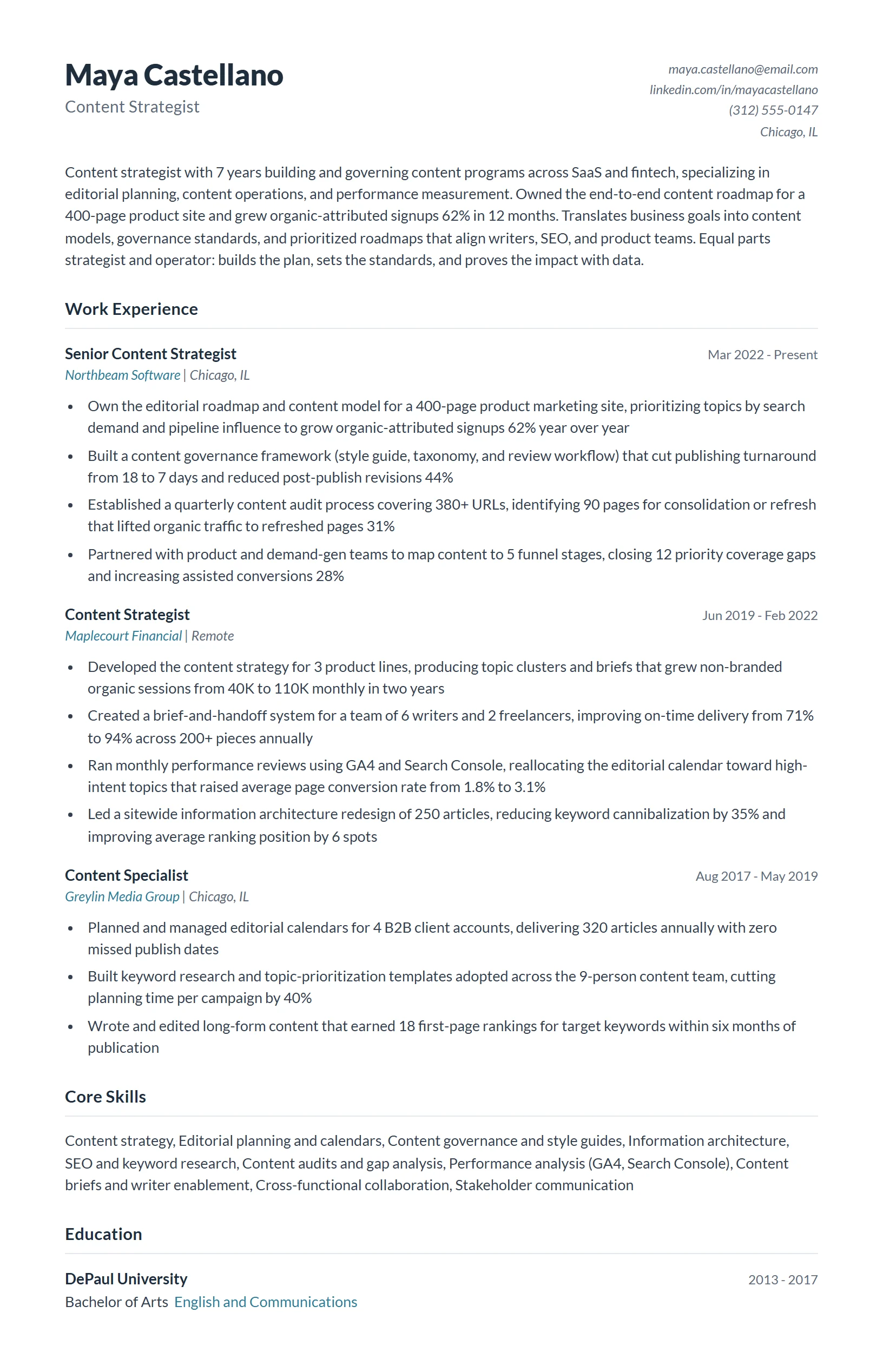
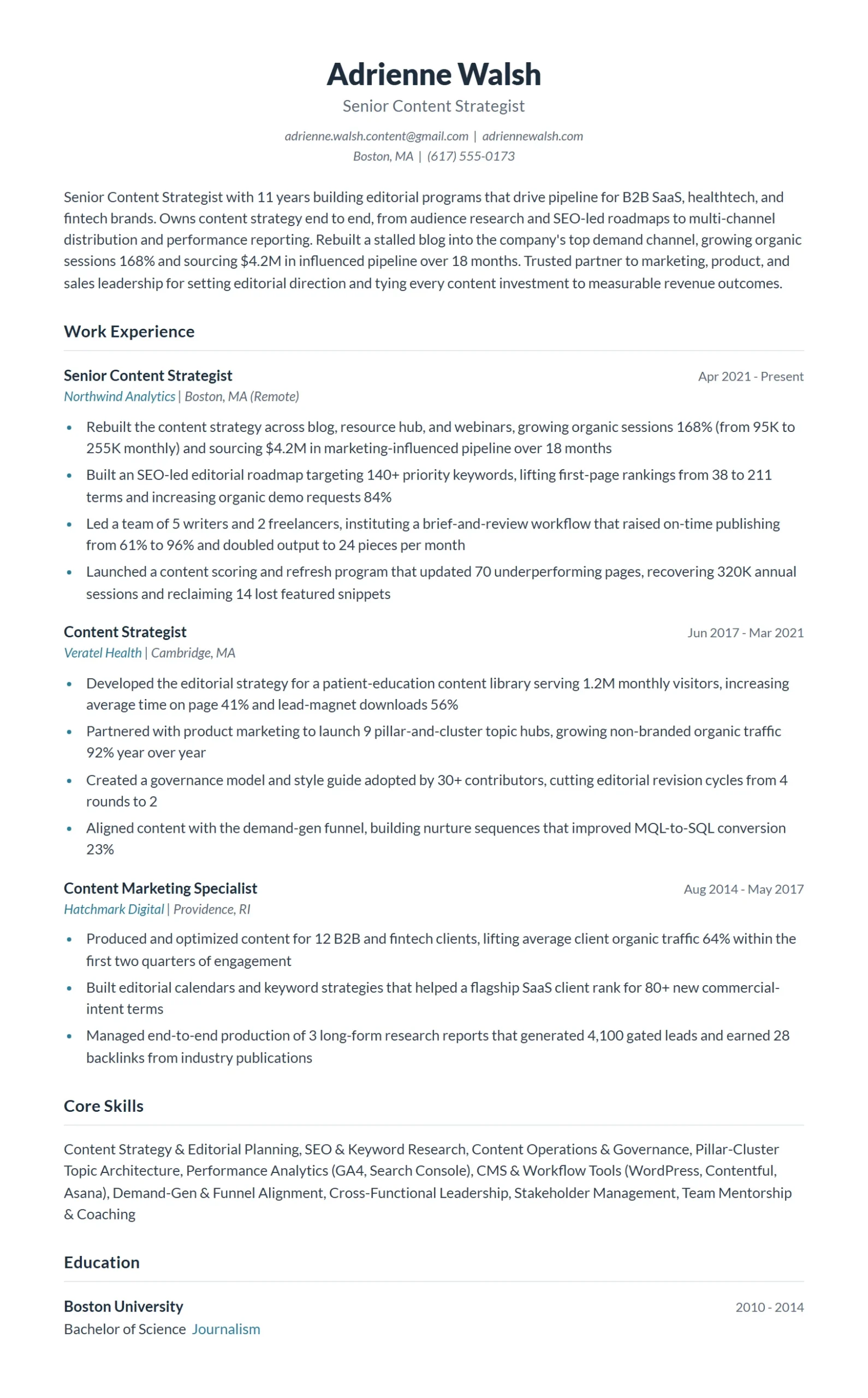
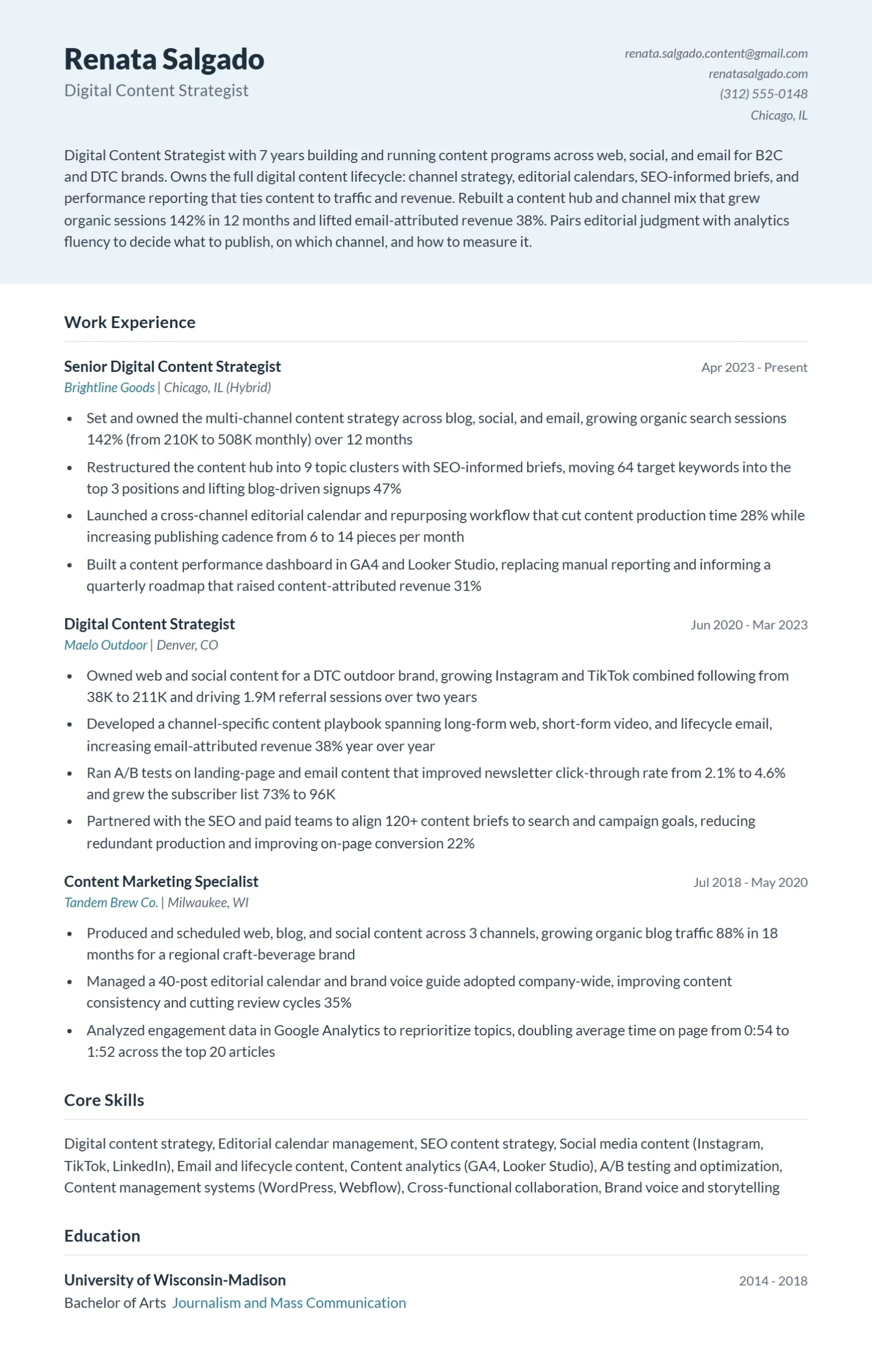


A Content Strategist owns the plan behind the content: who it is for, what it should accomplish, where it lives, and how success gets measured. You connect business goals to editorial calendars, SEO research, briefs, and performance data, then steer writers and designers to execute. Your resume has to show that you think in systems and ship results, not just that you can write.
Hiring managers want evidence you can move a metric. They scan for content strategy frameworks, audience and keyword research, content audits, CMS and analytics tools, and clear outcomes like traffic, leads, or engagement lifts. Before a human reads any of it, an applicant tracking system (ATS) checks your resume for the exact terms in the job description, so the language you choose decides whether you make the shortlist.
The examples below show how to frame your work so both the ATS and the hiring manager say yes. Match your real experience to the patterns here, lead with measurable wins, and you will have a resume that competes for the roles you actually want.
Ready to build yours? Try our ATS-friendly resume builder or scan your draft against the job description.
Content Strategist resume example
A mid-level strategist who owns the content roadmap, editorial calendar, and performance reporting across channels. This resume balances strategic thinking with proof of execution.
It opens with a summary that pairs a content philosophy with a hard result, like a traffic or lead lift, so the value is clear in seconds. The skills section names frameworks, SEO research, content audits, and analytics tools that match common job descriptions, which helps it clear ATS keyword checks. Every bullet ties an activity to an outcome, showing the candidate drives results rather than just managing tasks.
Senior Content Strategist resume example
An experienced strategist who sets content vision, mentors writers, and reports outcomes to leadership. This resume reads as a leader, not just a doer.
It leads with scope and influence: budgets owned, teams guided, and programs that scaled across the org. Bullets quantify business impact such as pipeline contribution or organic growth over time, which is what hiring managers expect at this level. Leadership and stakeholder-management keywords sit alongside strategy terms so it ranks well in ATS screens for senior roles.
Digital Content Strategist resume example
A strategist focused on web, social, and digital channels who maps content to the buyer journey. This resume centers digital fluency and measurable engagement.
It foregrounds channel-specific results across web, email, and social, signaling the candidate knows where audiences actually are. The skills list pairs UX and CMS familiarity with analytics platforms, matching how digital roles are written. Concrete metrics like conversion rate or session growth give the ATS the exact terms it scans for and give the reader proof.
SEO Content Strategist resume example
A strategist who builds content around keyword research, search intent, and ranking growth. This resume leads with organic results and technical SEO awareness.
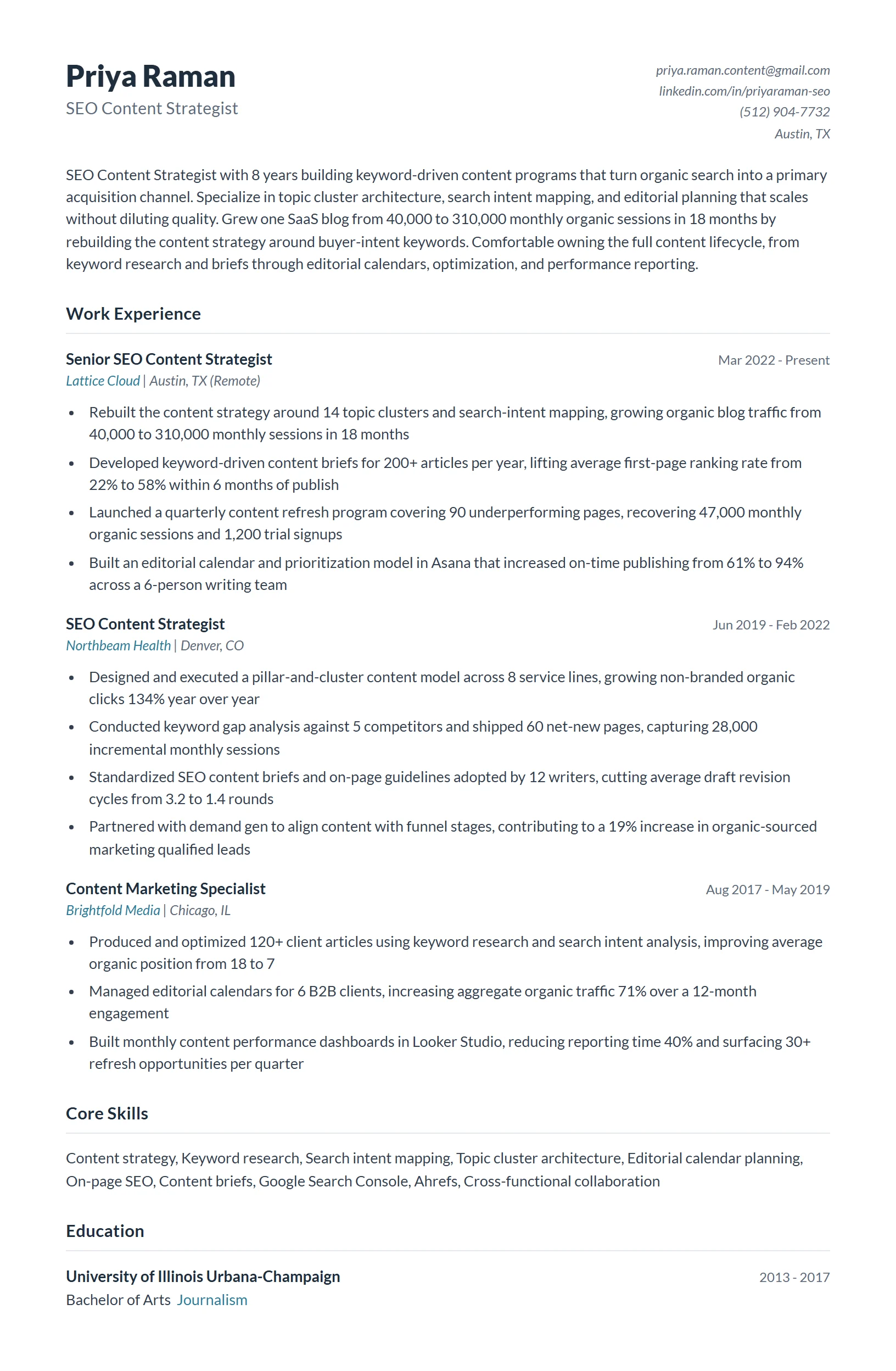
It puts search-driven wins up top, like keyword rankings gained or organic traffic grown over a defined period, so the impact is undeniable. The skills section names tools such as keyword research and analytics platforms plus on-page and technical SEO terms that ATS filters look for. Bullets connect each SEO tactic to a business outcome, separating it from a generalist writer resume.
Content Marketing Strategist resume example
A strategist who ties content directly to demand, nurture, and pipeline. This resume frames content as a revenue driver, not a cost center.

It connects content programs to marketing funnel metrics like leads, MQLs, or pipeline influenced, which is the language hiring teams reward. Skills span campaign planning, lifecycle content, and marketing analytics, matching keyword-heavy job posts so it survives ATS screening. Each bullet shows ownership of a goal and the result delivered, proving the candidate moves the numbers that matter.
How to write a Content Strategist resume that gets interviews
Hiring managers skim a Content Strategist resume for proof you can connect content to business outcomes, not just publish posts. They want evidence you can build a strategy, own an editorial calendar, grow organic traffic, and tie content to leads or revenue. Most companies also run your resume through an Applicant Tracking System (ATS) before a human reads it, so your language has to match the job description first. The tips below help you do both: clear the ATS scan and convince the editor or marketing lead reading next.
- Lead with results, not a list of content you produced: Anyone can say they wrote blog posts. Show what the content did: “grew organic traffic 140% in 12 months,” “drove 2,300 marketing-qualified leads from a 9-piece content series,” or “lifted email click-through rate from 1.8% to 4.2%.” Tie your work to traffic, rankings, engagement, conversions, or pipeline. If you cannot share revenue numbers, use traffic, ranking, and engagement metrics. They prove impact just as well.
- Show you own strategy, not just execution: Content Strategist is a strategy role, so prove you set direction. Reference the work that separates a strategist from a writer: audience and keyword research, content audits, editorial calendars, messaging frameworks, content briefs, and governance. A resume that only lists articles written reads as a content writer. Show that you decided what to create, why, and how you measured it.
- Make your SEO and analytics fluency obvious: Most Content Strategist roles expect you to grow organic search and report on performance. Name the tools you actually use (Google Analytics 4, Google Search Console, Ahrefs, Semrush, Surfer) and the work you did with them: keyword research, search-intent mapping, on-page optimization, content refreshes, and topic-cluster builds. Pair the tool with a result, like “refreshed 40 underperforming pages using Search Console data, recovering 65,000 monthly organic sessions.”
- Match keywords and tools to the job description: The ATS scans for specific terms. Mirror the language in the posting: content strategy, editorial calendar, SEO content, content marketing, CMS, content governance, brand voice. List the platforms you know (WordPress, HubSpot, Contentful, Webflow) and the channels you own (blog, email, social, gated assets). If the role says “content operations” and that describes your work, use that exact phrase. Skip outdated tools and never keyword-stuff. Recruiters can tell.
- Show cross-functional leadership and influence: Strategists rarely create alone. Hiring managers want someone who can brief writers, align with SEO and demand-gen, work with designers and product, and get buy-in from stakeholders. Use bullets that name the collaboration and the outcome: “Directed a team of 6 freelance writers and an editor to ship 50 SEO articles per quarter while holding a 95% on-time publish rate.” This signals you can run content as a function, not just produce it.
- Tailor to each role and keep the format ATS-friendly: A B2B SaaS content role, a brand-storytelling role, and an SEO-heavy role reward different keywords and case studies. Reorder your skills and swap your headline metrics to mirror each posting. Then keep the format clean: standard section headings, a single column, no text boxes or graphics that scramble parsing. Run it through Jobscan to check your match rate against the job description before you apply.

Content Strategist resume summary examples
Your summary is the first thing a recruiter reads. Lead with your specialty, years of experience, and a quantified win.
Good content Strategist resume summary examples
- Content Strategist with 7+ years building data-driven content programs for B2B SaaS. Grew organic traffic 140% in 18 months and sourced 2,300+ marketing-qualified leads through a topic-cluster strategy. Owns the full arc from keyword research and editorial calendar to brief, publish, and performance reporting in GA4 and Ahrefs.
- Senior Content Strategist specializing in SEO content and content operations. Built an editorial system that scaled output from 8 to 45 articles per quarter while lifting average page-one rankings 60%. Directs a team of writers and editors and partners closely with demand gen to tie content to pipeline.
- Content Strategist with an editorial and brand background, fluent in turning audience research into messaging that converts. Led a content refresh that recovered 65,000 monthly organic sessions and rebuilt brand voice guidelines adopted across 4 marketing teams. Known for pairing sharp storytelling with measurable search and engagement gains.
What to avoid
- Creative content strategist looking for an exciting opportunity to tell great stories and grow my career with an innovative company. (It is all about what the candidate wants, not what they deliver. There is no specialization, no tools, no metrics, and no proof of strategy. A hiring manager learns nothing they can act on.)
- Passionate writer and strategist who loves creating engaging content and is a self-starter with strong attention to detail. (Pure adjectives with no proof. “Engaging” and “passionate” are claims anyone can make. It names no strategy, no SEO or analytics work, and no measurable result, so the ATS and the recruiter both skip past it.)
Content Strategist resume skills
Pull the exact tools and methods from each job description, then mirror that language here. This is a quick resume snapshot, so keep it to your strongest, role-relevant skills rather than an exhaustive list.
Hard skills for a content Strategist resume
- Content Strategy
- SEO Content
- Keyword Research
- Editorial Calendar Management
- Content Audits
- Google Analytics 4
- Google Search Console
- Ahrefs / Semrush
- CMS (WordPress, HubSpot)
- Content Performance Reporting
Soft skills for a content Strategist resume
- Editorial Judgment
- Cross-Functional Collaboration
- Stakeholder Communication
- Project Management
- Strategic Thinking
Content Strategist resume work experience bullet point examples
Lead each bullet with a strong verb and a measurable result.
Good bullet point examples
- Built and executed a topic-cluster content strategy that grew organic traffic 140% (from 95,000 to 228,000 monthly sessions) and generated 2,300 marketing-qualified leads in 18 months.
- Owned the editorial calendar and brief process for a 6-writer team, scaling output from 8 to 45 articles per quarter while holding a 95% on-time publish rate.
- Ran a content audit and refresh of 40 underperforming pages using Search Console and Ahrefs data, recovering 65,000 monthly organic sessions and lifting 18 keywords onto page one.
- Partnered with demand gen and SEO to launch a gated-asset program that sourced $1.2M in pipeline and lifted blog-to-trial conversion from 1.1% to 3.4%.
Bad bullet point examples
- Wrote and edited blog posts and other content for the company website. (Lists a task with no outcome. It names no strategy, no audience or keyword decision, and no metric. It tells the reader you produced content but not whether any of it worked.)
- Responsible for managing the content calendar and social media. (“Responsible for” describes a job duty, not an accomplishment. There is no scale, no result, and no proof of impact. Lead with a strong verb (Built, Directed, Scaled) and end with a number instead.)
- Created engaging content that helped increase brand awareness and traffic. (Vague and unquantified. “Engaging” and “helped increase” are opinions with no proof. Replace them with the actual metric, such as the percentage traffic lift, ranking gain, or leads generated.)
Content Strategist resume tips
A strong Content Strategist resume proves you drive measurable growth, not just content volume, and these six tips help yours do exactly that.
- Mirror the Job Description: Pull exact phrases like ‘content strategy,’ ‘editorial calendar management,’ and ‘SEO content’ directly from each posting and weave them into your summary and experience sections so ATS parsers score your resume as a strong match before a human ever reads it.
- Quantify with the Right Metrics: Content Strategists are judged on organic traffic growth, keyword rankings, lead conversion rates, and content-attributed pipeline, so replace vague claims with numbers like ‘grew organic sessions 65% in 9 months’ or ‘increased MQL volume by 30% through gated content refresh’.
- Name Your Tools Explicitly: List the platforms you have used, including Google Analytics 4, Google Search Console, Ahrefs, and Semrush, by their full names because ATS systems match on exact strings and hiring managers scan for tool fluency before scheduling interviews.
- Highlight Audit Experience: Content audits are a differentiating skill many candidates skip, so if you have conducted them, state the scope clearly, for example ‘audited 400-page site, identified 120 underperforming URLs, and improved average position by 18 spots within two quarters’.
- Show Cross-Functional Reach: Because content strategists sit at the intersection of SEO, product, demand gen, and design, briefly name the teams you collaborated with on each role to signal stakeholder communication skills that pure writers often lack.
- Add Relevant Certifications: Google Analytics 4, HubSpot Content Marketing, and Semrush SEO certifications are quick ATS and recruiter trust signals, so list them in a dedicated certifications line with the issuing body and year earned rather than burying them in a skills block.
Pair your content Strategist resume with a cover letter
A strong resume goes further with a tailored cover letter. Browse our content strategist cover letter examples to round out your application.
Content Strategist resume frequently asked questions
Lead with measurable outcomes tied to content, like organic traffic growth, engagement lift, or pipeline influenced, rather than listing tasks. Mirror the exact skills and tools named in the job description (SEO, editorial calendars, CMS platforms, analytics) so the ATS can match your resume to the role. Run your resume against the posting before you apply to confirm the keywords actually appear.
Quantify leading indicators, not just final outcomes: number of pieces shipped, organic sessions, keyword rankings gained, conversion rate on key pages, or email open and click rates. If a campaign is still maturing, frame the result as a trend (grew blog traffic 40 percent over two quarters). Pair the number with the strategic decision you made so hiring managers see your judgment, not just the metric.
Prioritize the skills the job description emphasizes, then back them with evidence. Common ones include content strategy, SEO, editorial calendar management, content audits, audience research, analytics (GA4, Looker), and CMS tools like WordPress or Contentful. Include both the spelled-out term and the acronym (search engine optimization and SEO) since an ATS may screen for either.
A strategist resume should emphasize planning, governance, and measurement: defining content pillars, owning editorial calendars, running audits, and setting performance benchmarks. A writer resume centers on production and craft, while a marketer resume leans toward campaigns and demand generation. If you are applying for strategy roles, move strategic ownership and cross-functional leadership to the top and treat hands-on writing as supporting evidence.
Write two or three sentences that name your years of experience, your core focus areas (SEO content, B2B, lifecycle), and one or two standout results. Work in the job title and a few priority keywords from the posting so it reads as a match to both the recruiter and the ATS. Skip generic phrases like “results-driven professional” and lead with something specific you have actually done.
Yes, at least lightly. The core experience stays the same, but reorder bullets and adjust keywords to match each job’s priorities (one role may weight SEO, another may weight content operations or product content). Tailoring raises your ATS match rate and signals to the hiring manager that you read the description. Compare your resume to each posting before submitting so you can see exactly which terms are missing.