Best Email Marketing Resume Examples for 2026
An email marketing resume has to prove revenue, not just sends. See 2026 email marketing resume examples and the metrics and ATS keywords that win interviews.



Email marketers own one of the highest-ROI channels a company has. The role blends strategy and execution: you segment audiences, write and build campaigns, run A/B tests, manage automation and deliverability, and tie every send back to opens, clicks, and revenue. Whether you sit on the specialist side building campaigns or the manager side owning the channel, your resume has to prove you move the numbers, not just hit publish.
Hiring managers skim an email marketing resume for results they can trust: list growth, conversion lifts, revenue driven, and the platforms you actually know. Before a person reads it, though, an applicant tracking system scans for the right signals first, things like Klaviyo, HubSpot, Marketo, segmentation, A/B testing, deliverability, and the exact role keywords pulled from the job description. A resume that clears the ATS and frames your impact in numbers is what earns the interview.
The examples below show how email marketers present their experience across specialties and levels, from a hands-on specialist to a channel-owning manager to adjacent CRM, lifecycle, and automation roles. Use them as a starting point, then run your own resume through Jobscan to match it against the job description and find the keywords you are missing before you apply.
Ready to build yours? Try our ATS-friendly resume builder or scan your draft against the job description.
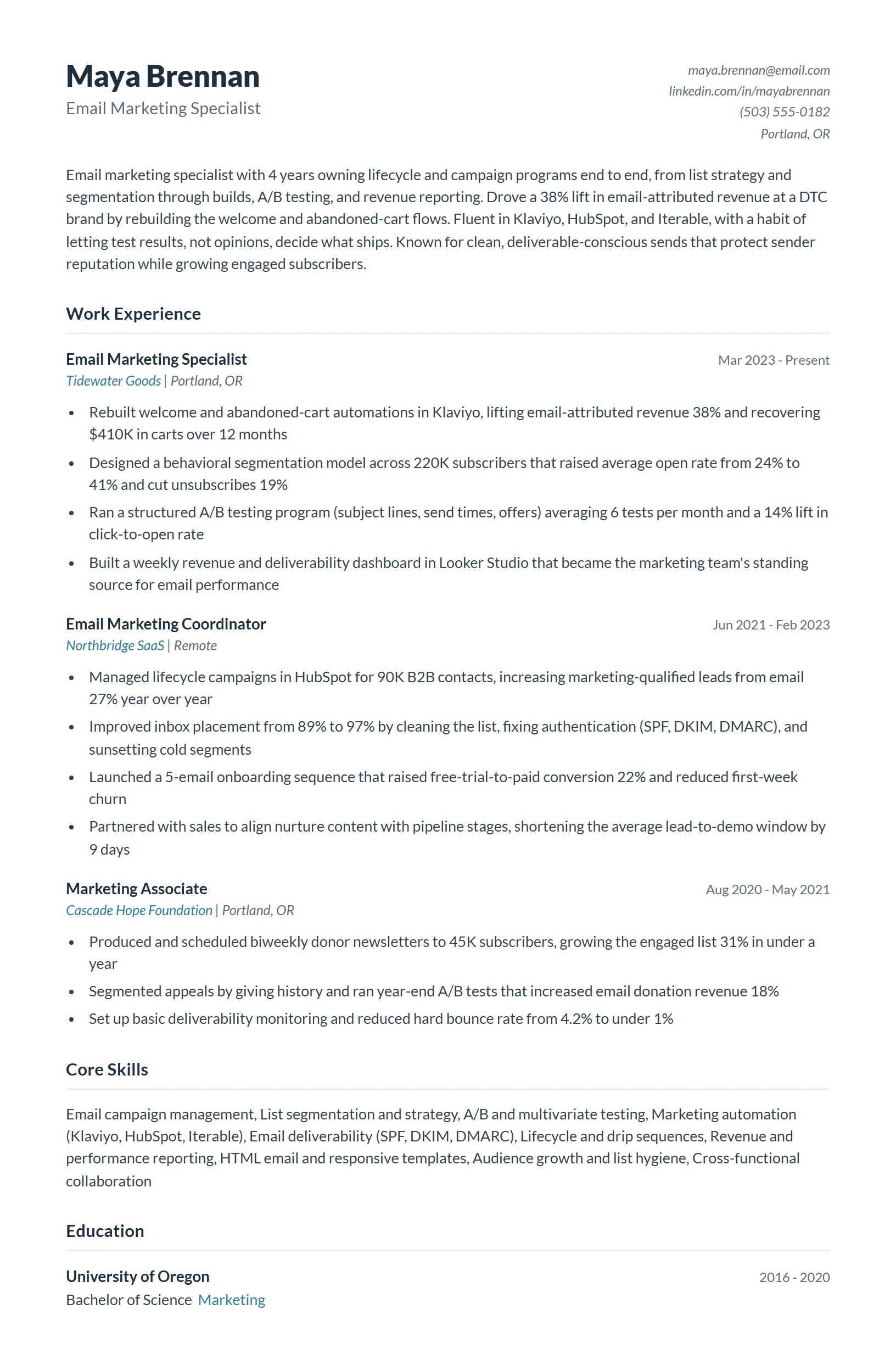
Email Marketing resume example
Not sure how to show both campaign craft and business impact on one page? This email marketing resume example shows how to pair the work you did with the revenue and engagement it drove.
This resume works because it quantifies outcomes on every line, like list growth, open and click-through lifts, and revenue per campaign, instead of just listing tasks. It surfaces ATS keywords such as segmentation, A/B testing, automation, and the specific ESP up top, then backs them with experience that shows the full campaign lifecycle from strategy to reporting. A clean single-column format keeps it easy for recruiters and the ATS to scan.
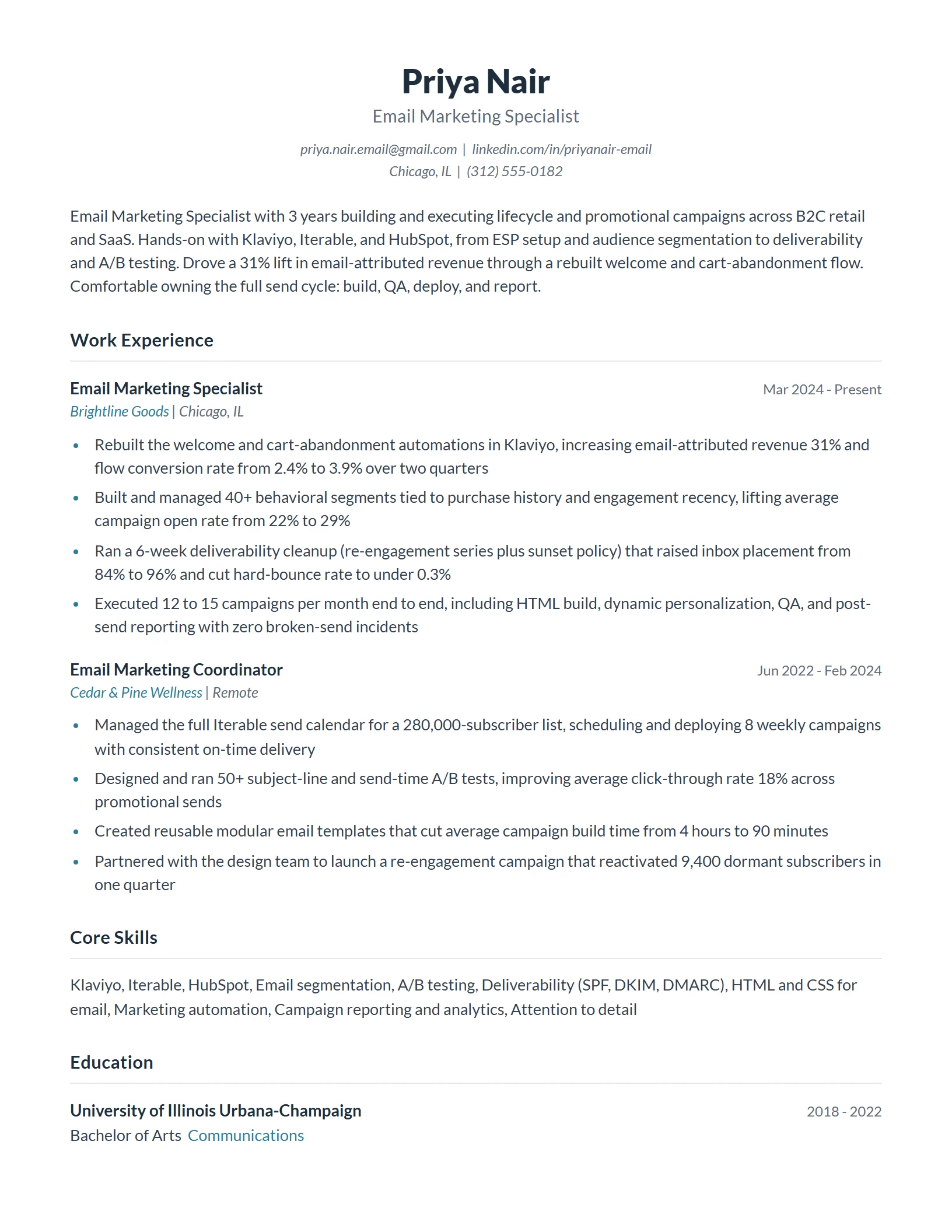
Email Marketing Specialist resume example
Specialist roles are won on execution and craft. This email marketing specialist resume example shows how to prove you can build, test, and ship campaigns that perform.
This resume works because it foregrounds hands-on execution: campaign builds, segmentation, deliverability management, and A/B testing tied to measurable engagement gains. It names the exact tools and platforms an ATS scans for, then shows results per campaign rather than vague duties. The emphasis on craft and consistency signals a dependable builder a team can hand the calendar to.
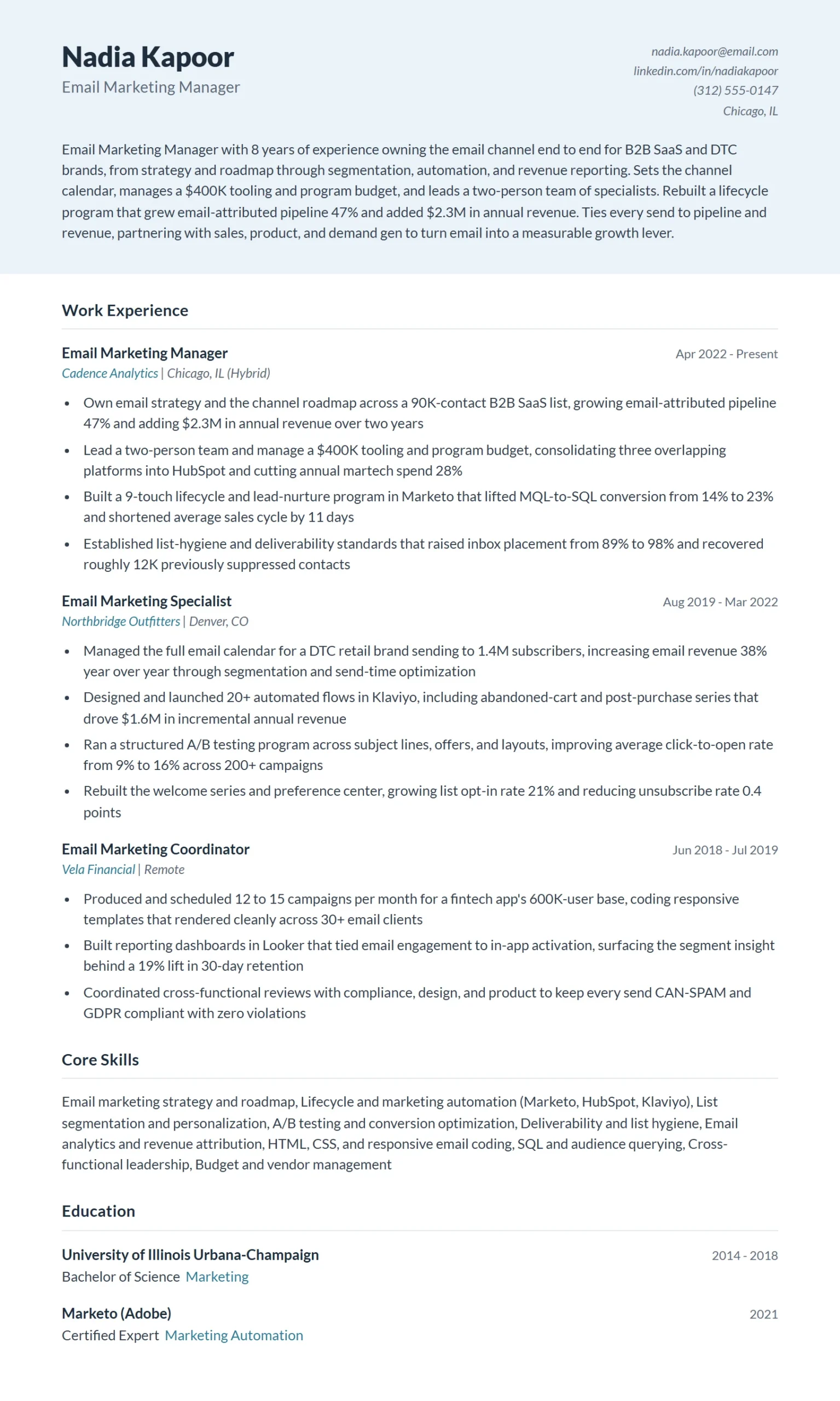
Email Marketing Manager resume example
Stepping up to manage the channel means proving strategy and ownership, not just execution. This email marketing manager resume example shows how to frame channel leadership and revenue impact.
This resume works because it shifts the emphasis from individual sends to owning the channel: setting strategy and calendar, managing tools and budget, and tying email to pipeline and revenue. Quantified outcomes like revenue driven, retention gained, and program scale signal seniority a title alone cannot. It still carries the platform and method keywords an ATS expects, so strategy never costs visibility.
CRM Manager resume example
CRM roles reward database ownership and lifecycle thinking across channels. This CRM manager resume example shows how to highlight retention, segmentation, and platform expertise.

This resume works because it centers the customer database and cross-channel lifecycle communications (email, SMS, push) rather than one-off campaigns. It quantifies retention, reactivation, and revenue from segmented programs, and names CRM platforms like Salesforce, HubSpot, or Braze that hiring teams and the ATS scan for. The framing reads as an owner of customer relationships, not just a campaign builder.
Lifecycle Marketing Manager resume example
Lifecycle roles are about the whole customer journey, not a single send. This lifecycle marketing manager resume example shows how to map your work to onboarding, activation, retention, and churn.

This resume works because it organizes results around journey stages, showing programs that improved onboarding completion, activation, and churn rather than isolated campaign metrics. It pairs automated lifecycle keywords (onboarding, retention, reactivation, segmentation) with the platforms behind them, and quantifies impact in retention and revenue terms. The cross-functional framing signals someone who owns outcomes across the funnel.
Marketing Automation Specialist resume example
Automation roles are won on technical fluency and clean workflows. This marketing automation specialist resume example shows how to highlight the systems and nurture programs you build.

This resume works because it centers the technical craft: building drip campaigns, lead-nurturing workflows, lead scoring, and integrations in platforms like Marketo, HubSpot, or Pardot. It names those exact tools for the ATS and quantifies impact in qualified leads, pipeline influenced, and time saved through automation. The focus on data hygiene and workflow logic reads as a specialist who keeps the engine running.
How to write an email marketing resume that gets interviews
Hiring managers scan an email marketing resume for proof you can grow a list, drive opens and clicks, and tie campaigns to revenue. They want platform fluency, a testing mindset, and numbers that show your sends actually moved the business. Most companies also run your resume through an Applicant Tracking System (ATS) first, so your language has to match the job description before a human ever sees it. The tips below show you how to do both: clear the ATS scan and convince the marketer reading next.
- Lead with revenue and pipeline, not send volume: Anyone can blast an email. Show what it earned: “drove $640K in attributed revenue from lifecycle campaigns,” “grew email-sourced pipeline 35% in two quarters,” or “recovered 18% of abandoned carts through a 3-touch flow.” Sending a lot of email is a chore; turning email into a revenue channel is the job. Put a money or pipeline metric on your strongest bullets and let send counts play a supporting role.
- Quantify the metrics that prove deliverability and engagement: Email is the most measurable channel you can list, so use it. Cite open rate, click-through rate, conversion rate, list growth, unsubscribe rate, and deliverability or inbox-placement gains with before-and-after numbers: “lifted open rate from 19% to 27%,” “cut unsubscribe rate 40% after a re-segmentation,” “improved inbox placement to 98% by fixing SPF, DKIM, and DMARC.” Vague claims like “strong engagement” read as filler to both the ATS and the recruiter.
- Name your ESP and the exact tools from the posting: ATS scans for specific platforms. List the email service providers and tools you actually use (Klaviyo, Iterable, Marketo, HubSpot, Mailchimp, Braze, Salesforce Marketing Cloud) and match the job description’s wording. If the role says “Marketo” and you ran Marketo, write “Marketo,” not “marketing automation tool.” Add adjacent skills the posting names too: HTML/CSS for email, Litmus or Email on Acid for rendering, and SQL or Looker if you pull your own audience segments.
- Show the full lifecycle, not just one-off blasts: Strong candidates own automated journeys, not just newsletters. Reference the flows you built and the stages they cover: welcome series, onboarding, lead nurture, abandoned cart, win-back, and re-engagement. A bullet like “built a 5-email welcome series that lifted first-purchase rate 23%” signals you think in systems and customer journeys. Listing only “monthly newsletter” reads as a junior, batch-and-blast operator.
- Make A/B testing and segmentation central: Email hiring rewards a testing mindset. Show what you tested and what you learned: “ran 40+ A/B tests on subject lines and send times, lifting average CTR 14%,” or “rebuilt segmentation into 12 behavior-based cohorts, raising revenue per email 28%.” Naming the variable, the result, and the rollout proves you optimize with data instead of guessing. Pair this with personalization and dynamic content if the role calls for it.
- Tailor to the role: B2C lifecycle, B2B nurture, or CRM: A DTC lifecycle role, a B2B demand-gen nurture role, and a CRM or retention role reward different keywords and wins. Reorder your skills and swap your headline metrics to mirror each posting (revenue and retention for B2C, MQLs and pipeline for B2B). Then keep the format ATS-friendly: standard section headings, no text boxes or columns that scramble parsing, and a single clean column. Run it through Jobscan to check your match rate against the job description before you apply.

Email Marketing resume summary examples
Your summary is the first thing a recruiter reads. Lead with your specialty, years of experience, and a quantified win.
Good email Marketing resume summary examples
- Data-driven email marketing manager with 6+ years running lifecycle and retention programs across DTC and SaaS. Built automated flows in Klaviyo and Iterable that drove $1.2M in attributed revenue and lifted email-sourced revenue 34% year over year. Fluent in A/B testing, behavior-based segmentation, and deliverability optimization, with average open rates above 30%.
- Email and CRM specialist focused on turning subscribers into repeat buyers. Owns the full lifecycle from welcome series to win-back, recently raising 90-day retention 21% and recovering 18% of abandoned carts through automated flows. Strong in HubSpot, SQL-based segmentation, and Litmus rendering, with a track record of 40+ A/B tests that grew CTR 14%.
- B2B email marketer specializing in lead nurture and demand generation in Marketo. Scaled a nurture program that generated 1,400 marketing-qualified leads per quarter and contributed 35% of sourced pipeline. Known for tight sales alignment, clean deliverability (98% inbox placement), and segmentation that lifted reply rates 26%.
What to avoid
- Creative email marketer looking for an exciting role where I can use my skills and help a great brand grow its audience. (It is all about what the candidate wants, not what they deliver. There is no ESP, no specialization (B2C vs B2B), no flows, and zero metrics. A hiring manager learns nothing they can act on.)
- Hard-working marketing professional with a passion for email and a great eye for engaging content and catchy subject lines. (Pure adjectives with no proof. “Catchy subject lines” is a claim anyone can make, with no open rate, CTR, or revenue to back it. It names no platform and no testing process, so the ATS and the recruiter both skip it.)
Email Marketing resume skills
Pull the exact ESP and methods from each job description, then mirror that language here. This is a quick resume snapshot, so keep it to your strongest, role-relevant skills rather than an exhaustive list.
Hard skills for a email Marketing resume
- Email Marketing
- Marketing Automation
- Lifecycle / Drip Campaigns
- A/B Testing
- List Segmentation
- Klaviyo / HubSpot / Marketo
- Deliverability (SPF, DKIM, DMARC)
- HTML/CSS for Email
- Email Analytics & Reporting
- CRM Management
Soft skills for a email Marketing resume
- Copywriting
- Data Analysis
- Cross-Functional Collaboration
- Attention to Detail
- Project Management
Email Marketing resume work experience bullet point examples
Lead each bullet with a strong verb and a measurable result.
Good bullet point examples
- Built a 5-email welcome series in Klaviyo that lifted first-purchase rate 23% and added an estimated $480K in annual revenue.
- Rebuilt list segmentation into 12 behavior-based cohorts, raising revenue per email 28% and cutting unsubscribe rate 40%.
- Ran 40+ A/B tests on subject lines, send times, and CTAs, increasing average click-through rate from 2.1% to 3.4% across the program.
- Improved inbox placement to 98% by fixing SPF, DKIM, and DMARC and running a 60-day re-engagement campaign that pruned 22K inactive contacts.
Bad bullet point examples
- Sent out weekly email newsletters to the company’s subscriber list. (Lists a routine task with no outcome. There is no metric, no flow, and no business result. It tells the reader you pressed send but not whether the email did anything.)
- Responsible for managing email campaigns and the marketing automation platform. (“Responsible for” describes a job duty, not an accomplishment. It shows no specific action and no measurable impact. Lead with a strong verb (Built, Launched, Grew) and end with a result instead.)
- Helped increase engagement and improve our open rates through better content. (Vague and unquantified. “Increase” and “better content” are opinions with no numbers. Replace them with the actual lift, such as open rate moving from 19% to 27%, and name what you changed to get it.)
Email Marketing resume tips
A strong email marketing resume proves you can move subscribers from inbox to purchase, and these tips help you show exactly that.
- Mirror ATS Keywords: Pull exact phrases from each job posting, such as ‘lifecycle campaigns,’ ‘list segmentation,’ or ‘marketing automation,’ and place them in your skills section and bullet points so the ATS scores your resume as a strong match before a recruiter reads it.
- Quantify Email Metrics: Go beyond ‘improved open rates’ and cite the numbers that matter to hiring managers: open rate, click-to-open rate, conversion rate, revenue per email, list growth percentage, and unsubscribe rate reductions.
- Name Your Platforms: Spell out every platform you have used, Klaviyo, HubSpot, Marketo, Salesforce Marketing Cloud, and Mailchimp, because ATS systems often scan for tool names verbatim and hiring managers filter candidates by platform experience.
- Show Deliverability Knowledge: If you have configured or maintained SPF, DKIM, or DMARC records, say so explicitly on your resume, because deliverability expertise is rare and immediately separates you from candidates who only write copy and build templates.
- Add Relevant Certifications: List certifications such as HubSpot Email Marketing, Klaviyo Product Certification, or Marketo Certified Expert directly under your name or in a dedicated section, since many ATS filters screen for these credentials by keyword.
- Separate HTML Skills Clearly: If you can hand-code or edit email templates using HTML and CSS, state it plainly in your technical skills section rather than burying it in a bullet point, because many teams need someone who can fix rendering issues without waiting on a developer.
Pair your email Marketing resume with a cover letter
A strong resume goes further with a tailored cover letter. Browse our cover letter examples to round out your application.
Email Marketing resume frequently asked questions
List a mix of platform skills, analytics, and strategy. Strong picks include email service providers (Klaviyo, Mailchimp, HubSpot, Marketo, Braze), A/B testing, segmentation, list management, automation and drip campaigns, deliverability, HTML/CSS for email, and core metrics like open rate, click-through rate, and conversion rate. Mirror the exact tools and terms from the job description so your resume matches what the ATS is scanning for.
Tie every bullet to a number that shows business impact, not just activity. Use metrics like open rate, click-through rate, list growth, revenue per email, and conversion lift (for example, “Grew subscriber list 38% in six months” or “Lifted campaign revenue 22% through send-time optimization”). If you do not have exact figures, use defensible ranges or percentages rather than vague phrases like “improved engagement.”
Pull keywords straight from the job posting and weave them naturally into your summary, skills section, and experience bullets. Common ones include email automation, segmentation, lifecycle marketing, CRM, deliverability, A/B testing, marketing automation platforms, and the specific ESP named in the listing. Run your resume through a scanner before applying so you can confirm the match rate and fill any gaps.
Open with your years of experience, your strongest channel results, and the platforms you know best. For example, “Email marketing specialist with 5 years driving lifecycle campaigns in Klaviyo and HubSpot, including a 30% increase in repeat-purchase revenue.” Keep it to two or three sentences and lead with a number so a recruiter sees your value in the first few seconds.
Highlight transferable work like managing a newsletter, running campaigns for a club or side project, or completing a certification from HubSpot, Mailchimp, or Google. Show hands-on familiarity with an ESP, basic segmentation, and reading campaign reports, even from personal or volunteer projects. Pair that with a focused skills section and a summary that signals you understand metrics, and you can compete for entry-level and coordinator roles.
Yes, certifications signal credibility and help fill keyword gaps, especially early in your career. Recognized options include HubSpot Email Marketing, Mailchimp Foundations, Klaviyo Product certifications, and Google Analytics. Add a short certifications section near the bottom of your resume and include the issuing platform name so it registers with both recruiters and the ATS.