Best Pharmacist Resume Examples for 2026
Pharmacist resume examples for 2026 showing how to feature clinical skills, licensure, and patient-safety wins so your application clears ATS filters.



Pharmacists play a crucial role in healthcare, ensuring patients receive the correct medications and understand their proper usage. Whether you’re an experienced pharmacist or just starting out, this blog offers expertly designed resume samples and actionable tips to help you write a compelling resume.
According to the U.S. Bureau of Labor Statistics, employment for pharmacists is projected to grow 5 percent from 2023 to 2033, about as fast as the average for all occupations. Employers seek candidates with strong clinical knowledge, attention to detail, and excellent patient communication skills. A well-structured resume is essential to showcase these qualities and secure your next opportunity.
If you’re unsure how to make your resume stand out, you’re in the right place! Keep reading to learn how to highlight your skills, optimize your resume for applicant tracking systems, and increase your chances of landing an interview.
Pharmacist resume example
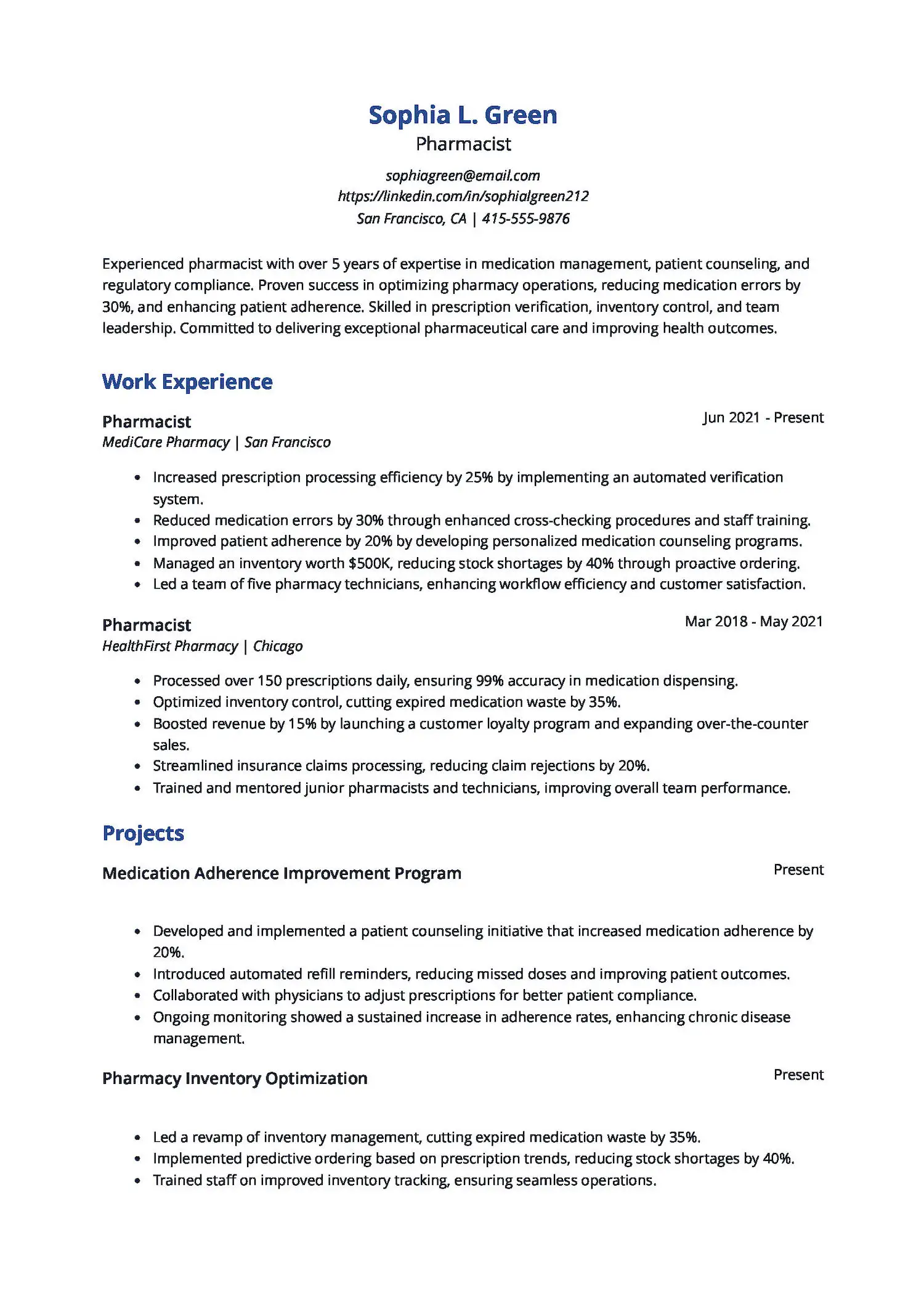
Are you looking to land a pharmacist role but unsure if your resume stands out? Does your experience in medication management and patient care reflect your full potential? A well-structured resume, like the one below, highlights key achievements, skills, and impact, helping you get noticed.

Pharmacists play a crucial role in healthcare, ensuring safe and effective medication use. Employers look for candidates who can manage prescriptions, optimize inventory, counsel patients, and maintain regulatory compliance. Your resume should showcase your expertise, problem-solving abilities, and leadership skills to prove you’re the right fit.
This resume makes a strong first impression with a strong professional summary that gets straight to the point. It highlights key skills and achievements like expertise in medication management, showing real impact rather than just listing responsibilities. Employers can quickly see how the candidate adds value.
The work experience section is just as effective. It’s well-structured, with bullet points focusing on measurable results like “managing an inventory worth $500K”. Each role demonstrates problem-solving, efficiency, and leadership, making it easy for hiring managers to recognize a strong candidate.
Registered pharmacist resume example
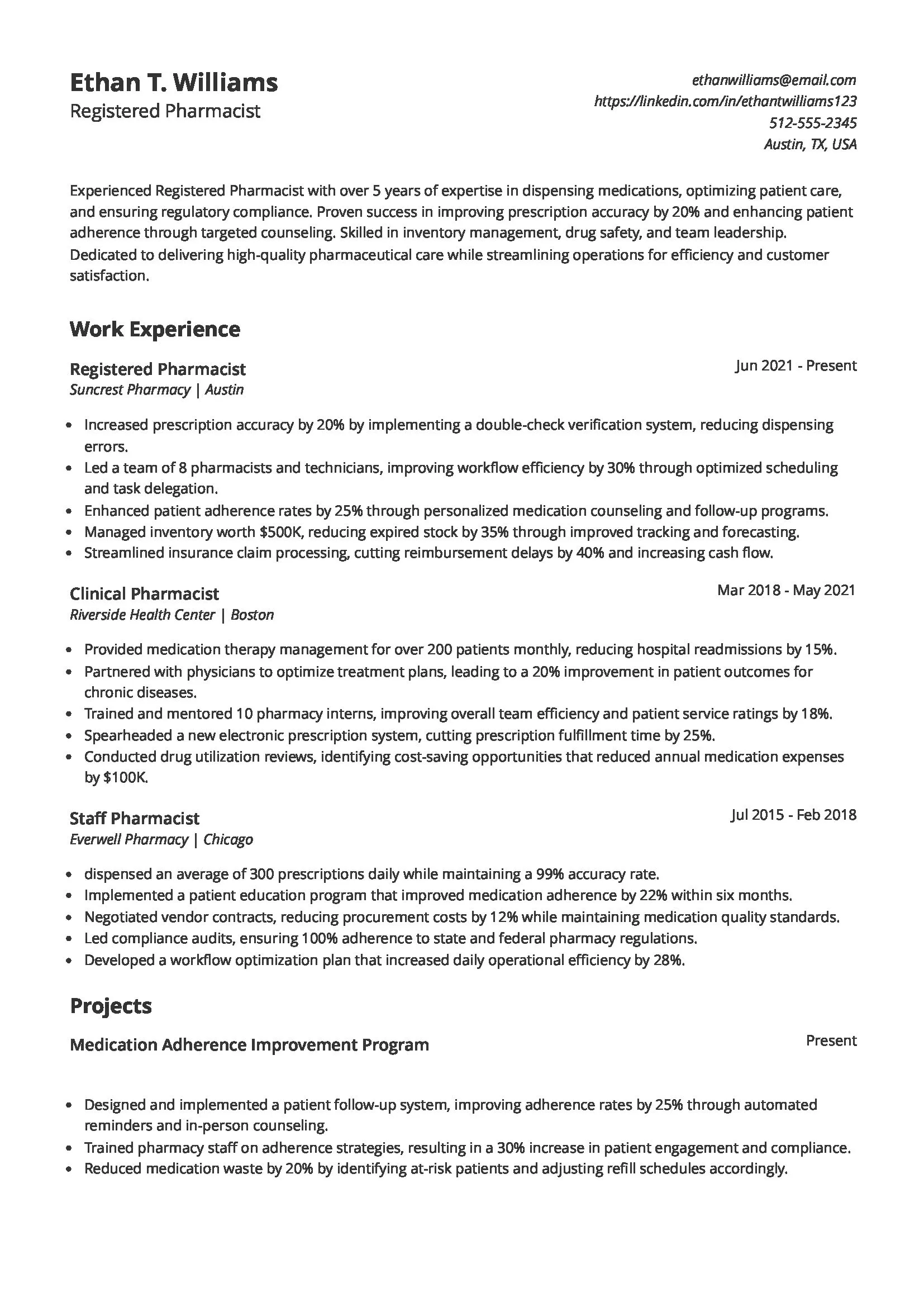
Looking for a registered pharmacist job but not sure how to make your resume stand out? Struggling to highlight your skills and certifications effectively? Check out this well-written resume example to see how you can showcase your expertise in medication dispensing, patient counseling, and regulatory compliance.

A registered pharmacist plays a critical role in ensuring medication safety, accuracy, and adherence. Employers look for professionals with strong attention to detail, knowledge of drug interactions, and a commitment to patient care. Leadership, inventory management, and regulatory compliance are also key.
If you’re aiming for the role of a registered pharmacist position, make sure your resume highlights both your qualifications and the real impact you’ve made in pharmacy operations and patient outcomes.
This resume works because it goes beyond listing job duties—it highlights real impact. Metrics like improving prescription accuracy by 20% and reducing expired stock by 35% show measurable success. The skills section is detailed yet easy to scan, covering both technical expertise and leadership.
Each role includes achievements that matter to employers, from boosting efficiency to enhancing patient care. The structured format, clear bullet points, and strong project highlights make it stand out.
Pharmacist manager resume example
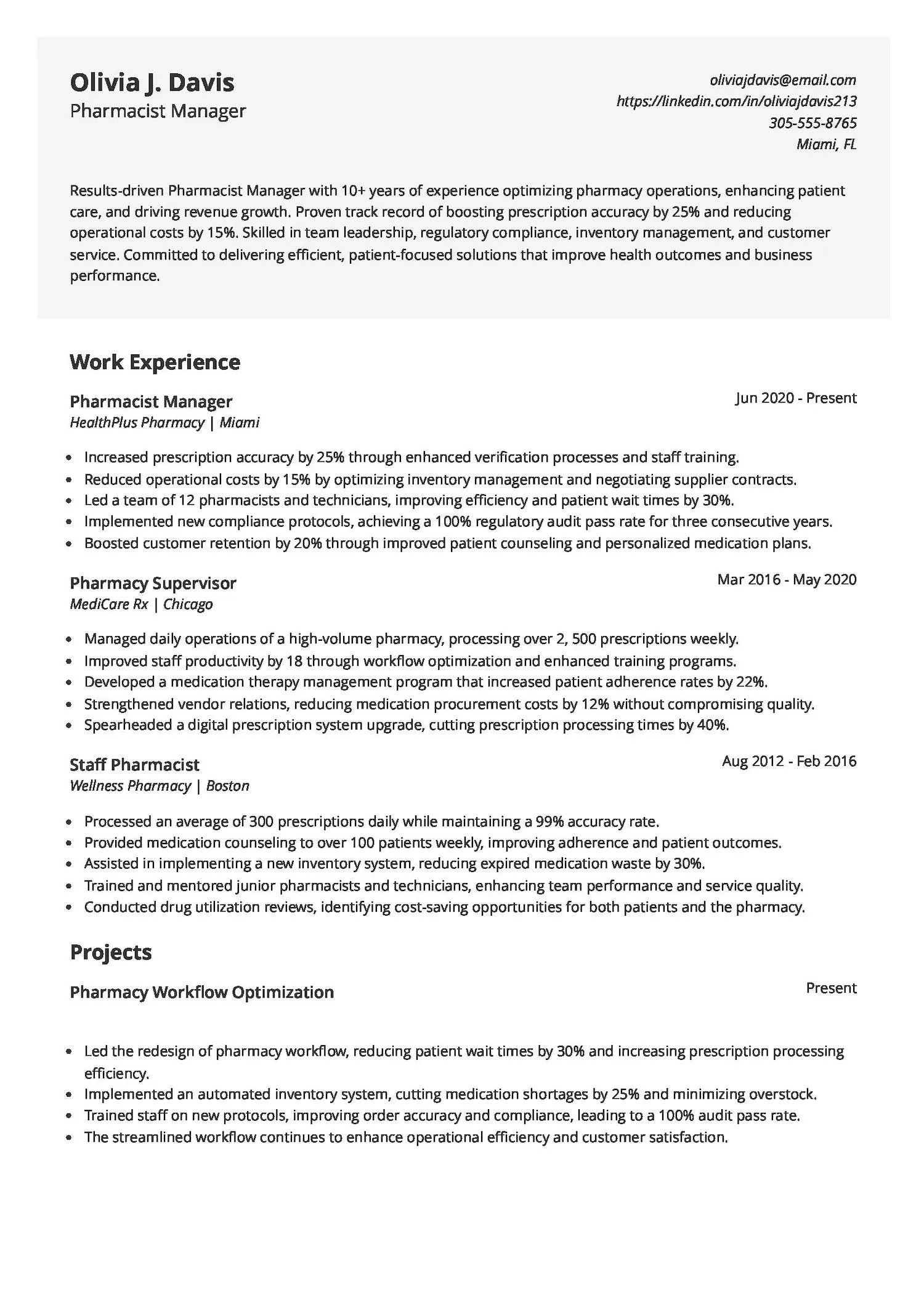
Want to stand out as a strong leader in pharmacy management? Not sure how to showcase your impact on operations and patient care? This pharmacist manager resume example highlights key achievements in efficiency, compliance, and leadership to help you write a compelling application.

Pharmacist managers are expected to oversee daily operations, ensure compliance, manage inventory, and lead a team of professionals—all while improving patient outcomes. Employers look for candidates with strong leadership, problem-solving, and communication skills. If you’re aiming for a managerial role in pharmacy, your resume should highlight measurable achievements in efficiency, compliance, and customer retention.
This professional resume template immediately stands out with its clear structure and results-focused approach. The projects section uses strong action verbs like “led,” “implemented,” and “spearheaded,” showcasing leadership and problem-solving in pharmacy management. It highlights expertise in workflow optimization and digital systems—key responsibilities for a pharmacist manager. With a clean layout, clear headings, and concise bullet points, it’s easy to scan, ensuring key achievements stand out at a glance.
Also Read: 10 Best Resume Skills to Put on a Resume
How to write a pharmacist resume that will get you an interview
A well-written pharmacist resume can help you stand out in a competitive job market. Whether you’re an experienced pharmacist or just starting your career, your resume should showcase your expertise, certifications, and commitment to patient care.
Many healthcare organizations and pharmacies use Applicant Tracking Systems (ATS) to scan resumes before they reach a hiring manager. Think of ATS as a search engine—if your resume doesn’t include the right keywords, it may not be seen by a hiring manager.
For a pharmacist role, hiring managers often search for terms like “medication therapy management,” “patient counseling,” “regulatory compliance,” and “inventory management.” Including these keywords can increase your chances of being noticed.
How ATS works:
- Job posting setup: Employers list job titles, required skills, and qualifications.
- Resume scanning: The system scans submitted resumes, extracting key details.
- Searchable database: Hiring managers sort candidates based on relevant keywords.
If your resume isn’t ATS-optimized, it could get overlooked, even if you’re highly qualified. Using relevant keywords and a clear, structured format improves your chances of landing an interview.
Need help creating an ATS-friendly resume? Jobscan’s ATS resume maker helps you write a well-structured resume, integrate the right keywords, and highlight your strength, giving you a better shot at securing interviews.

Key elements of a pharmacist resume
A strong pharmacist resume should highlight your expertise in medication management, patient counseling, regulatory compliance, and collaboration with healthcare teams. Key sections include:
- Contact information – Name, phone number, email, and LinkedIn (if applicable).
- Professional summary – A concise, compelling overview of your experience and skills.
- Core skills – Highlight essential competencies such as pharmacology knowledge, prescription verification, and patient education.
- Work experience – List relevant job roles with achievements that demonstrate your impact in the work experience section.
- Education & certifications – Include your pharmacy degree, licensure, and any additional certifications (e.g., immunization certification).
- Additional sections – Consider adding research, publications, or professional memberships.
Write a strong professional summary
Your professional summary should provide a snapshot of your qualifications, emphasizing key strengths, years of experience, and areas of expertise. Tailor it to the specific job by incorporating relevant keywords.
Let’s look at some good and bad professional summaries below to see the difference.
Good examples of a resume summary
- “Experienced retail pharmacist with 8+ years in retail and hospital settings, specializing in patient education, medication safety, and regulatory compliance. Adept at collaborating with healthcare teams to optimize treatment outcomes. Proven track record of improving pharmacy operations and enhancing patient satisfaction.”
- “Detail-oriented clinical pharmacist with expertise in drug interactions, chronic disease management, and electronic health records. Passionate about providing personalized care and ensuring medication safety for diverse patient populations.”
Bad examples of a resume summary
- “I am a pharmacist looking for a job. I have worked in a pharmacy and know how to fill prescriptions. I am good with customers.”
- “Hardworking and motivated. Have experience working in a pharmacy and handling medicine. Looking for a position to grow my skills.”
Want to write a compelling resume summary? We have got you covered. Jobscan’s professional summary generator takes the guesswork out of the process by writing a powerful, accomplishment-driven summary tailored to your experience. Simply enter your details, and let Jobscan create a polished summary that grabs recruiters’ attention.
Demonstrate key pharmacist skills
A pharmacist resume should effectively showcase both hard and soft skills to demonstrate expertise in medication management, patient care, and operational efficiency. Below are some key skills to consider that appeal to hiring managers and ATS software:
Hard skills for a pharmacist
- Prescription Verification
- Medication Dispensing
- Drug Interaction Analysis
- Pharmacology Knowledge
- Inventory Management
- Insurance Processing
- EHR Management
- Compounding Techniques
- Regulatory Compliance
- Sterile Preparation
Soft skills for a pharmacist
- Attention to Detail
- Patient Counseling
- Team Collaboration
- Problem-Solving
- Leadership Skills
- Adaptability Skills
- Time Management
- Multitasking Ability
- Communication Skills
- Critical Thinking
Effectively incorporating these skills into your resume bullet points allows you to showcase your achievements and demonstrate your expertise. However, simply listing responsibilities isn’t enough—how you present your pharmacy skills can make a significant difference. Let’s look at some examples of the right and wrong ways to highlight your experience and skills in your resume bullet points.
Write impactful resume bullet points for a pharmacist
Resume bullet points are the core of your experience section. They should clearly communicate your skills, the impact you’ve made, and the value you bring to a team. Instead of listing tasks, focus on what you accomplished using specific tools, action verbs, and measurable results. Here’s what that looks like:
Good examples of resume bullet points
- “Implemented a new medication reconciliation system, reducing prescription errors by 30% and improving patient safety.”
- “Counseled an average of 50 patients daily on medication adherence, potential side effects, and drug interactions, enhancing treatment outcomes.”
- “Trained and supervised a team of 6 pharmacy technicians, ensuring compliance with state regulations and improving workflow efficiency.”
- “Optimized inventory management, reducing expired medication waste by 25% and improving stock availability.”
- “Led a pharmacy automation project, increasing prescription processing efficiency by 40% and reducing customer wait times.”
Bad examples of resume bullet points
- “Filled prescriptions and helped customers.”
- “Worked in a pharmacy and did daily tasks.”
- “Managed inventory.”
- “Talked to patients about their medicine.”
Leverage Jobscan’s bullet point generator to write compelling, results-oriented bullet points for your resume. Simply upload your resume and the job description to your Jobscan dashboard, and the tool will provide customized phrase suggestions that showcase your skills and accomplishments effectively.
Highlight your achievements as a pharmacist
When writing your pharmacist resume, focusing on achievements rather than just responsibilities can make a significant impact. Employers want to see how you’ve contributed to patient care, improved pharmacy operations, or enhanced efficiency. To make your accomplishments stand out, use quantifiable data, action verbs, and specific examples.
Here are some examples of how you can showcase your achievements effectively:
- “Developed a medication adherence program that increased patient compliance by 35%.”
- “Implemented a new inventory tracking system, reducing medication shortages by 40%.”
- “Led a compliance audit that resulted in zero violations and improved pharmacy ratings.”
- “Negotiated supplier contracts, reducing medication costs by 20%.”
- “Trained and mentored 10 pharmacy technicians, improving workflow efficiency and accuracy.”
Tailor your resume to the job description
Customizing your pharmacist resume for each job application increases your chances of standing out to hiring managers. Rather than sending a generic resume, align your skills, experience, and achievements with the specific requirements of the job description.
Here’s how to tailor your resume effectively:
- Analyze the job description: Identify key skills, qualifications, and responsibilities mentioned in the posting.
- Incorporate keywords: Use relevant industry terms and phrases from the job listing to improve ATS compatibility.
- Highlight relevant experience: Prioritize work history and accomplishments that match the job’s requirements.
- Adjust your professional summary: Emphasize skills and expertise that directly align with the employer’s needs in your resume objective.
- Refine your bullet points: Focus on achievements that demonstrate your ability to perform the role successfully.
- Make it ATS-friendly: Avoid excessive formatting, images, or unusual fonts to ensure your resume is ATS-friendly.
Also Read: The Top 5 ATS Resume Keywords of 2026
Include relevant education and certifications
Education and certifications play a crucial role in a pharmacist’s resume, demonstrating your qualifications and commitment to professional development. Employers look for candidates with the necessary academic background and industry-recognized credentials to ensure competency in pharmaceutical care.
Here’s how to effectively present your education section and certifications as a pharmacist:
- Include your degree, major, and institution in a concise format (e.g., Doctor of Pharmacy (PharmD), XYZ University).
- If you’re a recent graduate, add your graduation year and highlight relevant coursework, clinical rotations, or honors.
- For experienced pharmacists, keep it brief and focus on advanced degrees or specialized training.
- If transitioning to a new pharmacy specialty, mention coursework or certifications that align with your new focus, such as clinical pharmacy or regulatory affairs.
- List relevant certifications that enhance your expertise, such as immunization training, sterile compounding, or board certifications (e.g., BCPS, BCACP).
- If you specialize in a particular area, include credentials like Board Certified Oncology Pharmacist (BCOP) or Certified Diabetes Educator (CDE).
- For seasoned professionals, prioritize industry-recognized certifications over general training programs to highlight your advanced qualifications.
Top pharmacist certifications
- Board Certified Pharmacotherapy Specialist (BCPS)
- Board Certified Ambulatory Care Pharmacist (BCACP)
- Board Certified Oncology Pharmacist (BCOP)
- Certified Diabetes Educator (CDE)
- Immunization Certification
- Compounded Sterile Preparations Certification (BCSCP)
- Pharmacy-Based Immunization Delivery (APhA)
Pharmacist resume tips
Writing a strong pharmacist resume requires more than just listing your experience—it should effectively showcase your skills, achievements, and qualifications. Here are some key tips to help you stand out:
- Use a clear and professional format: Ensure your resume is easy to read with distinct sections for professional experience, skills, and certifications. Stick to a clean format with consistent font and spacing.
- Write a compelling professional summary: Highlight your expertise, years of experience, and key accomplishments in a concise opening statement.
- Focus on achievements, not duties: Use quantifiable results to show your impact (e.g., “Reduced prescription errors by 30% through improved verification processes”).
- Tailor your resume to the job description: Incorporate relevant keywords and skills mentioned in the posting to improve ATS compatibility and attract hiring managers.
- Keep bullet points concise and impactful: Use action verbs like “implemented,” “optimized,” and “led” to make your responsibilities and achievements stand out.
- Highlight both hard and soft skills: Demonstrate technical expertise such as medication dispensing and regulatory compliance, as well as communication and problem-solving abilities.
- Showcase relevant certifications and licenses: Include credentials like BCPS, BCACP, or immunization training to prove your qualifications.
- Ensure ATS compatibility: Avoid complex formatting, graphics, or tables that could prevent the ATS from reading your resume correctly.
- Proofread for accuracy: Eliminate spelling and grammatical errors, as attention to detail is crucial in the pharmacy profession.
- Use strong action verbs: Start each bullet point with powerful verbs like “implemented,” “optimized,” “spearheaded,” or “streamlined” to showcase your contributions and make your resume more impactful. Avoid generic phrases like “responsible for” or “helped with.”
Also Read: How to Organize Your Resume Sections to Stand Out?
Include a cover letter with your pharmacist resume
A well-written cover letter can strengthen your pharmacist job application by providing a personalized introduction to your skills, experience, and passion for the role. While your resume highlights your qualifications, a cover letter allows you to explain why you’re the right fit for the position and how you can contribute to the organization.
What to include in your cover letter:
- Introduction – Start with a strong opening that mentions the position you’re applying for and a brief statement on why you’re interested in the role.
- Your qualifications – Highlight your relevant experience, certifications, and key skills, such as patient counseling, medication management, or regulatory compliance.
- Key achievements – Provide specific examples of how you’ve contributed to pharmacy operations, improved patient care, or enhanced efficiency in past roles.
- Alignment with the employer’s needs – Explain how your expertise aligns with the company’s mission and how you can add value to their team.
- Closing statement – End with a strong conclusion, expressing enthusiasm for the opportunity and a request for an interview.
Including a tailored cover letter with your resume increases your chances of making a strong impression and securing an interview.
Need a standout cover letter fast? Use Jobscan’s cover letter maker to write a winning one in minutes!
Build a standout pharmacist resume with Jobscan
A well-structured pharmacist resume can make all the difference in landing your ideal job. By highlighting your key skills, tailoring your resume to the job description, and showcasing your achievements, you can stand out in a competitive job market. Don’t forget to pair your resume with a compelling cover letter to make a strong first impression.
Need help creating a polished, professional resume? Try Jobscan’s free resume builder to generate a customized, ATS-friendly resume in minutes. Simply enter your details, and let the tool format your resume to match industry standards, helping you get noticed by hiring managers faster.

Pharmacist common interview questions
Answer:
“If I notice a potential drug interaction, I immediately review the patient’s medical history and the prescribed medications. I would then consult with the prescribing physician to discuss alternative options or dosage adjustments. If necessary, I would educate the patient on possible side effects and precautions. My goal is always to ensure patient safety while maintaining a collaborative relationship with healthcare providers.”
Answer:
“When dealing with a frustrated customer, I remain calm and actively listen to their concerns. I acknowledge their frustration and reassure them that I am there to help. I provide clear explanations regarding their issue—whether it’s related to insurance, medication availability, or prescription delays—and offer solutions, such as contacting their doctor or insurance provider. My focus is on delivering excellent customer service and ensuring customer satisfaction.”
Answer:
“Accuracy is critical in pharmacy practice. I follow a systematic approach that includes verifying the prescription details, cross-checking patient records for allergies or interactions, and using barcode scanning technology when available. I also implement the ‘double-check’ method by reviewing prescriptions before finalizing them. If any discrepancies arise, I promptly consult the prescribing physician to clarify instructions and ensure patient safety.”
Answer:
“I stay informed by regularly reading industry journals, such as the American Journal of Health-System Pharmacy and Pharmacy Times. I also participate in continuing education programs, attend pharmacy conferences, and maintain memberships in professional organizations like the American Pharmacists Association (APhA). Staying up to date ensures I provide accurate information to patients and remain compliant with evolving regulations.”
Pharmacist resume frequently asked questions
A pharmacist resume should highlight both hard skills and soft skills that demonstrate technical expertise and patient care abilities. Essential hard skills include medication dispensing, drug interaction analysis, and regulatory compliance. Soft skills like patient counseling, attention to detail, and teamwork are equally important. Tailoring these skills to the job description will help showcase your qualifications effectively.
List your degree, major, and institution in a clear format. If you’re a recent graduate, include your graduation year and highlight relevant coursework or clinical rotations. For experienced pharmacists, keep this section concise and focus on advanced degrees, certifications, or specialized training that align with the role.
If you’re new to the field and do not have extensive experience, emphasize internships, clinical rotations, and relevant coursework to showcase your knowledge. Highlight transferable skills from recent jobs, such as customer service, teamwork, and problem-solving, gained from other roles. Certifications, like immunization training or pharmacy technician experience, can also add significant value to your qualifications.