IT Project Manager Resume Examples & Tips for 2025
Elevate your IT project manager resume for 2025 with our proven examples and tips. Learn how to emphasize your technical expertise, accomplishments, and career goals.



As the tech industry becomes increasingly competitive and employers seek candidates who can demonstrate both technical expertise and leadership skills at a glance, writing a standout IT project manager resume is more crucial than ever in 2025.
IT project manager bridges the gap between technical teams and business goals—yet translating that multifaceted role into a compelling resume can be a daunting task. Many job seekers in this field struggle with how to effectively showcase their experience, highlight achievements, and align their resumes with current hiring trends. That’s where this blog comes in.
In this guide, we’ll walk you through expert-written IT project manager resume examples, key sections to include, and best practices to help you build a resume that gets noticed. Whether you’re updating an old resume or starting fresh, this blog is designed to help you overcome common challenges and land the job you deserve.
IT project manager resume example
Looking to land your next IT project manager role but not sure how to present your experience? Take a look at the resume example below—it’s a solid reference if you’re aiming to build a resume that highlights your skills, wins, and leadership style. Use it as inspiration to structure your own, especially if you’re in a mid- to senior-level project management role.

An effective IT project manager resume should clearly show your experience managing cross-functional teams, improving systems, and driving results. Recruiters want to see how you’ve led projects from start to finish, saved time or money, and handled risks. Your resume should speak to both the strategic and the hands-on side of the job—things like Agile frameworks, stakeholder communication, resource planning, and tools like JIRA or Microsoft Project. Show that you’re not just good at keeping things on track, but that you help move the business forward.
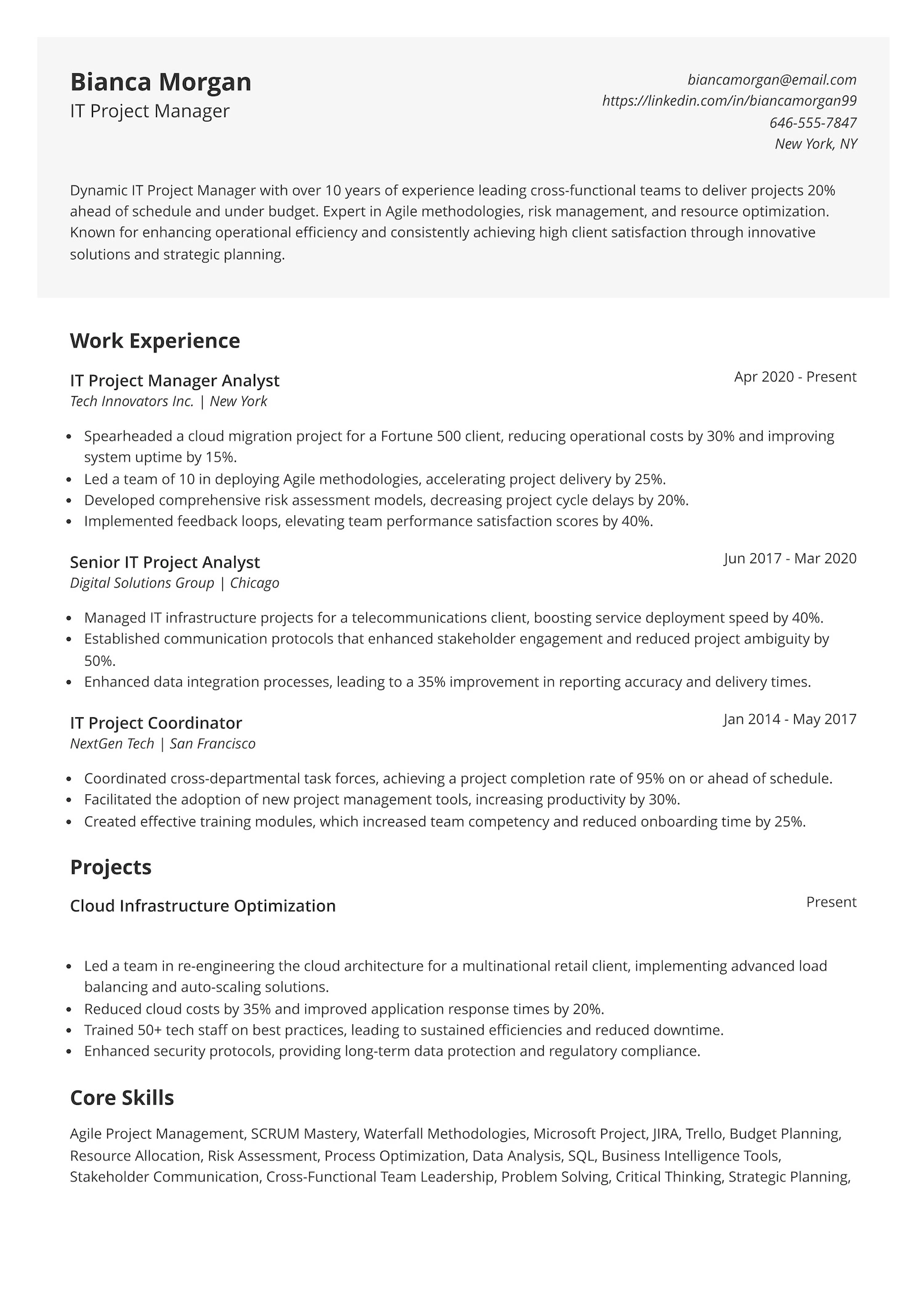
By showing proven results like reducing operational costs by 30% and boosting deployment speed by 40%, this resume clearly demonstrates real impact. It blends technical know-how—like cloud infrastructure and Agile methodology—with leadership strengths such as stakeholder communication and team performance.
The structure highlights measurable success, certifications, and growth, making it an ideal example for anyone aiming to land an IT project management role.
IT project coordinator resume example
Thinking about moving up in your project coordination career or stepping confidently into your next IT role, but not sure how to structure your resume? Check out the resume example below and learn how to clearly highlight your hands-on experience, coordination skills, and technical knowledge in a way that makes hiring managers take notice.
When it comes to IT project coordinator roles, employers are looking for more than just someone who can follow a timeline—they want someone who can lead teams, communicate with stakeholders, and keep everything running smoothly. Your resume should show how you’ve made an impact, how you solve problems, and how you manage budgets, tools, and timelines.
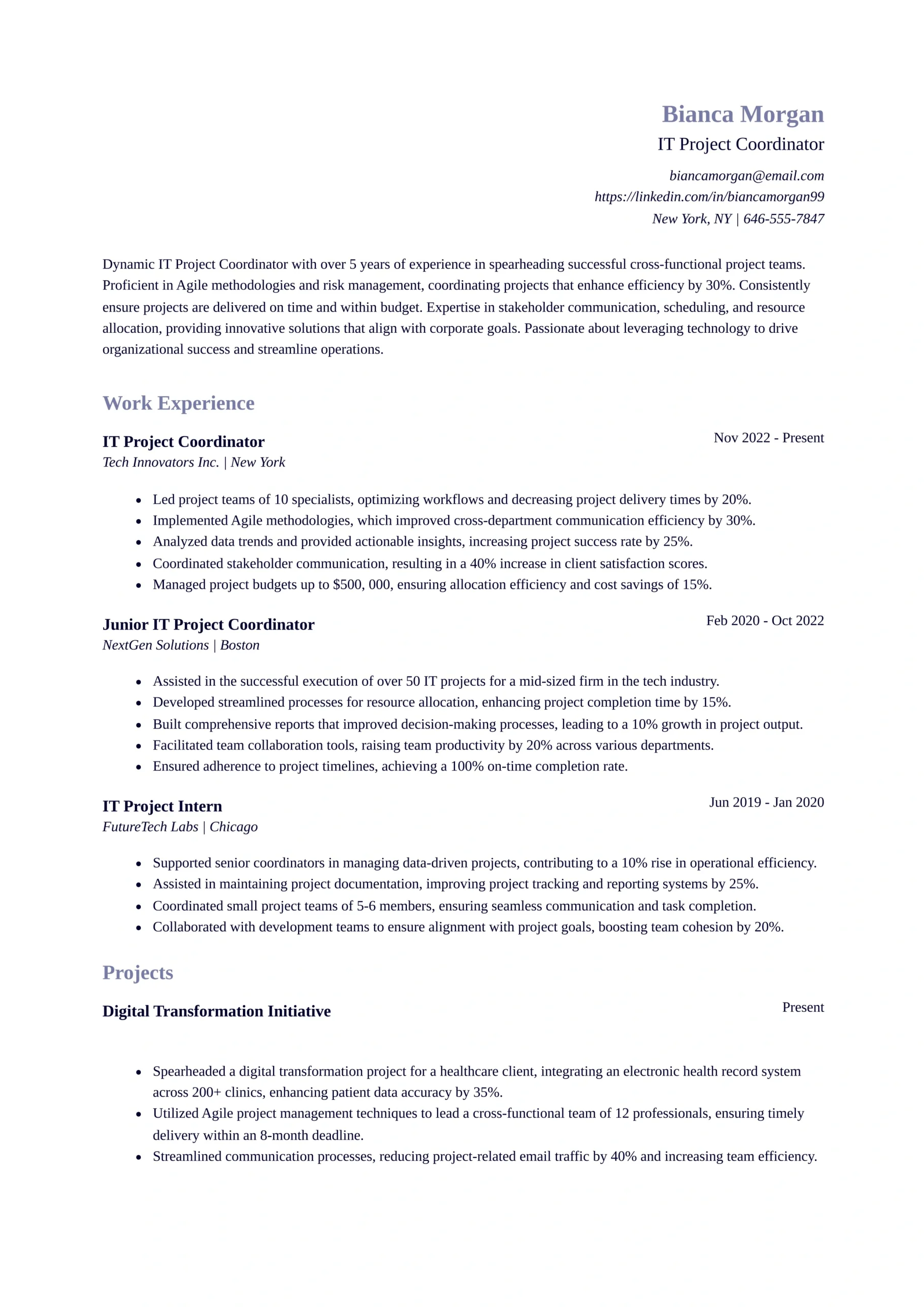
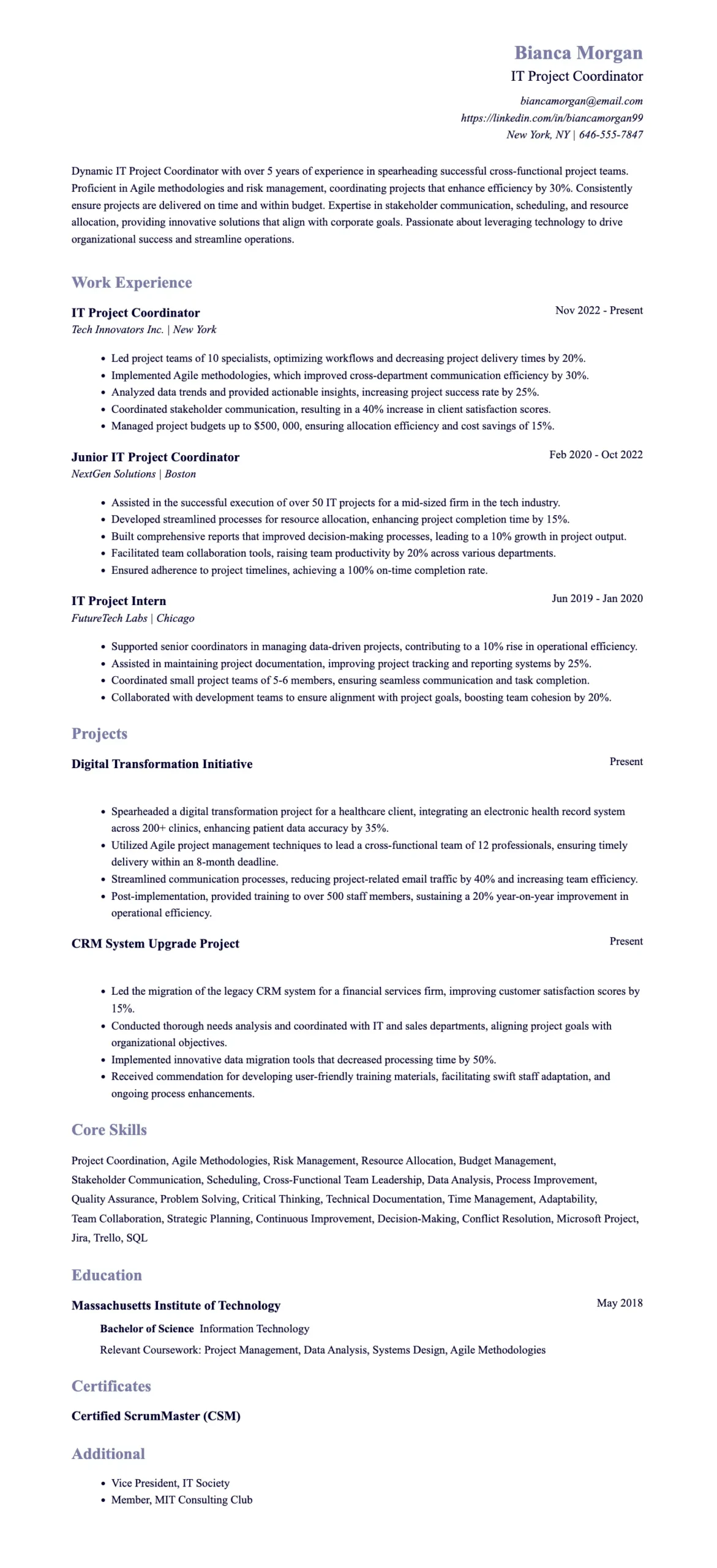
This resume stands out with a clear professional summary that highlights key achievements, like improving efficiency by 30% and managing budgets up to $500,000—right from the start. The projects section is especially compelling, showcasing hands-on leadership in complex initiatives like a 200+ clinic digital transformation and a CRM migration that improved customer satisfaction.
Together, these sections position the candidate as a proactive, results-driven coordinator ready for high-impact roles.
Junior IT project manager resume example
Are you wondering how to showcase your experience in a way that highlights leadership, strategy, and tech skills—all without overcomplicating your resume? This example gives a clear picture of how to present your impact, technical abilities, and growth in a straightforward and compelling format. Check it out, now!

For a junior IT project manager role, your resume should reflect how you’ve contributed to project success, collaborated across departments, and used tools like Agile, JIRA, and SQL to drive results. Employers seek someone who’s not only organized but also proactive in leading teams, solving problems, and improving processes.
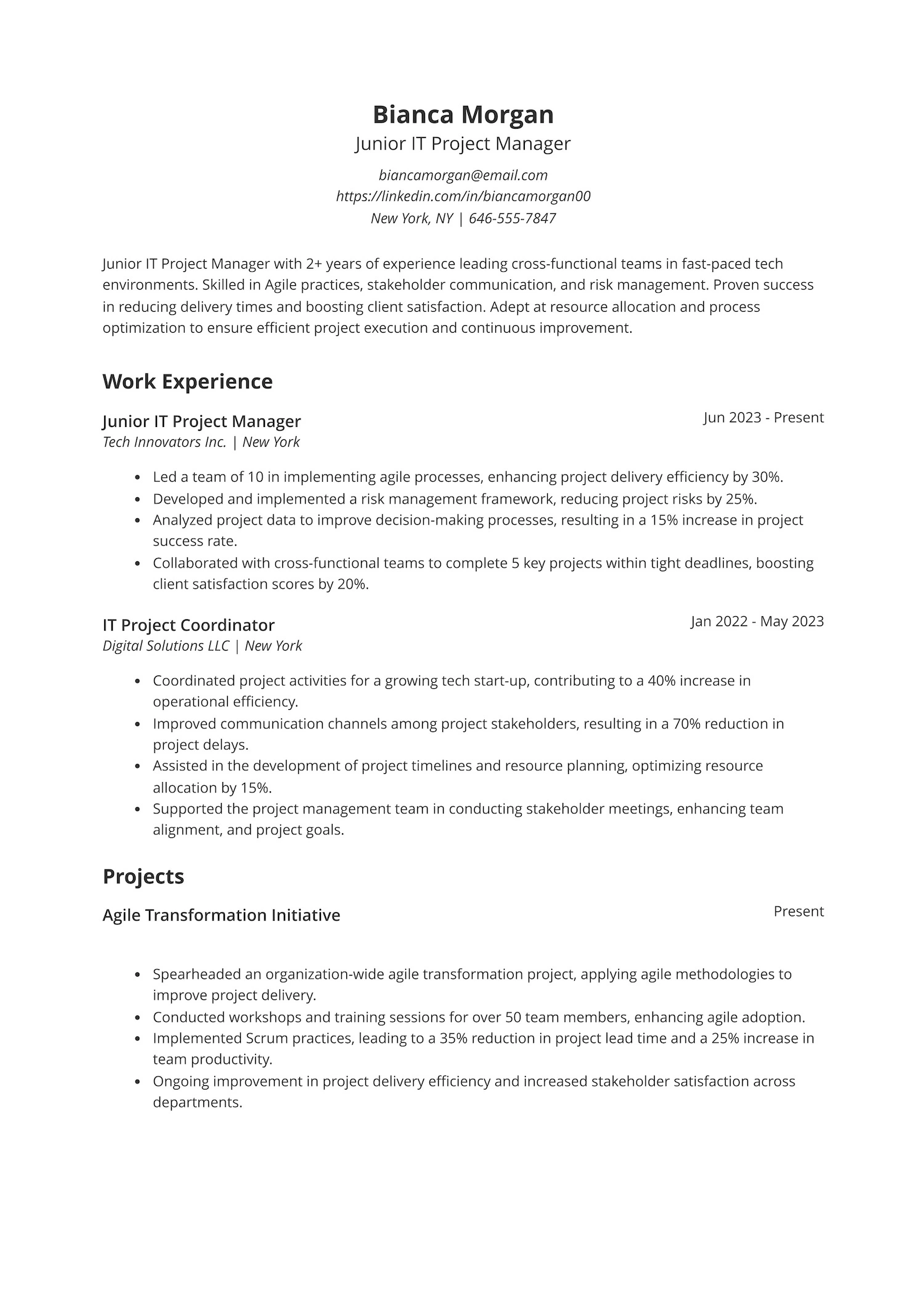
Packed with in-demand skills like Agile project management, stakeholder communication, and risk assessment, this resume effectively reflects the competencies employers seek in a junior IT project manager.
The work experience section shows real impact, like boosting delivery efficiency by 30% and reducing project delays by 70%. Each bullet point links to measurable results, presenting the candidate as a capable, detail-oriented professional ready to take on larger project management responsibilities.
Senior IT project manager resume example
Want to present over a decade of project leadership in a way that stands out? Take inspiration from the resume template below and see how you can balance technical skills, leadership achievements, and strategic thinking—all while keeping it clean and easy to read.

If you’re aiming for a senior IT project manager position, your resume needs to show more than experience—it should prove how you’ve led major initiatives, optimized resources, and delivered measurable results. Employers expect to see your ability to manage large budgets, lead cross-functional teams, and navigate evolving priorities.
With over a decade of experience and certifications like PMI-ACP and CompTIA Project+, this resume demonstrates mastery in leading high-stakes IT projects. The work experience section details measurable achievements, like completing a $10M software upgrade 30% ahead of schedule, showing strong leadership and results-driven execution.
Paired with top-tier education from Harvard and UC Berkeley, the candidate presents as an ideal senior-level hire ready to drive enterprise-level initiatives.
How to write an IT project manager resume that will get you an interview
With companies relying heavily on Applicant Tracking Systems (ATS) to streamline hiring, optimizing your resume for ATS is no longer optional—it’s essential. If your resume isn’t ATS-friendly, it may never even be seen by a hiring manager, regardless of how qualified you are.
An ATS functions like a search engine, scanning resumes based on keywords and relevance to the job posting. Understanding how ATS works can give you a significant advantage when writing your IT project manager resume.
Here’s what you need to know:
- Job posting setup: Employers input job titles, skills, qualifications, and key responsibilities into the ATS.
- Resume scanning: The ATS scans each resume submission, extracting relevant information like job titles, education, certifications, and keywords.
- Searchable database: All scanned resumes are stored in a searchable database. Hiring managers then use specific keywords or phrases—such as “agile methodologies,” “PMP certification,” or “project planning”—to locate suitable candidates.
Want a hassle-free way to build a powerful, ATS-optimized resume? Jobscan’s Free Resume Builder is the ultimate tool for IT project managers looking to stand out. It helps you write a professional resume tailored to your career goals and job targets by integrating ATS best practices directly into the building process. Say goodbye to missed opportunities and hello to more interview calls.

Key elements of an IT project manager resume
When writing a compelling IT project manager resume, it’s important to include the right elements that highlight your qualifications, experience, and value to potential employers. Each section should be strategically written to reflect your expertise in project management processes and your ability to lead diverse teams through complex initiatives. Here’s a breakdown of the key elements every IT project manager’s resume should include:
- Contact information: Include your full name, phone number, professional email address, location (city and state), and a link to your LinkedIn profile.
- Professional summary: A brief 2–4 sentence overview that highlights your years of experience, key achievements, and career goals.
- Core skills: Include a bulleted list of your top soft skills, technical skills, and project management skills, such as agile methodologies, risk management, strategic planning, project management software, and resource allocation.
- Work experience: Detail your past roles, focusing on accomplishments rather than duties. Use strong action verbs and quantify results where possible.
- Projects: Highlight specific IT project management-related projects, or other key initiatives you’ve led. Include the scope, technologies used, team size, and outcomes to showcase your project planning and execution skills.
- Education: List your degrees in reverse chronological order. Include the degree title, school name, graduation year, and any relevant coursework or honors related to project management methodologies.
- Certifications: Include relevant project management certifications such as PMP, CAPM, or certifications from the Project Management Institute.
- Honors and awards: Mention any recognitions that underscore your excellence or awards for project success or innovation. These add credibility and highlight your track record.
Write a strong professional summary
Your resume’s professional summary is your first opportunity to make a strong impression on a hiring manager, and it’s often the deciding factor for whether they keep reading. A well-written summary highlights your project management experience, technical expertise, and career achievements, all tailored to the role you’re applying for. It should be concise, keyword-rich, and focused on what makes you a valuable candidate.
Good examples of a resume summary
- “Results-driven IT Project Manager with over 8 years of experience leading cross-functional teams to deliver complex software development and infrastructure projects. Proven track record of improving operational efficiency, managing project timelines, and aligning IT strategies with business objectives in agile environments.”
- “Certified PMP with 10+ years of experience in IT project management, specializing in enterprise-level application rollouts, team leadership, and risk assessment. Skilled in using project management tools like Jira and MS Project to ensure on-time, within-budget delivery of high-impact initiatives.”
Bad examples of a resume summary
- “I am an IT project manager looking for a good opportunity to grow and use my skills in a company that values hard work and dedication.”
- “Worked in IT and managed projects. I can use project tools and have experience with teams. Looking to join a company where I can contribute.”
Need help writing a powerful, customized summary that aligns with your job goals and is ATS-friendly? Try Jobscan’s Summary Generator.
Demonstrate key IT project manager skills
To stand out as a top candidate, your resume should showcase a strong mix of hard skills (technical abilities specific to IT project management) and soft skills (interpersonal and organizational traits that support successful project management).
Hard skills for IT project manager
- Agile Project Management
- Waterfall and Hybrid Methodologies
- Risk Management and Mitigation
- Project Planning and Scheduling
- Budgeting and Cost Control
- Resource Allocation
- Project Management Software (Jira, Asana, Microsoft Project, Trello)
- Data Analysis and Reporting
- Cloud Infrastructure Management (AWS, Azure)
- Software Development Lifecycle (SDLC)
Soft skills for IT project manager
- Team Leadership
- Strategic Thinking
- Problem-Solving
- Effective Communication
- Conflict Resolution
- Time Management
- Adaptability
- Stakeholder Management
- Decision-Making Under Pressure
- Cross-Functional Collaboration
Including a balance of these IT project manager skills in your bullet points will help you demonstrate your technical expertise and ability to thrive in complex, real-world environments. Here are some good and bad examples to inspire you to write compelling bullet points that make your resume stand out.
Write impactful resume bullet points for an IT project manager
Resume bullet points are the core of your experience section. They should clearly communicate your skills, the impact you’ve made, and the value you bring to a team. Instead of listing tasks, focus on what you accomplished using specific tools, action verbs, and measurable results. Here’s what that looks like:
Good examples of resume bullet points
- “Led a cross-functional team of 15 to deliver a $3M enterprise software upgrade 2 months ahead of schedule, improving system performance by 30%.”
- “Implemented Agile methodologies across multiple teams, reducing project delivery times by 25% and increasing team productivity.”
- “Oversaw cloud migration project to AWS, ensuring zero downtime and reducing infrastructure costs by 20%.”
Bad examples of resume bullet points
- “Worked on different projects with the team.”
- “Responsible for managing software and teams.”
- “Helped reduce some costs during the year.”
Want to turn your job duties into impactful, results-driven bullet points? Try Jobscan’s Bullet Point Generator. It helps you write strong, keyword-optimized bullet points tailored to your role and industry, so your resume captures attention and makes it through the ATS.
Highlight your achievements as an IT project manager
Your achievements are the most persuasive part of your resume—they show hiring managers how you’ve delivered results and added value. Instead of listing responsibilities, focus on measurable successes that reflect your project management experience, leadership skills, and technical expertise.
Here are some strong examples of achievements to include on your resume:
- “Spearheaded the rollout of an enterprise-wide ERP system across 5 departments, resulting in a 35% increase in operational efficiency.”
- “Successfully led a $2.5M infrastructure upgrade project, completing it 3 weeks ahead of schedule and under budget by 10%.”
- “Reduced software deployment errors by 40% by implementing automated QA testing and CI/CD pipelines.”
- “Coordinated a remote project team of 20+ members across 3 time zones, achieving 100% on-time delivery across 8 software development projects.”
- “Drove adoption of Agile methodologies across the organization, decreasing project cycle times by 25% and improving stakeholder satisfaction scores by 18%.”
Tailor your resume to the job description
One of the most effective ways to land interviews is by customizing your resume for each job you apply to. A one-size-fits-all resume may get lost in the pile, especially when companies use Applicant Tracking Systems (ATS) to organize candidates based on how well their resume matches the job description. Tailoring your resume shows potential employers—and the ATS—that you’re the right fit for the role.
Here’s how you can tailor your resume to the job description:
- Scan the job listing for key skills, tools, and qualifications
- Match your job title and summary to reflect the role (e.g., IT Project Manager, Technical Project Manager)
- Use exact keywords from the job description in your skills and experience sections
- Adjust your professional summary to reflect the job’s top priorities
- Remove unrelated or outdated experience that doesn’t match the job description.
Include relevant education & certifications
When applying for an IT project manager position, showcasing your education and certifications is key to demonstrating your qualifications. Employers want to see that you have the technical and strategic knowledge needed to manage complex projects and lead teams effectively. Highlighting your education and certifications not only adds credibility but also helps you stand out from other candidates.
Here’s how to include relevant education and certifications on your resume:
- Start with your most recent or relevant degree.
- List the university or college where you obtained the degree.
- Include the year you graduated or are expected to graduate.
- If you’re a recent graduate, you can mention relevant coursework that’s directly related to IT project management.
- If applicable, mention any honors, awards, or distinctions such as Dean’s List or graduating with honors.
- In a separate section, list all your relevant certifications.
Top IT project manager certifications
- Project Management Professional (PMP)
- Certified ScrumMaster (CSM)
- Certified Agile Project Manager (PMI-ACP)
- CompTIA Project+
- Certified Information Systems Security Professional (CISSP)
- PRINCE2 (Projects IN Controlled Environments)
- Agile Certified Practitioner (PMI-ACP)
- ITIL (Information Technology Infrastructure Library)
IT project manager resume tips
To land an IT project manager role, your resume must be clear, concise, and results-driven. Follow these expert tips to create a compelling resume that grabs attention:
- Keep it concise: Aim for a resume length of 1–2 pages. Hiring managers typically spend just a few seconds reviewing each resume, so be clear and concise.
- Showcase cross-functional collaboration: Demonstrate your ability to work with diverse teams, including developers, stakeholders, and external vendors.
- Use action verbs: Begin each bullet point with a strong action verb like “led,” “implemented,” “spearheaded,” or “optimized” to convey impact.
- Focus on achievements: Rather than just listing duties, highlight your achievements, using numbers and metrics to showcase your impact.
- Avoid jargon: Use clear, simple language to ensure your resume is understandable to both technical and non-technical readers.
- Use a professional format: Ensure your resume is easy to read with clear headings, consistent formatting, and well-structured sections.
- Proofread: Typos and grammatical errors can ruin an otherwise strong resume. Always proofread carefully, or have someone else review it.
Include a cover letter with your IT project manager resume
A well-written cover letter is your chance to personalize your application and make a strong first impression. While your resume outlines your technical skills and experience, your cover letter gives you space to explain why you’re the right fit for the role—and how you align with the company’s goals and values.
Here are some key tips to write an effective IT Project Manager cover letter:
- Introduce yourself with a confident opening that grabs attention. Briefly state your years of experience and mention a standout achievement to hook the reader.
- Pick 2–3 key achievements from your resume that directly relate to the role. Use metrics and results when possible.
- Wrap up with enthusiasm, restating your interest and inviting the hiring manager to connect for an interview.
- Your letter should be no more than one page. Focus on impact, not repetition from your resume.
A great cover letter can set you apart, especially in competitive IT roles. If you’re not sure where to start or how to format it, Jobscan’s Cover Letter Generator can help.
Final words
Your IT project manager resume is more than just a list of jobs and skills—it’s your personal brand, your first impression, and your best chance to land interviews in a competitive market. Whether you’re a seasoned PM or transitioning into the role, building a resume that’s tailored, keyword-optimized, and results-focused is the key to standing out in 2025.
Ready to take your resume to the next level? Don’t leave it up to chance—use Jobscan’s Free Resume Builder to ensure your resume is ATS-friendly and targeted to your dream job. From writing your summary to perfecting your bullet points, Jobscan helps you build a high-impact resume that gets noticed—and gets results. Start optimizing today and take one bold step closer to your next big opportunity.