Best Grant Writer Resume Examples for 2026
Grant writer resume examples for 2026 that showcase funded proposals, research rigor, and award totals, with keyword tips to get past ATS and into interviews.



Grant writers are vital in helping organizations secure funding and drive their missions forward. In this guide, we’ll provide expert-written resume examples and tips to help you write a standout grant writer resume that catches the attention of hiring managers.
According to the U.S. Bureau of Labor Statistics, the demand for writers is expected to grow by 5% over the next decade, with many employers seeking strong writing, research, and project management skills. A well-written resume can make all the difference in securing an interview and landing your ideal job.
Ready to land your next grant writing role? Keep reading for valuable insights on creating a resume that showcases your skills and sets you apart from the competition!
Entry-level grant writer resume example
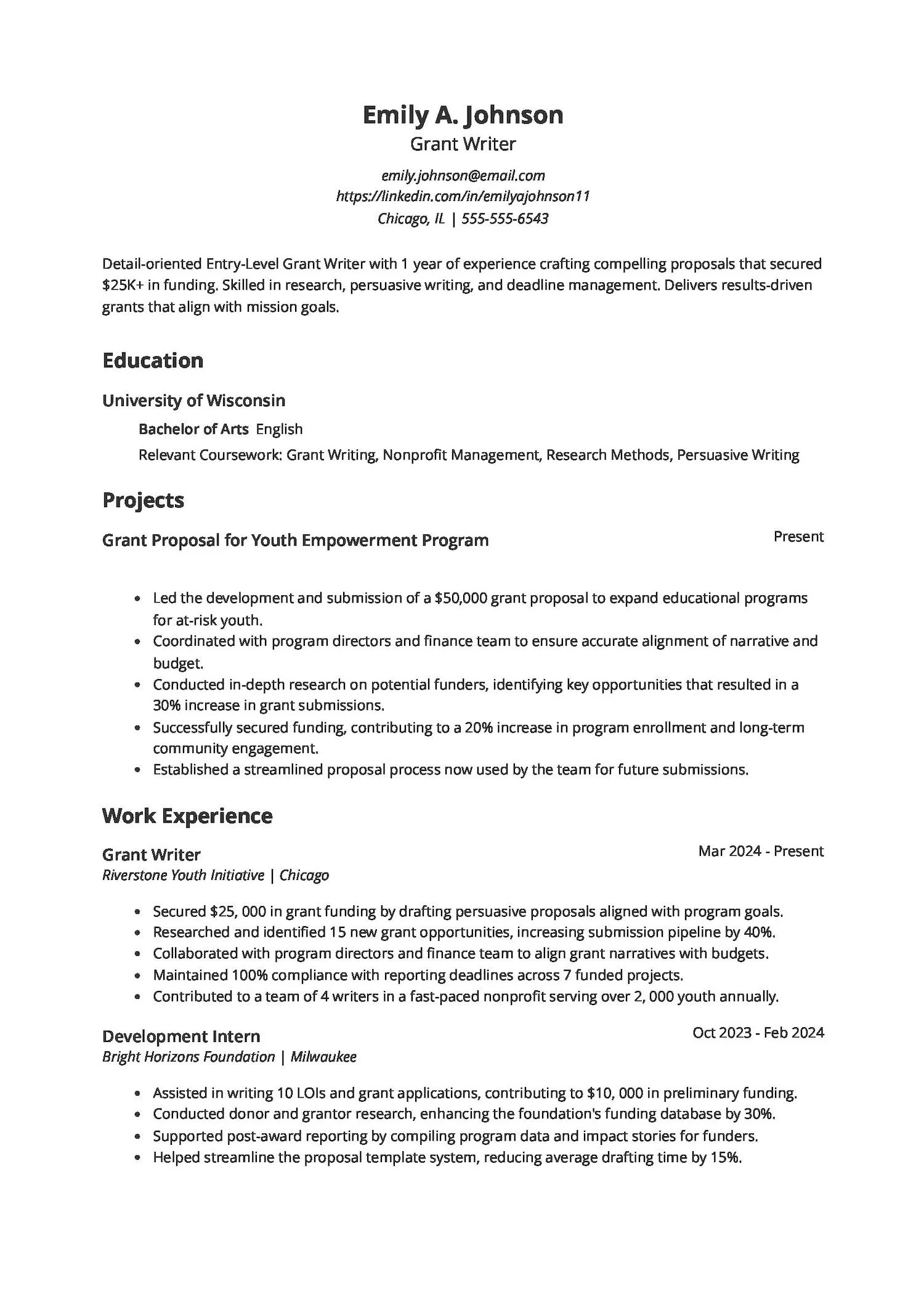
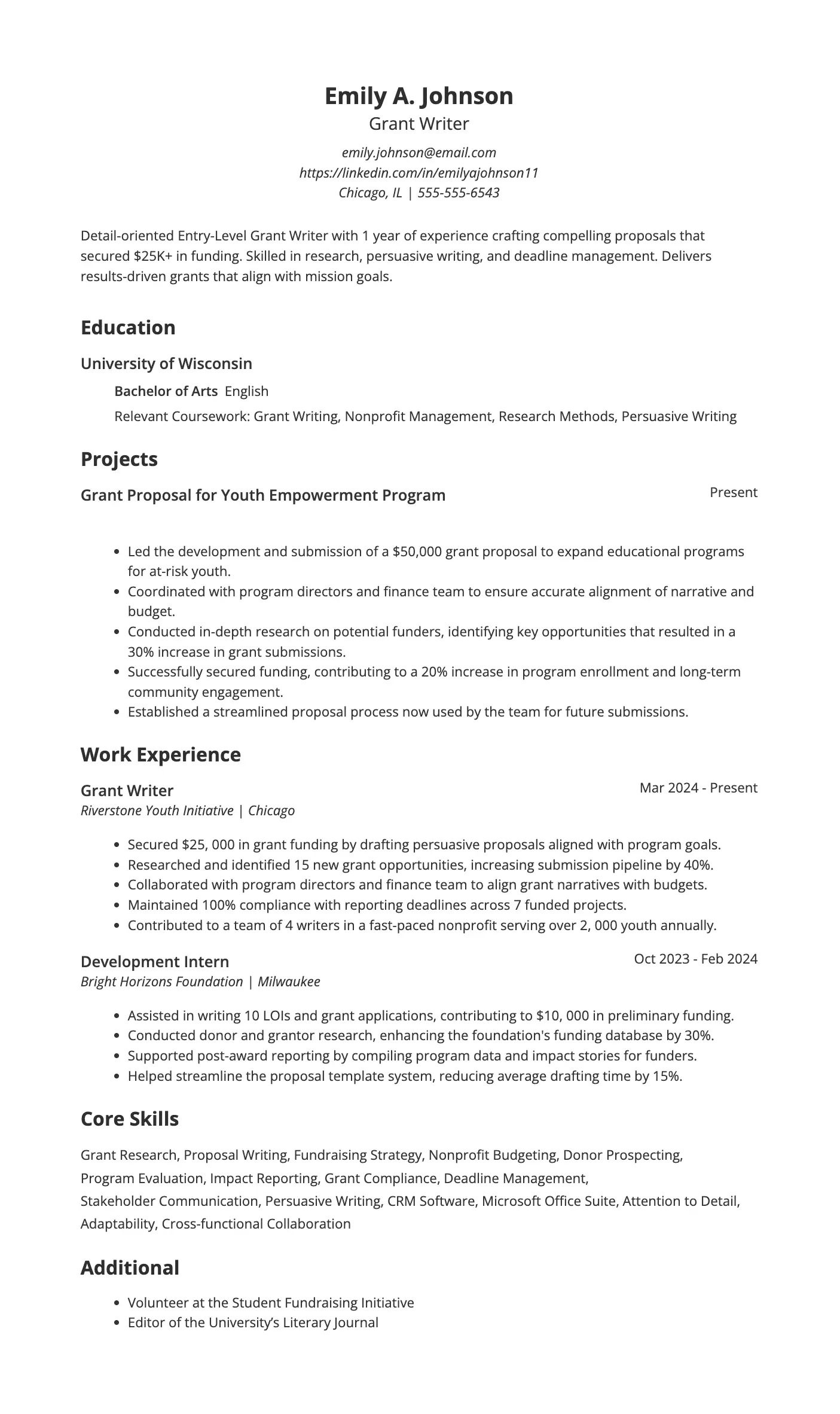
Looking to break into the world of grant writing but not sure how to showcase your early experience? Wondering how to highlight impact even if you’re just starting out? This resume is a great example of how to make a strong first impression as an entry-level grant writer.
This role calls for strong research, writing, and organizational skills. Candidates are expected to write compelling proposals, meet strict deadlines, and align funding requests with organizational goals. Attention to detail, collaboration, and the ability to communicate impact clearly are key to standing out.
This grant writer resume template starts strong with a clear, results-focused summary tailored to an entry-level grant writing role. The internship shows hands-on experience and measurable impact, which adds real value. It also highlights key skills employers look for in a grant writer position—research, writing, and collaboration—all backed by numbers. It’s organized, easy to scan, and shows potential to grow in the field.
Junior grant writer resume example
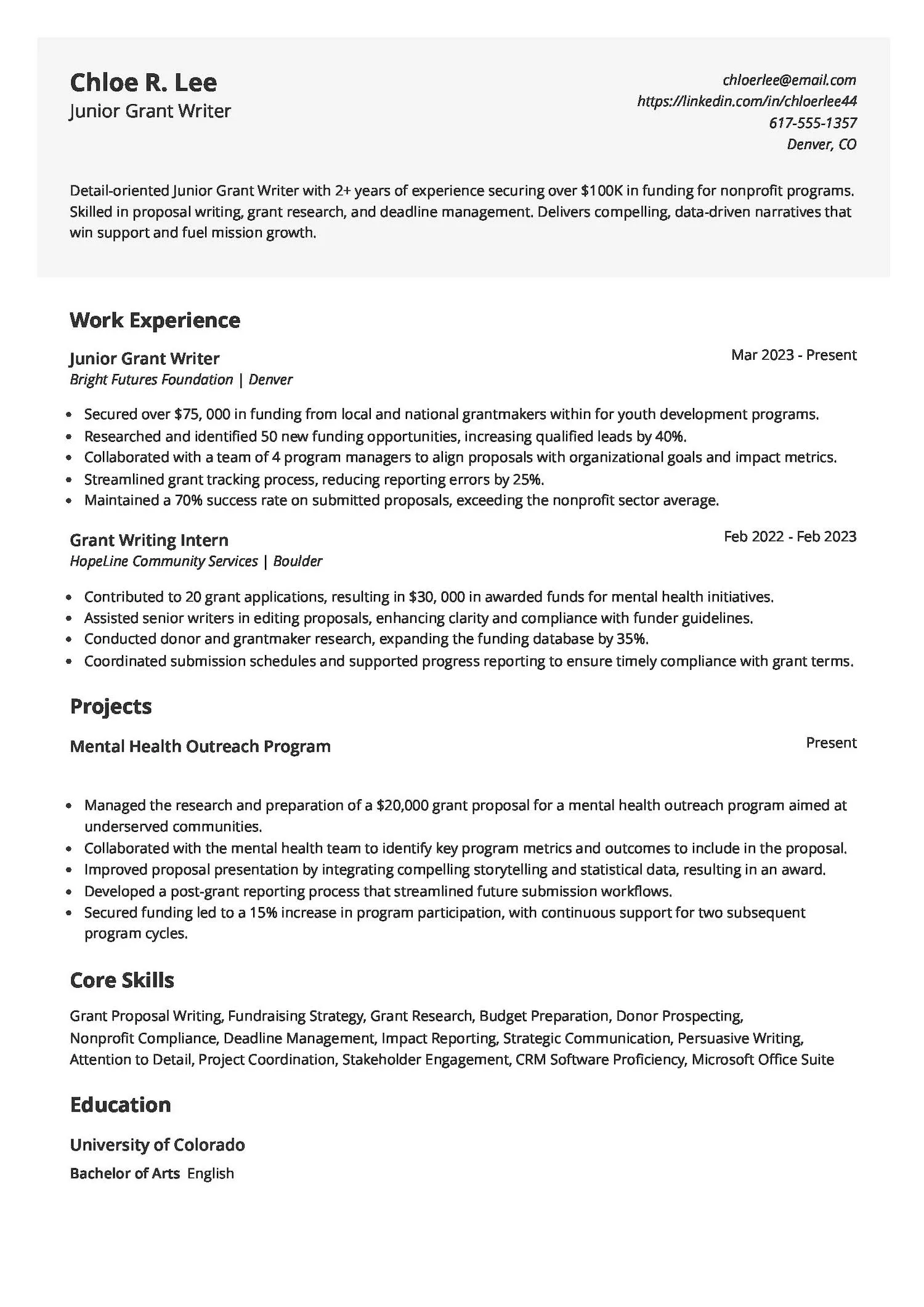
Are you a junior grant writer with a few years of experience, looking to take the next step in your career? Not sure if your track record is enough to stand out? This resume shows how to highlight your contributions and position yourself for better opportunities.
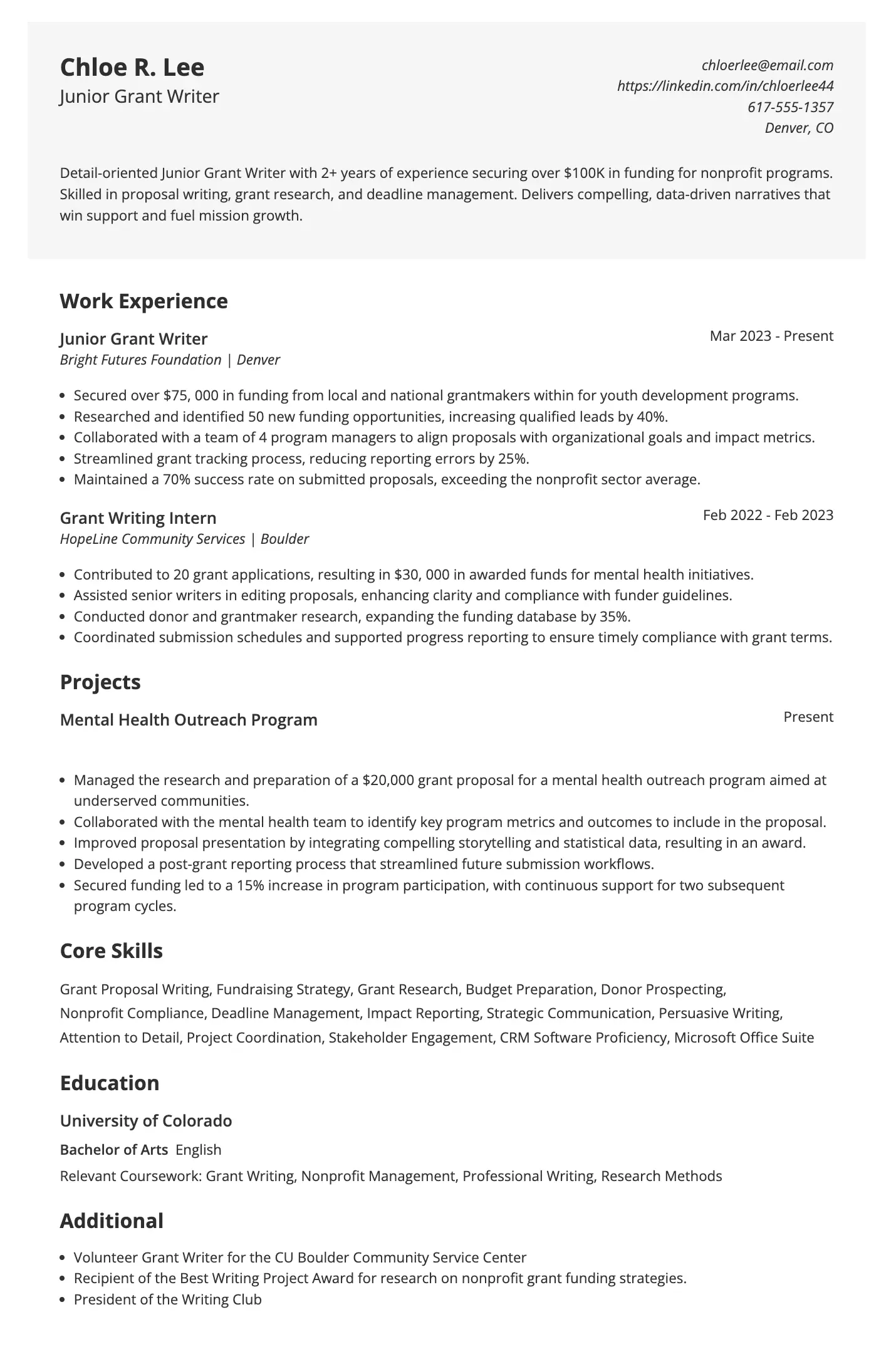
Junior grant writing roles call for strong research skills, attention to detail, and the ability to write proposals that align with organizational goals. Employers want candidates who can meet deadlines, follow compliance guidelines, and work with different teams. If you can show results—even on a small scale—you’re already on the right track.
This resume works because it highlights relevant skills like “Grant Proposal Writing” and “Donor Prospecting” right up front. The Core Skills section is tailored to what hiring managers look for in junior-level roles. Education supports the experience with coursework in grant writing and nonprofit management. Even with limited years on the job, the resume shows clear results and value, which is exactly what employers want to see.
Experienced grant writer resume example
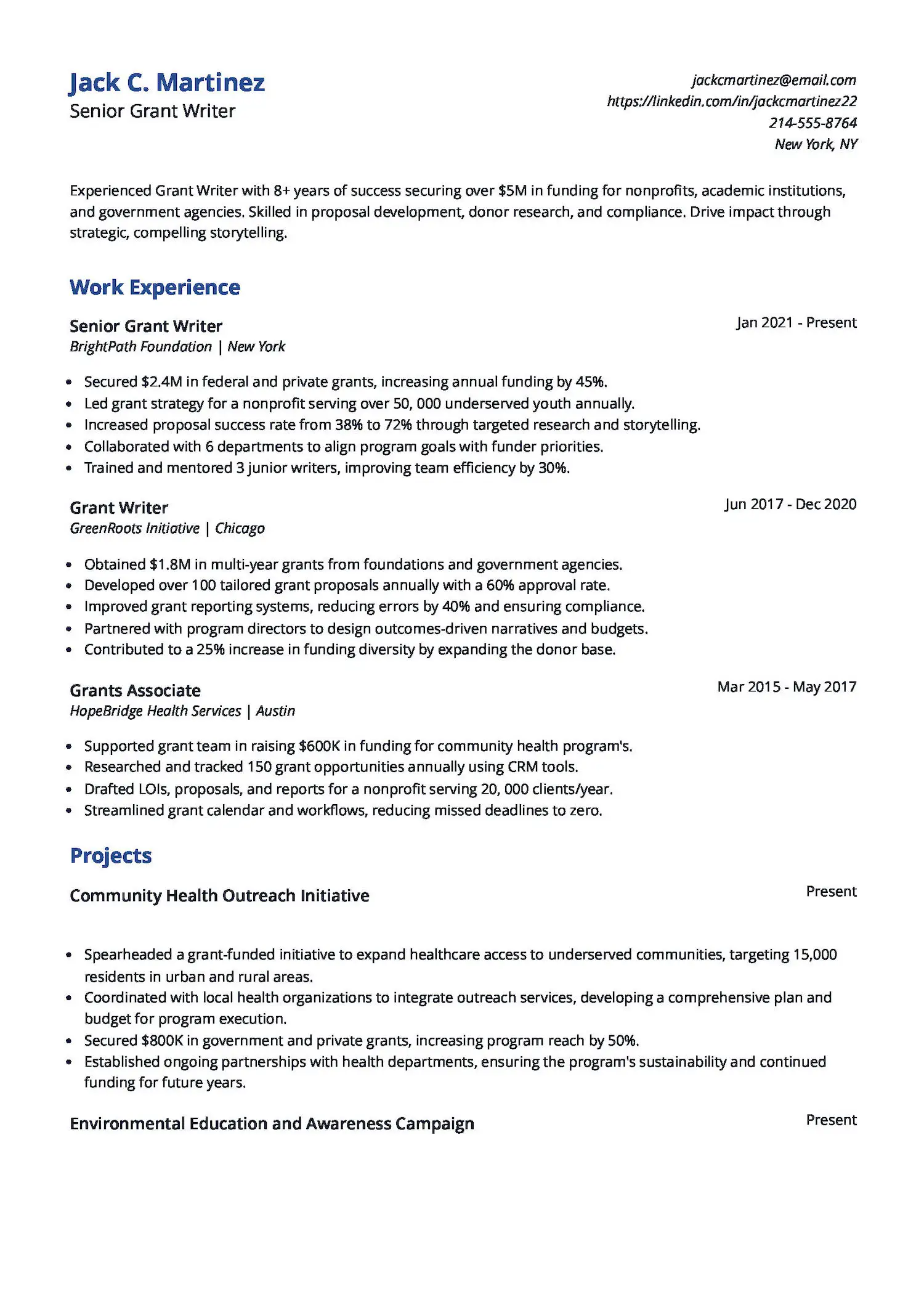
Ready to highlight your impact as an experienced grant writer and advance your career? A standout resume is the key to making that happen! This resume example shows how to effectively showcase your success, emphasizing strategic planning, cross-functional collaboration, and a strong track record of securing funding.
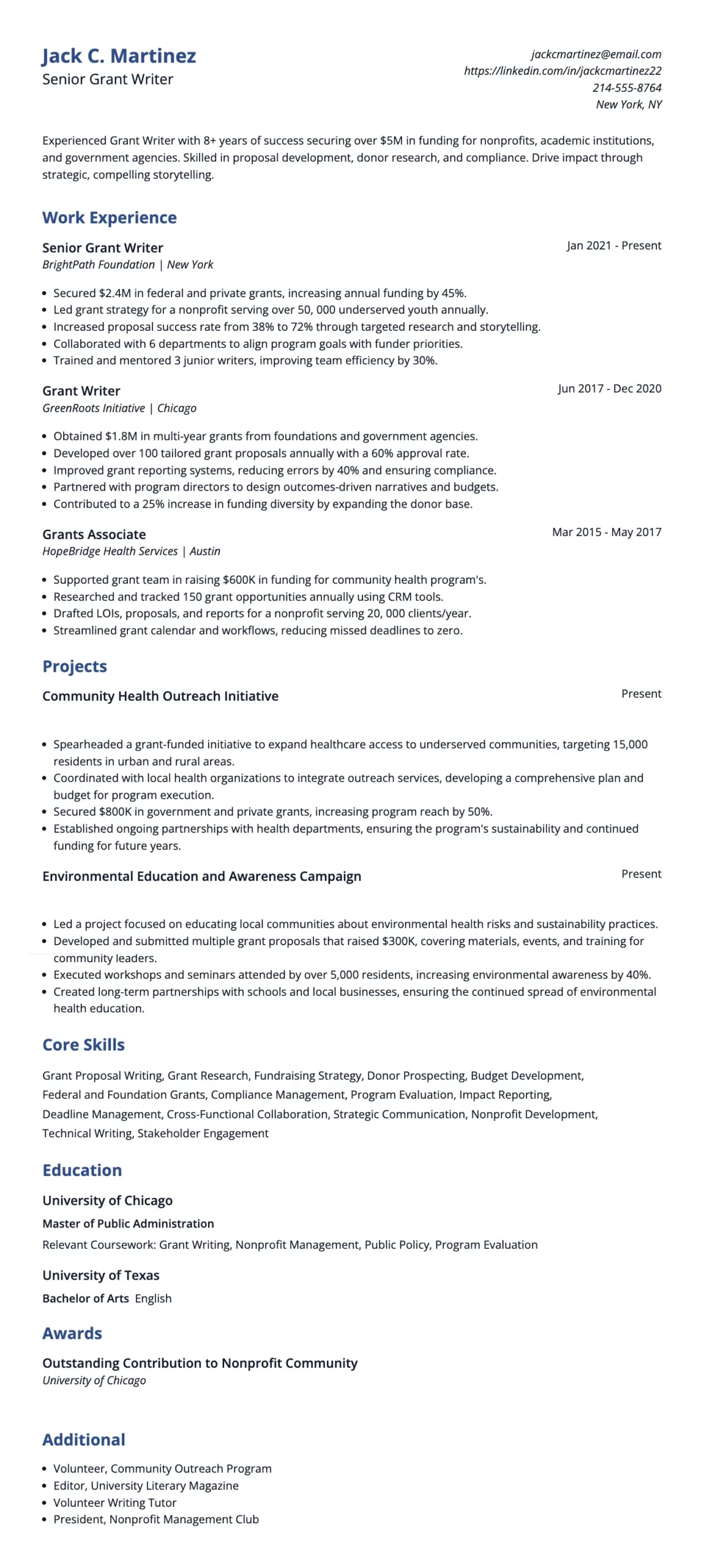
Experienced grant writers are expected to lead high-level proposal development, manage donor relationships, and ensure compliance across a variety of funding sources. Employers seek candidates who can consistently secure significant funding, mentor junior staff, and align grant strategies with organizational goals. Your resume should clearly reflect these achievements and skills.
This resume stands out due to its clear focus on quantifiable achievements, such as securing over $5M in funding, and its emphasis on collaboration with multiple teams to align proposals with organizational goals. These aspects appeal to employers because they demonstrate both individual success and the ability to work across departments. Highlighting specific results and a strategic approach ensures the resume captures attention and shows a proven ability to drive impact in grant writing.
Additionally, the format is clean, well-organized, and ATS-friendly, ensuring that applicant tracking systems can easily parse key skills and accomplishments while remaining visually appealing to hiring managers.
Also Read: 10 Best Resume Skills to Put on a Resume
How to write a grant writer resume that will get you an interview
Landing a job as a grant writer takes more than just strong writing skills—you need a resume that highlights your ability to secure funding, communicate effectively, and manage deadlines. Many nonprofits, educational institutions, and grantmaking organizations use applicant tracking systems (ATS) to manage and organize job applications. These systems scan resumes for specific keywords and formatting to determine which candidates best match the job description, similar to how a search engine works.
For grant writer roles, hiring managers often look for terms like “grant writing,” “proposal development,” “fundraising,” “donor relations,” and “budget preparation.” Including these keywords naturally in your resume can improve your chances of getting noticed.
How ATS works:
- Job posting setup: Employers define required skills, qualifications, and responsibilities in the job listing.
- Resume scanning: The ATS scans resumes for relevant keywords and pulls key details from your document.
- Searchable database: Hiring teams find resumes using those keywords to identify the most qualified applicants.
Want to make sure your resume is ATS-friendly and gets in front of hiring managers? Try using Jobscan’s ATS resume builder to create an ATS-optimized resume tailored to the grant writing field—for free!

Key elements of a grant writer resume
To create a compelling grant writer resume, make sure to include the following components:
- Contact Information – Include your name, phone number, email address, and links to your professional website or portfolio.
- Professional summary: A concise overview of your background, value, and top accomplishments.
- Core competencies or skills: Highlight strengths such as proposal writing, fundraising strategy, budget creation, donor relations, and compliance.
- Professional experience: In your work experience section, detail your previous roles with a focus on impact. Include metrics like funds raised and grants secured.
- Projects: Showcase relevant projects such as major grants written, cross-functional collaborations, or special initiatives that led to funding success.
- Education and certifications: Include degrees and any relevant certifications, like the Grant Professional Certification (GPC).
- Technical skills: Mention software tools and platforms you’re proficient in, such as Salesforce, GrantHub, or Foundation Directory Online.
Write a strong professional summary
Your professional summary should act as a snapshot of your value as a grant writer. It’s your chance to immediately capture the hiring manager’s attention with a few punchy, tailored sentences.
Let’s look at some examples of both good and bad grant writer resume summaries below.
Good examples of a resume summary
Here are some examples of good resume summaries:
- “Results-driven grant writer with 7+ years of experience securing over $5M in funding for nonprofits through strategic proposals and donor engagement.”
- “Accomplished fundraising professional with a proven track record in winning competitive federal and private foundation grants; skilled in research, storytelling, and cross-functional collaboration.”
- “Detail-oriented writer with extensive experience in education and healthcare grant writing; successfully led projects resulting in multi-year funding awards.”
Bad examples of a resume summary
Here are some examples of bad resume summaries:
- “I am a grant writer looking for a job where I can use my writing skills.”
- “Experienced in various writing tasks and familiar with fundraising. Looking to join a good organization.”
Let Jobscan’s resume summary generator simplify the process of writing a compelling professional summary for your grant writer resume. Just enter your background and experience, and it will create a polished, ATS-friendly statement tailored to the grant writing field. It’s an easy way to write a keyword-optimized summary highlighting your strengths and capturing hiring managers’ attention.
Demonstrate key grant writer skills
Hiring managers want to see more than just experience—they’re looking for the specific skills that make you an effective and impactful grant writer. Showcase both hard and soft skills throughout your resume, especially in your work history and summary sections.
Hard skills for a grant writer
- Grant Research
- Proposal Writing
- Budget Development
- Fundraising Strategy
- Program Evaluation
- Donor Communication
- Stakeholder Engagement
- Grant Management
- Compliance Reporting
- CRM Software
- Microsoft Office Suite
Soft skills for a grant writer
- Written Communication
- Verbal Communication
- Project Management
- Attention to Detail
- Team Collaboration
- Time Management
- Adaptability
- Critical Thinking
- Strategic Planning
- Problem Solving
Weaving these skills into your bullet points is a powerful way to showcase your accomplishments and demonstrate your expertise. But how you present them matters—let’s look at examples that show the right and wrong ways to do it.
Write impactful resume bullet points for a grant writer
Resume bullet points are the core of your experience section. They should clearly communicate your skills, the impact you’ve made, and the value you bring to a team. Instead of listing tasks, focus on what you accomplished using specific tools, action verbs, and measurable results. Here’s what that looks like:
Good examples of resume bullet points
- “Secured over $1.2M in competitive grant funding through tailored proposals to federal, state, and private funders.”
- “Developed and submitted 30+ successful grant applications annually with a 60% success rate.”
- “Led cross-functional teams to gather program data and prepare grant narratives aligned with funder priorities.”
- “Created detailed grant budgets in collaboration with finance teams, ensuring compliance with guidelines.”
- “Managed a grant portfolio of 20+ active awards, tracking deadlines, reporting requirements, and renewal funding opportunities.”
Bad examples of resume bullet points
- “Wrote grants for the organization.”
- “Helped get funding from different places.”
- “Worked on some proposals with other people.”
- “Handled budgets when needed.”
- “Submitted a lot of grants every year.”
Use Jobscan’s bullet point maker to write strong, results-driven bullet points for your grant writer resume. Simply upload your resume and the job description to your Jobscan dashboard, and the tool will generate tailored suggestions that highlight your grant writing skills, accomplishments, and impact, making your resume more compelling and ATS-ready.
Highlight your achievements as a grant writer
Achievements are crucial in a grant writer resume, as they highlight the impact you’ve made. Quantify your contributions by including figures like funds secured or the number of successful proposals. Focus on major milestones, such as securing large grants, improving proposal processes, or strengthening donor relationships, to showcase your success.
Here are some examples of how to highlight your achievements effectively:
- “Secured $2.5M in multi-year funding for an educational nonprofit, increasing the program’s annual funding by 30%.”
- “Wrote and submitted 50+ successful grant proposals, resulting in a 70% approval rate and $1M in funding over 2 years.”
- “Led a team of 5 to redesign the grant application process, reducing submission time by 25% and improving proposal quality.”
- “Successfully negotiated with foundations to increase grant amounts by 15%, resulting in an additional $500K in funding.”
- “Cultivated relationships with key funders, resulting in a 40% increase in donor renewals and repeat grants.”
Tailor your resume to the job description
Customizing your resume for each job application is key to making it stand out. By tailoring it to the job description, you can emphasize the most relevant skills and achievements that match the role.
Here’s how to tailor your resume effectively:
- Analyze the job description: Carefully review the job posting to understand the required skills and responsibilities.
- Use the right keywords: Incorporate relevant keywords to make your resume searchable in applicant tracking systems.
- Highlight matching experience: Focus on professional experience that aligns with the job’s needs.
- Adjust bullet points: Modify your bullet points to emphasize the skills and accomplishments that are most relevant to the role.
- Emphasize relevant achievements: Showcase key achievements that demonstrate the skills and results the employer is seeking.
- Adjust your professional summary: Tailor your summary to highlight your qualifications in line with the specific job requirements.
Also Read: The Top 5 ATS Resume Keywords of 2025
Include relevant education and certifications
Including your education and certifications is crucial for showcasing your qualifications as a grant writer. Highlight any relevant degrees and certifications that demonstrate your expertise and commitment to professional growth.
Here’s how to effectively showcase your education and certifications as a grant writer:
- List your degree, field of study, and institution (e.g., Bachelor of Arts in English, ABC University).
- For recent graduates, include your graduation year and relevant coursework, such as nonprofit management, grant writing, or research methods.
- If you’re new to grant writing or transitioning careers, emphasize any writing-related training or courses, such as grant writing workshops, nonprofit fundraising, or proposal development.
- Highlight certifications that demonstrate your expertise in grant writing, such as Grant Professional Certification (GPC), Certified Fund Raising Executive (CFRE), or other relevant certifications.
- Prioritize certifications that are highly regarded in the nonprofit sector and aligned with the role you’re applying for.
Top grant writer certifications
Here are some top certifications that can strengthen your resume:
- Grant Professional Certification (GPC)
- Certified Fund Raising Executive (CFRE)
- Certificate in Grant Writing (various institutions)
- Certified Nonprofit Professional (CNP)
- Advanced Grant Writing Certification (various institutions)
- Project Management Professional (PMP)
Grant writer resume tips
A polished and strategic resume can make all the difference in landing interviews. Use these tips to refine your resume and present yourself as a top-tier candidate:
- Keep it concise: Stick to a one-to-two-page resume.
- Use strong action verbs: Start bullet points with impactful action verbs like “secured,” “developed,” “managed,” or “led.”
- Quantify your achievements: Include numbers to highlight funding secured, proposal success rates, or project impact.
- Tailor each resume: Customize your resume for each role by matching the job description and using relevant keywords.
- Highlight both hard and soft skills: Emphasize a balanced mix of technical abilities and interpersonal strengths throughout your resume.
- Include certifications: List relevant certifications like GPC, CFRE, or grant writing certificates to show your qualifications.
- Showcase your portfolio: If possible, include or link to samples of successful proposals or summaries of funded projects.
- Proofread carefully: Grant writing demands attention to detail—make sure your resume is error-free.
- Include relevant projects: Highlight specific grant projects that demonstrate your skills and results.
- Choose a clean format: Use a professional, easy-to-read layout with clear section headers and consistent formatting.
Also Read: How to Organize Your Resume Sections to Stand Out?
Include a cover letter with your grant writer resume
Including a cover letter with your grant writer resume can make a lasting impression. It’s your chance to showcase your enthusiasm for the role, demonstrate your understanding of the grant writing process, and explain why you’re the perfect candidate. A well-written cover letter can set you apart from others who only submit a resume.
What to include in your cover letter:
- Personalize it: Address the hiring manager by name, if possible, rather than using a generic greeting.
- Start with a strong opening: Briefly introduce yourself, highlighting your grant writing experience and excitement about the opportunity.
- Highlight relevant skills and notable achievements: Focus on key skills and specific accomplishments that align with the job description, such as successful grants secured or experience with particular funders.
- Showcase your passion for grant writing: Express your enthusiasm for helping organizations secure funding and make a meaningful impact through your writing.
- Keep it concise: Keep your cover letter to one page, maintaining a professional yet engaging tone.
- End with a call to action: Express your eagerness to discuss how your qualifications align with the role and thank the hiring manager for considering your application.
Including a thoughtful cover letter shows your dedication and can significantly increase your chances of securing an interview. Need help writing a compelling cover letter? Consider using tools like Jobscan’s AI cover letter generator to create a tailored, ATS-friendly letter that enhances your resume.
Take your grant writing career to the next level with a winning resume
Writing a strong grant writer resume is all about showcasing your skills, achievements, and passion for helping organizations secure funding. By tailoring your resume to each job, highlighting measurable results, and including the right keywords, you can stand out to both hiring managers and ATS systems. With a polished, strategic resume, you’ll be well on your way to landing your next grant writing role.
Ready to take the next step in your grant writing career? Jobscan offers a suite of AI-powered tools designed to elevate your job search. With features like the resume scanner, AI Optimize, and LinkedIn Optimization, you can compare your resume against job descriptions to ensure it’s aligned with ATS requirements and recruiter expectations. Jobscan helps you spot missing keywords and formatting issues so you can tailor each application and increase your chances of landing interviews.

Grant writer common interview questions
Answer:
“I begin by thoroughly researching the funder to understand their mission, priorities, and past grant recipients. Then, I collaborate with program staff to gather key information and data. I focus on aligning our goals with the funder’s criteria and use clear, compelling language to tell the organization’s story. Before submission, I ensure all requirements are met and review the proposal for clarity, accuracy, and impact.”
Answer:
“I rely on strong project management skills to stay organized and on schedule. I maintain a detailed calendar of deadlines, break down tasks into manageable steps, and prioritize based on urgency and importance. When juggling multiple grants, I communicate clearly with team members and stakeholders to ensure everyone stays aligned and nothing falls through the cracks.”
Answer:
“At my previous organization, I led the writing and submission of a federal grant that secured $500K in funding for a youth development program. I coordinated with program staff, finance, and external partners to craft a compelling narrative and accurate budget. The funder later mentioned the clarity and alignment of our proposal as key reasons for awarding the grant.”
Answer:
“While the most obvious metric is the amount of funding secured, I also track success rates, renewal grants, and funder feedback. I evaluate how well proposals align with funder goals and whether they strengthen long-term relationships. I also review which parts of the process went well and where improvements can be made for future submissions.”
Grant writer resume frequently asked questions
When writing your grant writer resume, focus on both hard skills and soft skills in your resume skills section. Key hard skills include grant writing, proposal development, budgeting, fundraising strategy, and familiarity with tools like Microsoft Word. Soft skills such as written communication, project management, attention to detail, organizational goals, and collaboration are also crucial. Make sure to highlight relevant experience in grant research, stakeholder engagement, and compliance reporting, as these are highly valued in the field.
To include your education experience, list your degrees in reverse chronological order, starting with the most recent. Include the degree name, institution, and graduation year (if recent). If you have relevant coursework or projects related to grant writing or fundraising, you can also mention those. Additionally, if you have any certifications like Grant Professional Certification (GPC) or Certified Fund Raising Executive (CFRE), be sure to highlight them in a separate section.
If you’re new to grant writing, focus on transferable skills from other roles. Highlight experience in research, writing, and project management. Emphasize any volunteer work or internships related to nonprofit organizations, fundraising, or writing. If you’ve written proposals, even in non-grant contexts, include them as examples. Consider showcasing a portfolio of writing samples and any relevant training or courses in grant writing. Demonstrating your willingness to learn and your passion for the field will also help you stand out.