



You used ChatGPT to help with your resume. You hit submit. Now it’s late, you’re scrolling through Reddit, and someone is telling you the ATS just flagged your application and tossed it in the trash.
The fear that an applicant tracking system (ATS) can detect AI resumes is one of the biggest sources of job search anxiety in 2026.
It’s also, for the most part, not true.
In this guide, you’ll learn what an ATS actually does with your resume, how AI-powered features are changing how recruiters see your resume, where the real risk of using AI lives, and how to use AI to apply faster without getting filtered out.
Take a breath. Let’s get informed.
No major ATS detects AI-generated resumes. The artificial intelligence built into every major platform, including Workday, Greenhouse, iCIMS, SAP SuccessFactors, Lever, and Oracle Taleo, is designed for candidate matching and resume screening. None of it is built to detect who wrote your bullet points.
AI ranking is now the majority experience, at any company size. At Fortune 500 employers, and in the broader market, using ATS with AI features have become the norm, not the exception. The filing cabinet ATS is largely a thing of the past.
Third-party AI detectors are too unreliable to trust. Some recruiters use tools like GPTZero, but they’re notoriously inaccurate on professional writing and walk a dangerous legal line between fair and discriminatory candidate evaluation.
The real risks have nothing to do with detection. Applications fail for two reasons: complex formatting that breaks the ATS parser before anyone reads your resume, and generic unedited AI writing that a recruiter rejects in 30 seconds flat.
Your application now passes through two filters. An algorithm evaluates your skills, experience, and qualifications first. A human evaluates your writing second. Using AI well means optimizing for both: semantic alignment for the algorithm, specific and authentic language for the person.
What does an ATS actually do with your resume?
In short: It parses your resume, stores it, and in most cases algorithmically scores it against the job requirements before a recruiter ever opens it. It does NOT analyze who wrote it.
Before we talk about AI detection, you need an accurate picture of what an ATS is in 2026. The answer has changed significantly in the last two years, and most of what you’ve read online is based on an outdated model.
An applicant tracking system is a tool companies use to receive, store, and manage the application process for every role they post. According to our own research, 97.8% of Fortune 500 companies use an ATS to handle hiring. When you submit a resume online, it almost always lands inside one.
The old model vs. the new reality
The old mental model of an ATS as a “digital filing cabinet” is mostly obsolete. Here’s what’s actually changed:
Old model: Resume goes in, the info gets cut up and reorganized into a database, recruiter searches for keywords, finds you (or doesn’t).
Growing reality: Resume goes in, gets cut up and reorganized, AI analyzes the semantics of your work history, years of experience, and skill set (instead of just keywords), then assigns you a grade or tier before any human has looked at your application.
According to market share data from Jobscan’s State of the Job Search report and third-party ATS analysis, AI candidate ranking is now the dominant experience across both large and mid-market hiring.
Fortune 500 employers
At the largest companies, the platforms with active AI ranking control 79.3% of hiring:
| ATS platform | Fortune 500 share | Active AI ranking? |
|---|---|---|
| Workday (+ HiredScore) | 37.1% | Yes |
| SAP SuccessFactors | 13.4% | Yes |
| Phenom People | 8.7% | Yes |
| iCIMS | 8.5% | Yes |
| Oracle Recruiting Cloud | 6.3% | Yes |
| Taleo | 5.3% | Yes |
| Other (200+ vendors) | 20.7% | Varies |
General market (startups, mid-market, SMB)
Beyond the Fortune 500, the picture shifts slightly but AI ranking still commands a majority:
| ATS platform | General market share | Active AI ranking? |
|---|---|---|
| Greenhouse | 19.3% | Yes |
| Lever | 16.6% | Yes |
| Workday | 15.9% | Yes |
| iCIMS | 15.3% | Yes |
| BambooHR | 8.3% | Limited |
| UltiPro (UKG) | 7.8% | Limited |
| Taleo | 5.5% | Yes |
| Ashby | emerging | No |
| Other | 11.4% | Varies |
What the numbers actually mean for you
In the general market, platforms with full AI scoring (Lever, Workday, iCIMS, Taleo) account for 72.6% of applications. BambooHR and UKG add another ~16% with basic algorithmic filtering.
And as of February 2026, even Greenhouse, which held the last major human-first position, launched AI-assisted matching. The era of the purely human-first major ATS is effectively over.
This is the key point: AI ranking is not a Fortune 500 problem. It’s a majority-of-the-market reality.
What the ATS scoring process looks at
Different platforms use different architectures, but they all focus on the same core inputs: your resume’s text, the job description, and the match between them. Here’s what gets evaluated:
- Work experience: Job titles, employers, responsibilities, and how they align with the target role.
- Years of experience: Depth in the required domain.
- Skills: Both stated and inferred (modern AI can infer a skill from context, even if the exact phrase isn’t on your resume).
- Education: Degree level and field, weighted differently by employer and role type.
- Semantic alignment: How closely your language maps to the job description, not just exact keyword matches.
What an ATS is not built to do
Despite the AI scoring, there are things ATS platforms genuinely don’t do. Modern systems are not built to:
- Detect whether a human or an AI wrote your resume.
- Auto-reject applications based on writing patterns or phrasing.
- Make autonomous hiring decisions without human review.
The artificial intelligence embedded in these platforms evaluates what your resume says, not how it was written. The resume screening algorithm is entirely agnostic to whether you used ChatGPT, a professional resume builder, or a typewriter.
Does any major ATS detect AI resumes?
No. Not one major applicant tracking system natively detects AI-generated resumes.
Why not? Three major reasons.
- AI text detection technology is too unreliable: even OpenAI shut down its own classifier at 26% accuracy.
- Using detectors to filter applications creates legal liability under emerging regulations including the EU AI Act, NYC Local Law 144, and EEOC guidance on algorithmic hiring.
- The industry is moving in the opposite direction: platforms like Oracle actively invite candidates to generate cover letters using built-in AI, and Greenhouse’s official position still states that using AI to assist with your resume or cover letter is acceptable.
What every major ATS is doing is using AI to score how well your application matches the job. That distinction — matching over detection — is the most important thing to understand about how your resume is evaluated in 2026.
Here’s a breakdown of the major systems:
Workday
Workday is the dominant ATS in enterprise hiring. It’s used by more than a third of Fortune 500 companies.
In 2024, Workday acquired HiredScore and integrated it directly into its platform. HiredScore grades every applicant using an A, B, C, D system. An A represents the strongest job match, and D the weakest. These grades appear on the recruiter’s dashboard. They directly influence the order in which applications get reviewed.
The grading is based on your actual qualifications, including skills, experience, and work history. Writing style plays no role. How your resume was produced plays no role.
Workday commissioned an independent third-party bias audit using its own applicant data. The audit was conducted by a firm called Secretariat to verify that the grades don’t produce disparate outcomes across demographic groups.
There is no feature that detects AI-generated writing.
The hidden trap: Workday’s text parser is still rigid. Multi-column layouts, tables, and complex PDF formatting cause the parser to fragment your text before the AI ever evaluates it. A corrupted parse means the ranking AI can’t accurately read your work experience or actual qualifications and a highly qualified candidate can receive a “D” grade through no fault of their own.
Greenhouse
Greenhouse holds about 19% of the general market. It’s the most widely used ATS outside the enterprise world and the platform you’re most likely to encounter at tech companies and funded startups.
For years, Greenhouse was the notable exception on this list. It was a major platform that deliberately kept AI out of candidate ranking. That changed in February 2026 with the launch of Real Talent.
Real Talent does three things. It detects spam and fraudulent applications. It verifies candidate identity through a partnership with CLEAR. And it uses AI-assisted Talent Matching to compare applications against recruiter-defined job criteria, then organizes applicants so the strongest matches surface first.
Greenhouse is explicit that the AI never advances or rejects candidates on its own. Every hiring decision stays in human hands. But your application is now being evaluated and sorted by AI before a recruiter reviews it.
Greenhouse conducts monthly bias audits through Warden AI and publishes the results publicly. They also hold ISO 42001 certification for AI governance.
Greenhouse’s official position remains that using AI to help write your resume or cover letter is acceptable. There is no feature that detects AI-generated writing.
New to the platform? Our Greenhouse ATS guide covers how it works from the job seeker’s side.
Phenom People
Phenom is built for high-volume hiring. Large retail chains, healthcare systems, and logistics companies are its core market.
Its AI matching feature is called Fit Score. It automatically ranks candidates based on skills, job title, experience, and location. The strongest matches surface first on the recruiter’s dashboard and only job-relevant criteria factor into the score.
Phenom has run psychometric testing across race, gender, and age to evaluate Fit Score for bias. Their published findings showed that Fit Score demonstrated less bias than the average human recruiter. Those results are available in their 2025 Fit Score Report.
There is no feature that detects AI-generated writing.
iCIMS
iCIMS serves more than 4,400 companies across 200 countries. That includes roughly a quarter of the Fortune 500.
Their AI platform is called Coalesce AI. It includes a feature called Candidate Ranking. It reads your resume, compares it against the job description, and surfaces the strongest matches for recruiters to review first.
iCIMS formally acknowledges that Candidate Ranking qualifies as an automated decision tool under laws like NYC Local Law 144. That classification triggers specific compliance requirements. As a result, iCIMS conducts weekly bias audits and provides candidate opt-out mechanisms. They’ve also earned independent certification from TrustArc across seven responsible AI criteria.
There is no feature that detects AI-generated writing.
For the basics, see our iCIMS ATS guide.
SAP SuccessFactors
SAP is used by roughly 13% of Fortune 500 companies. In September 2025, SAP acquired SmartRecruiters. The two platforms have been integrating since, combining SmartRecruiters’ AI assistant, Winston, with SAP’s own AI copilot, Joule.
When a recruiter posts a job, Joule reads every incoming application. It then stack-ranks them from strongest to weakest match. Recruiters see the highest-scoring candidates first.
Joule goes beyond simple keyword matching. If your resume describes managing P&L, Joule can infer financial forecasting experience, even if you never used that exact phrase. The ranking is built entirely on skills and experience. Writing style does not factor.
There is no feature that detects AI-generated writing.
Lever
Lever is widely used by startups, VC-backed companies, and mid-market businesses.
Its AI matching feature is called Talent Fit. When you apply, your resume is anonymized first, stripping personal identifiers out. Then a large language model compares your resume against the job description. The result is a ranked list of candidates, with a plain-English explanation for each placement.
In Spring 2026, Lever added a second layer called AI Screening by VONQ. Rather than filtering candidates out based on their resume alone, it puts every applicant through a short structured screening experience at the point of application. Every candidate gets a consistent way to demonstrate fit beyond what’s on the page.
Lever’s AI governance runs on IBM’s watsonx.governance framework. That provides independent oversight and bias monitoring.
There is no feature that detects AI-generated writing.
Our Lever ATS guide covers the platform’s fundamentals for job seekers.
Oracle Taleo
Oracle handles hiring for roughly 12% of Fortune 500 companies.
Oracle’s AI scores every applicant from 0 to 5. It evaluates four dimensions: education, experience, skills, and overall profile match. Recruiters can sort applicants by any of those scores individually.
Here’s the part that matters most: Oracle can be configured to calculate scores the moment an application is submitted. That means AI has already ranked you before any human opens your file.
The weighting across those four dimensions is customizable per role. A technical role might weight skills heavily and discount education entirely. Another role might be configured the opposite way. Your score is shaped by decisions the recruiter made when setting up the job, not by any universal standard.
One more thing worth noting. Oracle’s platform actively invites candidates to draft their cover letter using built-in AI. The platform itself encourages AI-assisted writing. There is no feature that penalizes it.
Ashby
Ashby has grown quickly as a preferred ATS among growth-stage tech companies. It also takes a deliberately different position on AI than most platforms on this list.
Per their official documentation: the AI never ranks candidates or assigns numerical ratings. A human is always responsible for the final evaluation decision. Instead, Ashby’s AI-Assisted Application Review checks each resume against recruiter-defined criteria. For each criterion, it returns a simple “Meets” or “Does not Meet.” Recruiters then decide how to act on that information.
Ashby launched fraud detection in September 2025 to catch fake or mass-generated applications. Personal identifiers are stripped from resumes before they’re sent to any AI model. Their bias audit results are published publicly through a partnership with third-party auditor FairNow.
There is no AI writing detection. And unlike every other platform on this list, there is no ranking system either.
BambooHR and UltiPro (UKG)
These two platforms together account for roughly 16% of the general market and primarily serve small and mid-sized businesses. Neither deploys full AI ranking. BambooHR relies primarily on keyword-based filtering, and UKG has limited ranking capabilities compared to enterprise platforms. If you’re applying to a smaller employer on one of these systems, you’ll face less algorithmic scoring and more direct human review, though keyword alignment still matters for searchability.
What changes by platform
| ATS | Typical employer | AI ranking? | AI authorship detection? |
|---|---|---|---|
| Workday | Large enterprise, upper mid-market | Yes — A/B/C/D grades (HiredScore) | No |
| SAP SuccessFactors | Large enterprise, global | Yes — stack ranking via Joule | No |
| Phenom People | Large enterprise, high-volume | Yes — Fit Score ranking | No |
| iCIMS | Mid-to-large, healthcare | Yes — Candidate Ranking via Coalesce AI | No |
| Oracle / Taleo | Large enterprise, government | Yes — 0–5 score across 4 pillars | No |
| Lever | Startups, VC-backed, mid-market | Yes — Talent Fit ranked matching + VONQ screening | No |
| Greenhouse | Tech startups, SaaS | Yes — AI-assisted Talent Matching (human-led decisions) | No |
| Ashby | Growth-stage startups | No ranking — criteria-based “Meets / Does not Meet” | No |
| BambooHR | Small-to-mid businesses | Limited — keyword filtering only | No |
| UltiPro (UKG) | Mid-market | Limited ranking | No |
What about third-party AI detectors?
This is the next layer of worry: even if the ATS doesn’t detect AI, what if the recruiter runs your resume through GPTZero or Originality.ai? Could that get you rejected?
Yes, some recruiters do this. GPTZero markets directly to enterprise HR teams and offers integrations with major ATS platforms through tools like Zapier. So technically, your resume could be scanned by an AI detector.
But here’s the catch: AI detectors are notoriously bad at evaluating professional writing.
Why AI detectors fail on resumes
AI detectors work by looking at two things: perplexity (how predictable the word choices are) and burstiness (how much sentence length and structure varies).
Resumes are, by design, the kind of writing that scores low on both. Action verbs. Bullet points. Industry-standard phrasing. Tight, repetitive structure. Every well-written resume looks “AI-generated” by these metrics, whether you wrote it last week or in 2018.
That’s why job seekers report routinely seeing 85% to 100% AI-probability scores on completely human-written resumes when they test these tools.
The false positive problem is well documented
Research from Stanford found that AI detectors falsely flagged 61.3% of TOEFL essays written by non-native English speakers as AI-generated. The same pattern shows up in professional writing: people who write in standardized, formulaic, grammatically rigid styles get flagged the most.
Even OpenAI, the company that makes ChatGPT, deactivated its own AI classifier in July 2023 because it was only accurate 26% of the time at identifying AI-generated text. If the people who built the technology can’t reliably detect their own model’s output, no one else can either.
What this means for you:
The false-positive problem is real, and it does affect you if a recruiter uses one of these tools. Whether or not they do, your biggest protection is the same regardless: write specifically, edit thoroughly, and make sure your application reflects your real experience. Generic AI output gets flagged by detectors and by human eyes alike.
Further reading: 15+ AI job search tools review on which ones will keep you in the driver seat
So if the ATS won’t flag you, what will?
Now we get to the part that actually matters. The risk of using AI on your application is real. It just doesn’t come from an algorithm. It comes from the recruiter who has 30 to 60 seconds to decide whether to keep reading.
The application flood is real, and it’s brutal
The job market in 2026 is shaped by a feedback loop that makes the recruiter’s job almost impossible.
Applications per hire
3×
increase since 2021 (Ashby)
Applications per hire
+158%
since 2022 (Greenhouse)
Application rate
+45%
recent surge (LinkedIn)
Index: 2021 = 100. Derived from Ashby 2026 Talent Trends Report (109M+ applications analyzed; applications per hire tripled 2021–2024), Greenhouse March 2026 Benchmark Report (+157.7% applications per hire since 2022), and LinkedIn (+45% application rate surge). ChatGPT annotation marks the inflection point documented across all sources.
Job seekers adopted AI first. ChatGPT made it possible to apply to dozens of jobs in the time it used to take to apply to one. Applications started flooding in through job boards and company career pages at a scale that had never existed before. According to Jobscan's State of the Job Search report, application volumes have skyrocketed. Ashby's 2026 Talent Trends Report, which analyzed over 109 million applications, shows that applications per hire tripled between 2021 and 2024 and remained above 300 per hire throughout 2025. Greenhouse's March 2026 Benchmark Report found a 157.7% increase in applications per hire since 2022. LinkedIn has reported a 45% surge in application rates over a similar period.
In response, employers integrated AI into their ATS systems to manage the volume, not to hunt for AI use, but to quickly surface qualified candidates and strong candidates from a pool that was now humanly impossible to process by hand.
"Most recruiters don't care or notice that their application volume doubled or tripled. They're cherry-picking a few great applicants and ignoring the rest." - Tim Sackett, CEO, HRUtech.com
The direction of cause matters here: candidates didn't start using AI because employers added it. Employers added it because candidates created an application tsunami that required automation to manage.
How long a recruiter actually spends on your resume
Here's the data that should change how you think about your application:
| Time spent on first review | % of recruiters |
|---|---|
| Under 30 seconds | 35% |
| 30 seconds to 1 minute | 47% |
| Over 1 minute | 18% |
Source: ResumeGo, January–March 2024, n=418
Most recruiters give your resume less than a minute. Some give it less than 30 seconds. By then, the machine learning-powered ranking system has already filtered the pool down to the candidates with the most relevant experience for the role. The human is reviewing the shortlist of qualified candidates the AI surfaced, not the full applicant pool. In that window, they're not looking for nuance. They're scanning for proof, specificity, and whether your background actually maps to the job.
What recruiters say about AI-generated applications
Three recent surveys tell a consistent story:
- TopResume (May 2025, n=600): 19.6% of hiring managers said they would reject a resume they believed was fully AI-generated. 52% said using AI for proofreading or drafting was acceptable.
- Resume Now (March 2025, n=925): 62% of hiring managers said they would reject AI-generated resumes that lacked personalization. 78% said they value personalized detail over polished phrasing.
- Insight Global 2025 AI in Hiring Survey: 53% of hiring managers said they can immediately tell when a candidate used AI to generate their materials.
Read those numbers carefully. The rejection isn't happening because AI was used. It's happening because the AI output was generic, unedited, and lacked the personal detail that proves the candidate actually read the job description.
The specific tells that get AI applications rejected
Recruiters have been training themselves to spot AI writing for a couple of years now. The patterns are surprisingly consistent.
What screams "unedited AI" to a recruiter
| Signal | What it looks like |
|---|---|
| Overused words | "Delve," "tapestry," "meticulous," "results-driven," "spearheaded," "orchestrated," "synergized" |
| Identical sentence rhythm | Every bullet follows the exact same Action + Result structure with the same length and cadence |
| Missing context | "Increased revenue by 200%" with no mention of product, team size, or tools used |
| Skill inflation | Entry-level candidate claiming expert mastery in 25 platforms |
| Vague power verbs | "Visionary," "passionate," "innovative" with nothing concrete to back them up |
The fix for all of this is the same: edit. Add specifics. Replace generic phrases with details only you would know.
How should you use AI on each part of your application?
Different parts of your application carry different weight. Here's the quick breakdown.
Document 1: Your resume (highest stakes)
Your resume is the document the ATS parses, the recruiter scans first, and the one with the most riding on it. AI is genuinely useful here, but only as a starting point.
- Suggesting stronger action verbs and phrasing improvements.
- Reformatting bullet points for clarity and consistency.
- Identifying keywords from the job description that you should include.
- Tightening overly long sentences.
An AI resume builder or resume builder tool (including Jobscan's own) is genuinely useful for the drafting and optimization phase of building your CV. The use of AI here is not just accepted; it's expected. The question is what you do with the output.
- Adding the specific numbers, tools, team sizes, and outcomes only you know.
- Replacing generic phrases with language that demonstrates familiarity with the role and company.
- Confirming ATS-friendly formatting (no tables, no text boxes, no two-column layouts).
- Reviewing for consistency of tone and voice across all bullet points.
Why formatting matters as much as writing
According to data from CoverSentry's 2025 ATS Parsing Analysis, formatting problems are a major source of silent rejection:
| Format | Parsing failure rate |
|---|---|
| Standard .docx, single-column | 4% |
| 18% | |
| Two-column layout | Accuracy drops from 93% to 86% |
A beautifully written AI resume can still get auto-rejected, not because the ATS detected the AI, but because the ATS literally couldn't read the file. This is one of the biggest reasons behind the "AI resume rejected by ATS" myth.
Document 2: Your cover letter (lower stakes, higher specificity required)
Cover letters are read by humans, not parsed by software. They're often skimmed and often optional. But when they're read, they're judged primarily on one thing: did this candidate actually read about us?
A 150-word cover letter with one specific company reference and one mapped achievement will outperform a 500-word AI-generated essay every time.
The minimum viable cover letter:
- One sentence stating the role you’re applying for and why.
- One specific reference to the company (a recent project, a value, a product).
- One mapped achievement: your experience tied directly to a key requirement.
- One closing sentence with a clear next step.
Use AI to draft the structure. Just make sure your input is rich: paste in the full job description, including any company information. Jobscan's cover letter generator, for example, takes the full job description you provide and uses the company context within it to generate a more tailored draft. The more specific your input, the more specific the output.
Document 3: Application form fields (highest ROI for human effort)
Application forms ask short, focused questions: "Why this company?" "Tell us about a time you..." "What interests you about this role?"
These short answers carry disproportionate weight because recruiters read every single word. They are also the easiest place to spot generic AI output. Spend your human effort here. Even if you use AI to autofill, treat it as a starting point, not the finish line.
What should you never do with AI on a job application?
There's a difference between using AI to help you communicate your experience well and using AI to fabricate experience you don't have. The first is completely fine. The second will get you in trouble, just not in the way you think.
If your resume claims expert-level proficiency in 25 different software platforms when you’re a year out of college, recruiters will catch it. They will catch it during the screen, during the interview, or during a technical assessment. The interview is the real filter, and inflated skills are exposed almost immediately.
AI is happy to hallucinate impressive numbers. “Increased team productivity by 312%.” “Reduced costs by $1.2 million.” If you can’t back it up in a 30-minute interview, leave it off.
AI and your application: the at-a-glance summary
Here's the at-a-glance reference. Save this, screenshot it, do whatever helps.
| Document | What AI should do | What you must do | Red flags |
|---|---|---|---|
| Resume | Suggest verbs, surface keywords from the JD, tighten phrasing, format bullets. | Add specifics: numbers, tools, team sizes, outcomes. Confirm ATS-friendly formatting. | Tables, two-column layouts, generic phrases like "results-driven," skill inflation. |
| Cover letter | Draft a starting structure, propose phrasing. | Research the company yourself. Add one specific company reference and one mapped achievement. | Generic openings, no mention of the company, repeating your resume. |
| Form fields | Suggest a starting sentence if you're stuck. | Thoroughly check if AI drafted, or write the answer yourself. These are short and high-impact. | Polished paragraph answers to questions that should sound human. |
How does Jobscan's AI Optimize help you pass both filters?
Jobscan addresses both filters at once: the parsing and algorithmic scoring that happens before a human opens your file, and the generic writing that gets you rejected after they do.
A generic AI resume builder doesn't know which ATS the company uses, how that platform weights skills versus education, or what patterns its ranking engine responds to. It generates polished-sounding text and stops there.
Jobscan was built specifically to solve this problem. We've spent over a decade studying how applicant tracking systems work, and we've tested most of them ourselves. Our Fortune 500 ATS research covers millions of resumes and job descriptions analyzed across the platforms that dominate hiring at every company size.
That research powers Jobscan's resume scanner and our AI resume optimizer feature.
What AI Optimize actually does
When you run a resume through Jobscan, our system:
- Compares your resume to the job description using our proprietary algorithm.
- Identifies which keywords and skills the ATS is most likely to look for, based on which platform the company uses.
- Suggests specific edits to align your resume with the job description.
- Lets you review and approve every change before it goes anywhere.
The last point matters. We are firmly in the "human-in-the-loop" camp. AI prepares the work. You sign off on every edit. Nothing gets submitted with your name on it that you haven't reviewed.
Step-by-step: how to use AI Optimize
- Sign up at jobscan.co. A free account lets you run 5 scans a month on your resume. A premium account unlocks AI Optimize features.
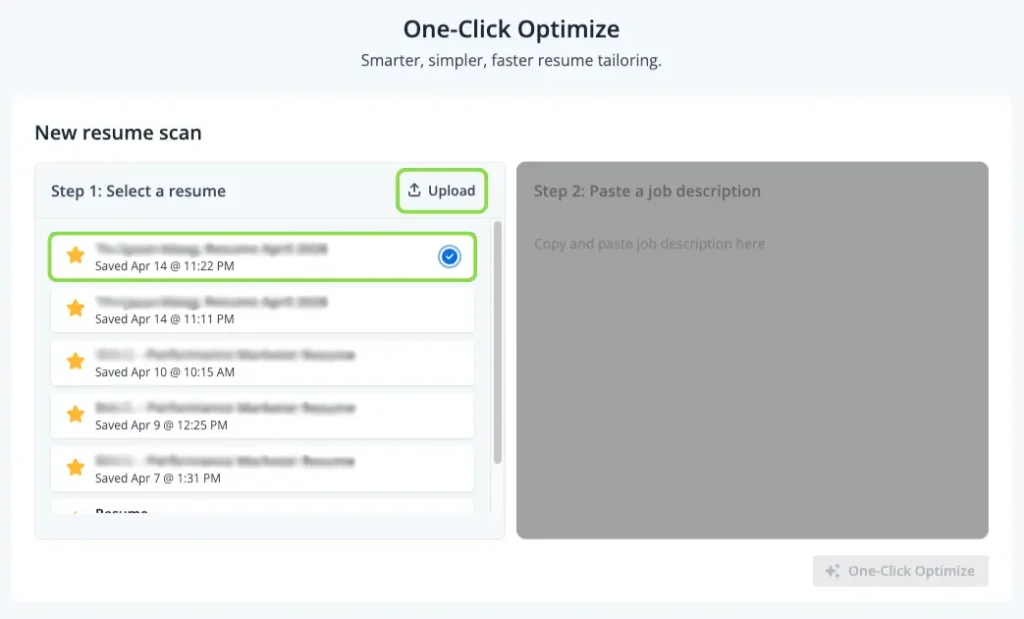
- Upload your resume. Use an existing resume saved in your account, or drop in your current .docx or PDF resume file.
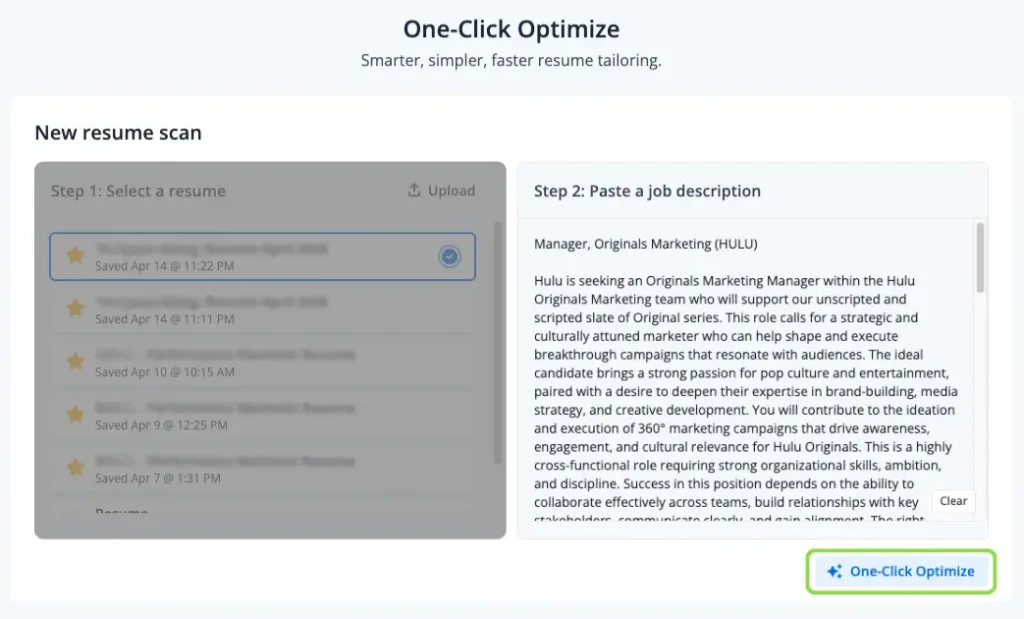
- Paste the job description. Copy the full job posting into the text field.
- Run AI Optimize. Jobscan compares your resume against the job description and simultaneously gives you a match report and full suite of specific recommendations based on that report.
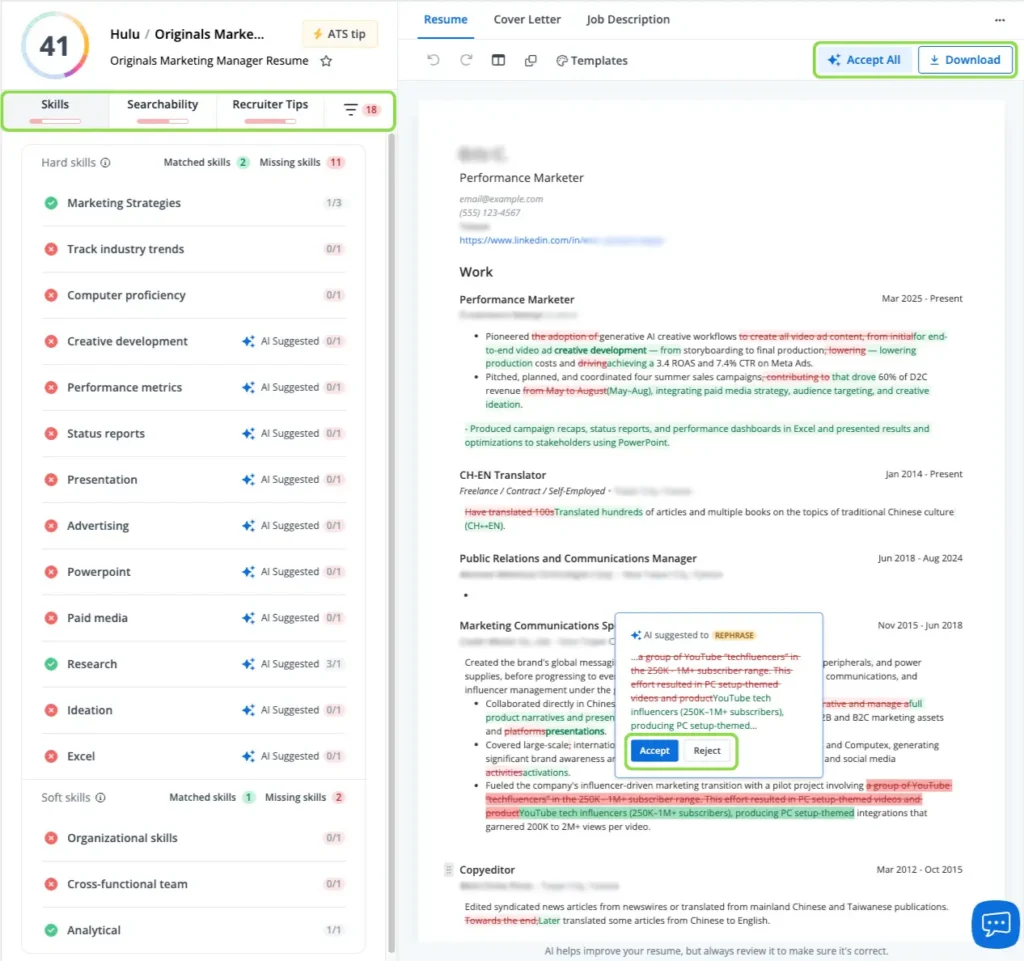
- Review the recommendations. You'll see which keywords are missing, which skills are underemphasized, and where formatting issues might trip up an ATS.
- Edit and download. Make the changes you agree with, manually edit those you don't, and download the final version in .docx (recommended in most cases) or .pdf file formats when you're finished.
Every suggestion is yours to accept or reject. You stay in control of what your resume actually says.
Why this is different from generic AI tools
Generic AI tools (like asking ChatGPT to "improve my resume") don't know which ATS the company uses, how that platform's screening process weights different criteria, or what semantic patterns its ranking engine responds to. They generate plausible-sounding text and call it done.
- A 12-year dataset on how ATS platforms actually parse and score resumes.
- Direct, hands-on testing of major ATS platforms to understand how they read and filter applications.
- Ongoing feedback from recruiters and university career centers.
- Analysis of millions of job descriptions to identify which keywords and skills map to each role’s ranking criteria.
If Workday is grading you on skills alignment before a recruiter ever opens your file, your resume needs to speak Workday's language, not just sound polished. That's the difference between a resume that gets ranked "A" and one that gets ranked "C" before any human has seen it.
The bottom line
Your fear of getting auto-rejected by an ATS for using AI is almost entirely unfounded. No major platform is built to detect AI authorship. Third-party detectors exist, and some recruiters do use them, but they are unreliable on professional writing and rarely used as an automatic disqualifier.
What is real: AI candidate ranking is now the majority experience across the job market. Your resume is likely being scored algorithmically before any human reads it, whether you're applying to a corporation or a startup. And then, if you make it through, a recruiter with 30 seconds will reject generic, unedited AI writing on sight.
Use AI as the tool it actually is: a fast, capable drafting assistant that needs your editing, your specifics, and your sign-off. Optimize for the algorithm. Then write for the human. The system is built to find good candidates. Be one.
No. None of the major applicant tracking systems used by Fortune 500 companies in 2026 (Workday, Greenhouse, iCIMS, SAP SuccessFactors, Lever, Ashby, Oracle Taleo) include native features for AI-authorship detection. The artificial intelligence inside these platforms is built for candidate matching and resume screening, not analyzing who wrote your bullet points.
Most likely yes, regardless of where you’re applying. At Fortune 500 companies, 79.3% of applicants go through a platform with active AI ranking (Workday, SAP SuccessFactors, Phenom People, iCIMS, Oracle, or Taleo). In the broader market, platforms with full AI scoring account for 53.3% of applications (Lever, Workday, iCIMS, Taleo), with another ~16% going through BambooHR or UKG with limited algorithmic filtering. Even Greenhouse, at 19.3% of the general market, launched AI-assisted Talent Matching in February 2026 — meaning some form of AI-powered candidate prioritization is now present across every major ATS platform, though Greenhouse still keeps final hiring decisions in human hands.
Not because of the AI itself. AI-generated resumes most commonly get filtered out for two unrelated reasons: complex formatting that breaks the ATS parser before your application is assessed, and generic unedited content that gets a low ranking score because it lacks specific work experience and relevant skills. Both are fixable.
Some recruiters do use third-party AI detectors, and automation integrations exist for major ATS platforms. But these tools are unreliable on resumes specifically. Stanford research found a 61.3% false-positive rate on writing by non-native English speakers, and OpenAI shut down its own detector because it was only 26% accurate. Even when recruiters use these tools, they typically don’t rely on them as the sole basis for rejection.
According to Insight Global’s 2025 survey, 53% of hiring managers say they can spot AI-generated applications immediately. The tells are consistent: overused words like “delve” and “tapestry,” vague power verbs without proof, identical sentence structure across all bullet points, missing context behind impressive numbers, and skill inflation that doesn’t match the candidate’s experience level.
Yes, if you edit it. 52% of hiring managers in TopResume’s 2025 survey said using AI for proofreading or drafting is acceptable. The deal-breaker is submitting the AI output unchanged. A 150-word cover letter with one specific company reference and one mapped achievement will outperform a polished but generic AI essay every time.
Gartner’s 2Q25 data shows 29.3% of job seekers used AI in their applications, up from 17.3% in 2024. That number is climbing fast. You are not alone, and you are not unusual for using these tools.
It can. Jobscan’s testing of major ATS platforms shows that complex formatting (tables, text boxes, two-column layouts, embedded images, non-standard fonts) can prevent the parser from extracting your information correctly. When that happens, your resume might be filed under the wrong fields or missing key information entirely. This is one of the biggest reasons people think their AI resume was “detected” when really it was just unreadable.
No. Using AI as a drafting and editing assistant is no different from using spellcheck, asking a friend to review your resume, or hiring a professional resume writer. What matters is that the final document is accurate, specific to you, and a genuine reflection of your experience. The line is between using AI to express your real experience well versus using AI to invent experience you don’t have.