



Job searching can be a frustrating and tedious process. A 2021 survey by Harvard Business School revealed that “being out of work did not just inflict financial hardship, it often cut much deeper, resulting in emotional suffering. It led to a lack of confidence, an absence of meaning in life, and an undermining of identity.”
What can job seekers do to take control of their job search? What does the hiring process look like for companies, and how can job seekers work with that system to increase their chances of getting an interview?
We started asking these questions over 10 years ago, and we immediately knew we needed to go straight to the source: the companies themselves. Thus, Jobscan was born, and years later, we started publishing the results of our ATS usage research.
Welcome to the 6th Edition of the Applicant Tracking System (ATS) Usage Report. This report tracks which Fortune 500 companies use an ATS and which ATS they use.
(Find this interesting? We welcome you to use any of these charts or insights in your own content, social streams, and client meetings.)
Let’s jump in…
ATS use by Fortune 500 companies
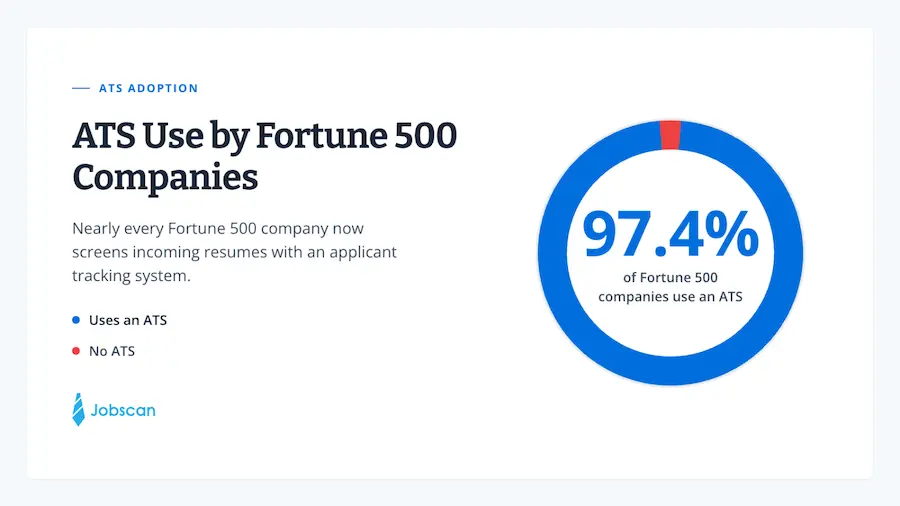
We’ll start by reporting on how many Fortune 500 companies use an applicant tracking system. We reverse-engineered the career pages for each company on the list. In 2026, we detected an ATS for 97.4% of Fortune 500 companies.
That amounts to 487 companies out of 500. The remaining 13 did not have a detectable ATS, which might just mean that they use a proprietary hiring system that was built in-house.
This number hasn’t changed much over the years.
- 2025: 97.8% of Fortune 500 companies used a detectable ATS.
- 2024: 98.4% of Fortune 500 companies used a detectable ATS.
- 2023: 97.4% of Fortune 500 companies used a detectable ATS.
- 2019: 98.8% of Fortune 500 companies used a detectable ATS.
- 2018: 98.2% of Fortune 500 companies used a detectable ATS.
Which ATS do these companies use?
ATS distribution across Fortune 500 companies
There were some notable ATS usage changes from 2025 to 2026.
In 2025, Workday (39.2% usage rate) and SuccessFactors (13.2% usage rate) were the most widely used ATS.
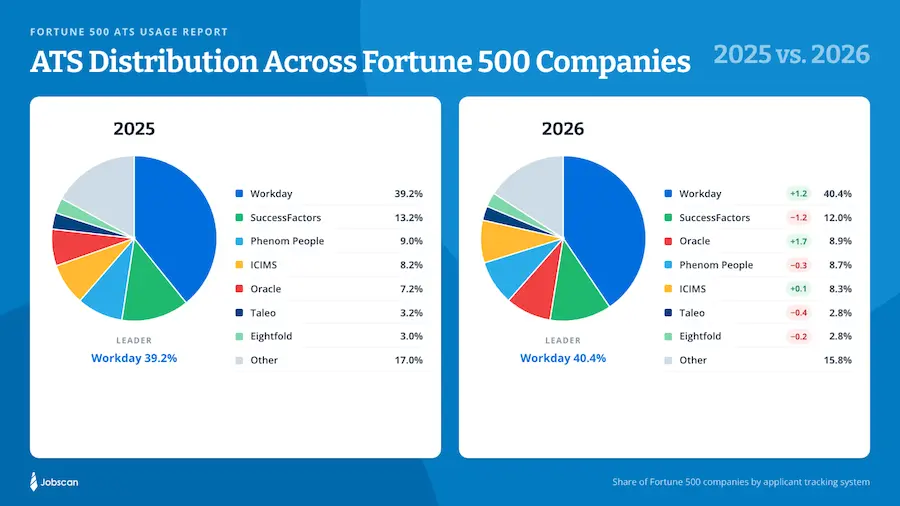
In 2026, Workday is still the most widely used ATS by far among Fortune 500 companies. Over 40% of the companies on the list use Workday for talent acquisition. SuccessFactors is still widely used and now has a 12% usage rate.
While Taleo usage is decreasing among Fortune 500 companies this year, iCIMS usage is still an enduring ATS for talent acquisition.
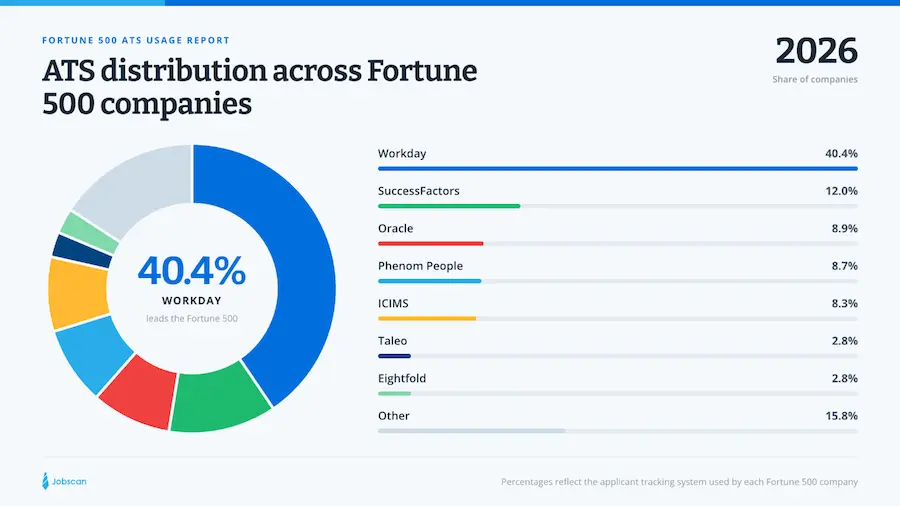
There are a myriad of other growing ATS out there, but Workday and SuccessFactors dominate and are used by a combined 52.4% of Fortune 500 companies.

General ATS distribution
For a wider view of companies outside the Fortune 500 list, let’s look at a statistic that gives us a broader look at ATS usage.
Using Jobscan data, we analyzed job descriptions from over 13,000 companies where an ATS was detected to see which ATS they use. The results were very different from the Fortune 500 results.
There is a broader distribution of ATS usage among these companies, which could vary in size and industry.
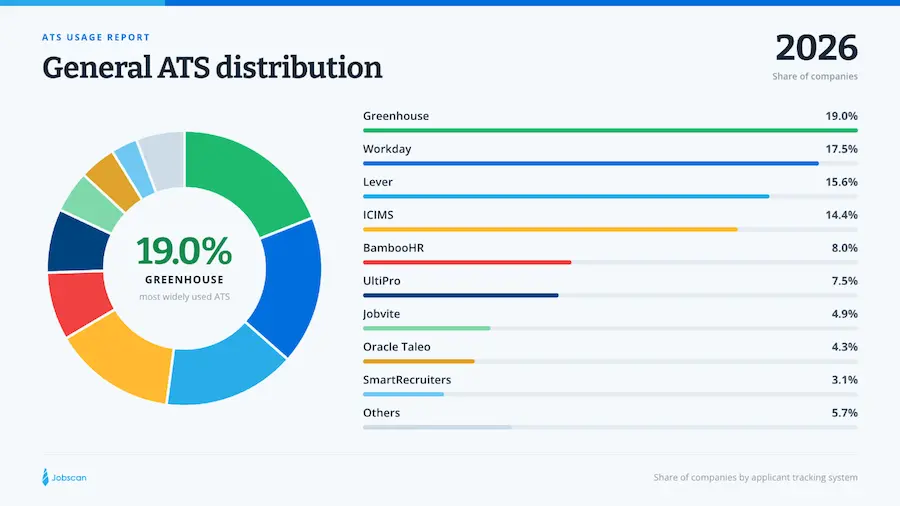
Here’s what we found:
- 19.0% of analyzed companies use Greenhouse
- 17.5% of analyzed companies use Workday
- 15.6% of analyzed companies use Lever
- 14.4% of analyzed companies use iCIMS
Exploring opportunities at lesser-known companies in their field can potentially give job seekers a better return on investment, simply due to the lower applicant volume.
What job seekers need to know about ATS
According to a recent report from The Times, corporate job postings receive an average of 250 applicants. CareerPlug’s 2024 Recruiting Metrics report proves that these metrics vary across industries, with automotive companies receiving an average of 212 applications per hire and hospitality, entertainment, and recreation organizations receiving an average of 25 applicants per hire.
These numbers will be larger for more well-known, established companies. At Jobscan, we were recently hiring a visual designer. We received over 1,400 applications.
Some recruiters will look at every single application, but many won’t. The aforementioned survey by Harvard Business School revealed that “more than 90% of employers […] initially filter or rank potential middle-skills (94%) and high-skills (92%) candidates” by criteria like skills, credentials, and years of experience. According to the report, “a recruiter will never see that candidate’s application, even though it might fill all of the employer’s requirements.”

“Many applicants are unaware of what an Applicant Tracking System is, let alone how it functions to select candidates to preview. To land a job, it’s essential to understand how an ATS works and apply that knowledge to creating a resume.”
An ATS can be used to search for candidates with certain skills, job titles, degrees, certifications, or keywords listed on their resume.
For example, to fill our position of Visual Designer, we could search for resumes that only include the skill “brand identity”. That would immediately narrow the candidate pool down.
Jobscan’s State of the Job Search Report unveils how recruiters use their ATS to find the best candidate from a sea of applications. 76.4% of recruiters surveyed revealed that they search and rank candidates by skills from the job description. Then, recruiters search for education, job title matches, licences and certifications, and years of experience.
Recruiters use their ATS as a copilot in discovering the perfect candidate. If you miss out on opportunities to highlight the details recruiters are searching for, they may never see your resume, even if you fit all the employer’s requirements.
The action plan for job seekers is simple.
- Tailor your resume for each job you apply for so that you cite specific skills and experience the recruiter might use the ATS to filter candidates by.
- Make sure your resume is parsable so that the ATS can detect those skills and experiences. Starting from an ATS-friendly structure with coached, quantified bullets keeps your resume parsable from the first draft.
- Understand how each ATS works so you can optimize based on their nuances.
Jobscan offers free AI-powered tools to help job seekers get more interviews. Our ATS resume builder helps you create an ATS-friendly resume, and it’s completely free to build and download your resume. It has been revamped as the AI Resume Builder: an AI coach interviews you one question at a time and turns your answers into strong, quantified bullet points, so your resume is parsable from the first draft.
Our free resume scanner gives you a free report with a Match Rate to show you how well you match the job requirements and guidance on what skills to expand on to increase your score. Jobscan’s job application tracker tool is free for all users and helps you track and manage your job applications.
How is AI being used in Fortune 500 companies’ ATS?
A noticeable change in our 2026 analysis was the introduction of visible AI integrations in ATS.
Multiple companies introduced an AI chatbot feature on their job listing pages, powered by Paradox, a company associated with Workday.
While it’s a Workday company, it can integrate with a host of ATS software like SuccessFactors, Greenhouse, ICIMS, JazzHR, Lever, Oracle, and others. So if you see an Paradox chatbot, it doesn’t automatically mean the ATS the organization is using for hiring is Workday.
Of the Fortune 500 companies, only seven were using Paradox exclusively to manage applications. While many other companies are choosing to integrate this AI chatbot, most treat it as an add-on.
Methodology and data
The data in this report was captured in two ways.
For the data on ATS use by Fortune 500 companies, we reviewed job listing pages for all 500 companies on the list. We were able to detect which ATS was used for 487 of the companies.
For the data on general ATS use, we used data from the ATS Tip feature in the Jobscan resume scanner. That feature allows users to enter the URL of the job they are applying for. Our system will automatically detect which ATS the company uses. The data came from over 1 million scans for 13,130 companies.
- Data on Fortune 500 companies was gathered upon the list’s release on June 3, 2026.
- Data on general ATS use are derived from all historical data from the Jobscan resume scanner, dating back to 2016.
- Individual companies were not contacted for information on ATS market share or individual use. The data was collected manually by an in-house data team to ensure an accurate and unbiased report.
FAQs
Many large and well-known companies across various industries use Applicant Tracking Systems (ATS) for their hiring processes. These include tech giants like Google and Microsoft, finance leaders like JPMorgan Chase, retail behemoth Walmart, and global consulting firm Accenture.