



Contributed by Ihor Lavrenenko from Pesty Marketing
I hire remote candidates for agency marketing roles, mostly SEO specialists and web designers. I’m not reading resumes for entertainment. I’m trying to answer one question fast. Can I put you on a client account and trust the work that goes out?
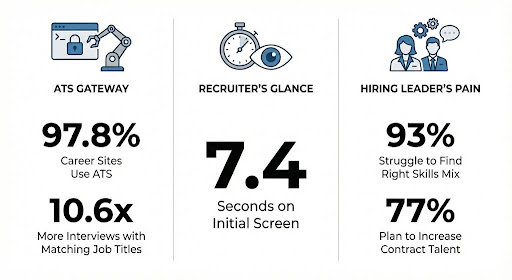
The catch is that your resume has to get through the software before it gets to me. Jobscan’s research found an ATS on 97.8% of Fortune 500 career sites in 2025, and their analysis of 2.5 million applications found that resumes with matching job titles got 10.6 times more interviews. The Ladders’ eye-tracking study also reported that recruiters spent 7.4 seconds on the initial screen. On the hiring side, Robert Half reported that 93% of marketing and creative leaders struggle to find candidates with the right mix of skills, and 77% planned to increase contract talent use, a strong signal that “ready to contribute” matters more than ever.
So that’s what I’m going to help you do – write an agency-ready marketing resume that reads cleanly for ATS, feels human for a recruiter, and sounds like someone who has shipped real work.
What I screen for when I hire remote SEO and web design candidates
Most resumes fail me in the same way. They describe activity, not outcomes. They also hide the stuff that tells me you can operate in an agency. Client pressure, shifting priorities, and quick turnarounds are normal here, and I need signals that you can handle that without spiraling.
For SEO roles, I look for proof that you can prioritize. Anybody can list “keyword research.” I want to see what you fixed first, why it mattered, and what moved after. For web design roles, I’m not hiring for taste alone. I’m hiring for pages that load, layouts that work on mobile, and designs that support conversions. If you can connect design decisions to a goal, you stand out immediately.
Remote work adds one more filter. I need to feel like you can communicate your thinking without having to meet for everything. A resume can show that without saying “self-starter.” The way you write bullets, the way you label projects, and the way you present results already tell me how you think.
The numbers behind the first screen
The hiring process feels personal, but the early stage is very mechanical. If you understand what the numbers imply, you stop wasting time polishing the wrong things.
| Verified signal | What it means | What I want to see on your resume |
| 97.8% of Fortune 500 companies had a detectable ATS in 2025 | ATS friendly formatting is not optional for online applications | Simple section headings, clean layout, and keywords placed in context |
| Recruiters spent 7.4 seconds on the initial resume screen in 2018 | Your lane and credibility have to show up fast | Clear target title, a tight summary, and proof near the top |
| Matching job titles earned 10.6 times more interviews in Jobscan’s analysis of 2.5 million applications | Job titles work like search terms | A truthful target headline that mirrors the posting language |
| 93% of marketing and creative leaders said it’s hard to find the right mix of skills | General resumes blend in | Focused skill set that fits the role you want |
| 77% planned to increase contract talent use | Hiring teams want people who can plug in quickly | Tools, workflows, and deliverables that match agency life |
That table is the whole game. Your resume has to be skimmable and as much specific as possible.
Pick one agency role and write for it
A common mistake is trying to create one resume that covers everything. It reads safe, but it performs poorly. Agencies do not hire “marketing.” We hire for specific work we need covered right now.
If you want SEO roles, your document should read like an SEO who collaborates with content and dev. If you want web design roles, it should read like someone who designs and builds with performance in mind. If you are applying to hybrid agency roles, you still need a primary identity so a recruiter can categorize you at a glance.
This is also where ATS comes into play. The system is scoring your resume against a specific posting. A resume written for “general marketing” is usually weaker than a targeted SEO or design posting, even if you are qualified.
How I pull marketing resume keywords without sounding robotic
I approach job descriptions the way I approach SEO research. I do not guess intent. I look at the language the market is already using.
Here’s the approach I recommend, explained without turning it into a checklist. Start by collecting a few postings for the same role type and highlight repeated nouns and tool names. You are looking for terms that describe deliverables, platforms, and outcomes. Then compare that list to the one posting you want most, because the exact words in that posting matter for ATS resume keywords. Finally, keep only the terms you can defend in a conversation. If you cannot explain how you used “GA4 event tracking” or “technical SEO,” it does not belong on the page.
This keeps your resume human. It also keeps your keywords honest, which is what helps you in interviews.
Where keywords actually belong on an agency resume
I see candidates cram keywords into a skills block and hope it works. Sometimes it does. More often, it turns the resume into a weird word cloud that reads like a panic attack.
Instead, I place keywords where systems can parse them, and recruiters naturally look for them.
Your target title and headline are in the first place. If the posting says “SEO Specialist,” and you are truly an SEO Specialist, that phrase should exist near the top. Job titles act like search terms in ATS databases, and this is one of the easiest wins you can take.
Your summary is in second place. I like two or three sentences that clearly state your lane, a strength that matters to agencies, and one proof point. A summary that says “results-driven marketer” tells me nothing. A summary that says you improved organic leads for service businesses and you work with technical fixes, content briefs, and reporting tells me exactly where you fit.
Your skills and tools rank third. I separate capabilities from platforms so both humans and systems can read them quickly. A mixed list of everything you have ever touched dilutes credibility.
Experience bullets are in fourth place, and the most important one. This is where keywords become believable because they live inside outcomes.
What skills get paid more in 2026 and how to use that in your positioning
If you want to look “agency-ready,” you should demonstrate at least one area of depth that aligns with what hiring teams pay more for. Robert Half’s 2026 marketing and creative research finds that 78% of leaders offer higher pay to candidates with specialized skills, and they list the specific skill areas they pay more for.
| Skill area leaders pay more for | Share of leaders willing to pay more |
| Digital marketing strategy | 44% |
| AI and machine learning | 37% |
| Marketing automation | 33% |
| Marketing research and analytics | 32% |
| Web and mobile development and design | 31% |
The practical takeaway is simple. Pick one of these areas that actually matches your background and bring it forward with proof. A shallow list of five “premium” skills reads like a copy-paste. One premium skill with real outcomes reads like someone I can place on accounts.
Turn agency work into bullets that get interviews
Agency hiring managers want results, but they also want to understand the lever you pulled. That is why I like bullets that include the channel, the change, and the metric. If you are remote, clarity matters even more because the resume is doing much of the communication work for you.
To keep this clean and readable, here are examples in a table format. These are patterns I see from candidates who move forward.
| Role type | Weak bullet that blends in | Strong bullet that sounds agency ready |
| SEO | Worked on SEO and improved rankings | Fixed indexation and internal linking issues on a multi location services site, then rewrote content briefs around high intent queries, which increased non branded organic sessions by 38% in 12 weeks |
| SEO plus dev | Helped improve site performance | Partnered with a developer to reduce redirect chains and template bloat, improving page speed on priority landing pages and increasing organic form submissions |
| Web design | Designed landing pages for clients | Redesigned a lead gen landing page and shipped the build in WordPress, then tested two layout variations, increasing form conversion rate from 2.1% to 3.0% |
| Agency collaboration | Communicated with clients | Led weekly reporting and priorities for a client account, translating analytics into a short action plan that reduced revision loops and improved on time delivery |
If you cannot share client names, share the industry and the scope. “Multi-location dental group” is fine. “Home services lead gen site” is fine. What matters is that the work sounds real and the metric fits the channel.
Keep the ATS resume format boring on purpose
Design-heavy resumes are tempting, especially for creative roles. But most ATS parsers still prefer predictable structure. I have seen good candidates get buried because a two-column layout broke how the system reads dates, titles, or section headers.
When you want an ATS-friendly marketing resume, boring is a feature. Use a one-column structure, standard headings, and clean bullets. Save visuals for your portfolio, not your resume file.
This matters even more for web designers. Your portfolio can show taste. Your resume should show that you can work within constraints.
Add proof without turning your resume into a portfolio
When I hire for remote roles, I cannot rely on “I’ll know it when I meet them.” Proof helps me move faster.
I like a short “Selected work” area near the top, but kept tight. Two or three project lines are enough. Include client type, channel, outcome, and a link if you have something shareable. If confidentiality is a concern, redact names and keep the results honest. A clean Notion page or a simple Google Drive folder can work if it opens fast and is organized.
For SEO candidates, a short audit excerpt is gold. Show the priority list and a quick explanation of why you chose those fixes first. For web design candidates, include one wireframe and the final page, along with a sentence about the conversion goal. That is the kind of thinking agencies want.
Final pre-submit resume check
- Does your headline match the target job title language, and is it truthful?
- Can I understand your lane in the first 7 to 10 seconds?
- Do you have at least two outcome-driven bullets on page one?
- Are your marketing resume keywords placed inside real sentences, not dumped in a block?
- Is your ATS resume format one-column with standard section headers?
- Do you include proof links that open cleanly and do not require sign-in?