




Measurable accomplishments are one of the most important parts of a resume, but they often trip up job seekers.
Many people think they don’t have any, especially if they haven’t won awards or led big projects. Others mix up responsibilities with results, or worry they can’t use numbers without exact data.
But the truth is, almost every role creates impact. You just need to know how to uncover it.
This article will show you how to identify your accomplishments and include them on your resume. Plus, you’ll find real examples from a variety of fields to help you get started.
Resume accomplishments are specific, measurable results that prove the value you delivered in a role. They go beyond listing duties to show what you actually achieved.
Here’s what accomplishments can look like across different areas:
Professional accomplishments:
-
“Exceeded sales or performance goals.”
-
“Improved a process or increased efficiency.”
-
“Solved a complex problem or implemented a new system.”
-
“Led a team, trained colleagues, or managed projects.”
-
“Earned a promotion, award, or positive client feedback.”
Educational accomplishments:
-
“Raised your GPA or made the Dean’s List.”
-
“Completed an advanced certification or degree.”
-
“Led a successful group project or academic initiative.”
-
“Earned honors like magna cum laude.”
-
“Took on leadership roles in school clubs or activities.”
Personal accomplishments (when relevant):
-
“Volunteered or organized community events.”
-
“Completed personal development goals like language learning or career training.”
-
“Overcame a challenge that built relevant skills like resilience, adaptability, or communication.”
Throughout this article, you’ll learn how to identify your accomplishments, write compelling bullet points, and tailor them to the job, plus tools to help make the process easier.
What are resume accomplishments?
Resume accomplishments highlight the positive impact you made at work, whether through results, improvements, or key contributions.
The strongest resume accomplishments are measurable, meaning they include numbers to show the size or significance of your results.
For example, “increased sales” is an accomplishment. But “increased sales by 20% in six months” is a measurable accomplishment, and far more effective on a resume.
Here are some more examples:
- “Reduced costs by 15%.”
- “Led a project that finished 30 days ahead of schedule.”
- “Increased organic traffic by 40%.”
- “Saved the company $200,000 annually.”
- “Managed and mentored a team of 30 employees over 5 years.”
In a recent Jobscan survey, 58% of recruiters said measurable achievements are what make a resume stand out most.
Numbers talk, but only when they’re relevant to the job you’re applying to. In fact, 55% of recruiters said tailored resumes are more impressive, proving that customization is just as important as quantification.
Resume accomplishments are NOT responsibilities
Many resumes list responsibilities but leave out accomplishments. This is a common mistake.
Responsibilities are the tasks you’re expected to perform, like managing a team, overseeing projects, or responding to customer inquiries.
Accomplishments, on the other hand, focus on the results of those tasks: what you achieved, improved, or delivered.
Put simply: responsibilities show what you did; accomplishments show how well you did it. A strong resume should include both.

How many resume accomplishments do you need?
A strong resume should include 3 to 5 measurable accomplishments. Ideally, each major skill or area of expertise listed should be backed up with a clear example that shows the impact of that skill.
For example, if project management is listed as a skill, include a bullet point like: “Successfully managed a team to complete a $1 million project two months ahead of schedule.”
The goal is to show not just what you can do, but how well you’ve done it. Quantified results make your resume more credible, more compelling, and more likely to catch a recruiter’s attention.
What if you don’t have any accomplishments?
This is a common concern, but the truth is, almost everyone has quantifiable accomplishments.
Start by thinking about your day-to-day work. What tasks did you complete? What problems did you solve? Even without exact numbers, estimates can still highlight your impact.
Even if you’ve never written an accomplishment statement before, here are five ways to build one from the numbers hiding in your daily work:
1. Estimate time saved
Think about tasks you made faster or more efficient. Did you automate something? Create a shortcut? Streamline a process? Even small time savings add up.
Example: “Streamlined filing procedures, saving 2 hours per week—30% faster than before.”
2. Quantify your support for others
Support work is easy to overlook, but it’s valuable, especially when it helps others succeed. If you trained coworkers, answered questions, or pitched in during busy times, estimate the number of people you helped or the time you saved them.
Example: “Trained 5 new team members, reducing onboarding time by 20%.”
3. Highlight customer service volume
Customer-facing roles generate plenty of measurable impact. Consider how many customers you served, how quickly you resolved issues, or how satisfaction scores improved.
Example: “Managed 50+ customer inquiries daily, resolving issues 10% faster than the team average.”
4. Measure the volume of your task
Even routine tasks can become accomplishments when you show their scale. If you handled a large workload, managed inventory, processed forms, or scheduled appointments, quantify it.
Example: “Oversaw 200+ inventory items weekly.”
5. Estimate cost savings
Cost savings can come from process improvements, vendor changes, or simply spotting inefficiencies. Even rough estimates can show that you think strategically and add value.
Example: “Recommended a vendor change, cutting supply costs by 12%.”
PRO TIP: You don’t need exact numbers to make your accomplishments count. It’s okay to estimate, as long as your estimate is reasonable and based on what you remember. Recruiters want to see impact, not perfection.

Once you’ve written your accomplishment statements, you’ll need to place them in the right spots on your resume. While the resume headline might contain your catchiest accomplishment, the two most common locations are your work experience entries and your resume summary (used by those who’ve entered the workforce) or resume objective (used by recent grads or career changers).
For detailed formatting guidance on structuring each work entry, see our guide: formatting your work experience section.
How do you write accomplishments on your resume?
Writing strong, measurable accomplishments doesn’t have to be difficult. The key is to focus on results and structure each bullet point in a way that highlights your impact.
Here’s an overview of the whole process before we dive into the writing details:
Aim for 3–5 per role. Each major skill on your resume should be backed by at least one result that proves it.
Tasks you made faster, streamlined, or scaled are all fair game. How many did you handle? How much time did you save?
Open every bullet with a past-tense verb: led, reduced, built, launched, trained, negotiated. Never “responsible for” or “helped with.”
Anything that changed because of your work: time saved, costs reduced, people trained, satisfaction improved. You don’t need awards or a fancy title.
Training, mentoring, and helping teammates is valuable. Estimate how many people you helped and what it saved them.
Be precise about what you worked on. “Worked on onboarding” says nothing. “Redesigned client onboarding to cut setup time” earns attention.
Leadership, communication, and teamwork aren’t vague on a resume when connected to a downstream result. Find the outcome, then measure it.
Spotted an inefficiency, renegotiated a vendor, or prevented a costly mistake? Even a rough figure shows strategic thinking.
Every bullet needs a “so what.” Show what changed because of your work. An outcome turns a task description into proof of value.
Don’t wait until you’re job hunting. Log wins now — in a doc, a note, a folder in your email — while the numbers are still accurate and the context is fresh.
Past performance reviews, manager emails, project reports, dashboards, CRM data, ticketing systems. The numbers are there — you just need to find them.
For complex wins: Challenge (the problem), Action (what you did), Result (what changed). Every bullet answers both “what” and “so what.”
1. Start with a strong action verb
Bullet points should begin with action verbs like led, improved, developed, or launched. These words make your accomplishments feel more dynamic and results-driven.
Avoid weak openers like responsible for or helped with. These phrases make your contributions sound passive.
- “Led a team of 6 sales reps to exceed quarterly targets by 15%.”
- “Managed weekly inventory counts to ensure 100% stock accuracy.”
- “Coordinated a 3-day company event for 200+ attendees under budget.”
- “Responsible for managing the sales team.”
- “Helped with inventory tracking.”
- “Was in charge of event planning.”
2. Identify what you did
Be specific about the task, project, or process you worked on. Generic phrases like worked on or involved in don’t say much about your role or contribution.
- “Redesigned client onboarding process to improve retention and reduce setup time.”
- “Updated website content to align with brand messaging and improve user experience.”
- “Presented weekly reports to leadership to inform product roadmap decisions.”
- “Worked on client onboarding.”
- “Involved in website updates.”
- “Participated in team meetings.”
3. Add the outcome or result
Show what happened because of your work. Outcomes give your bullet points purpose and help recruiters understand the value you delivered.
- “Coordinated weekly team meetings, reducing scheduling conflicts and improving team communication.”
- “Digitized 1,000+ records, reducing retrieval time by 40%.”
- “Developed social content that boosted engagement by 25% in three months.”
- “Handled scheduling for weekly team meetings.”
- “Organized files.”
- “Created social media posts.”
4. Quantify the impact (when possible)
Numbers make your accomplishments more concrete. Even estimates are better than none. They help illustrate the size and scale of your results.
- “Improved website load time by 40%, reducing bounce rate by 20%.”
- “Resolved 50+ customer issues per week with a 95% satisfaction rating.”
- “Managed a $250,000 annual budget with 100% compliance and no overspending.”
- “Improved website performance.”
- “Assisted customers.”
- “Managed budgets.”
5. Use the C.A.R. formula
For larger or more complex accomplishments, use the C.A.R. formula: Challenge, Action, Result. This helps frame your impact in a way that’s clear, concise, and compelling.
For example:
Challenge: The company was struggling to re-engage inactive users.
Action: Launched a targeted email campaign using segmented lists and personalized content.
Result: Generated 500+ new leads in one month.
Bullet point: “Launched a re-engagement email campaign for inactive users, resulting in 500+ new leads in one month.”
If you’re already familiar with the STAR method (Situation, Task, Action, Result), this is a similar approach. Here’s how to use STAR on your resume if you prefer that framework.
PRO TIP: Stuck turning your accomplishments into bullet points? Jobscan’s resume bullet point generator can help you phrase them clearly and professionally.
And if you are building the resume from scratch, an ATS resume builder keeps your accomplishment bullets in a format the ATS can parse cleanly.
6. Translate soft skills into hard metrics
Soft skills like leadership, communication, and teamwork are hard to quantify, but not impossible. The key is to find the downstream effect of that soft skill.
Instead of writing “strong leadership skills,” ask: what happened because of your leadership?
- Leadership → Team output: “Led a team of 8 that delivered 3 product launches in 6 months.”
- Communication → Stakeholder satisfaction: “Presented weekly updates to C-suite, earning a 95% approval rating on project direction.”
- Teamwork → Efficiency: “Collaborated across 4 departments to reduce handoff time by 30%.”
The soft skill is the how. The metric is the so what. Every accomplishment statement should answer both.
7. Match your accomplishments to the role
Writing strong, metric-driven bullet points is only half the work. The other half is selecting the relevant experience to highlight.
A hiring manager reading your resume for six seconds won’t spend time connecting the dots between your background and their open role. You have to do that work for them.
That means looking at the job posting before you finalize your bullets. What outcomes does the role prioritize? Revenue growth? Operational efficiency? Team development? Customer retention? Pick the accomplishments from your history that directly mirror those priorities, and lead with them.
Think of it as curating, not rewriting. You’re not inventing new accomplishments for every application. You’re selecting which of your real wins to feature, based on what will land hardest with this particular reader.
The challenge is doing this quickly across multiple applications.
Jobscan’s resume scanner compares your resume to the job description and shows you exactly which of your contributions align, and which gaps you might want to address with additional context. Here’s how it works:
- Paste in your resume.
- Paste in the job description.
- Click “Scan.”
You’ll receive a match rate showing how closely your resume reflects the priorities of the role, and a report highlighting which contributions could be more precisely worded.
Here is an example of the report and match rate:
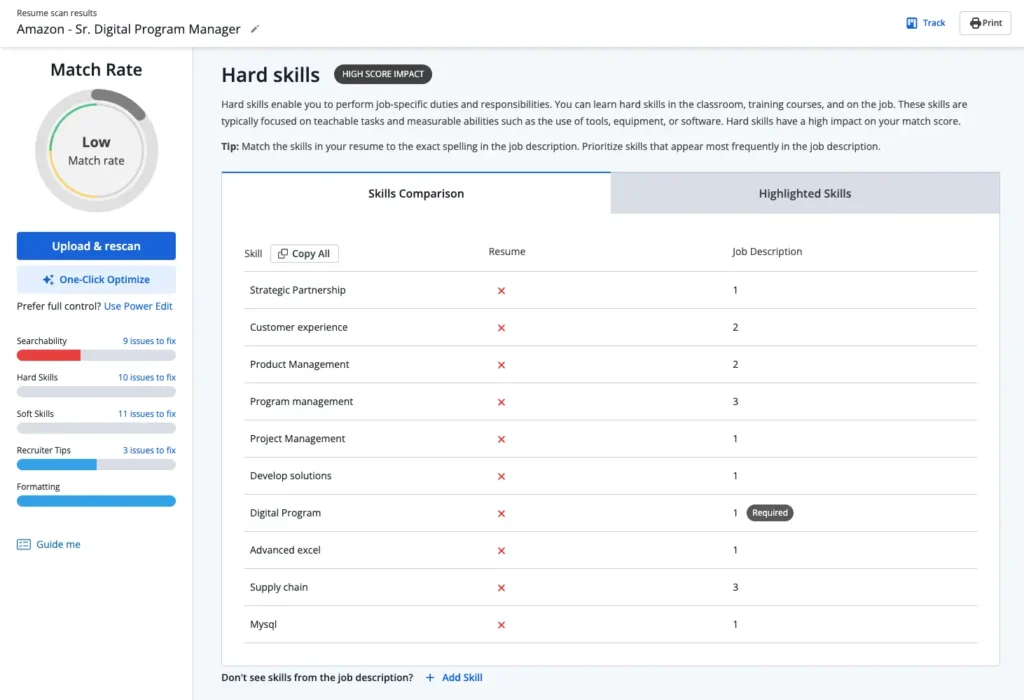
The red X’s highlight the hard skills that are missing from the resume. Adding them will increase your match rate and your chances of landing an interview.
How to track accomplishments while you’re still in the role
Most people only think about their accomplishments when they’re already job hunting. By then, the details have faded. You can’t remember the exact percentage, the project wrapped up two years ago, and your performance reviews are buried in an old email folder.
The fix is simple: treat your wins like a running document, not a last-minute memory exercise.
Here’s what to log and where to find it:
| What to track | Where to find it | Example |
|---|---|---|
| Performance metrics | Your manager’s reports, dashboards, or quarterly reviews | “Exceeded Q3 sales target by 18%” |
| Positive feedback | Emails, Slack messages, or post-project notes from colleagues or clients | “Client wrote: fastest onboarding we’ve experienced” |
| Process changes you initiated | Your own task notes, project management tools like Asana or Jira | “Simplified intake form, reducing processing time by 2 hours per week” |
| Volume or scale of your work | CRM data, ticketing systems, inventory records | “Handled 200+ support tickets per week” |
| Before-and-after comparisons | Any baseline data from when you started a role or project | “Inherited team with 60% retention; brought it to 85% in 18 months” |
Resume accomplishments examples
Here are examples of resume accomplishments broken down into general job categories. Feel free to adapt these to your own experience.
1. Customer service examples
- “Maintained a 97% satisfaction rating over a 24-month period as a customer care representative.”
- “Increased client retention by 59% by implementing an efficient grievance resolution process and customer feedback system.”
- “Managed 500+ customer accounts without any complaints in 5 years and maintained a 100% customer rating in online reviews.”
- “Increased customer base by 25% and improved customer response time by 11%, directly impacting sales in 2023.”
- “Drove Quality Assurance (QA) from an average of 65% to 90%.”
2. Sales examples
- “Exceeded retail sales goals by an average of 17% every quarter in 2024.”
- “Expanded the client base by 60% in just 3 months.”
- “Implemented an efficient sales funnel, directly increasing sales by 30% in 2024.”
- “Created a robust pipeline and improved closing rate by 11% in just 2 months.”
- “Recognized as the Top Salesman in Company X for 4 consecutive years.”
- “Led a team of 10 sales professionals who consistently brought big accounts, driving year-over-year company profits at a rate of 80%.”
3. Marketing examples
- “Created campaigns that facilitated improved market share and customer engagement in 2024.”
- “Grew email subscriber list from 300 to 2,000 in 8 months without expanding the monthly budget.”
- “Managed and deployed profitable Facebook ad campaigns with a monthly budget of $20,000.”
- “Created an SEO strategy that improved organic website traffic to the corporate blog by 58% year over year.”
- “Created 32 new blog posts, 5 eBooks, and 6 landing pages, making up 30% of the company’s online content.”
- “Exceeded customer acquisition target by 25% and increased new subscribers by 50% by launching niche marketing campaigns.”
4. Computer science examples
- “Reduced data processing time by 50% by building a new cloud data infrastructure.”
- “Worked with the CEO to analyze 10+ technology systems and consolidate them into a new system that encompassed all programs needed to reach business needs.”
- “Developed and launched a new software application that increased user engagement by 35% and reduced system downtime by 20%.”
- “Led a team of 10 in the successful migration of a company’s database to a cloud platform, resulting in a 40% improvement in data retrieval speeds and a $50,000 annual cost savings.”
- “Set up and trained a staff of 15 on how to use the Microsoft Azure platform for cloud computing purposes.”
- “Reduced company spending from $6M to $800K and cut mainframe software costs by proposing renegotiating strategies.”
5. Management examples
- “Created a company culture initiative that raised employee satisfaction rates by 25% year over year.”
- “Hired and managed a team of 6 data scientists to successfully deploy a new data processing platform ahead of schedule.”
- “Implemented a bi-weekly meeting with 9 other department heads to discuss goals, updates, and challenges, increasing productivity across departments by 20% year over year.”
- “Reimagined business development strategy to include a 20% increase in Salesforce, resulting in $550M in increased profits year over year.”
- “Led the company through a complicated reorganization, resulting in a 75% increase in profits with minimal employee turnover.”
- “Grew working capital by 30% in 6 months, allowing the company to take advantage of better resources for continued growth.”
- “Implemented a company-wide work-from-home policy, resulting in an 87% increase in employee satisfaction, a 21% increase in productivity, and a 38% decrease in PTO usage.”
- “Received 2 promotions, from co-management to director-level, in less than 12 months.”
- “Chosen as team lead on 15 design projects in 2024, 30% more projects led than any other team member.”
6. Human resources examples
- “Raised employee retention rates by 15% over a 5-year period by implementing a tiered interview system and organizing a minimum of 2 team outings per quarter.”
- “Counseled, educated, and advised over 3,500 university students in just a year.”
- “Created simplified HR processes that boosted company productivity and morale by 10%.”
- “Prepared regular pulse surveys for employees that increased transparency and engagement by 11%.”
- “Recruited at least 30+ high-performing individuals who are now executives in big companies in 3 years.”
- “Organized the company’s annual international summit, including flights, accommodations, and itineraries for more than 30 attendees.”
- “Scheduled and staffed coaching sessions for 70 weekly athletic classes.”
- “Organized quarterly volunteer projects with upwards of 50 volunteers per event.”
7. Teacher and education examples
- “Assisted head teacher in overseeing and educating 18 students for 3 months.”
- “Developed a comprehensive student submission system for final exam projects in the University’s online portal, accessible by more than 3,000 students.”
- “Approved more than 50 pieces of new curriculum in the foreign languages department during the Spring semester of 2024.”
- “Documented children’s learning processes and regularly met with parents, increasing student performance by 32% and parent engagement by 20%.”
- “Awarded as an outstanding secondary teacher in Mathematics within the district for 3 consecutive years.”
8. Administrative work examples
- “Reduced time spent on inventory by 20% by reorganizing the physical storage of supplies.”
- “Digitized the company’s internal microfilm library of more than 5,000 files.”
- “Managed multi-line phone system and effectively handled 200 tickets on a daily basis, contributing to a 60% increase in customer satisfaction.”
- “Established an efficient document database during my first 30 days in Company X, reducing idle time by 10% and improving overall efficiency.”
- “Created policies for the entire administrative team and streamlined processes that helped boost employee morale by 15%.”
- “Provided administrative support to the Director of Operations and 50+ team heads in the office while helping HR with employee orientation and training.”
- “Implemented a filing system for human resources, organizing more than 300 past and current employee documents.”
9. Accounting and finance examples
- “Led a process redesign and decreased the company’s month-end close time by 53%.”
- “Increased the department’s productivity by 10% by establishing process improvement initiatives and implementing strict compliance with GAAP and SEC guidelines.”
- “Provided timely financial reporting that led to business improvement and a 25% drop in company costs in 2024.”
- “Offered financial advice on crypto assets and investments to 50+ executives.”
- “Contributed to over $65,000 in profits in 2024 through proposed system changes and investment strategies.”
- “Reduced the company’s operating expenses by 15% through the implementation of cost-saving initiatives and renegotiation of supplier contracts, saving $200,000 annually.”
- “Managed an investment portfolio that achieved a 12% annual return, outperforming the market average by 5% and increasing client assets by $1.5 million.”
Measurable accomplishments in school or college
If you’re a student, recent graduate, or someone with limited work experience, you can still include measurable accomplishments on your resume.
These can come from class projects, internships, part-time jobs, extracurriculars, or academic milestones.
For example, instead of just listing your degree, highlight results:
- “Improved GPA from 3.2 to 3.8 in two semesters by implementing new study strategies.”
- “Led a team of classmates on a marketing project that increased campus event attendance by 40%.”
Even honors and coursework can show impact. If you made the Dean’s List, graduated magna cum laude, or held a high GPA, include it in your education section, especially if it supports your candidacy.
Make sure your formatting is clear and consistent, especially in your education section. If you’re still in school or recently graduated, it’s helpful to include your expected graduation date so employers know your timeline.
For high school students or those without a college degree, it’s perfectly acceptable to include your high school diploma, especially if you’re applying for entry-level roles or apprenticeships.
- How to list high school on your resume — tips and examples
- How to list your degree — correct order and formatting
- When to exclude education — age bias and relevance
- Where to put your GPA — placement and thresholds
- How to list internships — format and framing
Finally, don’t overlook other student experiences. Involvement in clubs, leadership roles, or extracurricular activities can all translate into resume accomplishments, especially if you helped organize events, grow membership, or lead initiatives.
Even your hobbies can count if they show commitment, creativity, or relevant skills. Here’s how to decide which hobbies to put on your resume.
Volunteer work can also be a strong addition, particularly when it shows transferable skills or community involvement. This guide on how to format volunteer experience on your resume can help you make it stand out.
If you’re not sure where to start, this guide on resumes with no work experience offers helpful strategies and examples.

Resume best practices that strengthen your accomplishments
Strong accomplishments are only effective when the rest of your resume supports them. Here are the quick wins that make the biggest difference:
- Clear resume sections — like summary, work experience, skills, and education — help recruiters find what they need fast.
- If it’s been a while, update your resume with stronger language and more recent results.
- Stronger word choice pays off. Swap overused adjectives for better resume adjectives or more powerful action verbs.
- Show your level of expertise for each skill. This guide to listing skill levels on your resume shows you how.
- Go beyond duties. Include certifications, awards, and tools you’ve used, like the Microsoft Office suite or Python projects.
- Freelance work, babysitting, or job shadowing all count, especially when paired with results.

- Accomplishments show results. Responsibilities show duties. Your resume needs both, but results are what get you noticed.
- Numbers matter, even estimates. A rough figure beats a vague claim every time.
- Use the C.A.R. formula for your biggest wins: Challenge, Action, Result. It gives any accomplishment a clear shape.
- Soft skills become resume-ready when you connect them to outcomes. Leadership counts when it produced measurable team results.
- Tailor which accomplishments you feature for each role. You have more wins than you think. Choose the ones that match what the job values most.