



In the world of resume analysis tools for universities, VMock and Jobscan stand out as the top players.
Career coaches face the challenge of providing impactful, one-on-one guidance to a high volume of students while spending valuable time on repetitive resume work.
Today, this challenge is amplified by a job market in which a college degree no longer offers the promise of professional employment for young graduates. As Career Advisors, your goal is to get back to working with students, providing the kind of nuanced support that truly helps them succeed.
The question is, which resume analysis tool—VMock or Jobscan—is your best partner in this mission?
Both systems have some feature similarities. They both use artificial intelligence (AI) to analyze students’ resumes. They both provide students with a resume score along with tips to help them improve their scores.
However, they deviate in how they do those things. And once you start to consider the use case for higher education, those differences become significant.
Let’s take a look at VMock first:
VMock is great for the basics
VMock is great at covering the basics of resume optimization. Its SMART resume feature analyzes resumes against 100+ criteria to make sure users are adhering to best practices.
These criteria include:
- Word choice and grammar.
- Evaluation of the skills and competencies listed on the resume.
- The layout, formatting, and visual appeal of the resume.
- Feedback on each bullet point, ensuring clarity and impact.
VMock has other features that can help students, including:
CareerFit – Students can access a “Fit Score”. This tells them how well their skills and qualifications match specific career pathways.
Aspire – Students can optimize their LinkedIn profile so it attracts a higher number of views from potential employers.
SMART Wall – This is a curated list of job opportunities tailored to students’ skills and experience.
SMART Pitch – This tool helps students prepare for job interviews by providing them with a score based on their answers.
VMock is great at the basics. It’s a useful tool for students new to resume writing, offering immediate feedback on fundamental best practices like formatting and keyword presence for general job titles.
All these features are a great starting point for job seekers writing a resume for the first time. However, VMock’s approach falls short in a crucial area for the 2025 job market:
It doesn’t account for how the Applicant Tracking System (ATS) truly works.
VMock doesn’t account for ATS
As a careers professional, you know that the job search is more complex than ever. The number of college-educated adults is projected to increase by 7-11 million by 2034, intensifying competition for a shrinking pool of suitable professional jobs. At the same time, we know from our 2025 ATS Usage Report that a staggering 97.8% of Fortune 500 companies use an ATS to manage their hiring process.
This reality creates a major pain point for you and your students. Over 99.7% of recruiters use filters in their ATS to find candidates, often starting with skills, educational background, and job titles. For students to even have a shot at an interview, their resume must be specifically tailored to get past the ATS.

The key thing to understand about ATS is that it enables employers to filter and search for resumes based on keywords.
VMock recommends keywords relevant to general job titles, but it doesn’t address the specific keywords from a particular job description. This is a critical distinction.
In fact, 88 percent of employers claim their ATS dismissed qualified candidates because they didn’t precisely match the job description criteria.
Ultimately, this is a key difference: VMock allows a student to create one good resume for many applications. This limits its capabilities for job seekers – especially students.
When You Dig A Little Deeper Into VMock
As you can see, VMock handles the basics very well but doesn’t optimize for the ATS.
What about if we start considering how it works for organizations?
This is where is design shows some cracks. VMock is useful mainly for freshmen/early-stage resume building. First time resume-builders who aren’t immediately going to enter the job market.
Once the job search becomes more complex (which happens early), it becomes less useful – for jobseekers, grads, and alumni. Because its tools are designed to make a very specific kind of resume, VMock ultimately encourages conformity, not employer-readiness.
But there is a second, even more important feature to pay attention to: how VMock scores resumes.
The Big Chill: What Is Benchmark Resume Scoring?
VMock’s entire product hinges on benchmarks: preloaded sets of resumes that a school uploads to “teach” the system what a “good resume” looks like.
To build a resume benchmark for a business student you upload only resume templates that are best for a business student. To benchmark for another academic discipline requires creating a separate benchmark, then training the system on those resumes.
The issue here may not be obvious on the surface, after all, having business students have a resume perfect for a business student makes sense. Except, that benchmark is only good for students in that discipline, not so good for any of the other students you may be working with.
If a university does not specifically benchmark for different majors or industries (e.g., STEM fields, arts, non-business majors), then the advice is generally inaccurate — because the sample data fails to capture the nuances that matter across disciplines.
This model creates serious real-world consequences.
The Likelihood of False Negatives and False Positives
The first practical issue with its benchmarking is the frequency of ‘false negatives’ and ‘false positives’.
False negatives are the result of how VMock creates the benchmarks. Because there can be only one benchmark to score from, a university has create a benchmark for each discipline to score their resumes.
Therefore, if a career services team only has one benchmark and uses business student resumes to teach VMock, then their engineering and arts majors are scored against that. Those students are likely to receive poor scores. The advice they receive is then watered down and not as effective. To VMock, they have ‘bad’ resumes, even when an employer would recognize them as a quality resume.
False positives do the opposite – they score resumes highly for matching the benchmark, regardless of whether they will impress employers or lead to interviews in an actual application situation. You may think your students’ resumes are scoring highly, when in fact, they aren’t matching what employers are looking for.
It’s Ok, Though, You Can Have More Benchmarks – For A Price
Now as we noted, organizations can have more than one benchmark – but this comes at an additional cost. If your institution teaches multiple academic disciplines, your cost (and implementation effort) can skyrocket fast. You might end up paying for five or six benchmarks.
Each benchmark also requires time and effort to implement and build. Your advisors will spend hours uploading and training the benchmark to be exactly what you want.
This reveals another issue: markets change. At the time of writing this, the market is going through a massive disruption to entry-level jobs. Even subtle shifts in how employers are hiring can impact the effectiveness of a benchmark.
So if it takes months to build a benchmark, and the benchmark is out-of-date a few months later, this can limit the effectiveness of VMock for career centers.
Of course, you can reconfigure a benchmark. But, you guessed it, that comes with an added cost and additional setup work and staff time requirements.
The Frustrating User Experience Rolls Downhill Onto Career Services
How VMock scores resumes ends up frustrating many users. Both false negatives and false positive can lead to big hits on student confidence and trust in career centers.
But they also find issues with arbitrary rules (naming conventions, banned words), a lack of a live editing experience (which requires tedious re-upload cycles), and scores that don’t improve despite making updates.
If students are getting great scores but not seeing the outcomes they expect, or they consistently see poor scores despite following all the feedback VMock suggests, students are likely to give up and usage usually drops off after mandatory requirements are met.
Even worse, students are questioning their scores to career advisors, as they should. If career advisors don’t have confidence in the scores themselves or can’t explain or defend those scores, it’s going to further erode trust in the career center.
It doesn’t help that VMock limits access to active students only. After graduation, those former students are out of luck.
The Ideal VMock User Is Not The Ideal Career Services User
Which brings us back around to who the ideal VMock user is, or in this case, isn’t. Upperclassmen, jobseekers, graduate students, and alumni need resumes tailored to actual job posting. VMock’s capabilities do not meet the needs of these users.
These groups find VMock’s advice misaligned, the scores misleading, and the access limited after graduation.
Because VMock doesn’t teach students how to get a job, but how to match an academic template. Students with a lot on the line, with very real employment desires and goals, won’t find the solution they are looking for.
Jobscan: A Strategic Partner That Empowers Career Advisors
Jobscan’s approach to resumes is based in real-world applications: what are employers and recruiters looking for?
This begins with understanding that every resume needs to be tailored to a job description.
Our research from The State of the Job Search in 2025 shows that tailoring an application to a specific job description is not just a best practice – it’s a necessity. In a market where 44% of job seekers don’t get a single interview in a month, every advantage counts.
Of course, many university career coaches say they can’t convince students to tailor their resumes.
Students don’t like doing it. Why? Because it’s too time-consuming and difficult. It means they could end up with ten resumes for ten job applications. It can be demotivating to do that amount of work without seeing the outcomes to reinforce the method.
Jobscan removes all that friction.
How Does Jobscan Score Resumes
At Jobscan, we believe a good resume is dependant on what the employer is looking for. As such, Jobscan does not use benchmarking to score resumes. Instead, our scoring is outcome-focused.
Our tool scores resumes based on the requirements of the employer. It is effectively scoring resumes against how they would be scored by employers.
When ATS optimization is layered on top, the scoring is both practical and pragmatic – what needs to go on a student’s resume to impress an employer, and what does their resume need to show to be seen?
This allows our guidance to be transparent and clearly explain how it ties to employer needs.
- What skills are missing from a student’s resume?
- Is their resume formatted for an ATS to read?
- What information is the ATS looking for that’s missing on their resume?
- What do recruiters look for when reading a resume?
VMock might not tell a student that a crucial keyword is missing, but Jobscan does.
Our Match Report provides a clear match rate and actionable guidance on what skills to expand on. Similar to VMock, Jobscan analyzes resumes against a set of established criteria for best practices – we just take it many steps further.
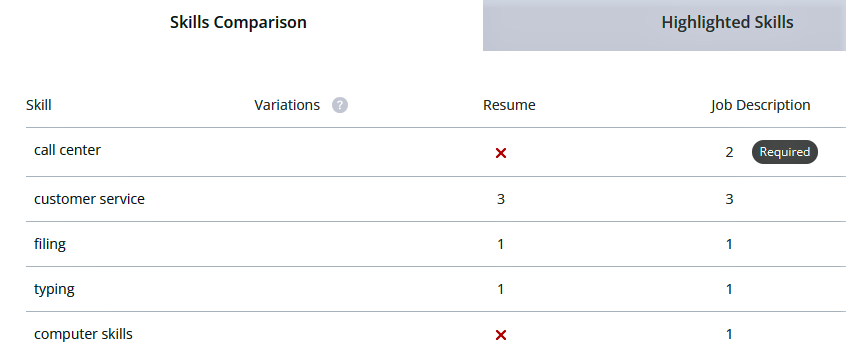

An example of Jobscan’s “Recruiter’s Tips” section, showing its deep understanding of the evolving recruitment landscape to ensure that students receive the most current and relevant advice.
This scoring criteria has is outcome-focused. For example, our data shows that candidates with a job title on their resume that matches the target title had an interview rate 10.6 times higher than those who did not. Similarly, including a cover letter increased interview rates by 3.4 times.
This also makes the scoring easier to defend to students. Jobscan provides students and advisors with clear, employer-backed metrics (ATS match, keyword alignment).
The sweet sauce? Implementing the recommended changes can be done live in Power Edit. Want to add a missing skill? Student’s can use Jobscan’s AI to provide a phrase suggestion, then copy and paste it into their resume or have Jobscan automatically add the skill to their ‘Skills’ section with the click of a button.
Jobscan is effectively teaching students the skill of how to apply for work – not once, but repeatedly throughout their careers.
Your Students Can Do This As Often As Needed
By making it easy to tailor their resume, Jobscan effectively allows students to create a resume for every job application. Therein lies another key difference between VMock and Jobscan: while VMock offers a limited number of resume uploads per year, Jobscan allows unlimited resume scans.
With Resume Tracker, students can manage all their new resumes to keep them for the next great opportunity. Even better, with Job Tracker, they can track all the jobs they apply for and the resume and cover letter they used for it (also, keep track of their interview dates and notes in a single view).
With Jobscan, your students can continuously learn and adapt, creating a tailored resume for every new opportunity, staying competitive in a constantly shifting market.
Jobscan Is Relevant At All Career Stages
Jobscan’s objective is to make sure a users’ resume is developed based on what a company is looking for, not an arbitrary SMART score.
This makes our tool useful to students looking for internships, entry-level jobs, or an alumni who is 10+ years into their career and are looking to pivot.
It also means Jobscan is inclusive across majors and industries. The tool is agnostic about what a student’s background and discipline is – it’s goal is to score students against the criteria of the company they are applying to. Provided they aren’t applying for a job in a different industry than they majored in (who does that?) their score will reflect the real-world qualifications for the work.
Jobscan is also available long after graduation. Your graduates can continue to use the tool, extending the value further than their time in school. Your career center to provide service to them into their alumni years.
Jobscan Can Be Implemented Fast, For Immediate Return on Investment
So, you now understand how Jobscan scores resumes and can meet the needs of the far more students. Notice something?
Jobscan involves no effort or time from you and your staff, and no added costs.
Our tool has been used by job seekers for years, which makes it a plug-and-play solution for organizations.
This also means our Customer Success focus is on added value. Jobscan provides a turnkey adoption kit (FAQs, email templates, course slides) and ongoing support, such as providing student education materials on the tool.
You’ll also get to know your success rep by their first name.
Jobscan Has A Lot More Under The Hood
Jobscan doesn’t just optimize resumes. It offers a comprehensive suite of tools that address all aspects of the job search process.
Jobscan’s suite of tools include:
- LinkedIn Enhancement – Students optimizing their LinkedIn profile with this tool can increase their number of views by 132 percent.
- Cover Letter Generator – Students can use GPT-4 technology to create a personalized and ATS-friendly cover letter in one click.
- Cover Letter Scanner – Students can analyze their cover letters against the job listing to identify the skills and qualifications they should highlight.
- Job Tracker – Students can track and manage all their job applications and interviews in one place.
- Job Matcher – Students can access a curated list of job listings from Indeed based on the top skills and keywords found in their resume.
- Interview Prep – Students can simulate realistic interviews for any job position and level up their skills in no time.
Whatever your need to prepare students for the job search, Jobscan can streamline it so you can focus on time-on-task for individualized career support.
Jobscan: A Tool That Scales Career Services
While job seeking solutions are crucial, they are only part of the puzzle for what career centers are looking to do: transformative career services.
To achieve that requires nuanced, strategic career support. Repetitive resume reviews often get in the way. Including Jobscan in your processes directly addresses one of your biggest pain points: scalability.
As you can see, the tool empowers students to self-service that repetitive work, and/or frees your career advisors to do that work very quickly in one-on-one meetings.
It’s the difference between teaching a student to fish rather than giving them a fish to eat.

Because our solution automates the repetitive work of resume tailoring and ATS optimization, you can streamline the transactional tasks of resume and cover letter writing (as well as LinkedIn enhancement and interview prep).
And your team can use the admin view to monitor how many resumes they have scanned and their scores, giving you an accurate idea of their usage and the effectiveness of their work so you can better assist them.
With those transactional tasks made more efficient, you are free to reclaim valuable time in your one-on-one coaching session. You can then focus on providing the tailored, individualized advice and personal connection that you believe are essential for student success.
Isn’t This A Way For AI To Take Career Services Jobs?
Some might object that using AI removes the human element from career services, or worse, takes jobs away.
At Jobscan, we believe just the opposite.
Our tools are designed to complement human expertise, not replace it. By automating the transactional tasks of resume review, we empower career services teams to get back to the work you love: providing the personal guidance and emotional connection that are truly essential for a student’s career development.
AI can allow career advisors to do the work that makes their job more impactful.
Final thoughts on VMock vs. Jobscan
In a world of increasing complexity and AI-driven hiring, you need the tools that will give your student every advantage they can get.
VMock is great for students new to resume writing, offering immediate feedback on fundamental best practices like formatting and keyword presence for general job titles. It has has a lot of really useful features to create an excellent resumes. Its benchmarking allows students to create very specific, discipline-based resumes.
Jobscan takes a different approach, focusing on scoring criteria that teaches students to create a resume that is more likely to succeed on an application. Jobscan provides a comprehensive solution that helps students beat the ATS and gives them as many opportunities as they need to do so.
The kicker is that Jobscan’s approach actually enriches the career advising job. By allowing career advisors the freedom from repetitive tasks, career center teams get to do the work that truly matters.
Bring Jobscan to your school
Interested in Jobscan for your university career center? Check out our Higher Education solutions page.
More expert insights on how to make Career Services transformational: