Best Entry-Level Human Resources Resume Examples for 2026
New to HR? These entry-level human resources resume examples for 2026 show how to frame internships, coursework, and skills to clear ATS and land interviews.

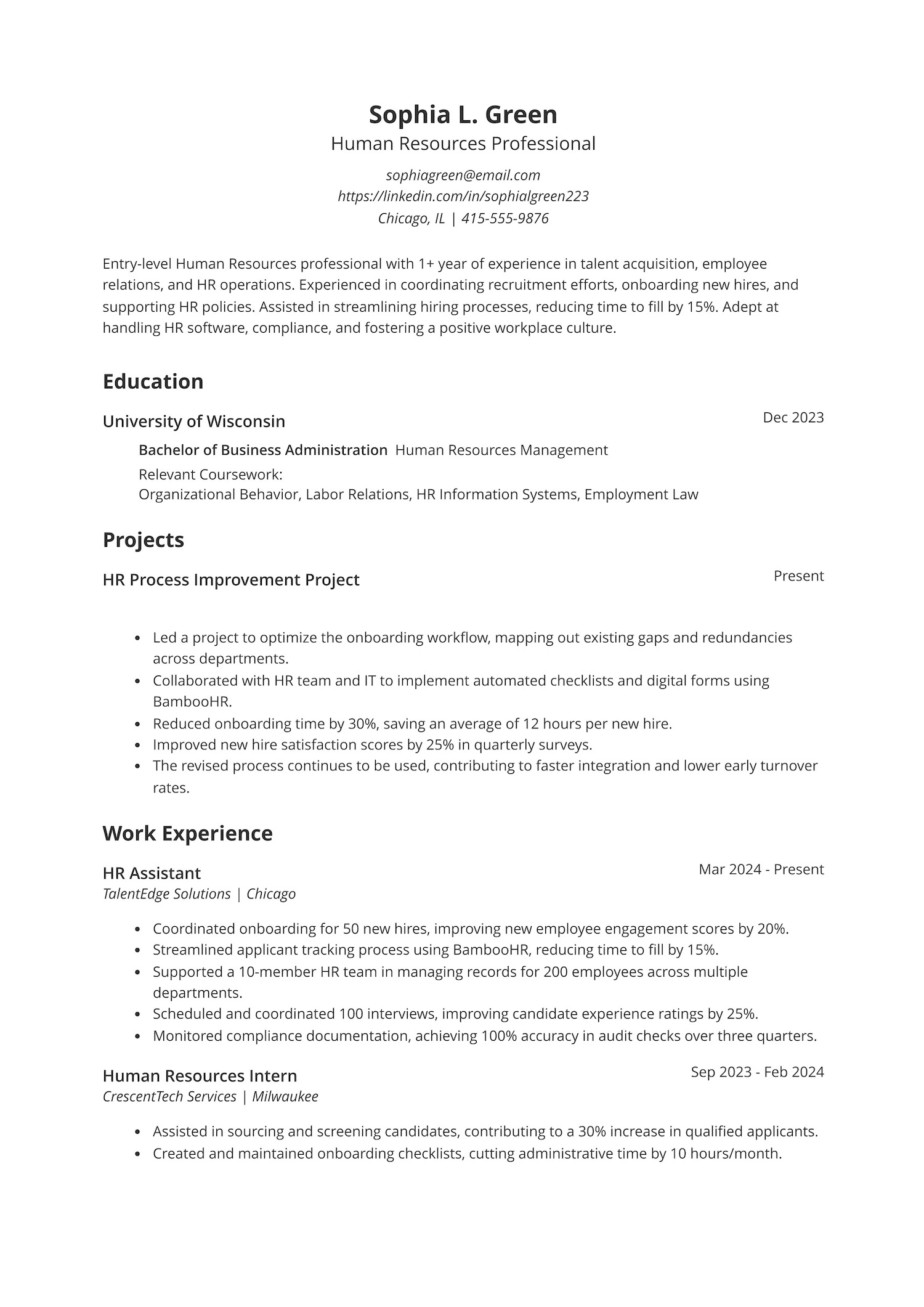
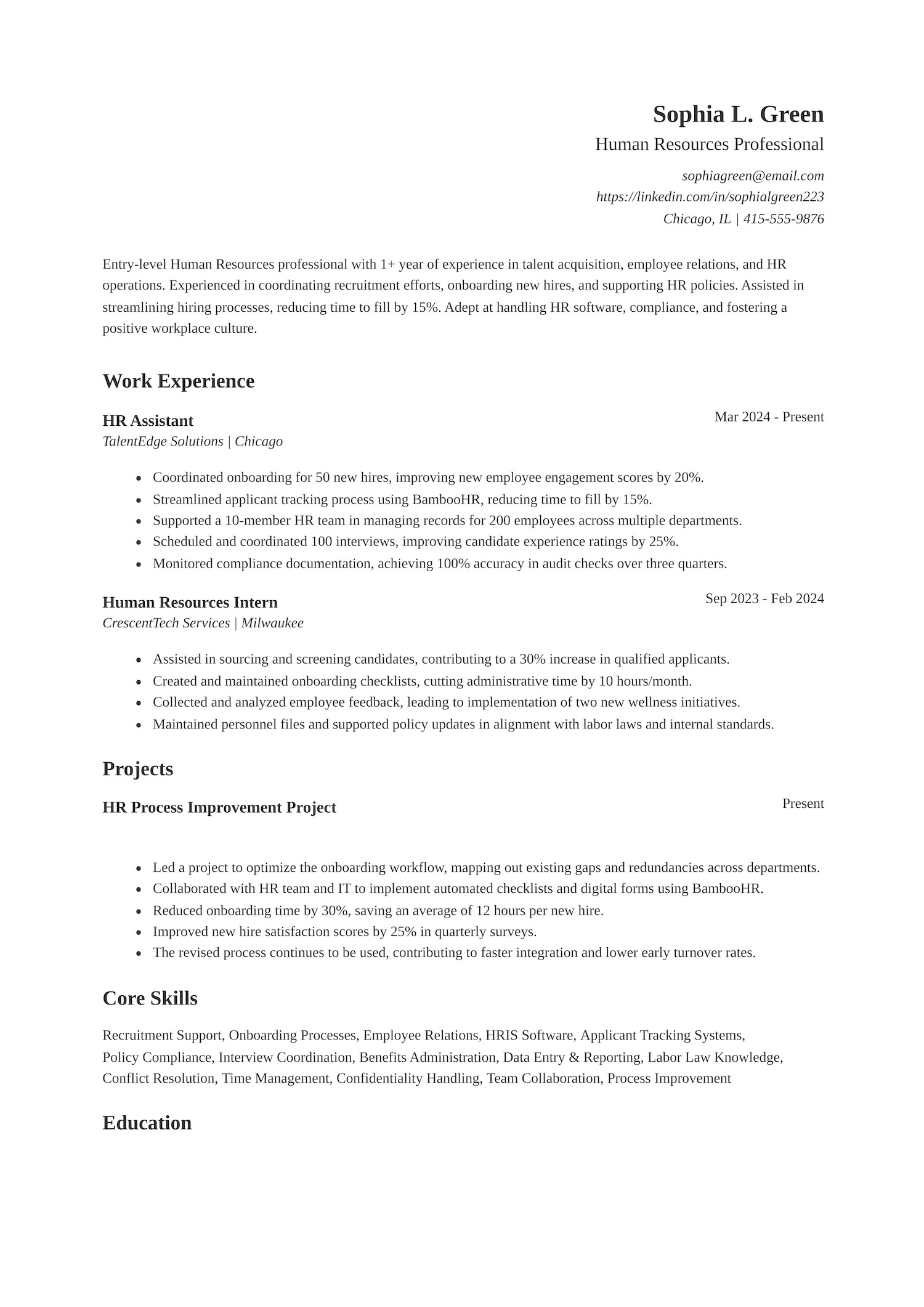
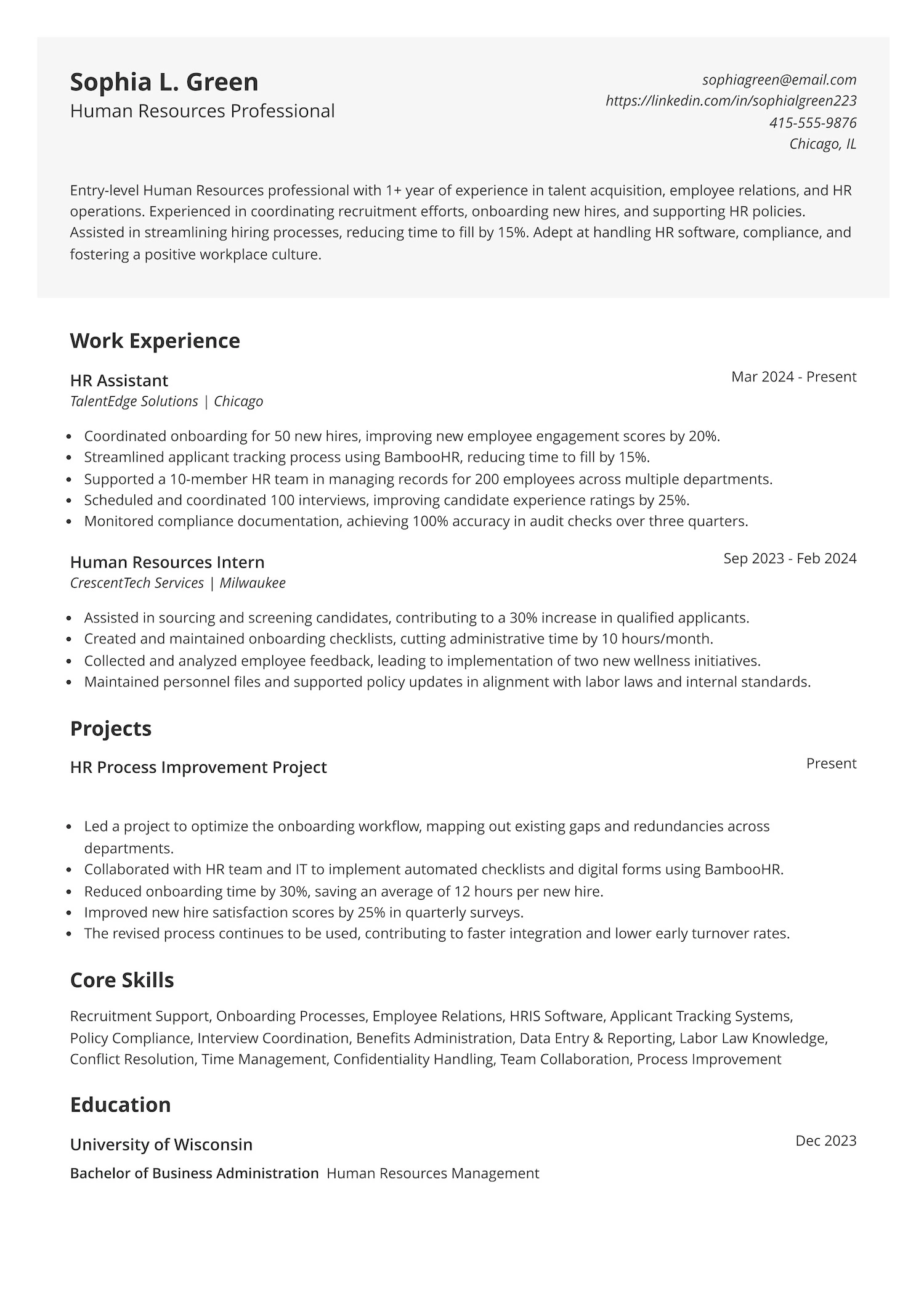


Human Resources plays a crucial role in shaping company culture, supporting employees, and ensuring smooth business operations. If you’re aiming to break into the HR field, this guide will guide you with expert-written resume examples and tailored tips to help you create a standout entry-level HR resume.
According to the U.S. Bureau of Labor Statistics, employment of human resources specialists is projected to grow 8% from 2023 to 2033. Employers seek candidates who can communicate effectively, handle confidential information with care, and contribute to employee engagement initiatives, making a well-structured resume crucial for breaking into the field.
Not sure where to begin? Keep reading—we’ve got resume examples, expert tips, and everything you need to confidently launch your HR career.
Entry-level human resources resume example
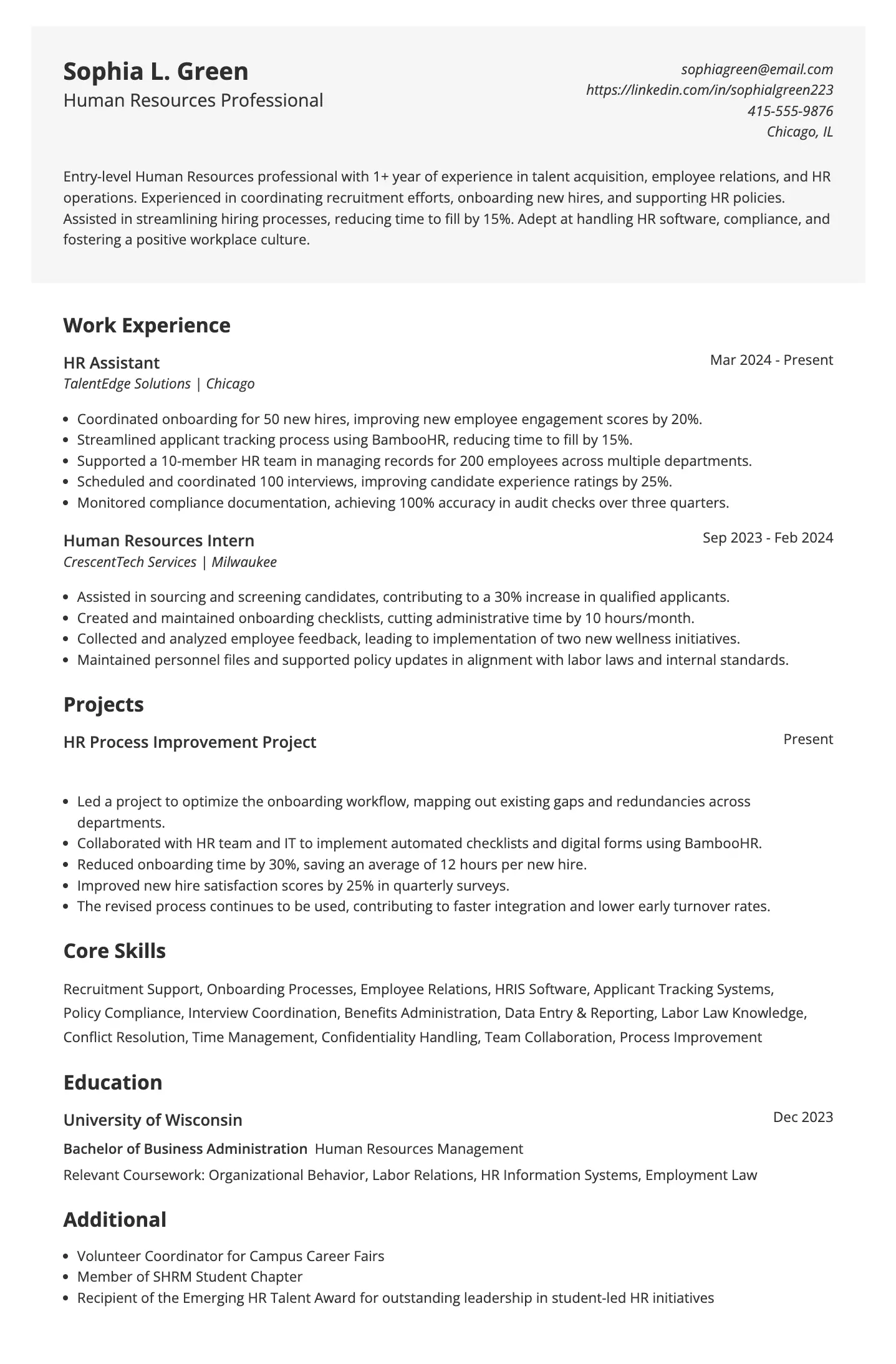
Wondering how to get started in HR with limited experience? Not sure how to highlight internships or make your early HR contributions stand out? This entry-level human resources resume example shows exactly how to showcase real impact, even with just over a year of experience.
HR roles call for strong communication, attention to detail, and the ability to juggle multiple tasks while keeping people at the center. Whether it’s recruitment, onboarding, or policy support, hiring managers look for candidates who can hit the ground running and adapt quickly to fast-paced environments.
This resume template has a clear, focused summary that shows readiness for an entry-level HR role. The internship experience highlights real contributions, which helps build credibility early on. The education section adds value by showing relevant coursework, leadership roles, and honors, making the candidate more well-rounded. It also covers key HR skills that match what hiring teams look for. Plus, it has a clean layout with ATS-friendly formatting.
How to write an entry-level human resources resume that will get you an interview
Writing a standout entry-level human resources (HR) resume is all about showcasing your potential, passion for people, and understanding of workplace dynamics—even if your hands-on HR experience is limited. With the right structure, strategic keyword use, and a compelling summary, you can create a resume that impresses recruiters and lands interviews.
Many employers use applicant tracking systems (ATS) to simplify the hiring process. Think of ATS like a search engine—if your resume doesn’t feature the right keywords and proper formatting, it might not be seen by the decision-makers.
For an entry-level HR role, hiring managers often search for terms like “employee relations,” “talent acquisition,” “onboarding,” and “HRIS.” Including these keywords can increase your visibility in the hiring process.
How ATS works:
- Job posting setup: Employers specify the skills, qualifications, and experience they’re looking for.
- Resume scanning: The system extracts key information from your resume.
- Searchable database: Hiring managers use relevant keywords to search through resumes.
Make sure your resume is ATS-friendly and reaches recruiters with Jobscan’s free ATS resume builder. It’s a fast, easy way to build a polished, ATS-friendly resume that aligns with industry expectations—completely free!

Key elements of an entry-level human resources resume
To make a great impression as an aspiring HR professional, your resume should include:
- Contact details: Your name, phone number, email, LinkedIn profile, and optionally a professional portfolio or personal website.
- Professional summary: A brief, impactful snapshot of your skills, background, and career goals.
- Core skills: A list of relevant HR skills such as recruitment support, onboarding, employee relations, HR software, etc.
- Education: Degrees, certifications, or HR coursework (e.g., a bachelor’s in business administration or a certificate in human resource management).
- Experience: Add internships, volunteer roles, part-time jobs, or academic projects that demonstrate transferable HR skills in the work experience section.
- Projects: School or personal projects that show your ability to handle HR-related tasks like creating employee handbooks, planning training programs, or using HR tools.
- Achievements: Specific accomplishments (even in non-HR roles) that show initiative, leadership, or teamwork.
- Certifications (if any): SHRM-CP, PHR, or LinkedIn Learning HR courses.
Write a strong professional summary
Your professional summary is often the first thing a hiring manager reads—so make it count. Tailor it to reflect your enthusiasm for HR, transferable skills, and educational background. Since you’re applying for an entry-level position, focus on potential rather than experience.
Let’s look at some examples of both good and bad professional summaries below to see the difference.
Good examples of a resume summary
- “Enthusiastic and detail-oriented recent human resources graduate with internship experience in recruitment and employee onboarding. Skilled in using HRIS systems and supporting administrative tasks. Passionate about fostering positive workplace environments and contributing to HR strategy.”
- “Recent business administration graduate with a concentration in HR and hands-on experience coordinating training sessions and assisting with policy updates during a summer internship. Brings strong communication skills and a proactive approach to problem-solving.”
Bad examples of a resume summary
- “I am looking for an HR job where I can grow my skills. I am a hard worker and a team player.”
- “Entry-level HR person seeking any opportunity to gain experience in any HR department.”
Struggling to write a strong professional summary? Let Jobscan’s summary generator help. By entering your information, you’ll get a polished, ATS-optimized summary that highlights your potential in Human Resources and helps you make a strong impression on recruiters.
Demonstrate key entry-level human resource skills
As an entry-level HR candidate, it’s important to highlight both hard and soft skills that prove you’re ready to contribute to a professional HR environment. Even if your experience is limited, you can still show competence and readiness by focusing on transferable skills, relevant coursework, and internship or volunteer experiences.
Hard skills for entry-level human resources
- HRIS Systems
- Applicant Tracking
- Recruitment Support
- Onboarding
- HR Documentation
- Benefits Administration
- Payroll Basics
- Microsoft Excel
- Labor Laws
- Employee Handbooks
Soft skills for entry-level human resources
- Communication
- Conflict Resolution
- Organization
- Time Management
- Empathy
- Discretion
- Attention to Detail
- Collaboration
- Problem-Solving
- Adaptability
Incorporating your HR skills into your resume bullet points is key to showing potential employers what you bring to the table. Merely listing responsibilities won’t suffice—how you showcase your skills can truly set you apart. Check out these examples to understand how to highlight your skills in your resume bullet points in a clear, results-focused way.
Write impactful resume bullet points for an entry-level human resources
Resume bullet points are the core of your experience section. They should clearly communicate your skills, the impact you’ve made, and the value you bring to a team. Instead of listing tasks, focus on what you accomplished using specific tools, action verbs, and measurable results. Here’s what that looks like:
Good examples of resume bullet points
- “Assisted in screening over 50 job applications during a summer internship, helping the HR team identify qualified candidates more efficiently.”
- “Supported onboarding for 10+ new hires by preparing orientation materials and coordinating training schedules.”
- “Created a mock employee handbook as part of a university project, including sections on workplace policies, benefits, and code of conduct.”
- “Collaborated with a team of 4 to plan a virtual employee engagement event, resulting in 95% participation from staff.”
Bad examples of resume bullet points
- “Helped people at work and did what was asked.”
- “Worked with a team and did some paperwork.”
- “Managed stuff related to employees.”
- “Participated in meetings and took notes.”
Use Jobscan’s bullet point maker to create powerful, achievement-driven resume bullet points. Upload your resume and job description to your Jobscan dashboard, and the tool will offer tailored phrase suggestions to highlight your skills and successes effectively.
Highlight your achievements as an entry-level human resource professional
As an entry-level HR professional, it’s important to highlight your achievements to show you can contribute to the company’s success right from the start. Even without years of experience, you can demonstrate how your efforts in internships, volunteer work, or academic projects have made an impact. Focus on measurable outcomes and specific examples that showcase your initiative, leadership, and problem-solving skills.
Examples of how to highlight your achievements effectively:
- “Streamlined the onboarding process for new hires, reducing paperwork completion time by 20%.”
- “Coordinated and executed a company-wide survey that resulted in a 15% increase in employee satisfaction scores.”
- “Implemented a new tracking system for employee attendance, which improved accuracy and reduced administrative errors by 25%.”
- “Assisted with recruitment for a seasonal project, successfully filling 10+ positions within a 2-week timeframe.”
- “Developed and presented a training session on workplace diversity, which was attended by 50+ employees and received positive feedback.”
Tailor your resume to the job description
Customizing your resume to fit the specific job description is one of the most effective ways to catch the attention of hiring managers. By aligning your skills, experiences, and achievements with the job’s requirements, you show the employer that you are a perfect fit for the role. Tailoring your resume increases your chances of getting noticed and invited for an interview.
Here’s how to tailor your resume to the job description:
- Analyze the job description: Carefully read the job posting and highlight key qualifications, responsibilities, and skills that the employer is looking for.
- Use the right keywords: Incorporate keywords from the job description into your resume, especially in your professional summary, skills, and experience sections. Many employers use ATS (applicant tracking systems) to read these keywords.
- Highlight matching experience: Emphasize your past roles and responsibilities that align closely with the job you’re applying for. Showcase how your previous work directly supports the specific HR tasks mentioned in the job description.
- Adjust bullet points: Revise your resume’s bullet points to reflect the language and skills in the job description. Focus on showcasing relevant achievements and tasks using similar phrasing as the job posting.
- Match your skills: Align your core skills and experiences with the qualifications mentioned in the job description. Use similar keywords and phrases to increase the chances of your resume appearing in searches of the applicant tracking system (ATS).
- Highlight relevant achievements: Emphasize achievements and experiences that directly relate to the specific HR tasks or projects mentioned in the job description.
- Adjust your professional summary: Customize your professional summary to reflect how your goals align with the employer’s needs. Focus on showing how you can add value in the specific role you’re applying for.
Also Read: The Top 5 ATS Resume Keywords of 2025
Include relevant education and certifications
For an entry-level human resources (HR) position, your education and certifications can play a crucial role in demonstrating your foundational knowledge and commitment to developing HR expertise. While hands-on experience is valuable, relevant education and certifications provide credibility and make your resume stand out.
Here’s how to present your education and training:
- Clearly state your degree, major, and university (e.g., Bachelor of Business Administration in Human Resources, ABC University).
- As a recent graduate, include your graduation year and relevant coursework like organizational behavior, labor relations, or talent management.
- If you’re coming from another field, highlight courses or certifications that align with HR principles.
- Mention foundational HR certifications such as the aPHR (Associate Professional in Human Resources) or LinkedIn Learning HR courses.
- Stick to recognized credentials that reflect your readiness for an HR career rather than listing every seminar or workshop.
Top entry-level human resources certifications
Here are the top human resource certifications that can enhance your resume:
- SHRM-CP (Society for Human Resource Management – Certified Professional)
- PHR (Professional in Human Resources)
- aPHR (Associate Professional in Human Resources)
- LinkedIn Learning HR Courses
- HRBP (Human Resources Business Professional)
Entry-level human resources resume tips
Creating a strong HR resume as an entry-level candidate means more than just listing internships or coursework—you need to clearly present your skills, relevant achievements, and certifications. Here are some essential tips to help your resume stand out:
- Use a clear and professional layout: Organize your resume with well-defined sections for your summary, education, skills, certifications, and experience. Choose a clean, easy-to-read font and maintain consistent formatting throughout.
- Write a compelling professional summary: Write a brief introduction that highlights your HR interests, relevant experience (internships, projects), and your enthusiasm for supporting people and organizational goals.
- Focus on achievements, not just tasks: Instead of listing generic responsibilities, show how you made an impact—e.g., “Coordinated onboarding for 10+ hires during internship, reducing setup time by 15%.”
- Tailor your resume to each job: Carefully read the job posting and incorporate relevant keywords and skills to boost your chances of getting through applicant tracking systems (ATS) and catching a recruiter’s eye.
- Keep bullet points concise and results-driven: Use strong action verbs like “coordinated,” “assisted,” “organized,” or “supported” to describe your contributions and accomplishments.
- Highlight a mix of hard and soft skills: Include job-specific skills like HRIS Systems or Onboarding, as well as soft skills like Communication and Collaboration.
- Show relevant certifications: Add HR credentials such as SHRM-CP, aPHR, or LinkedIn Learning courses to show your initiative and dedication to the field.
- Optimize for ATS: Avoid tables, graphics, or unusual formatting. Stick to a clean, text-based layout to ensure your resume is parsed correctly by applicant tracking systems.
- Proofread thoroughly: Double-check grammar, spelling, and punctuation. A polished, error-free resume reflects attention to detail—something every HR employer values.
Also Read: How to Organize Your Resume Sections to Stand Out?
Include a cover letter with your human resources resume
A thoughtful, well-written cover letter can enhance your HR job application by offering a personalized introduction that complements your resume. While your resume outlines your qualifications, a cover letter gives you the space to share your motivation, highlight your interest in HR, and show how your skills align with the specific role and organization.
What to include in your cover letter:
- Introduction – Begin with a clear statement mentioning the position you’re applying for and why you’re excited about the opportunity to work in human resources at that specific company.
- Your qualifications – Summarize your relevant education, certifications, and skills, such as onboarding, recruitment support, or HRIS knowledge, that make you a strong fit for the role.
- Key achievements – Include examples from internships, class projects, or part-time roles where you’ve demonstrated initiative, organization, or problem-solving in a team or HR-related setting.
- Alignment with the employer’s needs – Show how your background and interests connect with the company’s mission, culture, or values, and how you plan to contribute as a member of their HR team.
- Closing statement – Wrap up with a confident conclusion, expressing enthusiasm for the role and a polite request for an interview or further discussion.
Use Jobscan’s cover letter creator to create a professional, ATS-friendly cover letter that supports your resume and showcases your enthusiasm for starting a career in Human Resources. Capture the hiring manager’s attention with a personalized introduction that reflects your potential.
Build a standout entry-level human resources resume with Jobscan
Starting your career in HR? A strong resume is your first step toward landing that entry-level Human Resources role. By emphasizing your education, interpersonal skills, and any relevant coursework or internships, you can show hiring managers you’re ready to contribute to a growing HR team. Pairing your resume with a thoughtful cover letter can make your application even more impactful.
Not sure where to start? Try Jobscan’s ATS resume maker to create a tailored, ATS-friendly resume in just minutes. The tool formats your resume to align with current hiring standards, helping you present your qualifications clearly and professionally, so you can stand out in a crowded job market.

Entry-level human resources common interview questions
Answer:
“I’ve always been passionate about helping people and creating positive workplace experiences. During my college years, I took a few HR-related courses and really enjoyed learning about organizational behavior, employee engagement, and recruitment. That’s when I realized that HR combines both people skills and strategy—two things I genuinely enjoy. I’m excited to contribute to a team where I can support both employees and business goals.”
Answer:
“Confidentiality is a core responsibility in HR, and I take it very seriously. During my internship, I worked with sensitive employee data and understood the importance of discretion and secure documentation. I always follow company policies, use secure systems, and avoid discussing private matters in public or informal settings.”
Answer:
“First, I would listen to the employee carefully to understand the situation without making assumptions. Then I’d ask open-ended questions to gather all relevant facts. If needed, I’d consult with a supervisor or follow the company’s conflict resolution process to ensure a fair and professional resolution. My goal would be to help both parties feel heard while maintaining a respectful and productive work environment.”
Answer:
“During my internship, I gained hands-on experience with BambooHR and Workday. I used them to help track employee records and assist with onboarding tasks. I’m also comfortable learning new tools quickly and have completed online training in HRIS basics. I’m eager to expand my technical skills and adapt to the systems used by your team.”
Entry-level human resources resume frequently asked questions
As an entry-level HR professional, focus on both hard and soft skills. Hard skills to highlight include HRIS systems, applicant tracking systems (ATS), recruitment, onboarding, and regulatory compliance. Soft skills like communication, organization, problem-solving, and empathy are also essential. Demonstrating proficiency in these skills, even from coursework or internships, can strengthen your resume.
For an entry-level HR resume, include your degree(s) in HR like Bachelor of Science in Human Resources Management, business, or a related field, with the university name and graduation year. Mention HR-specific courses like employee relations, HR management, or labor laws to show your knowledge base. If applicable, add academic honors, GPA, or leadership roles in HR-related clubs to further highlight your qualifications.
If you lack direct HR experience, focus on transferable skills, academic projects, or internships. Highlight any roles where you managed people, coordinated events, or worked in customer service. If you’ve had any HR-related tasks, like assisting with recruitment or organizing training, be sure to include them. Tailor your resume to each job description by focusing on the most relevant skills and experiences.