Best Writer Resume Examples for 2026
Looking for a writer resume that gets read? These 2026 examples show how to feature your portfolio, publications, and the versatile skills hiring editors want.



A skilled writer is essential in today’s content-driven world, shaping narratives that inform, engage, and persuade. This blog offers expert-written resume examples and actionable tips to help you stand out in the competitive writing industry.
According to the U.S. Bureau of Labor Statistics, employment for writers and authors is projected to grow by 5% from 2023 to 2033, with approximately 15,100 openings each year. Employers seek writers who demonstrate creativity, adaptability, and strong communication skills. A well-written resume is crucial to showcase these qualities and secure your next opportunity.
Ready to elevate your resume? Dive into our examples and tips to write a compelling resume that highlights your unique talents. Let’s get started and make your application shine!
Copywriter resume example
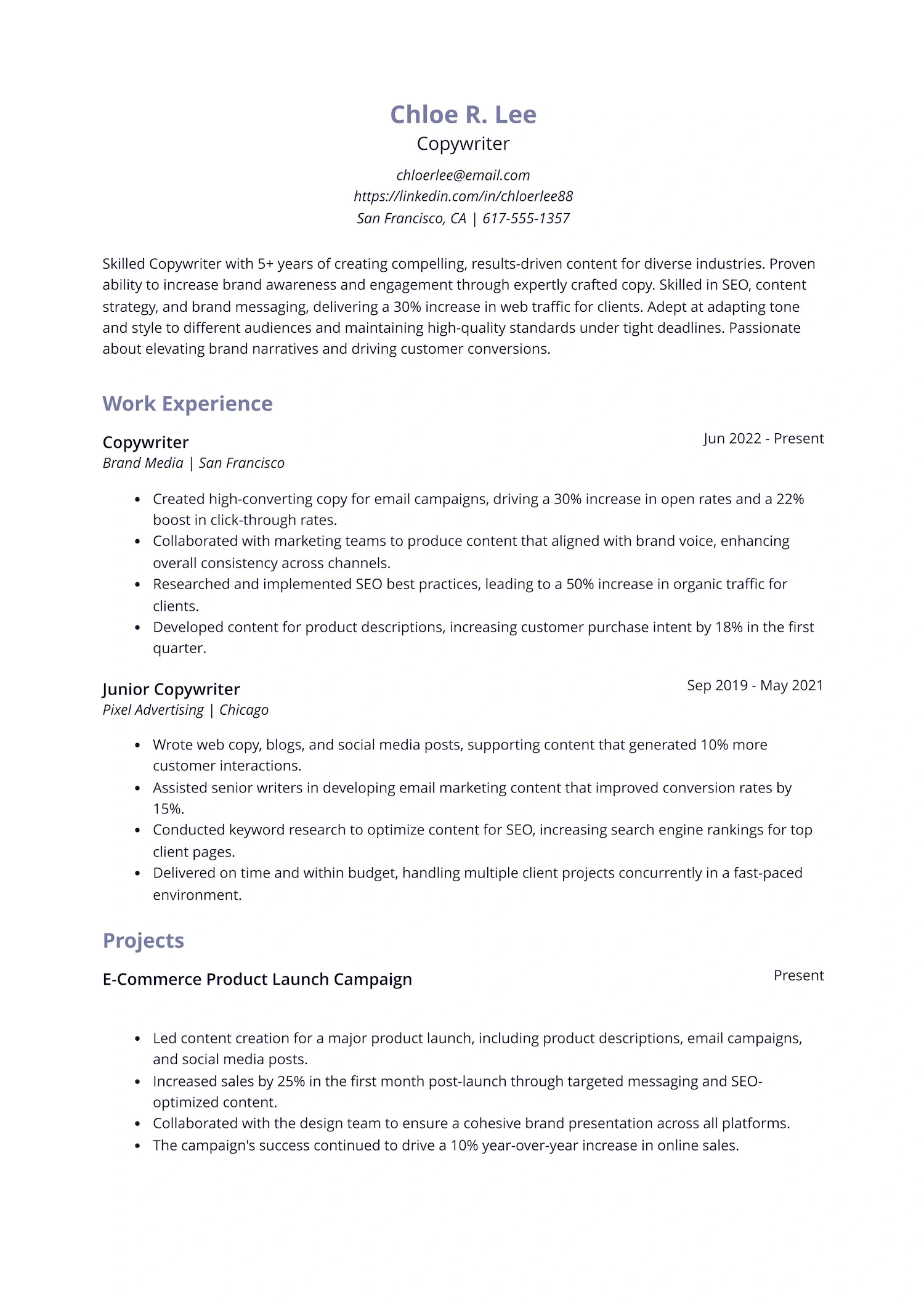
Struggling to find the right words to highlight your writing skills? Wondering how to show off your SEO knowledge and creativity without sounding repetitive? This Copywriter resume example shows exactly how to build a strong, focused application that gets noticed.
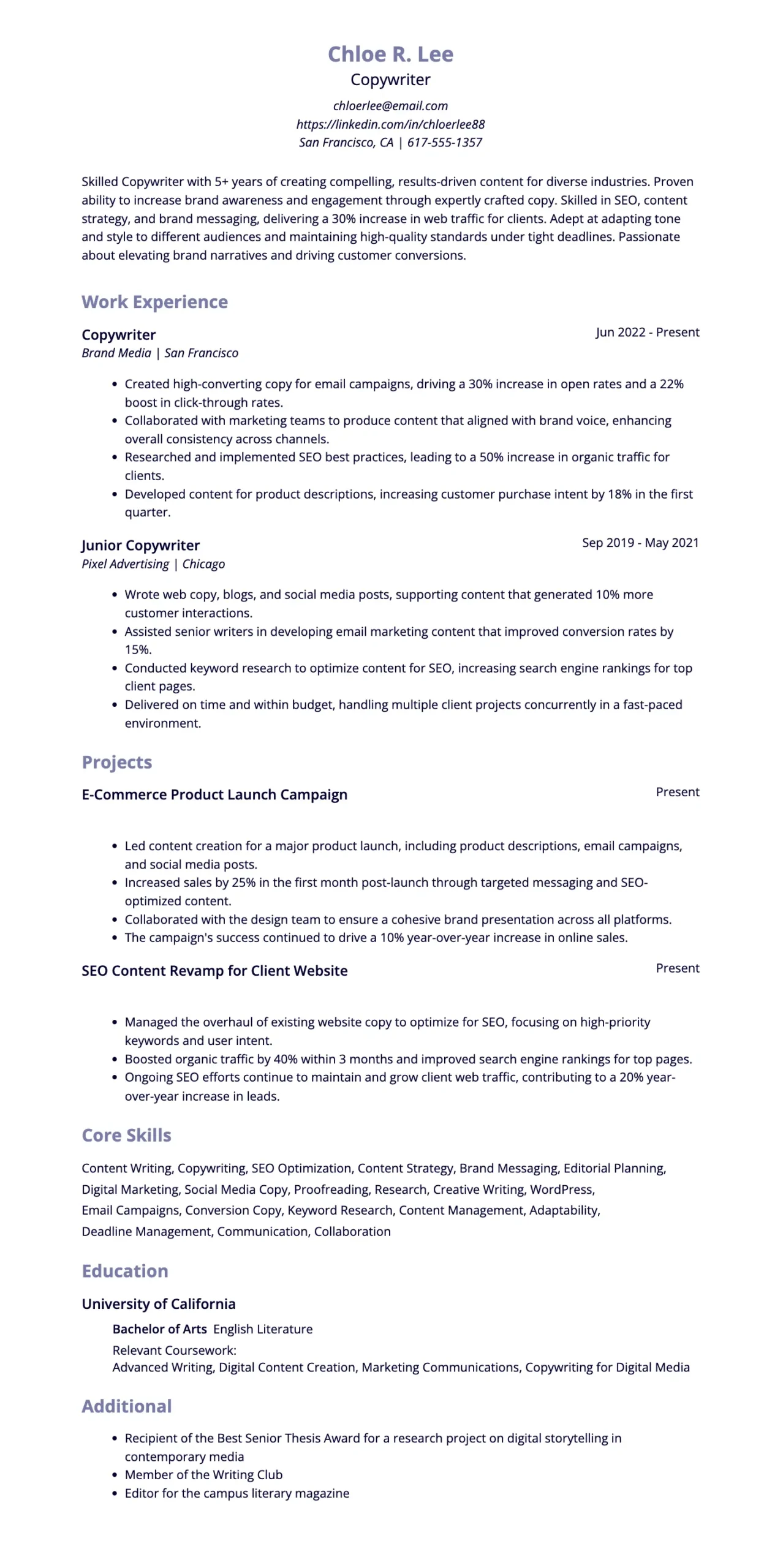
Copywriting roles today call for more than just clever words—they expect you to drive engagement, boost brand presence, and adapt across platforms. Employers look for candidates who understand SEO, content strategy, and how to match tone with audience needs, all while meeting tight deadlines and business goals.
This resume highlights real-world projects like the “E-commerce Product Launch Campaign” and “SEO Content Revamp for Client Website,” showing impact with clear results. Relevant skills like SEO, brand messaging, and content strategy are front and center. The clean, ATS-friendly format makes it easy to scan, helping employers quickly see the value and experience. It’s clear, focused, and shows exactly what a strong copywriter can deliver.
Technical writer resume example
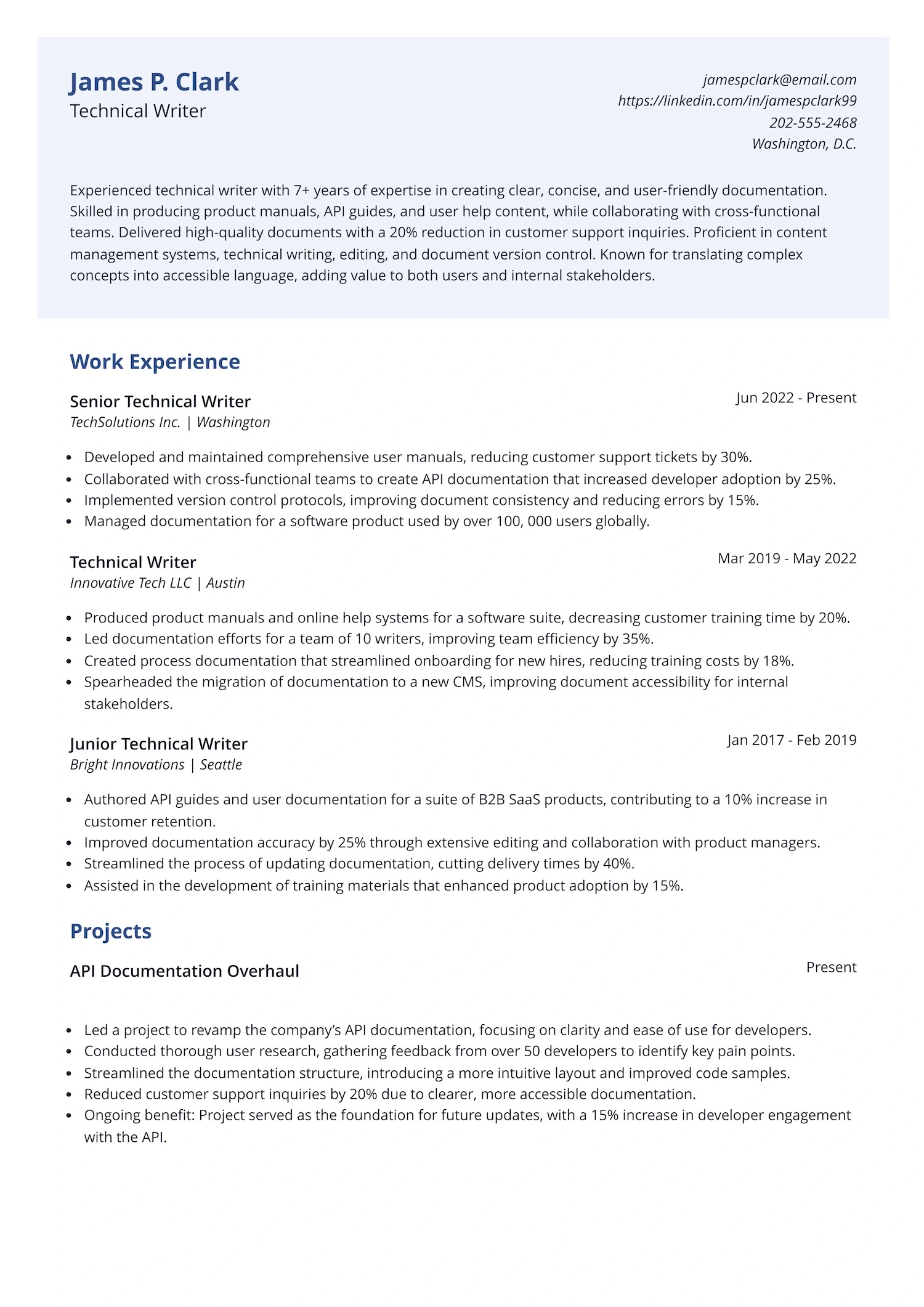
Having trouble getting noticed for technical writing jobs? Wondering how to showcase your experience with documentation, APIs, and team collaboration the right way? Check out the resume example below—it’s clean, focused, and highlights the kind of impact hiring managers want to see.

Technical writing roles call for more than just writing skills. You’re expected to translate complex information into simple, usable content, manage documentation projects, and work closely with developers, product managers, and stakeholders. Strong attention to detail, organization, and clear communication are key to standing out.
This resume works because it shows a complete skill set. The core skills section mixes technical tools like CMS and Markdown with soft skills like Collaboration and Time Management, which hiring managers look for. The work experience focuses on real results, like reducing support tickets and improving product adoption rates. It’s clear, direct, and shows proof of value—exactly what employers want to see at a glance.
Grant writer resume example
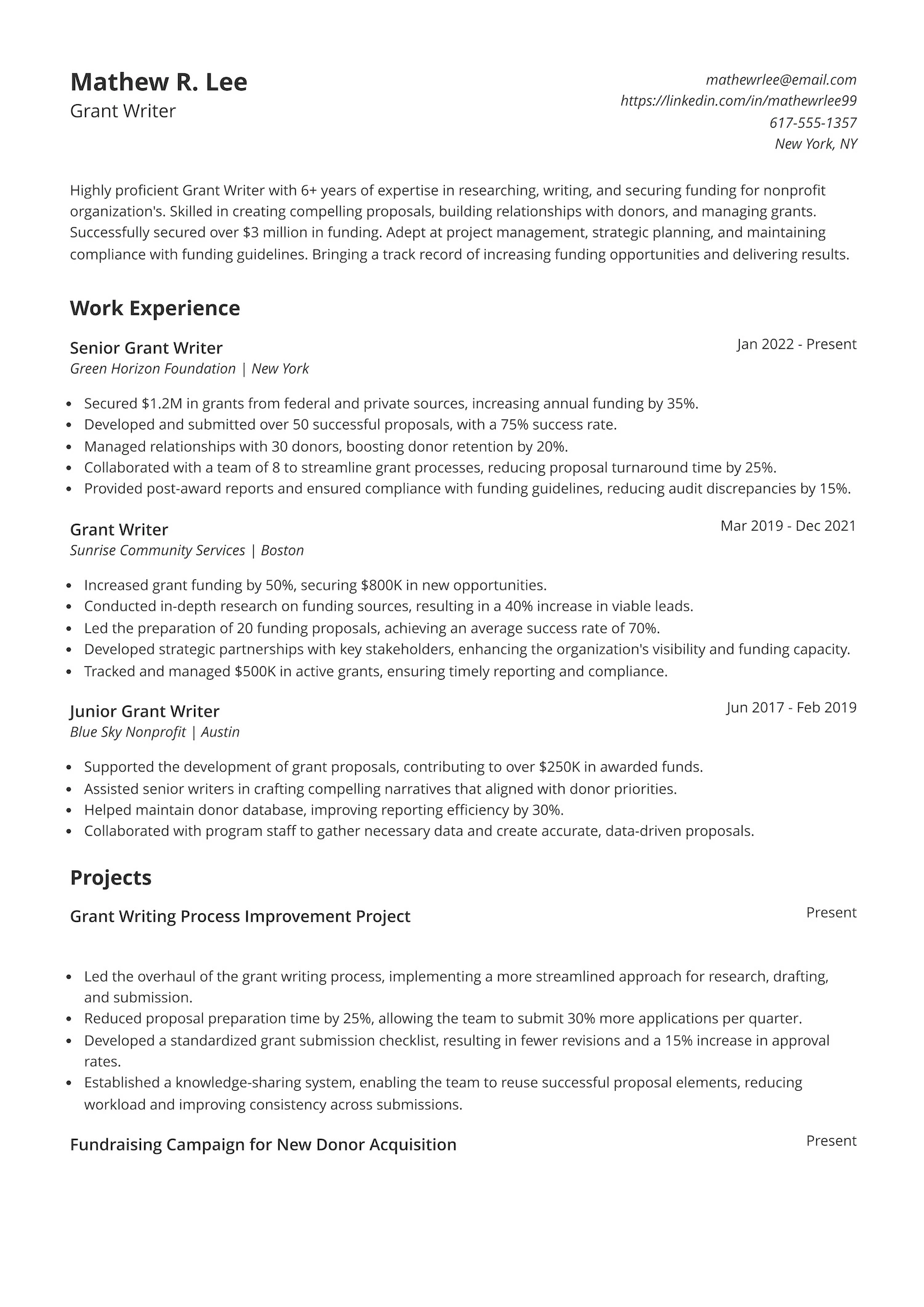
Looking to land a grant writing job but not sure what a strong resume looks like? Wondering how to show your experience securing funding or managing donor relationships? Check out the grant writer resume example below—it’s built to showcase real results, strong skills, and career growth in a simple, clear format.

Grant writing roles call for more than just good writing skills. Employers expect you to bring proven experience in securing funds, building donor connections, managing grants, and staying compliant with funding guidelines. A results-driven resume that highlights these areas can make all the difference.
This resume uses strong action verbs like “Secured,” “Developed,” and “Led” to show real ownership of results. Metrics like “$1.2M in grants” and “35% increase in funding” make the impact clear. The projects section also highlights leadership and improvements with real numbers. Adding relevant education, like an MPA with grant writing coursework in the education section adds even more credibility. It’s clear, results-focused, and exactly what employers want to see.
Freelance writer resume example
Are you looking to take your writing career to the next level? Do you want to write engaging, SEO-optimized content that helps brands grow and succeed? This resume example highlights expertise in content strategy, SEO, and copywriting, consistently delivering results that enhance brand visibility and drive engagement.
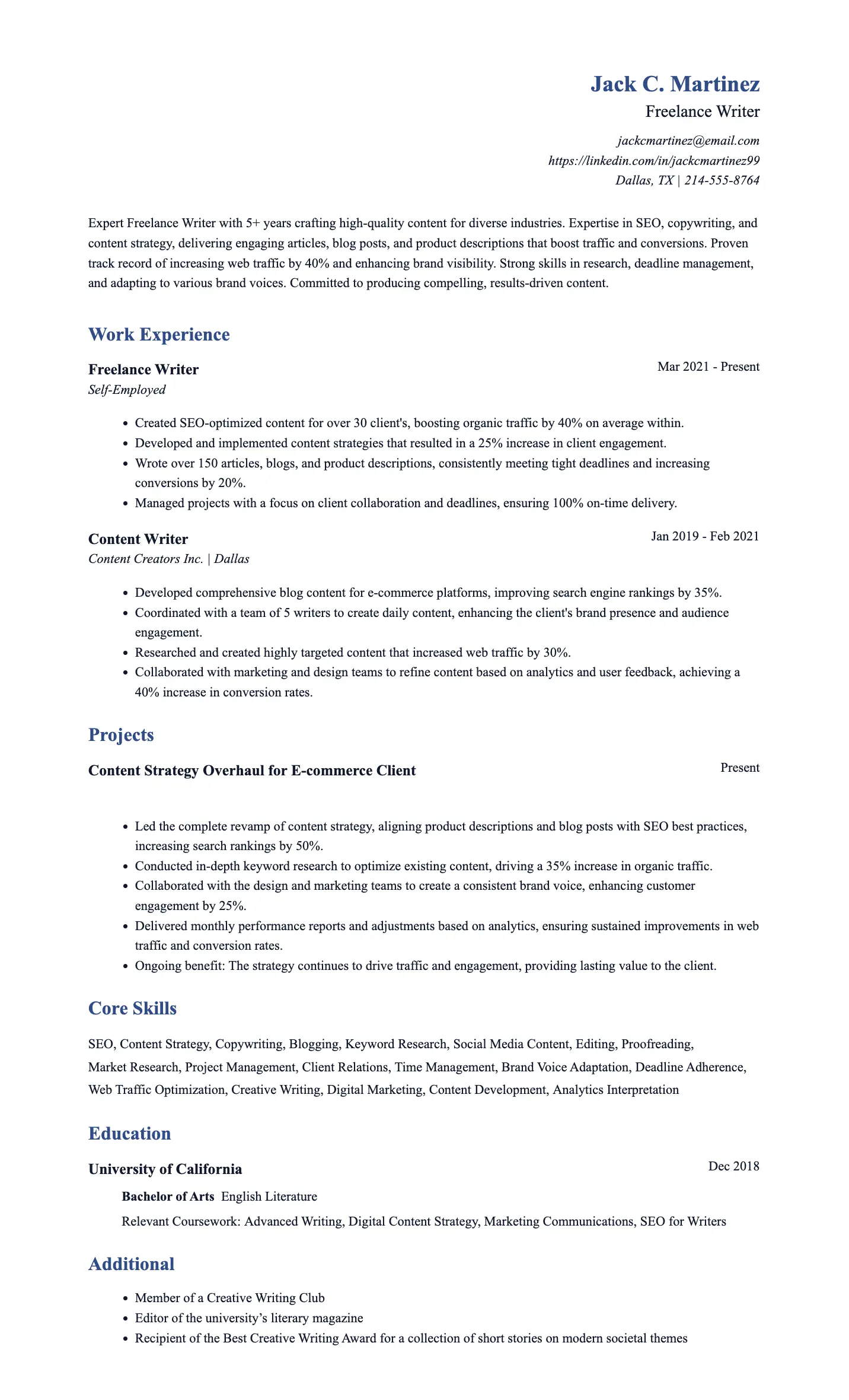
As a freelance writer, you’ll need to develop strong content strategies, adapt to different brand voices, and meet deadlines consistently. Your role will focus on creating content that drives traffic, engages readers, and increases conversions. Being adaptable, managing multiple projects, and collaborating with new clients to meet their needs will be key to your success.
This resume template stands out by focusing on measurable results, such as increased web traffic and improved conversions, which immediately appeal to employers looking for impact. It highlights a well-rounded skill set in SEO, content strategy, and copywriting, all essential for driving brand growth. The inclusion of specific projects and quantifiable achievements shows a proactive approach, while clear, concise formatting makes it easy for hiring managers to spot key qualifications at a glance.
Also Read: 10 Best Resume Skills to Put on a Resume
How to write a writer resume that will get you an interview
A strong resume is essential for landing an interview as a writer. Whether you’re an experienced content creator or just starting out, it’s important to highlight your skills, experience, and passion for writing in a way that grabs the attention of potential employers.
Many companies, especially in digital content and marketing, use Applicant Tracking Systems (ATS) to streamline the hiring process. ATS functions similarly to a search engine; your resume should include the right keywords or formatting to make sure your resume reaches the hiring team.
For a writer role, hiring managers often look for terms like “content creation,” “SEO writing,” “blog posts,” and “copywriting.” Including these specific keywords can increase your chances of standing out.
How ATS works:
- Job posting setup: Employers specify the required skills, experience, and qualifications in the job description.
- Resume scanning: The ATS scans resumes for relevant keywords and extracts key details.
- Searchable database: Hiring managers narrow down resumes based on keywords that match the job requirements.
Want your resume to be ATS-friendly and grab a recruiter’s attention? Use Jobscan’s free ATS resume builder to quickly write an ATS-optimized resume that aligns with current industry standards—completely free!

Key elements of a writer resume
To make your resume stand out, it needs to include the following essential sections:
- Contact Information – Include your name, phone number, email address, and links to your professional website or portfolio.
- Professional Summary – A concise statement that highlights your skills, experience, and what makes you a great fit for the role.
- Core Skills – Focus on the key writing skills you possess, such as copywriting, SEO writing, content strategy, editing, etc.
- Work Experience – A detailed list of your relevant jobs, internships, or freelance work, including your responsibilities and accomplishments in your work experience section.
- Education – Relevant degrees, certifications, or writing-related coursework.
- Projects or Portfolio – A key section showcasing specific writing projects, links to published articles, or portfolio samples.
Write a strong professional summary
The professional summary should be a brief, compelling section at the top of your resume. It should provide an overview of who you are, what you bring to the table, and what makes you stand out as a writer. Tailor this to the job you’re applying for, and make sure to highlight your experience, skills, and writing style.
Let’s look at some examples of both good and bad professional summaries below.
Good examples of a resume summary
- “Creative and results-driven content writer with 5+ years of experience creating engaging blog posts, articles, and marketing copy. Adept at SEO with a proven track record of driving traffic through strategic content planning. Passionate about producing high-quality content that resonates with target audiences.”
- “Detail-oriented technical writer with a background in software documentation and user manuals. Experienced in simplifying complex concepts for a broad audience. Strong attention to detail, committed to delivering accurate and user-friendly content, ensuring client satisfaction.”
Bad examples of a resume summary
- “Looking for a job as a resume writer. I can write resumes, and I am willing to learn.”
- “Hardworking and eager to start writing. I like writing, and I think I can help your company.”
Let Jobscan’s summary generator take the guesswork out of writing a professional summary by helping you create a compelling, ATS-friendly statement tailored to your writing experience. Just input your details, and Jobscan will generate a polished, keyword-optimized summary that grabs the attention of recruiters!
Demonstrate key writer skills
To stand out as a writer, it’s crucial to showcase a blend of both hard (technical skills) and soft skills that align with the specific demands of the job. Highlighting these skills effectively can help potential employers see the value you bring to the table.
Hard skills for a writer
- Search Engine Optimization (SEO)
- Copywriting
- Content Management Systems (CMS)
- Editing
- Research
- Technical Writing
- Content Strategy
- Proofreading
- AP Style
- Social Media Writing
Soft skills for a writer
- Creativity
- Attention to Detail
- Time Management
- Communication
- Adaptability
- Collaboration
- Problem Solving
- Critical Thinking
- Organization
- Work Ethic
Incorporating these skills into your bullet points can effectively showcase your achievements and highlight your expertise. However, there’s a right and wrong way to present your writing skills in your bullet points. Let’s explore examples that demonstrate how to highlight your skills effectively in your resume.
Write impactful resume bullet points for a writer
Resume bullet points are the core of your experience section. They should clearly communicate your skills, the impact you’ve made, and the value you bring to a team. Instead of listing tasks, focus on what you accomplished using specific tools, action verbs, and measurable results. Here’s what that looks like:
Good examples of resume bullet points
- “Optimized content for SEO, resulting in a 40% increase in organic search traffic.”
- “Produced 10+ blog posts per month, maintaining high-quality standards.”
- “Collaborated with marketing teams to create copy for email campaigns, boosting click-through rates by 25%.”
- “Researched and wrote articles on industry trends, improving audience engagement by 15%.”
Bad examples of resume bullet points
- “I write stuff for websites.”
- “Helped with writing projects occasionally.”
- “Wrote some blog posts and did research.”
- “Wrote content on a variety of topics, not always consistently.”
Take advantage of Jobscan’s resume bullet points generator to create impactful, results-focused bullet points for your writer resume. Just upload your resume and the job description to your Jobscan dashboard, and the tool will provide personalized phrase suggestions that effectively highlight your skills and achievements.
Highlight your achievements as a writer
When writing your writer resume, it’s important to highlight your accomplishments to show the impact of your work. This will not only demonstrate your skills but also showcase how you’ve contributed to the success of your previous employers or clients. Focus on measurable results, awards, and any recognition you’ve received.
Here are some examples of how to highlight your achievements effectively:
- “Increased website traffic by 40% through the implementation of SEO best practices in content.”
- “Wrote 100+ articles for a major online publication, contributing to a 25% growth in subscriber base.”
- “Developed content for a new product launch, leading to a 30% increase in customer engagement.”
- “Awarded ‘Best Content of the Year’ by [Publication Name] for a series of impactful blog posts.”
- “Successfully managed a content calendar for a team of writers, ensuring timely delivery of all projects.”
Tailor your resume to the job description
Customizing your resume for each job application is key to making it stand out. By tailoring it to the job description, you can emphasize the most relevant skills and achievements that match the role.
Here’s how to tailor your resume effectively:
- Analyze the job description: Carefully review the job posting to understand the required skills and responsibilities.
- Use the right keywords: Incorporate relevant keywords to help optimize your resume for the Applicant Tracking Systems (ATS).
- Highlight matching experience: Focus on professional experience that aligns with the job’s needs.
- Adjust bullet points: Modify your bullet points to emphasize the skills and accomplishments that are most relevant to the role.
- Emphasize relevant achievements: Showcase key achievements that demonstrate the skills and results the employer is seeking.
- Adjust your professional summary: Tailor your summary to highlight your qualifications in line with the specific job requirements.
Also Read: The Top 5 ATS Resume Keywords of 2025
Include relevant education and certifications
Including your education and certifications is essential for a writer’s resume. It not only shows you have the necessary qualifications but also demonstrates your dedication to improving your writing skills.
Here’s how to effectively showcase your education and certifications:
- List your degree, field of study, and the educational institution (e.g., Bachelor of Arts in English, ABC University).
- For recent graduates, include your graduation year and relevant coursework such as creative writing, journalism, or digital content creation in your education section.
- If you’re new to writing or switching careers, emphasize writing-related training or courses, such as copywriting, SEO writing, or content strategy.
- Highlight certifications that demonstrate your expertise, such as Content Marketing, SEO Writing, or Technical Writing certifications.
- Prioritize certifications that are well-regarded in the writing industry and relevant to the role you’re applying for.
Top writer certifications
Here are some top certifications that can enhance your resume:
- Content Marketing Certification
- SEO Writing Certification
- Technical Writing Certification
- HubSpot Content Marketing Certification
- Google Analytics Certification
Writer resume tips
Writing a standout writer resume takes more than listing your previous jobs. You need to show your essential skills, creativity, and the results you’ve delivered through your writing. Here are some tips to help you build a stronger, more effective resume:
- Focus on results: Highlight the impact of your writing, such as increased web traffic, higher engagement, or successful campaigns.
- Tailor each resume: Customize your resume for each job by using keywords from the job description and emphasizing the most relevant experience.
- Showcase your portfolio: Include links to writing samples or a portfolio website to give employers a direct look at your work.
- Use strong action verbs: Start bullet points with action verbs like “Created,” “Developed,” “Optimized,” or “Published” to make your achievements more impactful.
- Keep it concise: Stick to one page if possible, especially if you’re early in your career. Focus on your strongest and most relevant experiences.
- Use clear formatting: Make your resume easy to read with simple headings, consistent fonts, and bullet points that break up information.
- Highlight both hard and soft skills: Demonstrate your technical writing abilities as well as essential soft skills like creativity, communication, and adaptability.
- Include certifications: List relevant writing, marketing, or SEO certifications that add credibility to your expertise.
- Proofread carefully: A resume with spelling or grammar errors can cost you the job. Make sure every detail is polished.
Also Read: How to Organize Your Resume Sections to Stand Out?
Include a cover letter with your writer resume
Adding a cover letter to your writer resume can make a strong first impression. It gives you the opportunity to showcase your personality, highlight your passion for writing, and explain why you’re the right fit for the role. A well-written cover letter can set you apart from other candidates who only submit a resume.
What to include in your cover letter:
- Personalize it: Address the letter to the hiring manager whenever possible, rather than using a generic greeting.
- Start with a strong opening: Capture attention by briefly mentioning your writing experience and why you’re excited about the opportunity.
- Highlight relevant skills and achievements: Focus on a few key skills or accomplishments that align with the job description.
- Showcase your passion for writing: Let your enthusiasm for storytelling, content creation, or communication come through naturally.
- Keep it concise: Aim for a cover letter that’s no longer than one page, keeping your tone professional yet engaging.
- End with a call to action: Express your interest in discussing the role further and thank them for considering your application.
Including a thoughtful cover letter shows extra effort and can significantly boost your chances of landing an interview. Need help writing a compelling cover letter? Use Jobscan’s cover letter generator to create an ATS-optimized letter that complements your resume and captures the hiring manager’s attention!
Write a winning writer resume with Jobscan
Incorporating these tips into your writer resume will help you stand out in a competitive job market. By highlighting your skills, showcasing relevant experience, and tailoring your application materials to each job, you’ll increase your chances of catching the hiring manager’s attention. Keep refining your resume, and remember, a well-written application is your first step toward landing the perfect writing job!
Struggling to get started? Jobscan’s ATS resume maker takes the stress out of writing your resume. Quickly create a polished, ATS-friendly writer resume that meets today’s industry standards—so you can impress recruiters and land more interviews with ease.

Writer common interview questions
Answer:
“I’ve worked on a variety of projects including blog articles, web copy, email newsletters, and social media content. In my previous role, I wrote over 100 blog posts that helped increase organic traffic by 30%. I enjoy adapting my writing style to fit different writing styles and formats, audiences.”
Answer:
“I thrive under deadlines by staying organized and prioritizing tasks based on urgency. I break larger projects into smaller milestones to ensure steady progress. If any unexpected delays arise, I communicate early with my team to find solutions without compromising quality.”
Answer:
“I start by researching the topic thoroughly to ensure the content is accurate and relevant. After writing, I revise and edit carefully, paying close attention to flow, tone, and clarity. I also use tools like Grammarly and Hemingway Editor, and I always do a final manual proofread before submitting any piece.”
Answer:
“In one project, I created a series of landing pages optimized for SEO that helped a startup increase their lead conversions by 25% in three months. Seeing the direct impact of my work motivated me to continue learning about data-driven content strategies.”
Writer resume frequently asked questions
When creating a writer’s resume, it’s essential to highlight both hard and soft skills. Key hard skills might include SEO, copywriting, technical writing, resume writing, digital marketing, content strategy, and editing. Soft skills like creativity, communication, time management, and attention to detail are also vital. Make sure to showcase your ability to write across different formats (e.g., blogs, articles, social media management) and demonstrate diverse industry-specific expertise (e.g., healthcare, technology, or marketing).
In your writer resume, include your degree, field of study, and the institution where you studied. For recent graduates, it’s also helpful to list relevant coursework or writing-related projects you worked on during your education, such as creative writing or digital content creation for digital platforms. If you have certifications or additional writing-related training, be sure to include those as well. If you have limited experience, your educational background can play a key role in showing your foundational skills.
If you’re new to the writing field or do not have extensive experience, focus on transferable skills and relevant coursework. Highlight any freelance work, internships, or personal projects, such as blogging or creating content for social media posts. Emphasize your writing-related skills, such as strong grammar, research abilities, or attention to detail. You can also include any volunteer work where you created content or helped with writing tasks. Show your enthusiasm for writing and your willingness to learn and grow in the field.