



The biggest mistake people make with their LinkedIn headline? They don’t know what story they’re trying to tell.
Instead of a clear, keyword-rich tagline, their headline turns into a forgettable label that blends in with millions of other “Marketing Manager at Company X” defaults.
This is a problem because your headline is the most searchable field on your entire LinkedIn page. With 67% of recruiters now sourcing candidates through the platform, an optimized LinkedIn profile is the difference between getting found and getting overlooked.
To write a strong LinkedIn headline, start with your target job title, add 2–3 of your most relevant hard skills, then close with a specific value statement or niche. This structured template keeps it between 160–220 characters. The rough template: [Job Title] | [Top Skills] | [Unique Value]
Key takeaways:
- Your LinkedIn headline is the highest-weighted field in LinkedIn’s search algorithm. Keywords placed here carry more ranking power than anywhere else on your profile, including your work history.
- Most headlines underperform because they stop at a job title. Expand yours with the specific skills and tools recruiters are actually querying for.
- Place your most critical keywords in the first 80 characters: that’s the portion that appears in mobile search results and recruiter preview cards.
- The 220-character limit gives you room to target multiple search queries at once. Aim for 160–200 characters to avoid truncation and maximize keyword coverage.
- Regularly update your headline to reflect your current target role and keep your profile ranking in relevant recruiter searches over time.
- Jobscan’s LinkedIn Optimizer analyzes your headline against real job descriptions, scores your keyword match rate, and generates an optimized version in one click.

What is a LinkedIn headline?
Your LinkedIn headline is a short, keyword-rich tagline, up to 220 characters, that tells recruiters what you do and why you’re worth clicking. It’s one of the most essential elements of your LinkedIn profile, appearing right beneath your name and profile picture on your LinkedIn page.
“A candidate’s LinkedIn presence can make a huge difference in getting an interview, especially in today’s competitive market.” — Clair Levy, Precision Resume Solutions.
If you don’t create your own headline, LinkedIn will auto-generate one from your most recent job title and employer. But that default is generic, keyword-poor, and does nothing to differentiate you in search results.

How does LinkedIn’s search algorithm use your headline?
Understanding how LinkedIn’s search works behind the scenes will help you make smarter choices, especially if you are looking for a new job, when you write your headline using the formula in the next section,
Unlike your LinkedIn About section or work history, your LinkedIn headline carries outsized weight in the platform’s search algorithm. When a recruiter types “Project Manager” or “Python Developer” into LinkedIn Recruiter, the algorithm checks your headline first to determine relevancy (here’s a closer look at exactly how recruiters find you on LinkedIn).
If your headline is just your current job title, you’re invisible to the majority of different ways people job search on LinkedIn.
📖 Ready to tell your full story?
A powerful headline hooks recruiters, but your “About” section closes the deal. Once you’ve built your keyword-optimized headline, the next step is writing a LinkedIn summary that turns those profile views into recruiter conversations.
Read next: LinkedIn summary examples
Your headline is a search index, not just a label
Most professionals treat their headline like a name tag. But LinkedIn treats it more like a search index entry. The terms in your headline directly influence which recruiter queries you appear in, how high you rank in those results, and whether your name shows up in the mobile preview card, which only displays the first 80 characters of your headline info.
This has a practical implication: the terms you place earliest in your headline carry the most weight in search results. (You’ll see exactly how to apply this when we walk through the formula below.)
The two audiences you’re writing for
Every headline has to satisfy two readers simultaneously:
- The algorithm — which scans for keyword matches against the recruiter’s search query. The more relevant terms you include, the more searches you appear in.
- The human — who scans the search results list and decides whether to click your name or keep scrolling. Readability, clarity, and a compelling hook determine your click-through rate.
The formula in the next section is designed to satisfy both. But knowing that this tension exists will help you make better tradeoffs — for example, choosing a slightly longer headline (closer to 200 characters) to include one more searchable term, even if it makes the tagline less punchy.
How do you create a powerful LinkedIn headline?
Here’s a simple formula you can use to create an effective LinkedIn headline.
You can even copy and paste it into the writing platform of your choice to get started:
[Current Role/Profession] | [Primary Skills/Areas of Expertise] | [Unique Value] | [Notable Achievement] | [Personal Passion or Career Goal]
Let’s break down each part of the formula:
1. What role or industry should you lead with?
Your headline should quickly establish your professional identity. Use the exact title you hold at your current company. If it makes sense, include your level of experience too—words like “Senior,” “Manager,” “Director,” etc.
If your current job title doesn’t perfectly match your career goals, you can tweak it slightly to better reflect where you’re headed. Just be careful not to mislead.
- Senior Marketing Manager | SEO & Content Strategy Expert in Healthcare
- Project Manager | Expert in Agile & Scrum Methodologies | Delivering High-Quality Projects On Time in Fast-Paced Commercial Construction
- Software Engineer | Full-Stack Developer | Specialized in React & Node.js | Passionate About Building Scalable Solutions in the Energy Sector
2. What are the top competencies for your target position?
Many companies today focus on skills-based hiring. That’s why it’s critical to include your most relevant competencies or certifications in your headline.
To choose the right terms, study job listings for the roles you’re targeting. Identify the competencies, tools, and credentials that appear repeatedly — those are the keywords recruiters are filtering by.
Including these terms can also help you attract recruiters as they run candidate searches. Once you’ve featured those competencies in your headline, strengthen them further by collecting LinkedIn endorsements for the same skills, demonstrating to the algorithm and recruiters that your claims are backed up.
- Project Manager | Agile & Scrum Specialist | Leading High-Impact Teams
- Graphic Designer | Adobe Creative Suite & UX Design | Creating Engaging Visuals
- Financial Analyst | Data Analysis & Forecasting | Enhancing Business Decisions
Use Jobscan’s Skills Reports to discover data on the top proficiencies recruiters look for in your field to optimize your LinkedIn profile and get more interviews.
3. Which action words differentiate you from the competition?
Your unique value is what makes you stand out from everyone else in your field. It could be your specialized expertise or innovative problem-solving skills. Or it could be any other trait that makes you valuable to employers or clients.
In today’s competitive market, being just qualified isn’t enough. You need to be memorable.
- Marketing Manager | SEO & Content Strategy Expert | Growth-Driven Marketing Leader
- Business Analyst | Business Analytics & Data Solutions | Cost-Cutting Strategist
- Data Scientist | Machine Learning & Data Analytics Expert | Innovator in Predictive Modeling
4. Is there a measurable accomplishment you can include?
If possible, try to include a measurable accomplishment in your LinkedIn headline.
A measurable accomplishment uses numbers to show the impact you had. Tangible results are a powerful way to boost your credibility.
- Project Manager | Agile & Scrum Specialist | Efficiency-Driven Leader | Delivered Projects 15% Under Budget
- Sales Director | B2B Sales & Account Management | Revenue Growth Strategist | Boosted Revenue by $1.5M in FY2023
- Customer Experience Manager | Service Improvement Specialist | Champion of Customer Satisfaction | Raised Satisfaction Scores by 30%
5. What personal passion or career goal adds depth?
Make your LinkedIn headline more compelling by adding your personal passion or career goal. It can be a unique value proposition that only you can bring to your target role.
This highlights your enthusiasm and helps you connect with others who share your interests and values. For example, if you mentor or coach outside of work, make sure you’ve added that volunteer experience to your LinkedIn profile, then reference it in your headline to show leadership and community involvement.
- Marketing Manager | SEO & Content Strategy Expert | Proven Engagement Innovator | Increased Website Traffic by 200% | Passionate About Digital Transformation
- Data Scientist | Machine Learning & Data Analytics Expert | Innovator in Predictive Modeling | Improved Forecast Accuracy by 25% | Dedicated to AI Advancements
- Sales Director | B2B Sales & Account Management | Revenue Growth Strategist | Boosted Revenue by $1.5M in FY2023 | Focused on Building Strong Client Relationships
NOTE: The LinkedIn headline formula we’ve provided is just a handy guide for job seekers. Don’t feel like you have to stick to it rigidly. Tweak the formula to showcase your unique personality.
6. Is there an online tool to generate a LinkedIn headline?
A faster and easier way to create a strong LinkedIn headline is to use Jobscan’s LinkedIn optimization tool. One feature is a headline generator that uses your LinkedIn profile and the job descriptions you’re targeting.
It analyzes your skills, experience, and career goals. Then it creates a customized LinkedIn headline based on what employers are looking for.
Here’s how it works:
-
Paste in your LinkedIn profile URL.
-
Paste in at least three job descriptions for roles you’re targeting.
-
Click “Scan.”
-
The tool analyzes your current headline and shows you how well it matches what employers are looking for.
-
If you want a stronger option, just click “Generate New Headline” to get a customized suggestion.
-
Review the suggestion and tweak if needed.
Here’s what the headline section of the LinkedIn Optimizer looks like:
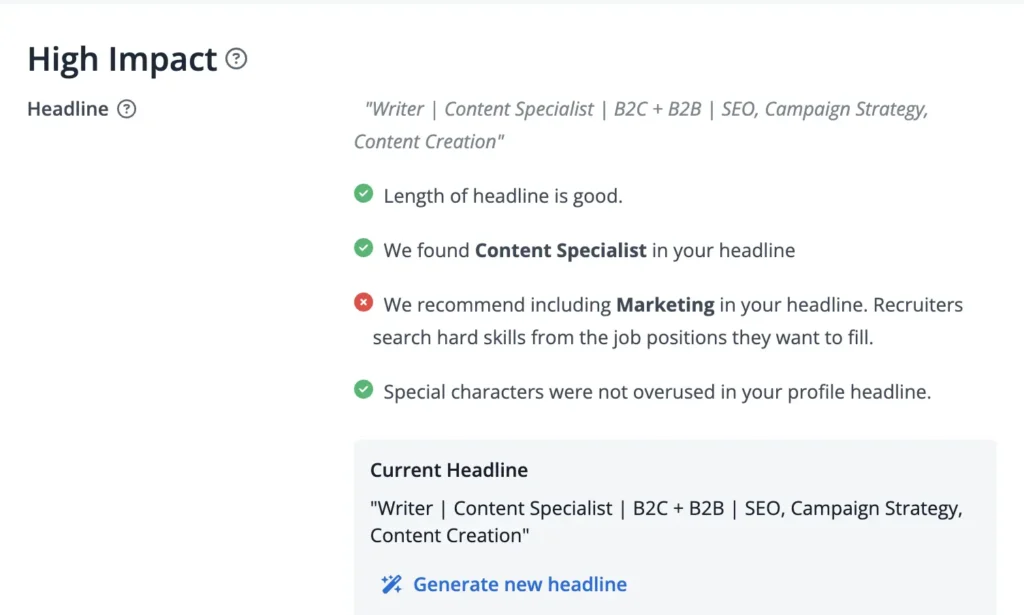
You can click “Generate new headline” to incorporate best-practices with one-click.
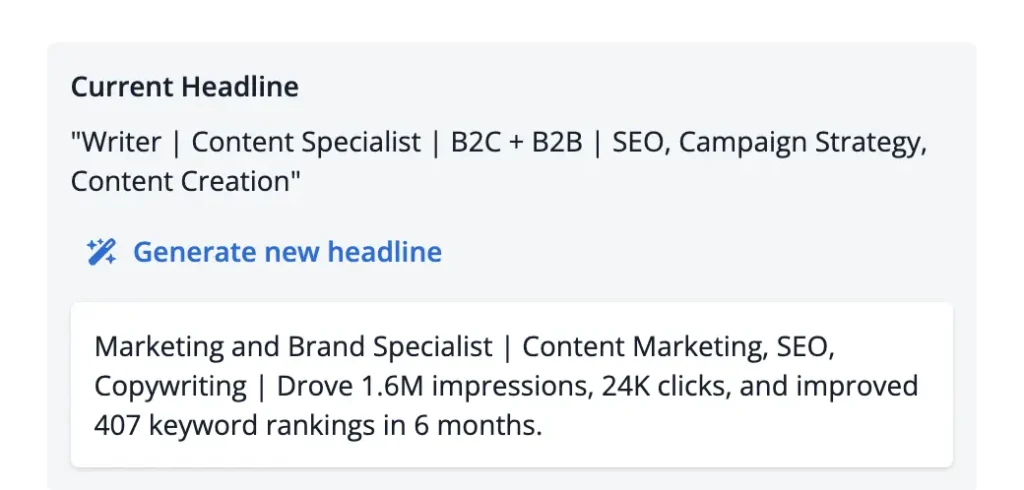
The LinkedIn Optimizer doesn’t just analyze your headline. It also looks at your summary section and gives you a Match Score showing how closely your entire profile aligns with your target roles.
This helps you create a stronger, more recruiter-friendly LinkedIn profile that gets you noticed. One example: after optimizing his profile with the tool, Kelly built a professional network and landed a job in a new city, proof that a polished profile can open doors beyond your local market.
How can you change your LinkedIn headline?
To change your LinkedIn headline, first go to your profile. Then click on the edit button in the upper right (it looks like a pencil).
You’ll then see an “edit intro” screen. Scroll down until you see the headline section. Update your headline and hit the “save” button.
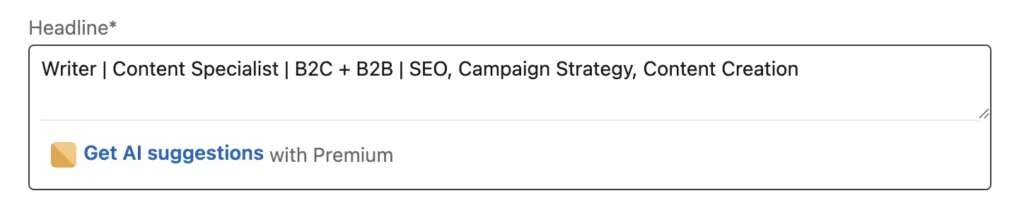
Your LinkedIn headline can be up to 220 characters long. It’s valuable space, so make every character earn its place.
- Read more: 28 LinkedIn Profile Tips to Supercharge Your Job Opportunities
- Read more: The Complete LinkedIn Optimization Guide
- Include certifications, licenses, or specialized training (e.g., “PMP,” “CPA,” “AWS Certified”)
- Avoid clichés and buzzwords that carry no search weight (e.g., “guru,” “ninja,” “results-oriented”)
- Add a differentiator that no other candidate in your field can claim
- Revisit your headline every time you change roles, earn a new credential, or shift your target position
- Use your Featured section to showcase work samples that back up your headline’s claims
What are some examples of effective LinkedIn headlines for different careers?
Now that you know how to write a compelling LinkedIn headline, let’s dive into some real-world examples. Here’s a key for finding the examples most relevant to you:
| Career stage | Best for | Jump to examples |
|---|---|---|
| Students with no experience | Current students building their first professional presence and seeking internships. | 1–3 |
| Recent graduates | New grads with limited work history looking to lead with academic achievements and extracurriculars. | 4–6 |
| Career changers | Professionals pivoting to a new field who need to bridge past experience with a new direction. | 7–8 |
| Entrepreneurs | Founders, freelancers, and consultants who need to lead with expertise and attract clients or collaborators. | 9–11 |
| Established professionals | Mid-to-senior level job seekers who need to articulate what sets them apart, not just what they do. | 12–21 |
What do LinkedIn headline examples for technology professionals look like?
Full-Stack Developer | Bridging the Gap Between Engineering & Product | Node.js, React, TypeScript, PostgreSQL
What makes this headline effective: This is great for a mid-level pro. It shows they don’t just code, they understand product, making them more valuable to a cross-functional team.
Principal Cloud Solutions Architect | 7x Certified AWS & Azure Expert | Migrating & Modernizing Enterprise Infrastructure
What makes this headline effective: “Principal” and “7x Certified” establish immediate authority. The value prop (“Migrating & Modernizing”) is exactly what enterprises pay for.
Offensive Security Engineer (Red Team) | I Find Critical Vulnerabilities Before Attackers Do | OSCP, OSCE
What makes this headline effective: This is a powerful, first-person “I” statement that perfectly and confidently describes the job. The certs (OSCP, OSCE) are non-negotiable proof.
Senior Cybersecurity Analyst (SOC) | Defending Fortune 500s from Advanced Persistent Threats (APTs) | CISSP, GCIH
What makes this headline effective: It’s specific (“SOC”), high-stakes (“APTs”), targets a clear audience (“Fortune 500s”), and lists top-tier certifications.
Machine Learning Engineer | Deploying Generative AI & LLMs into Production at Scale | Python, PyTorch, Kubeflow, AWS SageMaker
What makes this headline effective: This is extremely current and high-demand. It mentions the hottest fields (GenAI, LLMs) and—critically—the engineering part: “into Production at Scale.”
What do LinkedIn headline examples for marketing and sales experts look like?
Director of Demand Generation | I Build Scalable Revenue Engines for FinTech Startups | ABM, Marketing Ops & GTM Strategy
What makes this headline effective: “Revenue Engines” is a powerful term that CEOs love. It identifies a clear, high-value niche (FinTech Startups) and strategic skills (ABM, Ops).
SEO Strategist | Taking Brands to the #1 Spot on Google | I Grew Organic Traffic from 10k to 1.5M Monthly Visitors
What makes this headline effective: It makes a bold, confident claim (“#1 Spot”) and backs it up with a massive, specific metric (10k to 1.5M).
Product Marketing Lead | I Bridge the Gap Between Product, Marketing & Sales | GTM Strategy, Sales Enablement & Competitive Intel
What makes this headline effective: This perfectly describes the PMM’s critical cross-functional role and lists the three core pillars of the job.
Senior Business Development Rep (BDR) | I Connect CISOs with Next-Gen Security Solutions | Opening Doors & Building Pipeline
What makes this headline effective: It targets a specific, hard-to-reach buyer (CISOs) and uses strong, active language (“Opening Doors”) instead of passive “booking meetings.”
Senior Account Executive | Driving 7-Figure Deals by Helping CFOs Automate Financial Workflows | FinTech SaaS Specialist
What makes this headline effective: It’s a perfect “I help X do Y” formula. It specifies the buyer (CFOs), the solution (Automate Workflows), and the result (7-Figure Deals).
What do LinkedIn headline examples for healthcare professionals look like?
Physical Therapist (DPT) & Board-Certified Sports Clinical Specialist (SCS) | Helping Athletes Return to Play Safely & Quickly
What makes this headline effective: Lists credentials (DPT, SCS), a clear niche (Athletes), and a clear, desirable outcome (“Return to Play Safely & Quickly”).
Senior Radiologic Technologist (ARRT) | CT & MRI Specialist | Committed to Patient Safety and High-Quality Diagnostic Imaging
What makes this headline effective: Seniority, key credentials (ARRT), specific skills (CT & MRI), and a core value (“Patient Safety”).
Healthcare Compliance Officer | Ensuring 100% HIPAA, Stark Law & Anti-Kickback Adherence | CHC Certified
What makes this headline effective: This is direct and powerful. It names the specific, high-stakes regulations and the gold-standard certification (CHC).
Clinical Informatics Specialist (RN) | Bridging the Gap Between Clinicians & Technology | Optimizing EMR Workflows (Epic & Cerner) to Improve Patient Care
What makes this headline effective: Shows the “bridge” role, names the two biggest EMRs (searchability), and connects the tech (EMR) to the goal (Patient Care).
Healthcare Data Analyst | Turning EMR & Claims Data into Actionable Insights | SQL, Tableau, Python
What makes this headline effective: It states the value (Actionable Insights), the source (EMR & Claims Data), and the tools (SQL, Tableau, Python).
What do LinkedIn headline examples for finance and accounting look like?
Finance Manager | I Bridge the Gap Between Finance & Operations | Driving 15%+ Margin Improvement Through Cost Optimization
What makes this headline effective: It shows a cross-functional “bridge” role and leads with a quantifiable business impact (15%+ Margin Improvement).
Corporate Controller | Building Scalable, Audit-Proof Accounting Functions | SOX Compliance, Month-End Close & ERP Implementation
What makes this headline effective: “Audit-Proof” is a powerful, confident statement. It lists the three core pillars of a Controller’s job and shows they build systems (“Scalable”).
Tax Manager (CPA) | Saving S-Corps & Partnerships $1M+ Annually Through Proactive Tax Strategy & State/Local (SALT) Expertise
What makes this headline effective: It’s client-centric. It leads with a huge quantifiable result ($1M+) and names a specific, complex specialty (SALT).
Equity Research Associate | Covering the Enterprise SaaS Sector | Building DCF Models & Publishing Actionable Investment Theses
What makes this headline effective: Clearly defines a very specific and valuable coverage area (Enterprise SaaS) and lists the core job outputs (DCF Models, Investment Theses).
FinTech Compliance Officer | Building AML/KYC & Regulatory Frameworks for Payment Startups | CAMS Certified
What makes this headline effective: This is a high-demand, modern niche. It combines the industry (FinTech, Payments), the function (AML/KYC), and the key certification (CAMS).
What do LinkedIn headline examples for human resource specialists look like?
HR Business Partner (SHRM-CP) | I Empower Frontline Managers to Build High-Performing, Engaged Teams | Employee Relations & Performance Management Expert
What makes this headline effective: This is a perfect mid-level headline. It shows a clear mission (“Empower Frontline Managers”) and the specific skills used (Employee Relations, Performance).
University & Campus Recruiter | Building the Next Generation of Leaders | I Manage the Intern & New Grad Programs to Secure Future Talent
What makes this headline effective: It has an aspirational, clear purpose (“Building the Next Generation”) and defines a critical, strategic specialty (University Relations).
Employee Experience (EX) Manager | I Build Inclusive, High-Performance Cultures Where People Do Their Best Work
What makes this headline effective: This is a perfect, mission-driven headline. It connects “Inclusive” (a culture goal) with “High-Performance” (a business goal).
Diversity, Equity & Inclusion (DEI) Leader | Embedding DEI into the Business Strategy to Drive Innovation & Equitable Outcomes
What makes this headline effective: “Embedding” is the key. It shows this role is a strategic partner, not a silo, and connects DEI to a business outcome (“Innovation”).
Senior Compensation & Benefits Analyst | Designing Equitable Total Rewards Programs That Attract & Retain Top Global Talent | Pay Equity Expert
What makes this headline effective: It shows the business value (“Attract & Retain”) and names two of the most critical, in-demand specialties: “Total Rewards” and “Pay Equity.”
What do LinkedIn headline examples for project and product managers look like?
Technical Product Manager (TPM) | Bridging the Gap Between Engineering & GTM | API-First & Developer Platform Expert
What makes this headline effective: This perfectly defines the TPM’s “bridge” role. It names a highly technical, in-demand specialty (“API-First & Developer Platform”).
Agile Project Manager (CSM, SAFe) | I Empower Cross-Functional Teams to Deliver High-Quality Software Faster Through Process Improvement | Scrum Master & Agile Coach
What makes this headline effective: It’s methodology-focused. It shows how you manage (“Empower Teams”) and lists the most in-demand Agile certifications (CSM, SAFe) and roles.
Construction Project Manager | Managing $50M+ Commercial & Residential Builds from Design to Completion | Procore Certified
What makes this headline effective: This is industry-specific. It gives an immediate, impressive sense of scale ($50M+) and lists a critical, industry-specific software (Procore).
AI/ML Product Manager | Shipping Generative AI Products That Solve Real-World Business Problems | Python, SQL
What makes this headline effective: This is extremely current and high-demand. It shows you don’t just talk about AI, you ship it. Adding light technical skills (Python, SQL) boosts credibility.
What do LinkedIn headline examples for students and recent grads look like?
Recent Computer Science Graduate | Full-Stack Developer | Building Projects with React, Node.js & Python | Passionate About Creating User-Centric Code
What makes this headline effective: It claims the professional title (“Full-Stack Developer”), lists a specific tech stack, and shows passion.
Marketing Graduate (B.Com) | Certified in HubSpot & Google Analytics | Data-Driven Strategies for SEO, SEM & Social Media
What makes this headline effective: It leads with the degree, but immediately backs it up with in-demand certifications and the core keywords for the roles they want.
Recent Finance Graduate (Magna Cum Laude) | Skilled in Financial Modeling, DCF Valuation & Risk Analysis | Bloomberg Certified
What makes this headline effective: It shows high achievement (Magna Cum Laude), lists the three core skills for an analyst role, and includes a key certification.
Incoming Investment Banking Summer Analyst | Finance Student at NYU Stern | President, University Investment Club
What makes this headline effective: This is the high-achiever format. It shows the future role, the school, and a major leadership position.
Human Resources Intern at Deloitte | Business Administration Student | Focused on Employee Onboarding & People Analytics (Tableau)
What makes this headline effective: It leads with the intern experience and shows a focus on a high-demand HR specialty (People Analytics) with a hard skill (Tableau).
UX/UI Designer | 5-Project Portfolio (Figma, Sketch) | Designing Intuitive Mobile & Web Apps | Recent Cognitive Science Graduate
What makes this headline effective: It confidently claims the title (“UX/UI Designer”) and immediately points to the proof (5-Project Portfolio) and tools.
Recent Data Science MSc Graduate | 8 Years of Experience in Retail Management | Now Applying Predictive Analytics to Business Operations
What makes this headline effective: It shows exactly how the “old” experience (Retail) and “new” skills (Data Science) combine to create unique value.
What do LinkedIn headline examples for career changers look like?
Full-Stack Software Developer | 8+ Years as a Problem-Solving High School Math Teacher | Java, React, Node.js, SQL
What makes this headline effective: It leads with the new title. It reframes “Teacher” as “Problem-Solver,” which is a core engineering skill.
Data Analyst | 10+ Years in Retail Management, Now Using Data to Drive Business Decisions | SQL, Tableau, Python, Power BI
What makes this headline effective: It connects the past (Retail) to the future (Business Decisions). It shows they have the commercial acumen to back up their new technical skills.
PMP & CSM Certified Project Manager | 10+ Years in Event Management, Now Delivering Complex Tech Projects On Time & On Budget
What makes this headline effective: Leads with the gold-standard certifications (PMP, CSM). It directly reframes “Event Management” (high-stakes, on-time delivery) to “Tech Projects.”
Technical Project Manager | 6 Years as a Registered Nurse (RN) | Bridging the Gap Between Clinical Teams & IT/EMR Implementations
What makes this headline effective: This is a highly valuable niche. It shows they speak both languages (clinical and technical), which is rare and essential.
What do LinkedIn headline examples for unemployed job seekers look like?
Your headline is your #1 marketing tool, not a status update. It should be 100% focused on your value, skills, and professional identity to showcase your potential for career growth. You signal to recruiters that you’re available using the Open To Work feature (the green profile photo frame), not by wasting your precious headline space.
Senior Software Engineer | 10+ Years Building Scalable, Resilient Backend Systems | Java, Spring Boot, AWS, Microservices
What makes this headline effective: It’s confident and keyword-rich. A recruiter searching for “Java AWS” will find you. Your employment status is irrelevant to your skills.
Corporate Controller (CPA) | Building & Scaling Audit-Proof Accounting Functions | SOX Compliance, Month-End Close & ERP Implementation
What makes this headline effective: “Audit-Proof” is a strong, confident value prop. It lists your core, high-value skills.
AWS Certified Solutions Architect | 8+ Years in IT Support, Now Building & Migrating Scalable Cloud Infrastructure
What makes this headline effective: It puts your new, high-value certification front and center. It shows a logical progression from “IT Support” to “Cloud.”
Digital Marketing Manager | 7 Years Driving Growth with SEO & Paid Media | Returning to Marketing with New Skills in AI Tools
What makes this headline effective: This is strong re-entry headline after an employment gap. It shows you aren’t just returning—you are returning upgraded with new, relevant skills.
Your headline is for what you do, not who you are (or aren’t) working for. Be the professional you are, show your value, and let the Open To Work feature handle the logistics for recruiters.
What 10 things should you not to say in your LinkedIn headline?
- “Unemployed or seeking work” – Focus on your skills and expertise rather than your current job status.
- “Hard worker” – Generic terms like this don’t stand out. Instead, highlight specific skills or accomplishments.
- “Team player” – Overused and vague. Specify how you’ve contributed to team success.
- “Open to opportunities” – This is too broad. Be specific about the types of roles or industries you’re targeting.
- “Experienced Professional” – Too generic. Mention your field or specialty to add clarity.
- “Looking for a job” – Shift the focus to what you can offer rather than your job search status.
- “Detail-oriented” – Commonly used and lacks impact. Showcase your attention to detail with specific examples.
- “Guru/ninja/rockstar” – These terms can seem unprofessional and aren’t taken seriously.
- “Motivated self-starter” – Avoid clichés. Instead, provide examples of your initiatives.
- Personal information – Keep unrelated hobbies and personal interests out of your headline.
The same rules apply on paper, too. Recruiters skim the top of your resume the way they skim your profile, so give it the same keyword-first treatment. See our resume headline examples for formulas you can adapt.

LinkedIn allows 220 characters. It is ideal to use most of this space to include target job titles and relevant keywords.
Yes, absolutely. It is one of the most important fields recruiters use to search for candidates. A strong, keyword-rich headline makes you appear in more search results.
1. Go to your LinkedIn profile page.
2. Click the pencil icon in your introduction card (near your name).
3. Edit the “Headline” field.
4. Click Save.
• Target Job Title(s): Clearly state the role you are seeking (e.g., “Senior Data Analyst”).
• Key Skills & Keywords: Include specific, searchable terms from job descriptions (e.g., “Python,” “Tableau,” “Machine Learning”).
• Value Proposition: A brief statement on the results you deliver (e.g., “Turning Data into Actionable Business Insights”).
Use their language. Research job descriptions for roles you want. Identify the most common job titles, keywords, software, and certifications (e.g., “PMP,” “Salesforce Certified,” “Go-to-Market Strategy”) and include them in your headline.
Use Jobscan’s LinkedIn Optimizer to take the guesswork out of LinkedIn profile optimization.
• Using the default “Job Title at Company” (it’s not descriptive).
• Filling it with empty buzzwords (“Ninja,” “Guru,” “Visionary”).
• Having typos or grammatical errors.
• Being too vague and not including any searchable keywords.
Update it whenever your professional goals or status change, especially:
• When you start actively job searching.
• When you get a promotion or change roles.
• When you gain a significant new skill or certification.
Focus on your target, not your status. Never use “Unemployed” or “Seeking new opportunities” alone. Instead, use a forward-looking headline:
• Example: “Digital Marketing Manager Seeking New Role | SEO, SEM, & Content Strategy”
• Example: “Full-Stack Developer | React, Node.js, AWS | Open to New Projects”
A good headline clearly and quickly tells a recruiter:
• Who you are (your role, e.g., “Customer Success Manager”)
• What you do (your specialty, e.g., “SaaS,” “Enterprise Accounts”)
• What value you bring (your impact, e.g., “Driving Retention & User Adoption”)