Medical Receptionist Resume Examples & Tips for 2025
Looking for medical receptionist resume examples for 2025? Read our blog to find expert-written samples, must-have skills, and formatting tips to land your next role.



From managing patient appointments to ensuring patient satisfaction, medical receptionists are the backbone of front desk operations. As the healthcare industry evolves in 2025, so does the demand for skilled, well-organized, and tech-savvy medical receptionists with strong interpersonal skills, knowledge of medical terminology, and a knack for administrative support. If you’re hoping to land your next role—or even your first—as a medical receptionist, your resume needs to stand out.
This blog is designed to help job seekers like you write a compelling medical receptionist resume that highlights your years of experience, key skills, and relevant certifications, all while making a positive first impression on potential employers.
We’ll walk you through the best resume examples that not only get noticed but also get past the ATS (Applicant Tracking Systems). Whether you’re applying as a senior medical receptionist or starting fresh, this guide has everything you need to present your work history, technical skills, and communication skills in the best light. Let’s get started!
Medical office receptionist resume example
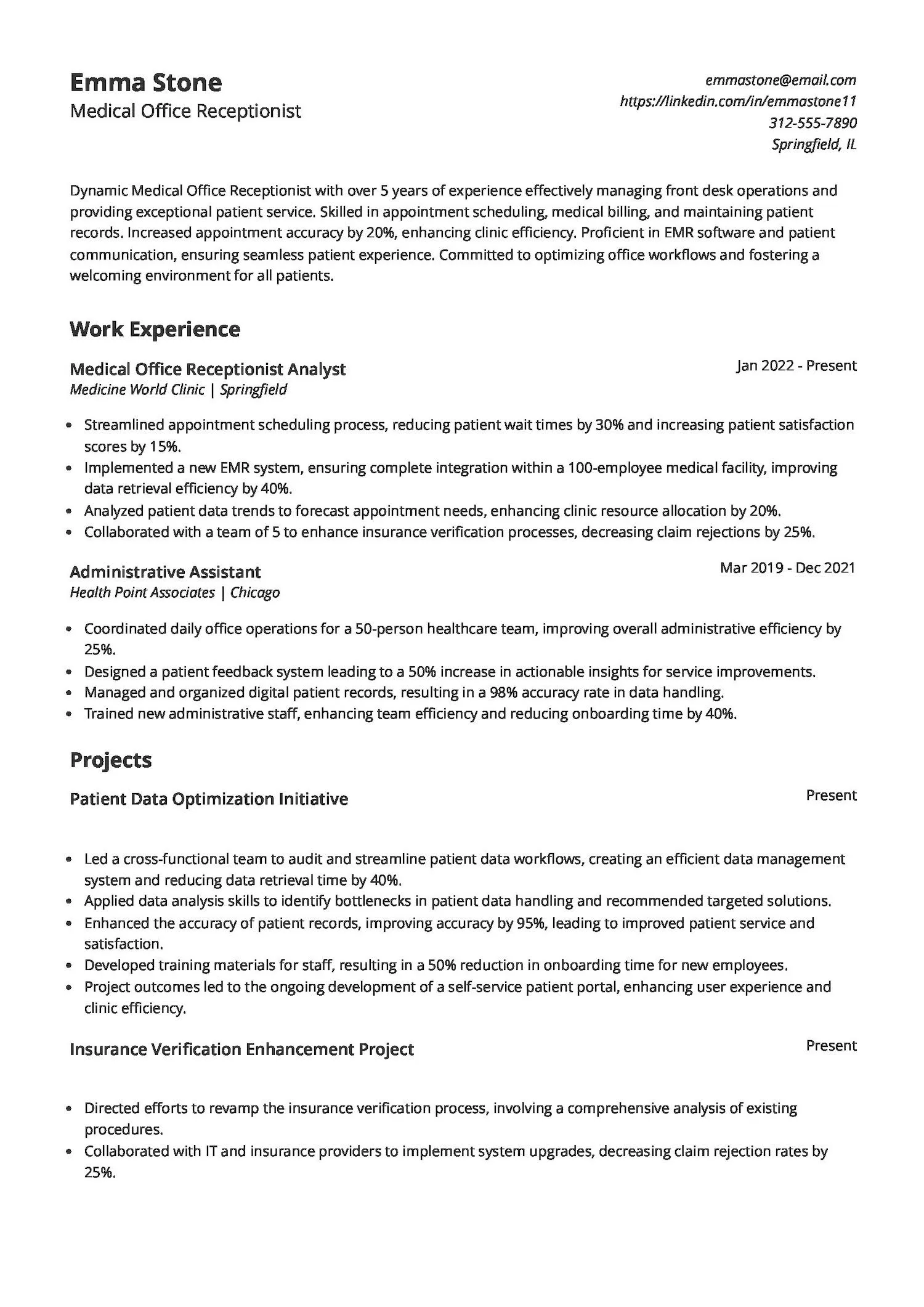
Looking to land your next medical office receptionist job but not sure how your resume stacks up? Take a look at this resume example—it’s built to impress. It combines strong metrics, real achievements, and keywords that hiring managers (and ATS systems) are actually looking for.

Sales manager roles call for a mix of strategy, team leadership, and strong communication. Employers want someone who can drive growth, lead teams, and hit revenue goals consistently. Resumes for this role should clearly show how you’ve made an impact with numbers, led people, and handled key accounts.
This resume stands out by combining measurable impact with a clear demonstration of technical and interpersonal skills. From improving appointment accuracy by 20% to reducing wait times by 30%, it shows proven success in key areas of medical office operations.
Strong project work and collaboration with cross-functional teams reflect leadership and initiative, while attention to EMR systems, billing, and patient communication make the candidate a top fit for modern healthcare environments.
Front desk medical receptionist resume example
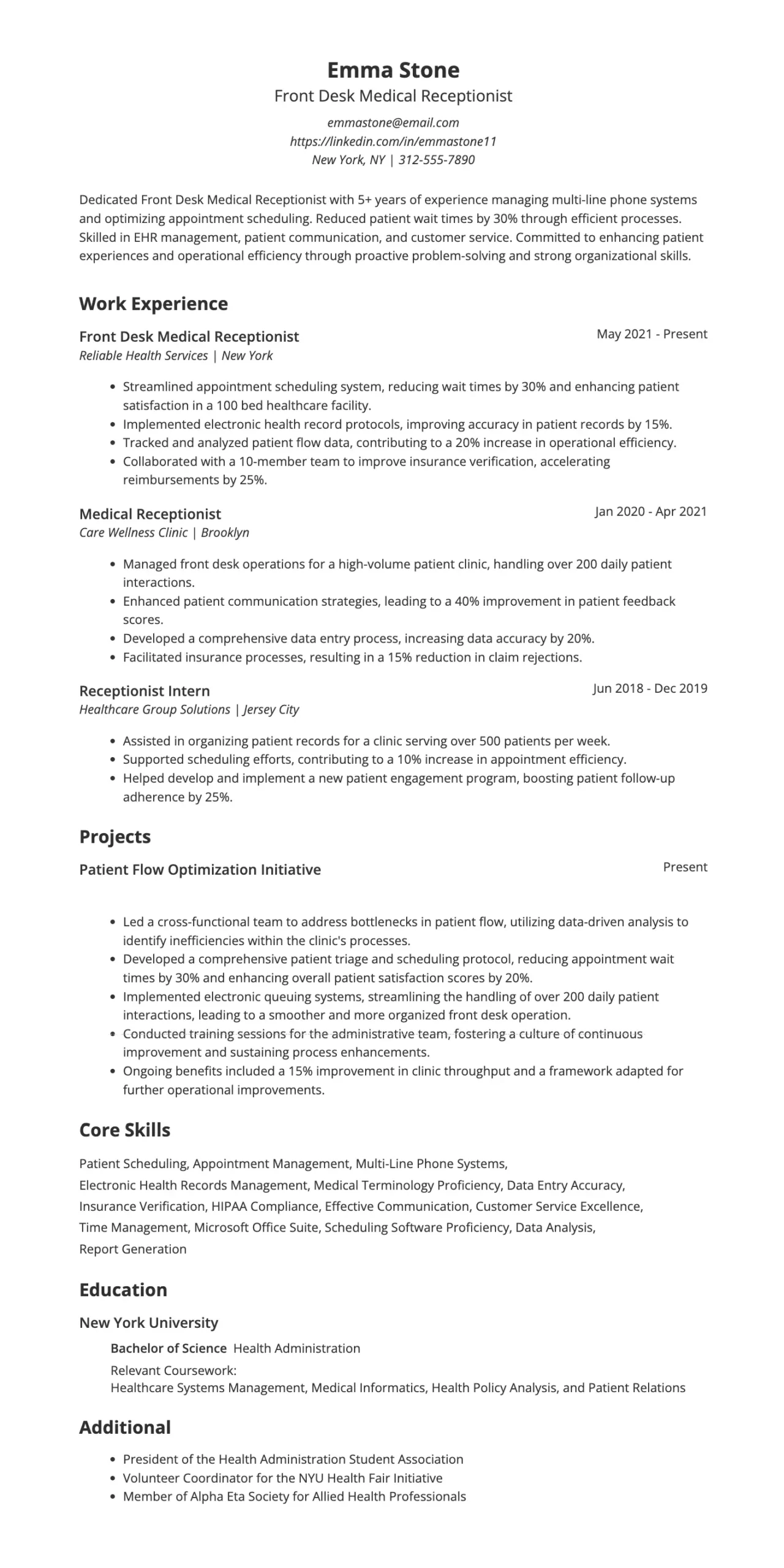
Feeling stuck trying to write the perfect resume for a medical receptionist role? You’re not alone. It can be tough to figure out what to include and how to stand out, especially with so many applicants. That’s why this resume example is a great reference. It’s clear, organized, and shows exactly how to highlight real achievements that employers care about.
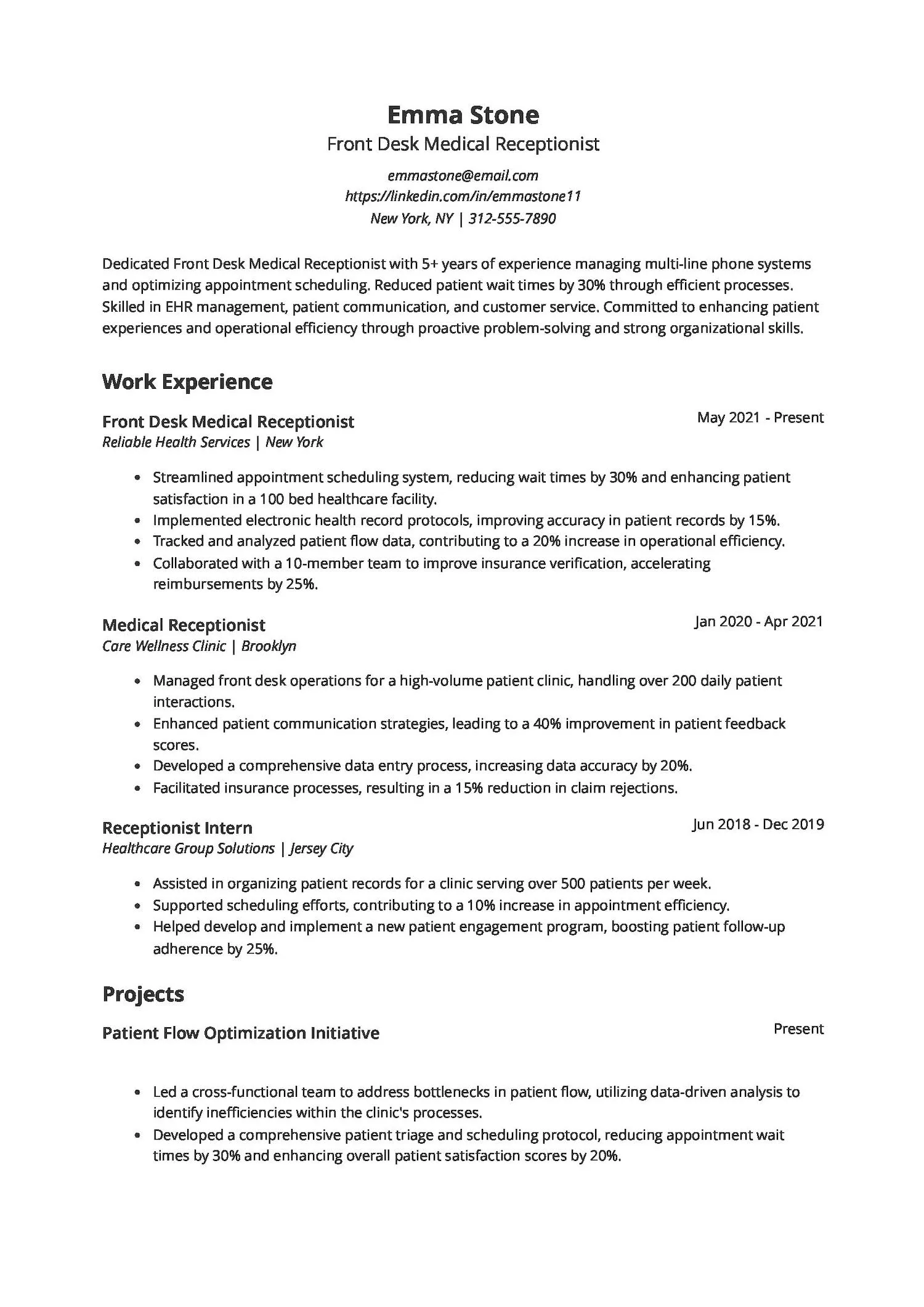
Front desk medical receptionist roles require strong communication, multitasking, and an eye for detail. Employers want someone who can handle busy front desk operations, manage patient records, and ensure smooth appointment scheduling. If you’re applying for this position, make sure your resume shows those strengths—and always back them up with real results.
This resume immediately showcases value with a results-driven summary that highlights key achievements like reducing patient wait times by 30% and enhancing operational efficiency.
The work experience section further builds on this by demonstrating a consistent track record of success across multiple roles. From managing over 200 daily patient interactions to boosting insurance reimbursement processes by 25%, the resume positions the candidate as a high-performing professional well-versed in front desk operations, EHR systems, and patient-focused service.
Medical receptionist resume example
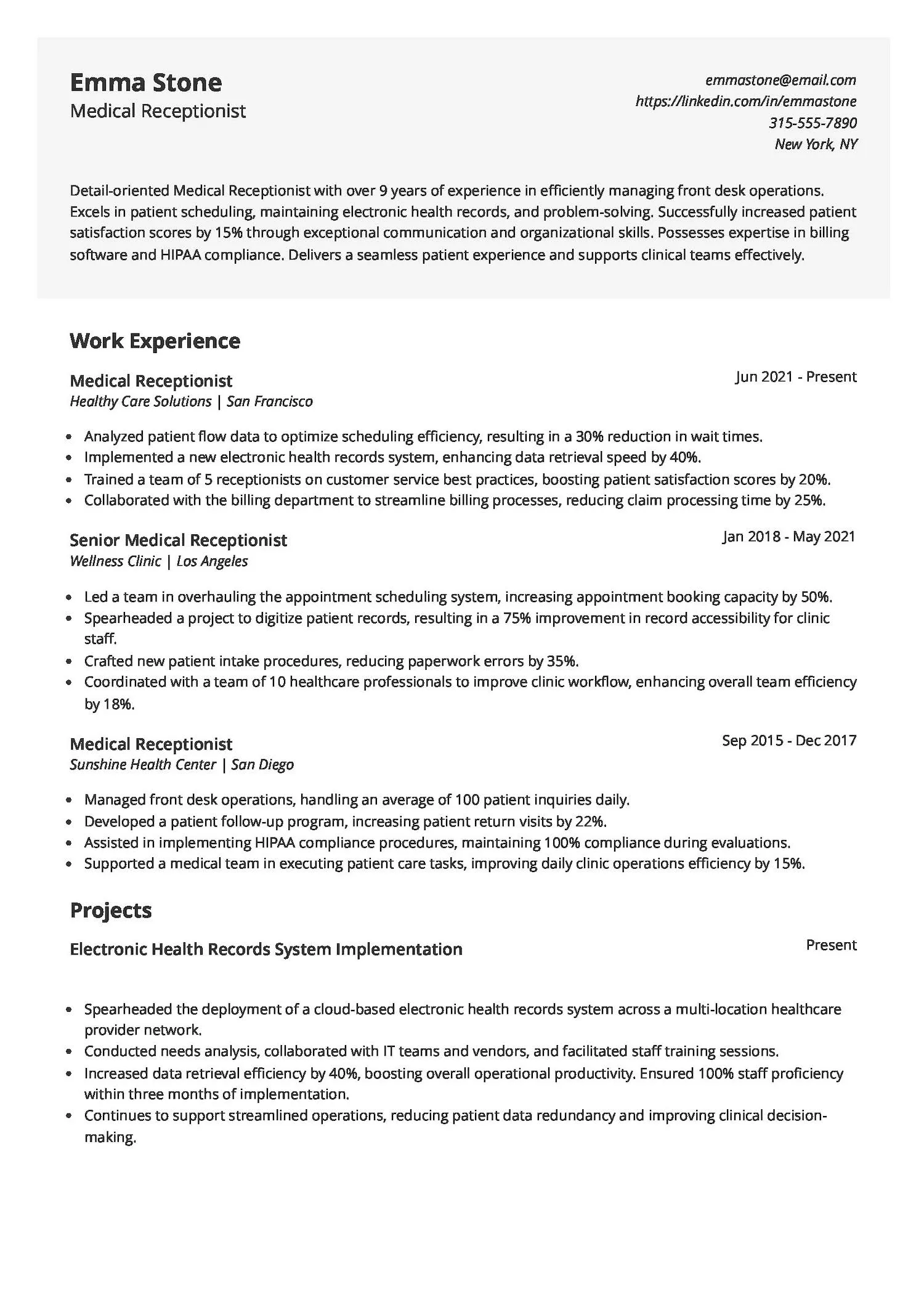
Finding the right way to showcase your experience on a medical receptionist resume can feel challenging, but with the right example, it gets easier. This resume highlights how to present your skills, accomplishments, and real results in a way that gets noticed. It’s a solid reference for building a resume that speaks directly to what healthcare employers are looking for.
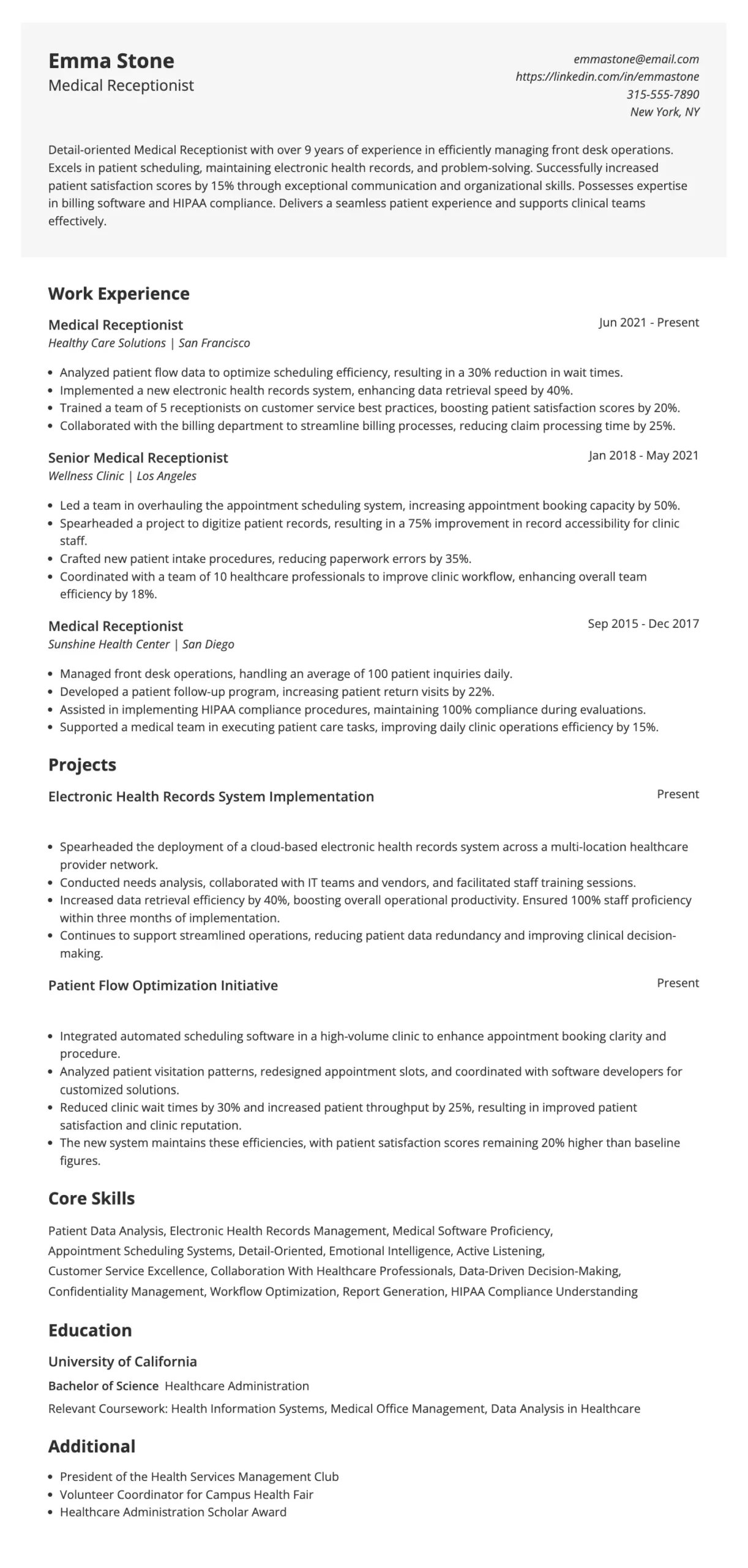
Medical receptionist roles require more than answering phones—you’re often the first impression of the clinic. Employers want someone who can multitask, manage sensitive health records, and keep operations running smoothly. Showing proven success in things like patient satisfaction, billing accuracy, and team collaboration can make your resume way more compelling.
This resume effectively showcases deep industry knowledge through a well-curated core skills section that emphasizes both technical proficiency and soft skills like emotional intelligence and collaboration. The inclusion of impactful projects—such as leading an EHR system rollout and optimizing patient flow—demonstrates initiative and leadership.
Honors like the Healthcare Administration Scholar Award further validate the candidate’s commitment to excellence, making this a strong example of a well-rounded, results-oriented medical receptionist resume.
How to write a medical receptionist resume that will get you an interview
Most healthcare facilities, clinics, and hospitals use ATS software to scan resumes before a human ever sees them. That means if your resume isn’t written with ATS in mind, it could get overlooked, no matter how qualified you are for the medical receptionist role.
Understanding how ATS works can help you tailor your resume with the right keywords, such as patient care, medical records, appointment scheduling, and customer service, increasing your chances of landing an interview.
Here’s a breakdown of how the ATS process works:
- Job posting setup: The hiring team inputs the job title, essential skills, and qualifications into the ATS—often including keywords like “HIPAA regulations,” “certified medical receptionist,” or “patient satisfaction scores.”
- Resume scanning: The system scans your resume for key skills, relevant certifications, and specific examples that match the job description.
- Searchable database: All resumes are stored in a database, allowing recruiters to run keyword searches.
For example, if a hospital is hiring for a front desk position, they may search for keywords like “patient scheduling,” “organizational skills,” or “administrative support.” If your resume includes these terms, you’ll be seen as an ideal candidate.
To take the guesswork out of this process, Jobscan’s Free Resume Builder is a game-changer for job seekers. Built specifically to beat the ATS, it helps you write your resume from scratch with the right action verbs, industry keywords, and formatting to pass the scan and impress recruiters.

Key elements of a medical receptionist resume
Including the right elements ensures your qualifications align with what hiring managers and ATS systems are looking for. Here are the essential sections every strong medical receptionist resume should include:
- Contact information: Start with your full name, phone number, email address, and city/state to ensure potential employers can easily reach you.
- Professional summary: Write a brief, engaging summary that highlights your administrative tasks experience, excellent customer service, and ability to support medical staff in fast-paced healthcare environments.
- Work experience: List previous roles in reverse chronological order, emphasizing accomplishments with action verbs and specific contributions such as managing patient wait times or improving health records accuracy.
- Core skills: Include relevant skills like data entry, medical billing, Microsoft Office Suite, and handling electronic medical records for diverse patient populations. Mention tools and systems you’ve used, such as EHR software for managing patient records and communication systems for handling phone calls and appointment scheduling.
- Certifications and education: Highlight credentials such as a certification in medical administrative assistance or training in healthcare administration, including school names and completion dates.
Write a strong professional summary
A strong professional summary should be concise, tailored to the medical receptionist role, and packed with relevant keywords like patient records, administrative tasks, and excellent customer service. It should also demonstrate your value with a proven track record or unique skills, such as proficiency in electronic medical records or experience working with diverse patient populations.
Good examples of a resume summary
- “Certified Medical Administrative Assistant with 5+ years of experience in fast-paced clinics, skilled in patient scheduling, managing electronic medical records, and reducing patient wait times. Known for delivering excellent customer service and improving front desk efficiency through strong organizational skills and mastery of the Microsoft Office Suite.”
- “Detail-oriented medical receptionist with a proven track record of supporting medical staff and optimizing administrative tasks. Adept at handling phone calls, maintaining patient records, and navigating insurance coverage verification processes in compliance with HIPAA regulations.”
Bad examples of a resume summary
- “I am looking for a job as a receptionist where I can learn and grow. I’m friendly and good with people and would like to work in a clinic or hospital.”
- “Hard worker with some experience in the medical field. Willing to do tasks and help out at the front desk.”
Not sure how to write a compelling summary? Jobscan’s Summary Generator takes the guesswork out by helping you create a keyword-optimized, ATS-friendly summary tailored to your target job. It’s the perfect tool to stand out from the competition and land more interviews!
Demonstrate key medical receptionist skills
Showing both your hard and soft skills on a resume is essential because it gives hiring managers a complete picture of your capabilities. Including the right mix of both skill types—especially when aligned with the job description—helps your resume pass ATS scans and stand out to employers.
Hard skills for medical receptionist
- Electronic Medical Records
- Data Entry
- Patient Scheduling
- Appointment Scheduling
- Medical Billing
- Microsoft Office Suite
- Health Records Management
- Insurance Verification
- Phone Call Handling
- Medical Terminology
- Patient Records Maintenance
- HIPAA Regulations Compliance
- Medical Assistant Support
- Administrative Tasks
- Insurance Coverage Coordination
Soft skills for medical receptionist
- Excellent Customer Service
- Communication Skills
- Interpersonal Skills
- Organizational Skills
- Attention to Detail
- Time Management
- Problem Solving
- Multitasking
- Professionalism
- Adaptability
- Empathy
- Conflict Resolution
- Team Collaboration
- Patience
- Dependability
Be sure to list these skills in bullet points to make them easy for hiring managers and ATS to scan. Keep reading for examples of good and bad medical receptionist resume bullet points to help you write yours with confidence.
Write impactful resume bullet points for a medical receptionist
Resume bullet points are the core of your experience section. They should clearly communicate your skills, the impact you’ve made, and the value you bring to a team. Instead of listing tasks, focus on what you accomplished using specific tools, action verbs, and measurable results. Here’s what that looks like:
Good examples of resume bullet points
- “Scheduled and coordinated over 50 patient appointments daily, reducing wait times by 20% and improving patient satisfaction scores.”
- “Maintained accurate electronic medical records in compliance with HIPAA regulations, supporting a clinic serving diverse patient populations.”
- “Provided excellent customer service by managing high-volume phone calls, verifying insurance coverage, and resolving patient inquiries efficiently.”
Bad examples of resume bullet points
- “Answered phones and worked at the front desk.”
- “Helped with patient stuff and did paperwork.”
- “Scheduled appointments when needed.”
Struggling to write powerful, results-driven bullet points? Jobscan’s Bullet Point Generator helps you write professional, keyword-optimized bullet points tailored to your role. Try it now!
Highlight your achievements as a medical receptionist
Your achievements are what set you apart from other candidates with similar experience. Instead of just listing responsibilities, focus on the impact you made—how you improved processes, supported the medical staff, or enhanced the patient experience. This not only shows your value but also demonstrates a proven track record of success in the medical receptionist role.
Here’s how you can highlight your achievements:
- “Reduced patient wait times by 20% by reorganizing appointment scheduling procedures and implementing a real-time check-in system.”
- “Maintained 100% accuracy in electronic medical records and patient records over two years, contributing to improved healthcare administration and compliance with HIPAA regulations.”
- “Handled over 75 phone calls daily while delivering excellent customer service, resulting in a 30% increase in patient satisfaction scores.”
- “Trained three new receptionists on front desk administrative tasks, contributing to faster onboarding and enhanced support for medical staff.”
Tailor your resume to the job description
Tailoring your resume to the job description is essential because it shows employers you’re the ideal candidate for a specific role, not just any role. It helps your resume pass through ATS scans by matching the exact keywords and qualifications they’re looking for. A customized resume increases your chances of getting noticed and landing an interview.
Here’s how to tailor your resume to the job description:
- Read the job posting carefully and highlight key skills and responsibilities.
- Match your bullet points to the language and priorities in the job ad.
- Use exact keywords like “HIPAA compliance” or “patient scheduling” from the description.
- Reorder your skills and experience to align with what the employer values most.
- Adjust your summary to reflect the specific role and company mission.
Include relevant education and certifications
This section helps prove your qualifications, shows your commitment to healthcare administration, and can give you an edge, especially if you’re a certified medical administrative assistant or have specialized training.
How to include education and certifications effectively:
- List in reverse chronological order, starting with your most recent education or certification.
- Include the name of the institution, degree or certification title, and the completion date.
- If space allows, add relevant coursework (e.g., “Medical Terminology,” “Insurance Processing”).
- For certifications, include the certifying body (e.g., NHA, AAPC) and note if it’s current or recently renewed.
- Only list certifications that are relevant to the role and demonstrate technical skills or healthcare knowledge.
Top medical receptionist certifications
Here are some top medical receptionist certifications that can enhance your resume:
- Certified Medical Administrative Assistant (CMAA)
- Certified Medical Receptionist (CMR)
- Certified Electronic Health Records Specialist (CEHRS)
- Medical Office Administration Certificate
- HIPAA Certification
Medical receptionist resume tips
Follow the tips below to write a standout resume:
- Use action verbs: Start each bullet point with dynamic verbs like “Scheduled,” “Managed,” “Coordinated,” or “Streamlined” to add impact.
- Tailor your resume: Match your skills and experience with the job description to satisfy the ATS and appeal to hiring managers.
- Keep it clean and professional: Use a simple, ATS-friendly resume template with clear headings and consistent formatting.
- Include certifications: Add relevant credentials like Certified Medical Administrative Assistant (CMAA) or HIPAA Certification to boost credibility.
- List relevant tools: Mention software and systems you’re proficient in, like Microsoft Office Suite, scheduling tools, or EHR platforms.
- Add a professional summary: Write a short, tailored summary that highlights your experience, top skills, and career goals.
- Proofread carefully: Avoid spelling and grammar errors—they can make a bad first impression and hurt your credibility.
Include a cover letter with your medical receptionist resume
A well-written cover letter is your chance to make a positive first impression before the interview. It allows you to introduce yourself, explain why you’re the ideal candidate, and highlight the skills and experience that make you a great fit for the medical receptionist role. A tailored cover letter can set you apart from other applicants and show potential employers that you’ve taken the time to understand their needs.
Tips for writing a strong medical receptionist cover letter:
- Start with a strong opening: Address the hiring manager by name if possible, and immediately express your interest in the role and facility.
- Highlight relevant skills: Mention key strengths like appointment scheduling, patient records management, excellent customer service, and familiarity with electronic medical records.
- Include specific examples: Show how your experience and achievements align with the job. For example, “In my previous role, I improved patient wait times by streamlining front desk operations.”
- Customize for the role: Use keywords from the job description to demonstrate that you’re a great match.
- Close with confidence: End by thanking the reader and expressing your enthusiasm for the opportunity to contribute to their team.
Writing a personalized, impactful cover letter doesn’t have to be stressful. Jobscan’s Cover Letter Generator helps you quickly create a professional, customized letter that aligns with the job description and highlights your unique strengths, so you can focus on landing the job, not worrying about formatting and phrasing.
Final words
Writing a standout medical receptionist resume is more than just listing tasks—it’s about telling your professional story in a way that captures attention and opens doors. As you begin creating or refining your resume, take inspiration from the examples and tips shared, and aim to present yourself with clarity, confidence, and intention.
And if you want a little extra help to make your resume truly shine, tools like Jobscan can guide you in the right direction, making the process smoother, faster, and far more effective.