



Your resume summary is a short paragraph at the top of your resume that highlights your most relevant experience, skills, and accomplishments. It’s like a personal pitch—giving employers a quick reason to keep reading.
Here are resume summary examples for different types of job seekers:
-
Experienced professional:
“Operations Manager with 10+ years of experience improving efficiency in manufacturing and logistics. Certified Six Sigma Black Belt with a track record of reducing costs by 18%.” -
Career changer:
“Project Manager transitioning into Digital Marketing. Skilled in planning, analytics, and leading teams. Known for completing projects under budget and ahead of schedule.” -
Recent grad / entry-level:
“Business Administration graduate with strong leadership skills and coursework in marketing, finance, and project management. Eager to contribute in a fast-paced environment.”
Writing a resume summary feels awkward for most people.
It’s easy to fall back on vague phrases like “hard-working team player” or end up with something that sounds stiff or forced.
But a strong summary is one of the best ways to grab a hiring manager’s attention right away. It’s also one of the only places on your resume where you get to shape your own story.
In this guide, you’ll learn how to write your resume summary that actually works, plus see resume summary examples you can use for inspiration.
What is a professional resume summary?
Your resume summary is like an elevator pitch. It’s a quick, punchy way to say, “Here’s what I can do.”
Placed near the top of your resume, this short statement highlights your most relevant skills, experience, and accomplishments, all in just a few lines.
Think of it as a teaser. It gives hiring managers a fast preview of why you’re a strong fit and encourages them to keep reading.
Your resume summary goes right below your contact info. If you’re using a resume headline, the summary should come next. Most resume summary statements are 2–5 sentences long, just enough to capture attention without overwhelming the reader.

What is the resume summary formula?
Now that you know what makes a great resume summary, here’s a simple formula you can follow.
Just click “Copy to Clipboard” and fill in the blanks to make it your own:
[Job Title] with experience in [Skill 1], [Skill 2], and [Skill 3]. Proven ability to [Accomplishment 1] and [Accomplishment 2]. Known for [Work style, strength, or value you bring to the role].

PRO TIP: Never use personal pronouns (e.g., “I,” “me,” “my”) in your resume summary, or anywhere else on your resume.
What are some resume summary examples based on your background?
Your resume summary should reflect where you are in your career and where you’re headed next.
Use these resume summary examples as inspiration to craft a summary that highlights your strengths and fits your goals.
1. What is a resume summary for an experienced professional?
If you’ve been in the workforce for several years, your resume summary should highlight your experience, key achievements, and any certifications or honors that set you apart.
“Operations Manager with 10+ years of experience leading process improvements in manufacturing and logistics. Certified Six Sigma Black Belt with a track record of reducing costs by 18% and improving on-time delivery rates by 30%. Recognized with the President’s Award for Excellence in 2023. Known for building high-performing teams and driving operational efficiency at scale.”
2. What is a resume summary for a career changer?
Changing careers? Your resume summary is the best place to explain your new direction. Start by including the job title you’re targeting. This helps your resume get found when recruiters search the ATS. Then show how your existing skills and experience transfer to the new role and add value.
“Project Manager transitioning to Digital Marketing Manager. Bringing 8 years of experience leading cross-functional teams with transferable strengths in strategic planning, data analysis, and team leadership. Known for completing projects 20% under budget and boosting team efficiency by 35%. Excited to apply problem-solving and planning expertise to data-driven marketing campaigns.”
3. What is a resume summary for a recent grad with no experience?
If you’re applying for entry-level roles and don’t have much work experience yet, but if you’ve completed relevant coursework, held leadership roles, or earned academic honors, your resume summary can still make a strong first impression. Focus on what aligns with the job and shows you’re ready to contribute.
“Motivated Business Administration graduate with strong organizational and communication skills developed through leadership in student government. Completed coursework in marketing, finance, and project management with a focus on team efficiency. Eager to apply analytical and problem-solving abilities in a fast-paced corporate environment.”
PRO TIP: Write your resume summary last. Once the rest of your resume is done, you’ll have a clearer view of your top skills and accomplishments, and know exactly what to highlight.
How can you tailor your resume summary to the job?
One of the biggest mistakes job seekers make is using the same resume for every application. It might seem efficient, but it’s not effective.
When you send your resume in, it usually goes into an applicant tracking system (ATS). This is software that most companies use today to sort and organize resumes.
When recruiters want to find suitable candidates, they search the ATS using keywords.
According to Jobscan’s State of the Job Search report, 99.7% of recruiters use filters in their ATS or similar systems to find qualified candidates.
Here’s how they search:
-
76.4% filter by skills
-
59.7% by education
-
55.3% by job titles
-
50.6% by certifications and licenses
-
44% by years of experience
Your resume summary is a great place to include keywords. Read the job description carefully. Highlight the most important skills and include them in your resume summary—if they apply to you.
The only problem with tailoring each resume is that it takes time and effort. And it can be hard to know which keywords are the most important.
Jobscan’s resume scanner takes the guesswork out of tailoring your resume. Here’s how it works:
-
Paste in your resume.
-
Paste in the job description.
-
Click “Scan.”
You’ll then receive a match rate that shows how closely your resume matches the job description, and a report highlighting the keywords you should add to your resume.
Here is an example of the report and match rate:
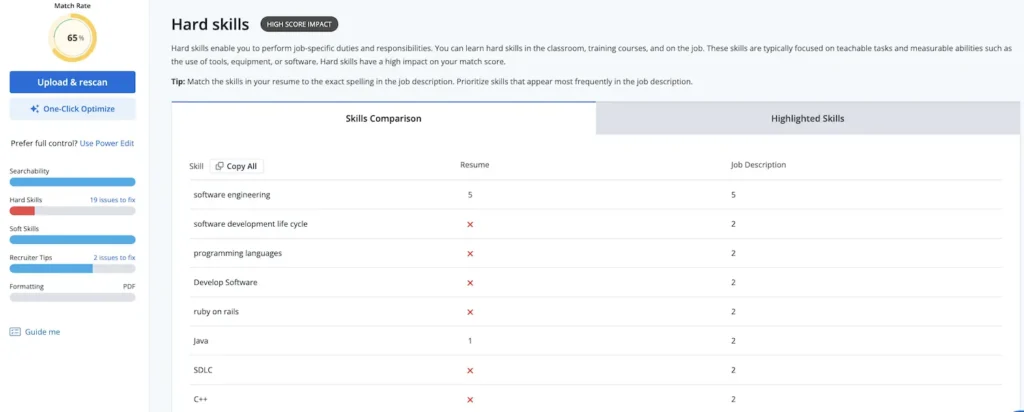
The red X’s highlight the hard skills that are missing from the resume. Adding them will increase your match rate and your chances of landing an interview.
How do resume summary examples look?
Use these professional resume summary examples for inspiration as you write your own. Each one is designed to highlight key skills, accomplishments, and the unique value you can offer employers.
1. What is a customer service resume summary example?
“Committed Customer Service Representative with 3 years of experience in fast-paced environments, achieving a 95% customer satisfaction rate. Reduced call handling time by 20% without compromising service quality. Skilled in problem-solving, communication, and providing high-quality customer support.”
Why this works: Emphasizes both soft skills and results, showing that the candidate is not just friendly but also effective.
See complete customer service resume examples.
2. What is a sales professional resume summary example?
“Dynamic Sales Professional with 4 years of experience in driving revenue growth and exceeding sales targets in competitive markets. Achieved a record 40% year-over-year sales increase through strategic client engagement and innovative sales tactics. Expert in relationship building, market analysis, and negotiation, with a proven track record of closing deals and fostering customer loyalty.”
Why this works: Clearly quantifies sales impact and ties skills to outcomes like revenue growth and customer relationships.
See complete sales resume examples.
3. What is a marketing manager resume summary example
“Dynamic Marketing Manager with 5 years of experience in developing and executing comprehensive marketing strategies that increased brand awareness by 40%. Expert in market analysis, campaign management, and cross-functional team leadership. Proven ability to drive market growth and enhance brand positioning.”
Why this works: Illustrates marketing impact with numbers and specific competencies that hiring managers are looking for.
See complete marketing resume examples.
4. What is an administrative assistant resume summary example?
“Proactive Administrative Assistant with 3 years of experience in fast-paced offices. Streamlined administrative processes, resulting in a 20% increase in efficiency. Skilled in data management, scheduling, and supporting team logistics with a keen eye for detail.”
Why this works: Demonstrates efficiency and reliability in office environments, with a specific stat that shows tangible improvement.
See complete administrative resume examples.
5. What is an entry-level resume summary example?
“Dedicated recent computer science graduate, eager to apply Machine Learning and AI specialization to an entry-level ML engineer role. Possesses practical experience in Python, TensorFlow, and scikit-learn, developed through academic projects and internship experience. A quick learner with proven analytical skills dedicated to contributing positively to a ground-breaking team. Ready to leverage a strong work ethic and academic foundation to achieve immediate results for Tech123.”
Why this works: Highlights key computer science functions and specialization, making the candidate’s value clear.
6. What is an IT specialist resume summary example?
“Results-oriented IT Specialist with 5+ years of experience in system administration, end-user support, and infrastructure optimization. Proven expertise in managing hybrid Windows/Linux environments, diagnosing complex hardware/software issues, and securing systems via Active Directory. A proactive problem-solver who has reduced help desk tickets by 30% by implementing robust IT solutions and documentation. Dedicated to demystifying technology for users and enhancing organizational productivity.”
Why this works: Quantifies success rate and streamlining, showing IT skills skill and effectiveness while backing it up with numbers.
See complete IT resume examples.
7. What is a project manager resume summary example?
“Strategic Project Management Professional with over 5 years of experience in leading projects from conception to completion across various industries. Successfully delivered projects 20% under budget and ahead of schedule, enhancing operational efficiency and stakeholder satisfaction. Expert in aligning project objectives with business goals, risk management, and team leadership.”
Why this works: Points to leadership, budget control, and deadline management, which are key skills for any project manager.
See complete project manager resume examples.
8. What is a registered nurse resume summary example?
“Dedicated Nurse with 6 years of experience in providing comprehensive patient care in hospital settings. Reduced readmission rates by 20% through effective discharge planning and patient education. Specializes in acute care, patient advocacy, and interdisciplinary collaboration.”
Why this works: Balances clinical expertise with outcome-driven care, showing how they improved patient health and system performance.
See complete nursing resume examples.
9. What is a data analyst resume summary example?
“Analytical Data Analyst with 3 years of experience in interpreting and analyzing data to drive successful business solutions. Developed a dashboard that reduced report generation time by 30%. Proficient in SQL, Python, and data visualization tools.”
Why this works: Points to technical proficiency and measurable results, two things every employer looks for in a data role.
See all data analyst resume examples.
10. What is a human resources resume summary example?
“Strategic Human Resources Professional with 6 years of experience in developing and implementing HR strategies that support business objectives. Enhanced employee retention by 25% through targeted development programs and benefits optimization. Expert in talent management, employee relations, and compliance.”
Why this works: Shows how HR strategy led to retention and growth, while emphasizing core areas of HR expertise.
See complete HR resume examples.
11. What is a finance and accounting resume summary example?
“Dedicated Accountant with 4 years of experience in managing accurate financial records, budgeting, and tax filing for diverse clients. Demonstrated expertise in streamlining financial processes, reducing errors by 20%, and enhancing operational efficiency. Proficient in GAAP, financial analysis, and software such as QuickBooks and SAP.”
Why this works: Highlights key accounting functions and includes metrics to show impact, making the candidate’s value clear and measurable.
See complete accounting resume examples.
12. What is a retail sales associate resume summary example?
“Customer-focused Sales Associate with 6+ years of experience in fast-paced retail environments. Proven ability to build genuine customer rapport, leading to a 25% increase in repeat client transactions. Consistently exceeded personal sales targets by 15% quarterly through consultative selling and deep product knowledge. Passionate about creating positive shopping experiences and contributing to team sales goals.”
Why this works: Highlights strong customer service skills and relationship-building with measurable results in profit performance.
See complete retail sales resume examples.
13. What is a software developer resume summary example?
“Innovative Software Developer with 5 years of experience in developing scalable software solutions. Contributed to a project that increased company revenue by 18% through software optimization. Proficient in multiple programming languages and agile methodologies.”
Why this works: Combines technical skill with business impact, which is exactly what hiring managers want to see in developer roles.
See complete software developer resume examples.
14. What is a graphic designer resume summary example?
“Innovative Graphic Designer with 7+ years of experience in developing complete branding identities, digital marketing collateral, and print media. Expert proficiency in the Adobe Creative Suite (Illustrator, Photoshop, InDesign). Delivered a brand refresh for a key client, resulting in a 40% increase in social media engagement. Passionate about translating complex ideas into clean, compelling visuals that drive business results.”
Why this works: Ties graphic design strategies directly to business outcomes, using numbers to show social media growth and engagement.
15. What is an operations manager resume summary example?
“Data-driven Operations Manager with 8+ years of experience in process optimization, supply chain management, and cross-functional team leadership. Proven track record of improving operational efficiency, successfully implementing a new inventory control system that reduced warehousing costs by 22% in one year. Skilled in scaling processes, managing budgets, and implementing lean methodologies to support long-term business growth.”
Why this works: Shows years of experience and quantifiable cost-saving results alongside leadership skills necessary for a manager.
16. What is an education and teacher resume summary example?
“Dedicated and student-focused Educator with 10+ years of experience in curriculum development, differentiated instruction, and technology integration. Fosters an inclusive and engaging classroom environment, leading to a 15% improvement in standardized test scores for struggling students. Skilled in leveraging data to inform instruction and collaborating with parents and staff to support student success.”
Why this works: Quantifies student success and emphasizes a range of skills required of a teacher,, from curriculum development to educational technology.
17. What is a legal professional resume summary example?
“Skilled Attorney with 7 years of experience in family law, achieving a 90% success rate across 200+ cases. Streamlined case preparation processes, reducing time to trial by 30%. Expert in negotiation, litigation, and client advocacy, committed to delivering exceptional legal outcomes.”
Why this works: Quantifies success rate and streamlining, showing legal skill and effectiveness while backing it up with numbers.
18. What is a healthcare support resume summary example?
“Compassionate Healthcare Professional with over 5 years of experience in providing top-notch care in various medical settings. Improved patient satisfaction scores by 30% through dedicated patient advocacy and care coordination. Skilled in patient assessment, treatment planning, and healthcare administration.”
Why this works: Balances compassion with outcomes, reinforcing that the candidate brings both heart and measurable value to healthcare.
19. What is a business analyst resume summary example?
“Versatile Business Analyst with 6+ years of experience bridging the gap between technical teams and business stakeholders. Expertise in requirements gathering, process mapping, and SQL-based data analysis. Successfully led the requirements definition for a new CRM system, which was adopted 20% faster than projected and reduced data entry errors by 35%. Dedicated to translating complex business needs into actionable technical solutions.”
Why this works: Shows their practical value by tying skills directly to efficiency improvements.
20. What is an engineering professional resume summary example?
“Dynamic Mechanical Engineer with 7+ years of experience in product design, finite element analysis (FEA), and full-cycle project management. Proven ability to optimize designs for manufacturability, leading a project that improved part efficiency by 18% and reduced material costs by 12%. Expertise in SolidWorks and AutoCAD, dedicated to delivering innovative and reliable engineering solutions.”
Why this works: Shows technical skills with results in efficiency, while highlighting their proficiency with critical tools in their field.
Should you include a resume summary?
Should you include a summary when writing your resume? In most cases, yes. A strong summary helps you make a great first impression, but it’s not always necessary.
Here’s how to tell if you need one:
-
You have relevant experience. Show off your skills and accomplishments right away, especially if they line up with the job.
-
You’re changing careers. Use your summary to highlight transferable skills and explain how your background fits the new role.
-
You have standout skills or credentials. This is a great place to mention certifications, technical expertise, or anything else that sets you apart.
-
You’re just starting out. If you have little or no experience, a resume objective might work better. It can focus on your goals and enthusiasm.
-
Your resume already tells the story. If your experience is straightforward and clearly aligned with the job, a summary might be unnecessary.
How can you write a non-traditional resume summary?
Your professional background isn’t always linear. For instance, you may be asking: “How can I write a strong resume summary if my background is in both IT and accounting?”
Instead of just listing skills from both fields, your summary should show how you use them together. Focus on the value you create at this intersection, whether that’s through automating accounting processes, analyzing financial data with your tech skills, managing financial systems (like ERPs), or performing IT audits with an accountant’s eye.
This is where resume tailoring is so important. Depending on what type of job or industry you’re transitioning to, you’ll need to highlight different proficiencies.
How do multi-skilled resume summary examples look?
Targeting a financial systems analyst or ERP specialist role
“Financial Systems Analyst with 8 years of experience leveraging a deep background in accounting to optimize and manage complex ERP systems. Proven ability to translate financial requirements for technical teams, lead system upgrades, and automate reporting functions, resulting in a 20% reduction in month-end close time. Adept in SQL, SAP, and developing custom data-driven dashboards for senior leadership.”
Why it’s strong: It leads with the “systems” identity, highlights the “accounting” benefit (translating requirements), and quantifies a key achievement.
Targeting an IT audit or risk assurance role
“CPA and CISA-certified professional with 6+ years of experience at the intersection of IT audit and financial compliance. Possesses a dual expertise in GAAP/SOX and IT general controls (ITGC), enabling comprehensive risk assessments of financial systems. Skilled in identifying control weaknesses and collaborating with IT and finance to secure data and ensure regulatory adherence.”
Why it’s strong: It leads with relevant certifications (CPA, CISA) and uses specific industry keywords (GAAP, SOX, ITGC) that show expertise in this niche.
Remember that highlighting the right keywords is what will help you shine in the eyes of the recruiter.
Read the job description. If it mentions “NetSuite,” “SOX,” and “Power BI,” make sure those words are in your summary (if you have the skills).
Jobscan’s resume scanner can make your keyword analysis and resume optimization faster, giving you more time to prepare for interviews.
How do you write a resume summary (step-by-step)?
Strong resume summaries follow a simple formula. Here’s the basic structure:
-
Start with the job title.
-
Mention your top skills or areas of expertise.
-
Add a key accomplishment or two.
-
Show how you’ll add value to the company.
Let’s break down each step:
1. What is your job title?
Use the exact job title from the job listing whenever possible. This helps your resume show up in applicant tracking system (ATS) searches.
In fact, Jobscan’s State of the Job Search research found that resumes using the exact job title from the posting were 10.6 times more likely to lead to an interview.
But what if you’re changing careers or don’t have that title yet? In these cases, use a phrase like “aspiring [job title]” or “transitioning into [job title]” to show intent without misleading.
2. What are your top skills or areas of expertise?
Highlight 2–3 key skills or areas of specialization that are relevant to the job. These should line up with what’s in the job description.
You can also mention how many years of experience you have in that area. This gives employers a quick sense of your depth and background.
If you’re new to the field, focus on transferable skills, training, or certifications that show you’re ready for the role.
3. What is your most key accomplishment?
Include one or two achievements that show the impact you’ve made in past roles. Use numbers if you can. Metrics help your summary stand out and feel more credible.
For example:
“Increased customer satisfaction scores by 25%” or “Managed a team of 10 across three departments.”
If you’re early in your career, you can highlight achievements from internships, school projects, or volunteer work.
4. How will you add value to the company?
Wrap up your summary with a short statement about what you bring to the table. This could be your work style, values, or how you help teams succeed.
Think about what makes you a good fit for the role or company and say it plainly.
For example: “Known for building strong client relationships and delivering results under pressure.”
This final touch helps connect your background to what the employer is looking for.
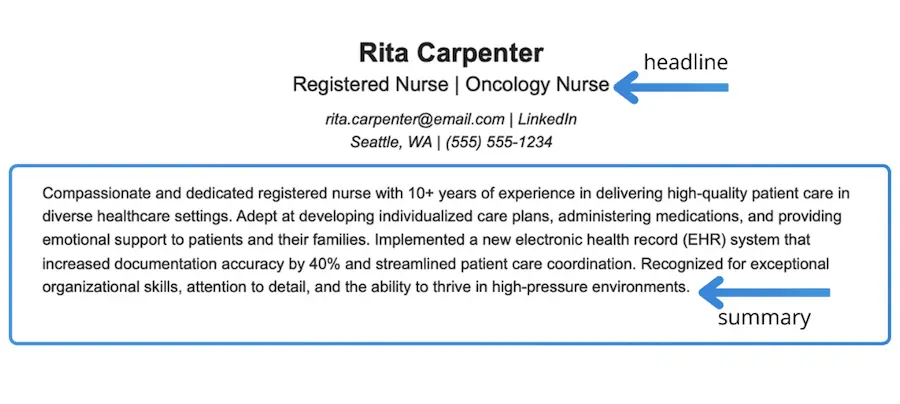
Below is an example of a resume summary. Place it at the top of your resume, below your resume headline and contact information, so it’s the first thing a recruiter sees.
Tips for writing a great resume summary:
-
Use keywords from the job description.
-
Include metrics or results if you can.
-
Focus on skills and accomplishments, not just duties.
-
Keep it brief—about 2–5 sentences.
-
Always tailor it to the job.
Your resume summary and a resume objective both sit at the top of your resume, but they serve very different purposes.
• A Resume Summary (or Professional Summary) is a 2-4 sentence “elevator pitch” that highlights your top skills, key experiences, and biggest achievements.
• A Resume Objective is a 1-2 sentence statement that explains your career goals and the type of role you are seeking.
Most recruiters and hiring managers strongly prefer your resume summary because it immediately shows them the value you can bring to their company. An objective is largely considered outdated.
Focus on potential, not past employment. Highlight:
• Education: “Recent [Your Degree] graduate…”
• Key Skills: Mention software, lab techniques, or soft skills (e.g., “project management,” “research”).
• Relevant Projects: Include academic, capstone, or significant personal projects.
• Passion/Goal: State your eagerness to apply your skills in [Target Industry/Role].
To be effective, your 2-3 sentence summary must include:
• Your Professional Title (e.g., “Customer Service Specialist”)
• Years of Experience (e.g., “…with 5+ years of experience…”)
• Top 2-3 Skills (Keywords) pulled from the job description (e.g., “…in CRM software and conflict resolution.”)
• A Quantifiable Achievement (e.g., “…proven ability to increase retention by 15%.”)
• Too Long: Keep it to 3-5 lines (2-4 sentences) maximum.
• Using First-Person: Avoid “I,” “me,” or “my.” Write in an implied first person.
• Vague Buzzwords: Avoid empty phrases like “team player” or “hard worker” without proof.
• Listing Duties, Not Results: Don’t say “Responsible for sales.” Say “Increased sales by 20%.”
• Not Tailoring: A generic summary gets ignored.
• Analyze the Job Description: Find the most important keywords and requirements.
• Mirror the Language: Use the exact keywords from the job description (e.g., if they want “P&L management,” use that phrase).
• Prioritize Relevant Info: Reorder your summary to put your most relevant skills and achievements first.
• Use Jobscan’s resume scanner to take the guesswork out of resume optimization.
The “7-second rule” refers to the average time a recruiter spends on the initial scan of your resume. You have about 7 seconds to make a strong impression and convince them your resume is worth reading further. A powerful summary is key to passing this test.
The best openings are direct and state your professional identity.
• Formula 1 (Title-Led): “[Adjective] [Your Job Title] with [Number] years of experience in [Key Skill/Industry].”
• Formula 2 (Skill-Led): “[Your Job Title] specializing in [Key Skill 1], [Key Skill 2], and [Key Skill 3].”