




You’re staring at your resume, wondering how to make your experience sound as impressive on paper as it is in real life.
You led this, you managed that… but so did everyone else.
That’s where spending time on choosing the very first word of every bullet point can make all the difference. It might seem minor, but starting your sentences with strong, targeted resume action verbs is the structural foundation of a winning resume.
That’s where recruiter eyes go once they’re done scanning major structural queues, and you only get a few seconds of their attention. In fact, one study found that leading with action-oriented language can boost your chances of landing an interview by 140%.
If your bullet points currently start with passive, weak phrases like “was responsible for” or “duties included,” you are actively losing the hiring manager’s attention.
In this master guide, we’ll break down the exact mechanics of a perfect bullet point and give you a categorized list of over 500 action verbs to build a resume that demands to be read.
What are action verbs?
Action verbs convey doing, and include words like achieved, designed, and implemented. They make you sound clear, confident, and results-driven.
The best place to use action verbs is at the beginning of your bullet points. You can also use them in your resume summary or resume objective statement to make a strong first impression.
Instead of saying “Responsible for improving customer satisfaction,” just say “Increased customer satisfaction.” It’s more direct, easier to read, and sounds stronger.
Don’t ever start a bullet point with “responsible for.” It’s vague, passive, and doesn’t show what you actually did. Hiring managers want to see action, not job descriptions.
Not sure which words to use? The lists below are packed with powerful action verbs to help you describe your experience with clarity and impact.
How do you write a stand-out bullet point?
A strong action verb is only one ingredient in a high-impact resume bullet point. The full formula is simple: Action Verb + What You Did + Measurable Result. Miss any piece and the bullet goes flat. Here’s what that looks like in practice.
Responsible for customer service for the sales team.
Resolved 40+ customer inquiries per day, reducing average response time from 24 hours to 4 hours.
Helped with the company’s social media accounts.
Grew company LinkedIn following from 2,000 to 8,500 in six months through a weekly content calendar.
Duties included onboarding new hires.
Trained 15 new employees on internal systems, cutting ramp-up time from four weeks to two.
Worked on quarterly budget reports.
Produced quarterly budget reports for a $4.2M department, identifying $180K in cost savings.
500+ resume action verbs by job function and skill
The verbs below are grouped into 8 categories based on the kind of work you did. Find the category that matches your experience and grab verbs from the list. If you’re stuck on a specific word you keep overusing, the table below also points you straight to the right category.
| If you keep writing… | …or your work involved | Go to |
|---|---|---|
| Managed, led, supervised, oversaw, ran | Leading people, projects, or budgets | Leadership and management |
| Created, made, built, worked on | Designing, writing, or producing original work | Creative projects and innovation |
| Handled, processed, did, performed | Day-to-day operations, admin, scheduling | Office work and administration |
| Looked into, studied, checked | Research, data analysis, investigation | Research and analysis |
| Helped, assisted, worked with | Supporting others, teamwork, collaboration | Team support and collaboration |
| Coded, used, worked with (tools) | Engineering, development, technical systems | Technical and engineering skills |
| Saved, reduced, tracked (money/numbers) | Budgets, financial data, metrics | Data, budgets, and numbers |
| Taught, trained, showed | Teaching, mentoring, onboarding | Teaching and mentoring |
Action verbs for leadership and management
Did you lead a project from idea to execution, or manage a team to get it done? The following action verbs go beyond “managed,” one of the most common verbs on resumes.
The words highlight how you coordinated people, organized resources, and drove results.
If the word pops up often in your current resume, consider a deep dive on synonyms for “manage.”
Full list of action verbs for leading and managing
- Advised
- Approved
- Authorized
- Chaired
- Coached
- Coordinated
- Counseled
- Delegated
- Determined
- Developed
- Diagnosed
- Directed
- Disseminated
- Empowered
- Enabled
- Enforced
- Ensured
- Examined
- Explained
- Established
- Facilitated
- Governed
- Guided
- Headed
- Influenced
- Initiated
- Inspired
- Installed
- Instituted
- Instructed
- Integrated
- Launched
- Lectured
- Managed
- Mediated
- Mentored
- Moderated
- Monitored
- Motivated
- Negotiated
- Orchestrated
- Organized
- Overhauled
- Oversaw
- Pioneered
- Presided
- Prioritized
- Processed
- Promoted
- Recommended
- Redirected
- Referred
- Reorganized
- Represented
- Responded
- Reviewed
- Revitalized
- Routed
- Spearheaded
- Sponsored
- Streamlined
- Strengthened
- Supervised
- Taught
- Trained
- Trimmed
- Validated
Use these verbs to show leadership and impact, then follow them with clear, specific outcomes:
-
“Orchestrated a cross-functional product launch, resulting in a 25% increase in user engagement.”
-
“Delegated daily tasks to a team of five, improving turnaround time by 30%.”
-
“Facilitated weekly planning meetings to align priorities and remove roadblocks.”
-
“Spearheaded a workflow overhaul that cut project delivery time by two weeks.”
-
“Directed onboarding for 10+ new hires, reducing training time by 20%.”
Action verbs for creative projects and innovation
Brought a fresh idea to life? Whether you designed, built, or wrote something, these action verbs help you showcase your creativity and originality in a way that gets noticed. And if “created” is carrying too many of your bullets, our guide to synonyms for created goes deeper.
The following words signal innovation. Use them to show you’re not just a doer, but a creative thinker.
Top picks to highlight creative work
- Created
- Designed
- Invented
- Developed
- Conceptualized
- Illustrated
- Produced
- Revamped
- Composed
- Built
Full list of action verbs for creative work
- Acted
- Adapted
- Addressed
- Arranged
- Assessed
- Authored
- Briefed
- Built
- Clarified
- Composed
- Conceived
- Conceptualized
- Conducted
- Constructed
- Corresponded
- Created
- Critiqued
- Curated
- Demonstrated
- Designed
- Developed
- Directed
- Drafted
- Edited
- Enabled
- Facilitated
- Fashioned
- Formulated
- Illustrated
- Influenced
- Initiated
- Interpreted
- Interviewed
- Introduced
- Invented
- Launched
- Lectured
- Performed
- Photographed
- Planned
- Presented
- Produced
- Projected
- Proofread
- Published
- Publicized
- Recruited
- Remodeled
- Reported
- Revitalized
- Revised
- Scheduled
- Screened
- Shaped
- Stimulated
- Storyboarded
- Summarized
- Taught
- Trained
- Translated
- Wrote
Use these verbs to show how your ideas translated into impact, whether through visuals, writing, design, or problem-solving:
-
“Developed a new branding concept that increased customer engagement by 40%.”
-
“Designed infographics and slide decks for executive presentations, improving clarity and visual appeal.”
-
“Created original video content that grew social media reach by 300%.”
-
“Composed product copy used across email campaigns, landing pages, and paid ads.”
-
“Revamped outdated marketing materials to align with new brand guidelines.”
Action verbs for office work and administration
Office work keeps everything running smoothly, but it often gets overlooked on resumes. These action verbs help you highlight your efficiency, attention to detail, and ability to keep operations on track.
Top picks to highlight office skills
- Coordinated
- Organized
- Processed
- Scheduled
- Documented
- Maintained
- Executed
- Prepared
- Implemented
- Resolved
Full list of action verbs for office work
- Adhered
- Administered
- Allocated
- Applied
- Assisted
- Assured
- Attained
- Awarded
- Balanced
- Budgeted
- Built
- Charted
- Completed
- Contributed
- Coordinated
- Defined
- Determined
- Developed
- Dispensed
- Distributed
- Documented
- Drafted
- Enacted
- Enforced
- Enlarged
- Evaluated
- Examined
- Executed
- Followed up
- Formalized
- Formulated
- Fulfilled
- Hired
- Identified
- Implemented
- Improved
- Installed
- Instituted
- Justified
- Maintained
- Managed
- Operated
- Ordered
- Organized
- Packaged
- Performed
- Planned
- Prepared
- Prescribed
- Processed
- Provided
- Recorded
- Repaired
- Reshaped
- Resolved
- Scheduled
- Screened
- Searched
- Secured
- Solved
- Started
Use these verbs to show how you kept operations efficient and ensured nothing slipped through the cracks:
-
“Coordinated travel arrangements and schedules for a 12-person sales team.”
-
“Processed over 100 invoices weekly with 100% accuracy.”
-
“Organized digital filing systems, reducing retrieval time by 40%.”
-
“Prepared monthly performance reports used in executive meetings.”
-
“Resolved scheduling conflicts and resource gaps to meet tight deadlines.”
Action verbs for research and analysis
Did your work involve digging into data, uncovering insights, or supporting decisions with evidence? These action verbs will help you show off your analytical and investigative skills.
Top picks to highlight research experience
- Analyzed
- Investigated
- Evaluated
- Interviewed
- Compiled
- Assessed
- Explored
- Identified
- Interpreted
- Researched
Full list of action verbs for research and analysis
- Administered
- Amplified
- Analyzed
- Applied
- Articulated
- Assessed
- Audited
- Augmented
- Balanced
- Calculated
- Charted
- Collected
- Compared
- Compiled
- Composed
- Concentrated
- Conducted
- Constructed
- Consulted
- Critiqued
- Detected
- Determined
- Discovered
- Documented
- Drafted
- Edited
- Evaluated
- Examined
- Exhibited
- Experimented
- Explored
- Extracted
- Focused
- Forecast
- Found
- Generated
- Identified
- Integrated
- Interpreted
- Interviewed
- Investigated
- Located
- Measured
- Obtained
- Organized
- Pinpointed
- Planned
- Prepared
- Processed
- Researched
- Reviewed
- Screened
- Summarized
- Surveyed
- Systematized
- Unearthed
Use these verbs to highlight how you gathered information, drew conclusions, and contributed to smarter decision-making:
-
“Analyzed customer survey data to identify key pain points and trends.”
-
“Investigated new vendor options, resulting in a 15% cost reduction.”
-
“Compiled research findings into executive briefings used for strategic planning.”
-
“Interviewed subject matter experts to support development of training materials.”
-
“Evaluated marketing campaign performance using A/B testing and web analytics.”
Action verbs for team support and collaboration
Support roles are critical to a project’s success, but the verb “helped” doesn’t seem strong enough.
When you need to highlight your ability to assist, these action verbs highlight how you contributed, collaborated, and kept things moving forward.
Top picks to highlight support and collaboration
- Collaborated
- Contributed
- Facilitated
- Partnered
- Supported
- Co-authored
- Assisted
- Guided
- Streamlined
- Mentored
Full list of action verbs for collaborative and supportive work
- Advanced
- Advised
- Aided
- Arbitrated
- Assisted
- Attended
- Backed
- Boosted
- Clarified
- Coached
- Co-authored
- Collaborated
- Consulted
- Contributed
- Coproduced
- Diagnosed
- Encouraged
- Expedited
- Facilitated
- Fostered
- Furthered
- Guided
- Helped
- Joined
- Melded
- Mentored
- Merged
- Motivated
- Negotiated
- Nursed
- Nurtured
- Optimized
- Participated
- Partnered
- Promoted
- Provided
- Reassured
- Reformed
- Rehabilitated
- Repaired
- Represented
- Served
- Settled
- Supplied
- Supported
- Stabilized
- Streamlined
- Trained
- Treated
- Tutored
- Unified
These examples show how you can frame your contributions in a way that’s specific, active, and impactful:
-
“Collaborated with product and design teams to improve user onboarding experience.”
-
“Supported senior analysts in preparing quarterly reports and data visualizations.”
-
“Facilitated smooth communication between departments during a major system migration.”
-
“Co-authored a grant proposal that secured $150,000 in funding.”
-
“Contributed to testing and documentation for a new internal tool rollout.”
Action verbs for technical and engineering skills
Did you code, build, debug, or improve a system? These action verbs help you communicate your technical abilities with clarity and confidence.
They’re especially useful for showcasing problem-solving, precision, and hands-on expertise across technical roles.
Top picks to highlight technical expertise
- Developed
- Programmed
- Engineered
- Tested
- Debugged
- Analyzed
- Deployed
- Configured
- Streamlined
- Integrated
Full list of action verbs for technical skills
- Analyzed
- Assessed
- Broadened
- Charted
- Classified
- Coded
- Collected
- Communicated
- Compiled
- Computed
- Conceived
- Conducted
- Constructed
- Coordinated
- Debugged
- Deployed
- Designed
- Detected
- Developed
- Devised
- Diagnosed
- Discovered
- Drafted
- Edited
- Educated
- Eliminated
- Evaluated
- Examined
- Excelled
- Expanded
- Expedited
- Explored
- Fabricated
- Facilitated
- Forecast
- Formed
- Gathered
- Generated
- Improved
- Increased
- Inspected
- Installed
- Instituted
- Integrated
- Interfaced
- Investigated
- Launched
- Lectured
- Maintained
- Mapped
- Mastered
- Measured
- Modified
- Molded
- Networked
- Operated
- Overhauled
- Packaged
- Pioneered
- Prepared
- Probed
- Processed
- Programmed
- Published
- Reconstructed
- Reduced
- Reported
- Researched
- Restored
- Revamped
- Streamlined
- Studied
- Supplemented
- Surveyed
- Systematized
- Tested
- Trained
- Updated
- Upgraded
- Wrote
Use these verbs to turn technical work into accomplishments that are clear, measurable, and easy to understand:
-
“Developed a custom CRM tool that reduced manual data entry by 70%.”
-
“Debugged legacy code to eliminate recurring system crashes and improve performance.”
-
“Deployed cloud-based infrastructure to support a 3x increase in user traffic.”
-
“Streamlined reporting workflows with automated scripts, saving 10 hours per week.”
-
“Integrated third-party APIs to expand platform functionality and improve user experience.”
Action verbs for data, budgets, and numbers
Did you work with data, budgets, forecasts, or financial reports? These action verbs help you highlight your analytical, budgeting, and results-driven skills without sounding repetitive or dry.
Whether you saved money, tracked key metrics, or increased revenue, the right verbs help your impact shine.
Top picks to highlight number-driven accomplishments
- Analyzed
- Budgeted
- Calculated
- Forecasted
- Reduced
- Increased
- Audited
- Projected
- Estimated
- Reconciled
Full list of action verbs for data, budgets, and financial impact
- Adjusted
- Administered
- Allocated
- Analyzed
- Appraised
- Assessed
- Audited
- Balanced
- Bought
- Budgeted
- Calculated
- Computed
- Converted
- Cut
- Decreased
- Developed
- Disbursed
- Dispensed
- Distributed
- Doubled
- Downsized
- Economized
- Eliminated
- Estimated
- Evaluated
- Exceeded
- Financed
- Forecast
- Funded
- Gained
- Generated
- Increased
- Invested
- Lowered
- Maintained
- Managed
- Marketed
- Measured
- Netted
- Planned
- Projected
- Purchased
- Quadrupled
- Qualified
- Reconciled
- Reduced
- Reported
- Researched
- Retailed
- Returned
- Saved
- Shopped
- Secured
- Sold
- Solicited
- Sourced
- Specified
- Supplemented
- Systematized
- Tested
- Tripled
- Underwrote
- Upgraded
- Upsized
- Vended
Here’s how to turn number-heavy work into bullet points that are measurable, clear, and compelling:
-
“Forecasted quarterly revenue based on sales trends, improving budget accuracy by 20%.”
-
“Analyzed customer acquisition costs and identified areas to reduce spending by $50K annually.”
-
“Budgeted and tracked a $1.2M departmental budget with zero overages.”
-
“Reduced shipping costs by 18% by negotiating vendor contracts.”
-
“Reconciled monthly financial reports to ensure alignment with company ledgers.”
Action verbs for teaching and mentoring
Did you lead a classroom, train coworkers, or mentor new hires? These action verbs help you show how you guided, supported, and inspired others to grow.
They’re perfect for highlighting leadership, communication, and knowledge-sharing, whether formal or informal.
Top picks to highlight teaching and mentoring
- Taught
- Trained
- Coached
- Mentored
- Instructed
- Guided
- Facilitated
- Presented
- Educated
- Encouraged
Full list of action verbs for teaching, mentoring, and guiding others
- Acquainted
- Adapted
- Advised
- Answered
- Apprised
- Augmented
- Briefed
- Built
- Certified
- Charted
- Clarified
- Coached
- Collaborated
- Communicated
- Conducted
- Coordinated
- Delegated
- Delivered
- Demonstrated
- Designed
- Developed
- Directed
- Dispensed
- Distributed
- Educated
- Effected
- Empowered
- Enabled
- Encouraged
- Enlarged
- Evaluated
- Explained
- Facilitated
- Formulated
- Generated
- Grouped
- Guided
- Implemented
- Individualized
- Influenced
- Informed
- Initiated
- Innovative
- Instructed
- Integrated
- Lectured
- Listened
- Motivated
- Persuaded
- Presented
- Responded
- Set goals
- Stimulated
- Summarized
- Taught
- Trained
- Translated
- Tested
- Tutored
These examples show how to highlight your ability to teach, support, and lead others:
-
“Trained 15+ new employees on customer service protocols, reducing onboarding time by 30%.”
-
“Mentored junior team members, contributing to two internal promotions within six months.”
-
“Presented weekly product walkthroughs to cross-functional teams to improve adoption and usage.”
-
“Facilitated skill-building workshops that boosted team productivity by 20%.”
-
“Instructed virtual courses on Excel and data analysis for non-technical staff.”
How to use action verbs on your resume
Swapping tired phrasing for stronger resume synonyms is one of the easiest ways to make your resume more dynamic, focused, and results-driven. But using them effectively takes more than swapping out the dated phrase “responsible for.”
Here’s how to make action verbs work harder for you when you write your resume.
1. Go beyond the most common verbs
Some verbs—like managed or led—are so common that recruiters barely register them. To stand out, choose more specific and powerful verbs that show how you did something and what the impact was.
The top 10 most overused action verbs are:
- Managed
- Led
- Created
- Implemented
- Improved
- Achieved
- Developed
- Resolved
- Planned
- Assisted
2. Match your verb tense to the job timeline
Use past tense for any role you’ve already left. Use present tense only for your current role. Mixing tenses inside a single job’s bullet points is one of the most common small errors that makes a resume look rushed.
| Previous jobs | Current job | Current job with a completed achievement |
| Led Developed Reduced Launched | Lead Develop Reduce Launch | past tense is still correct ex: “Led the redesign of the onboarding flow in Q2” |
If you’re listing a current role but describing work that already finished (a launched project, a closed deal, a shipped feature), use past tense for that specific bullet. Hiring managers read tense as a signal about whether the work is still in motion or already done.
3. Pair verbs with numbers
An action verb is just the start. What comes next matters even more. Numbers bring your accomplishments to life and help recruiters see the value you bring.
-
“Increased sales revenue by 30% through strategic marketing campaigns.”
-
“Reduced customer wait time by 50% by implementing a new queuing system.”
-
“Streamlined inventory management to cut overhead costs by 20%.”
Not sure if your resume shows enough measurable results? resume scanner will tell you if you’ve quantified your accomplishments effectively or not.
Here’s how to use it:
- Paste your resume into the scanner.
- Paste the job description into the scanner.
- Click the “Scan” button.
You’ll then see a Match Report that tells you how closely your resume matches the job description. The closer the match, the more likely you are to get an interview.
The Report also provides you with Recruiter Tips that highlight measurable results in your resume.

4. Use active voice
Stick to active verbs that clearly show you were the one making things happen. Avoid passive phrases like “was responsible for” or “was given.” For example:
Active: “Improved the process in collaboration with the team.”
Passive: “The process was improved by the team.”
Pro tip: Use a free tool like HemingwayApp to check your resume for passive voice.
5. Choose industry-relevant verbs
Tailoring your language to your field makes your resume feel more aligned with employer expectations. For example:
- Finance: Audited, Forecasted, Invested
- Marketing: Promoted, Analyzed, Optimized
- Tech: Coded, Debugged, Deployed
Not sure which words reflect you best? Check out this list of words to describe yourself for ideas that sound authentic and confident.
6. Tailor your resume to get more job interviews
Most companies, including 97.8% of Fortune 500 firms, use an Applicant Tracking System (ATS) to store and organize resumes. When recruiters search the ATS database, they use keywords from the job description.
These are usually skills and other qualifications they’re hiring for. To show up in those searches, your resume needs to be tailored so it includes those keywords.
To speed up the tailoring process, use Jobscan’s resume scanner. Simply paste your resume and the job description into the scanner and click “Scan.”
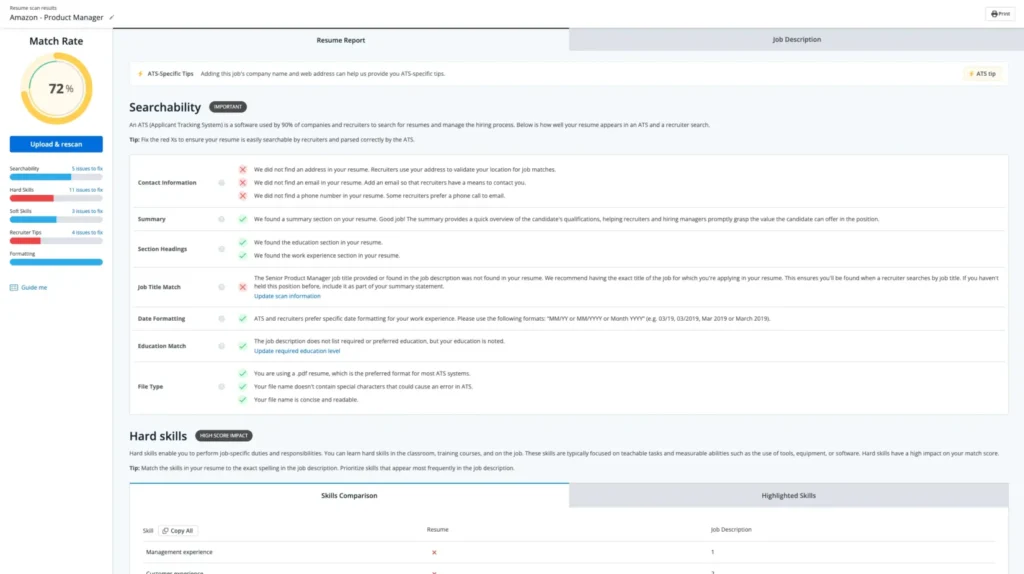
You’ll then receive a resume score that tells you how closely your resume matches the job description.
Here’s an example of a section of the Match Report:
You can try the resume scanner for free below:
If you’re wondering which layout works best for your experience, check out our article about resume formats before you start writing.
And if you’re not sure how to list your degree or school information, here’s how to write your education section on your resume.
Should you add references to your resume? To find out, check out our guide to references on a resume.
Key takeaways
-
Action verbs bring your resume to life. Starting bullet points with strong, specific verbs makes your accomplishments clear, confident, and memorable.
-
Avoid overused words. Verbs like “managed” and “led” are everywhere. To stand out, use more descriptive alternatives that show how you made an impact.
-
Use numbers to add credibility. Pair action verbs with metrics to show exactly what you achieved—whether it’s revenue growth, time saved, or costs reduced.
-
Tailor your language. Choose verbs that fit your industry and the specific job you’re applying to. Recruiters notice when your resume speaks their language.
-
Optimize for search. Recruiters use keywords to search resumes in Applicant Tracking Systems (ATS). Jobscan’s resume scanner helps you match your resume to the job description by identifying missing skills and improving your chances of being found.
FAQs
An action verb is simply a word that shows what you did, like “managed,” “designed,” or “created.” These verbs make your resume more dynamic and help your experience come across as stronger. Using them highlights your skills and accomplishments, making them stand out to potential employers.
Action verbs describe doing. Action verb examples include “run,” “jump,” “think,” and “read.” A variety of action verbs can really spice up your resume and make it more interesting to read.
The best place to use action verbs when you build your resume is in your work experience section. Start off your resume bullet points with action verbs. You can also use active verbs in your resume summary.
Avoid using the same active verb more than once on your resume. Check out our library of resume examples to see the best way to use action verbs.
Action verbs grab and hold the reader’s attention. They paint a clear and convincing picture of your accomplishments. They also convey a sense of enthusiasm and energy. Studies show that using action words on your resume increases the chance of getting an interview by 140%.
A list of action verbs for students includes organized, coordinated, led, collaborated, contributed, participated, volunteered, initiated, assisted, conducted, presented, created, designed, developed, implemented, researched, analyzed, evaluated, communicated, adapted, demonstrated, managed, facilitated, supported, mentored.
Avoid overused action verbs like managed, led, created, implemented, improved, achieved, developed, resolved, planned, and assisted on your resume and writing your cover letter.



