




Did you know that 65 percent of recruiters and hiring managers prefer candidates with relevant work experience? That’s why it’s critical that you outline your relevant experience on your resume. This helps recruiters see what you bring to the table and assess whether you are the right fit.
But what does relevant experience mean, and how can you best showcase them on your resume?
In this quick guide, you’ll find tips to make your resume shine. You’ll discover how to showcase your experiences. This helps you impress recruiters with clear examples.
Relevant experience on a resume refers to any professional or non-professional activities that demonstrate skills and knowledge applicable to the job you’re applying for. It’s crucial for showcasing your qualifications and making you a strong candidate, and can include past jobs, internships, volunteer work, freelance work, projects, job shadowing, and even hobbies.
What is relevant experience?
Relevant experience is any work experience you have that is directly related to the job you are applying for.
Knowing what to include on your resume and how to do it in 2025 can be confusing. Showing your relevant work experiences helps recruiters see if you are fit for the job.
You don’t need to have the exact same job title or be from the same industry to have relevant experience. What really counts is showing that you’ve picked up skills that can be transferred or applied to the new job.
For example, if you have skills using Microsoft Suite, or can use Python, that can apply to a number of different roles and industries. You can also consider a resume portfolio to show your skills, work experience, and qualifications.
Your work history and skills matter a lot, but adding hobbies and interests can also show who you are. Especially if the job description mentions it, knowing things like how to present any language skills on your resume or other relevant extracurricular activities can give you a competitive edge in the job market.
Any experience that shows your skills and abilities for the job you want is relevant.
These can include experiences from your:
- Previous roles
- Volunteer work
- Internships
- Freelance work
- Projects
- Training and certifications
- Leadership roles
- Academic activities
- Part-time work
Recruiters don’t read resumes like biographies. They scan them like ads. And the longer your resume is, the harder it is for recruiters to spot what matters most.
Wondering how far back should your resume go? The general rule is 10 to 15 years. That’s because most recruiters are focused on your recent work. They want to know what you’ve done lately, not what you were doing in the early 2000s.
“We don’t have time to read pages and pages,” said former Google recruiter Keanna Carter in a recent Jobscan podcast. “I can look at a resume for 20 seconds and know whether we’re moving forward with them or not.”
Start with a well crafted resume headline at the top of your resume, and then dive into your work related experience. If it’s older than 15 years old, it might be something to leave off your resume.
The key is that the experience has to be directly applicable to the job or role you are applying for.
How to identify relevant experience
Here are examples of how you can extract experiences relevant to your target role or industry.
Drawing experience from volunteer work
Suppose you are a recent graduate and you are applying for a role in HR.
As a fresh graduate, you may lack professional experience. But, you organized a recruitment event for a non-profit organization as a volunteer.
You screened candidates as a volunteer. You also arranged interview schedules. Plus, you made sure the recruitment event went well.
Here’s how you can word your relevant experience:
Supported a non-profit recruitment drive by screening over 50 candidates and coordinating event logistics, contributing to a streamlined hiring process and positive candidate experience.
Drawing experience from a different industry
Suppose you are shifting from a career in education to project management.
Previously, in your teaching role, you organized and managed multiple classroom projects. You ensured they were completed on time and you met educational objectives. You also coordinated school-wide events involving various stakeholders.
Although these are two different industries, you can draw relevant experience from your experiences as a teacher.
Here’s how you can word it:
Managed and coordinated 15 classroom projects and 5 school-wide events, ensuring 100% on-time completion and alignment with educational goals. Demonstrated strong organizational and leadership skills, leading to a 25% increase in student engagement and successfully collaborating with teachers, students, and parents.
Drawing experience from leadership roles
For instance, you are a recent graduate interested in an entry-level Project Coordinator position.
While in university, you led a club and managed group projects. You coordinated activities, managed schedules, and ensured effective team communication.
Here’s how you can word your relevant experience:
Coordinated a university club’s annual event, overseeing a team of 8 members. Managed timelines, delegated tasks, and ensured all project milestones were met. Successfully increased event attendance by 30% and received commendation from university administration for effective project management.
Drawing experience from previous roles
Let’s say you are applying for a Product Manager position.
As a former Senior Project Manager at a construction firm, you managed large-scale projects, coordinated cross-functional teams, and developed strategic plans. You also previously worked as a Marketing Director, where you implemented marketing strategies, led teams, and analyzed market trends.
With your previous roles, you can emphasize transferable skills such as leadership and critical thinking.
Here’s how you can word your relevant experience:
Directed large-scale projects in a construction firm, overseeing cross-functional teams and ensuring on-time, within-budget delivery. Developed strategic plans that optimized project outcomes and enhanced client satisfaction. As a Marketing Director, led impactful marketing campaigns, conducted in-depth market analysis, and drove product strategy, achieving a 20% increase in market share. These experiences demonstrate strong project management, strategic planning, critical thinking, and leadership skills, essential for the Product Manager role.
5 tips on demonstrating relevant experiences on your resume
Now that you already know how to extract relevant experience, here is how you can effectively identify and present your experiences on your resume:
1. Study the job description
First, you need to review the job description and understand what it requires.
Some jobs might require years of experience, a certain level of education, or knowledge of specific software or tools. They might also outline specific skills needed for the job. When you have multiple skills to showcase on your resume for a specific role, it can be helpful to add your skill levels or proficiency as well.
Next, you must comb through the job description and list the requirements and specific skills mentioned.
Then, carefully assess whether you have the skills and professional background that prove you are eligible for the job.
You can also use a tool like Jobscan, which uses AI to analyze the job description and highlight the job-specific skills and competencies you need to include in your resume to increase your chances of getting interviews.
Here’s what a scanned job description looks like after using Jobscan’s resume scanner tool:
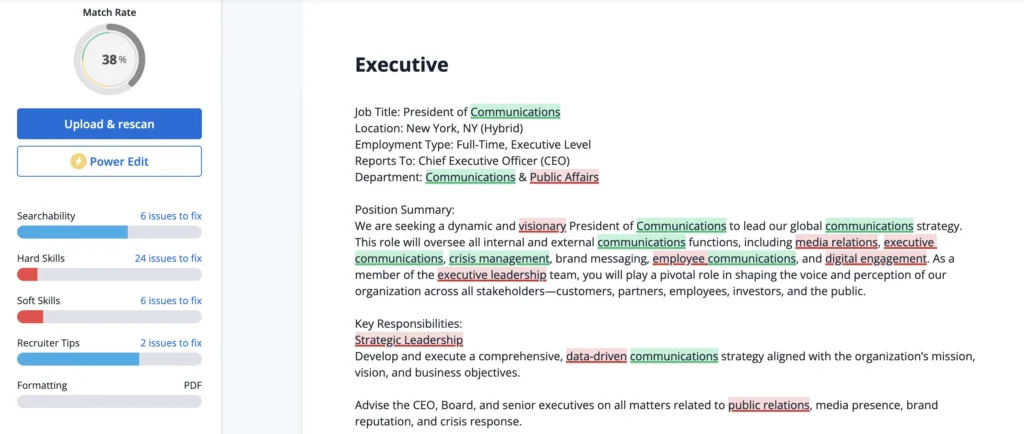
Using a tool like this should be the first step in updating your resume. The scanner will also help you optimize all of your resume sections, like your resume summary, your awards, your certifications, your publications, or your education section, and not just job history.
All of these sections (and more) can easily be created with Jobscan’s resume builder. When it comes to an education section, for example, you can easily add highlights and points like being on the Dean’s List, your expected graduation date, your degree, earning magna cum laude, or whether or not to add a high school diploma.
Wondering how to format your promotions? How to write a resume summary? An executive summary? The resume builder will do it for you. Unsure if you should include a picture on your resume? Jobscan is here to help.
2. Focus on measurable results
Measurable results are your specific accomplishments. They provide concrete proof of your capabilities and the value you bring to the company.
Instead of just listing your job titles and job responsibilities, highlight your notable achievements. You can also emphasize any promotions you earned and highlight tangible results.
Use numbers to show the impact you made and quantify your contributions using figures, dollar amounts, percentages, or metrics.
For example:
Instead of saying:
“Developed programs for employees to improve customer service.“
You can say:
“Developed programs for employees, which increased customer satisfaction by 20% within three months.“
Using measurable achievements adds credibility and makes your application more attractive to recruiters.
3. Showcase transferable skills
Transferable skills are skills you can use in different jobs, fields, or industries. They are proof of your areas of expertise for the job you’re applying for.
Examples of transferable skills include communication skills, problem-solving skills, critical thinking, and leadership skills.
In your resume, emphasize how you used those skills to excel in your previous jobs. Depending on the role, you can even add something like babysitting to your resume if it highlights the right transferable skills, like conflict resolution or time management.
For example:
Suppose you are a nurse transitioning to a career in HR. You can frame your relevant experience this way:
Nurse, WeCare Hospital, Seattle WA
- “Collaborated with different teams to develop comprehensive care plans tailored to each patient’s needs, demonstrating strong teamwork and communication skills.“
- “Assessed patient conditions, identified problems, and implemented timely interventions to achieve positive outcomes.“
- “Demonstrated excellent time management and organizational skills, effectively managing multiple responsibilities in a high-pressure setting.“
It is critical that you list all the skills mentioned in the job description. You can do this by manually highlighting the skills or using Jobscan’s resume scanner.
It saves you time by analyzing the job description and giving you a comprehensive report of how you can better match the job.
- Add your resume file or paste the text into the scanner.
- Copy and paste the job listing text into the scanner.
- Click “Scan.”
- Receive your score and get tailored advice to enhance your relevant experience, skills, and writing.
- Update and rescan your resume until you hit 75% or higher!
It also gives you a list of hard skills and soft skills you should mention to stand out to recruiters.
Here’s an example of the skills comparison in the resume scanner.

All you have to do then is work these skills into your resume. You also have to aim to match the number of times a specific skill is mentioned in the job description.
In the image above, “practice management” appears three times in the job description. This means that it should also be mentioned at least three times in your resume. Not only will the resume scanner show you what your resume needs, but also things to not include on your resume, like using your exact address on your resume.

4. Include volunteer work, certifications, and other relevant activities
When listing your relevant experience, include any volunteer experience, training, workshop, or certifications. Make sure they are relevant to the job you are applying for.
If you have limited work experience, you can include extracurricular activities. Whether lying on your resume is illegal or not, you should never lie on it. Including experiences from your freelance work, internships, or other leadership roles can help you fill this section out without stretching the truth.
You just need to frame your experiences in these activities to show recruiters that you are right for the job.
For instance:
Let’s say you are applying for a job in customer service, but you only have experience volunteering at a food bank.
You can mention the key skills you used or notable accomplishments you had while volunteering. Make sure to write it in a way that shows recruiters how these experiences uniquely qualify you for the role.
Here are sample relevant experiences:
- “Implemented an efficient queuing system, reducing wait times by 20%.“
- “Helped train new volunteers in customer service protocols. This contributed to a 25% increase in overall volunteer efficiency and effectiveness.“
In this example, although your experiences are drawn from volunteer work, they still show how you can excel in customer service. Helpful resume adjectives, like “efficient” and “effective”, are great ways to grab a recruiter’s attention.
5. Tailor your relevant experience to the job
The key is to tailor your relevant experiences to the specific job. Do this, especially when you are applying to many jobs.
It is important that you choose experiences that relate to the position. You should prove to recruiters that you have the relevant skills and abilities to do the job well.
Tailor your entire resume to the specific job you are applying for
When you submit your resume, it often goes into an applicant tracking system (ATS). This system helps recruiters quickly sort through hundreds of resumes.
Recruiters use the ATS to search for suitable candidates. They do this by typing job-specific keywords into the search bar.
Keywords can be:
- Job titles
- Skills
- Software or tools
- Industry-specific jargon
If your resume lacks specific keywords, no matter how qualified you are, recruiters will not be able to see it.
To prevent this, you need to tailor your resume to the job. Go through the job description. Then, pick out the relevant keywords and incorporate them into your resume.
Yes, this will increase your chances of getting noticed by recruiters. But it can also take a lot of your time and energy.
Jobscan’s resume scanner also matches your resume to the job description and gives you a resume score. It also suggests other ways to improve your resume so that it matches the job.
All you have to do is upload your resume and the job description and click “Scan.”
Here’s what it looks like:

Aim to increase your resume score by incorporating the keywords and following the tips. The higher your score, the higher your chances of being seen by recruiters.
However, don’t overdo it and stuff your resume with too many keywords. Just include the relevant ones.
Relevant work experience examples
There are different ways to showcase your relevant experience in your resume.
Here are examples of how to craft relevant experiences. They are useful whether you are just starting out, switching jobs or careers, or already a pro. Remember that work experience is enough, and at this stage of the application process, adding your references to your resume is a dated practice. Recruiters may ask to check, so preparing a list of references early in your job search still might be a good idea.
When you have limited work experience
When you lack work experience, you can include any volunteer work, internships, freelance work, and other activities.
Instead of outlining your job responsibilities, show what you accomplished. Include measurable accomplishments when possible and use strong action words. Then, tailor your experiences to the specific job you want.
Here is an example of a job description for an entry-level marketing analyst position:

A good relevant experience example for a recent business graduate applying for this job looks like this:

Powerful synonyms in the above example, like “collaborated” instead of “worked with”, will highlight your point even better. Instead of collaborated, you could also use aided, partnered, coached, and supported, for example.
When you are a career changer
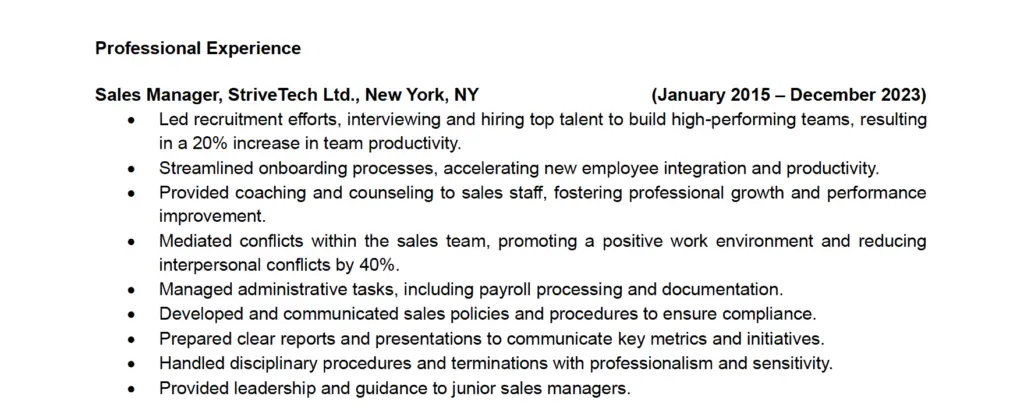
When switching careers, show how your skills, knowledge, and experiences from your past roles make you effective in the new role. Demonstrate the impact you made in your previous employment and include measurable achievements. Show transferable skills and use strong action words. Also, make sure your experience matches the job.
Here’s an example:
Let’s say you are a sales manager applying for a human resource manager post. The job description would look like this:
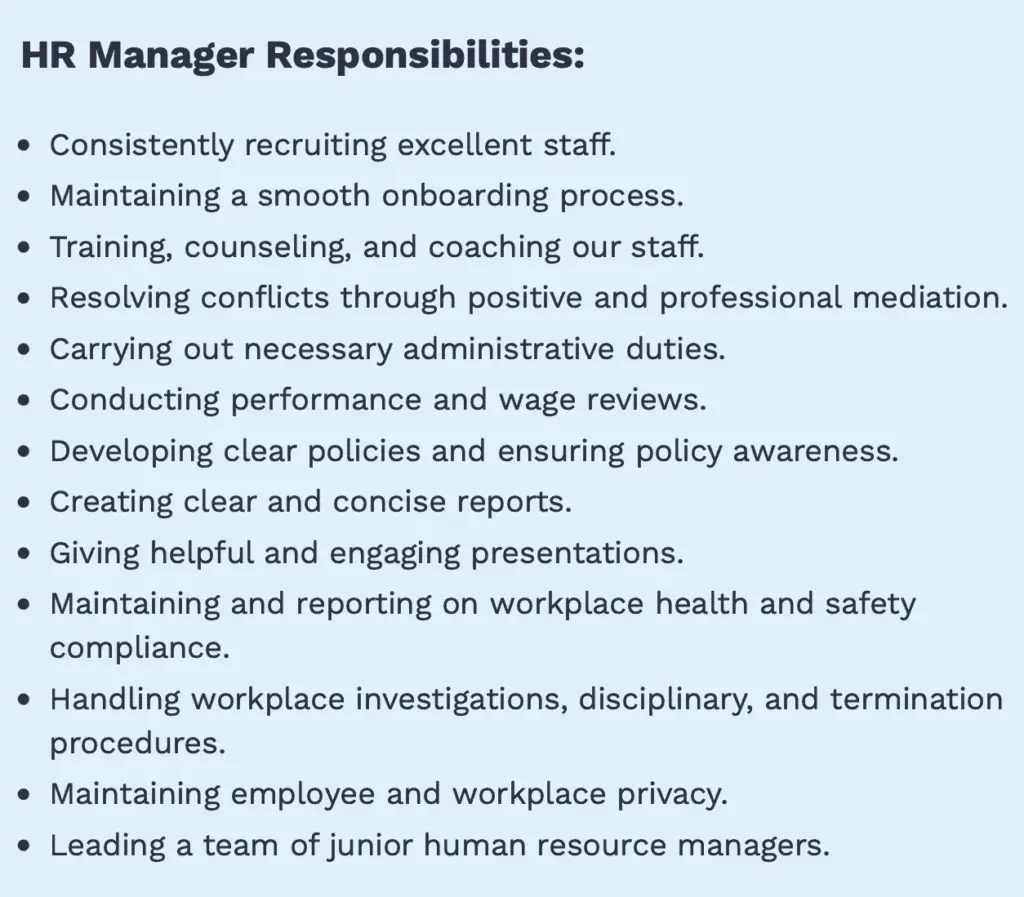
Here’s what you can include as relevant experience in your resume:
When you have relevant professional experience
When your experience matches the job you want, you need to prove your expertise and success to recruiters.
You can do this by highlighting your most relevant and significant contributions. Use measurable accomplishments and tailor your experiences to the specific requirements of the role.
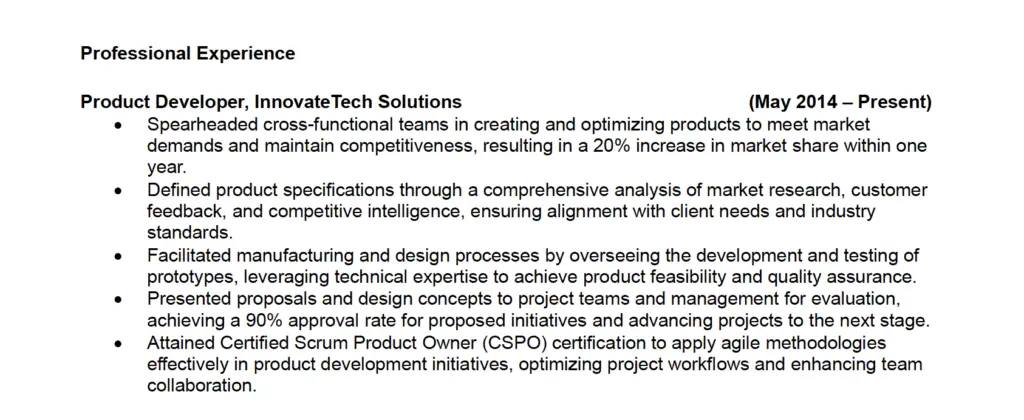
Here’s an example of a product developer job description:

Here’s an example of a great relevant experience section for this job:
Frequently asked questions
A relevant experience is any experience you have that directly relates to the job you are applying for.
Relevant experience can include your experiences from your:
1. Previous jobs
2. Volunteer work
3. Internships
4. Freelance work
5. Part-time job
6. Projects
7. Extracurricular activities
We recommend that you focus on your most recent experiences from the past 5 to 10 years.
You can show recruiters, hiring managers, or prospective employers that you have relevant experience by stating your experiences in your resume summary, work experience section, or skills section.
Just make sure that you tailor your experiences to the specific job you are applying for.
Try scanning your resume into Jobscan to see whether it matches the job description.